Essential Guide to Avoiding Roaming Fees with eSIM

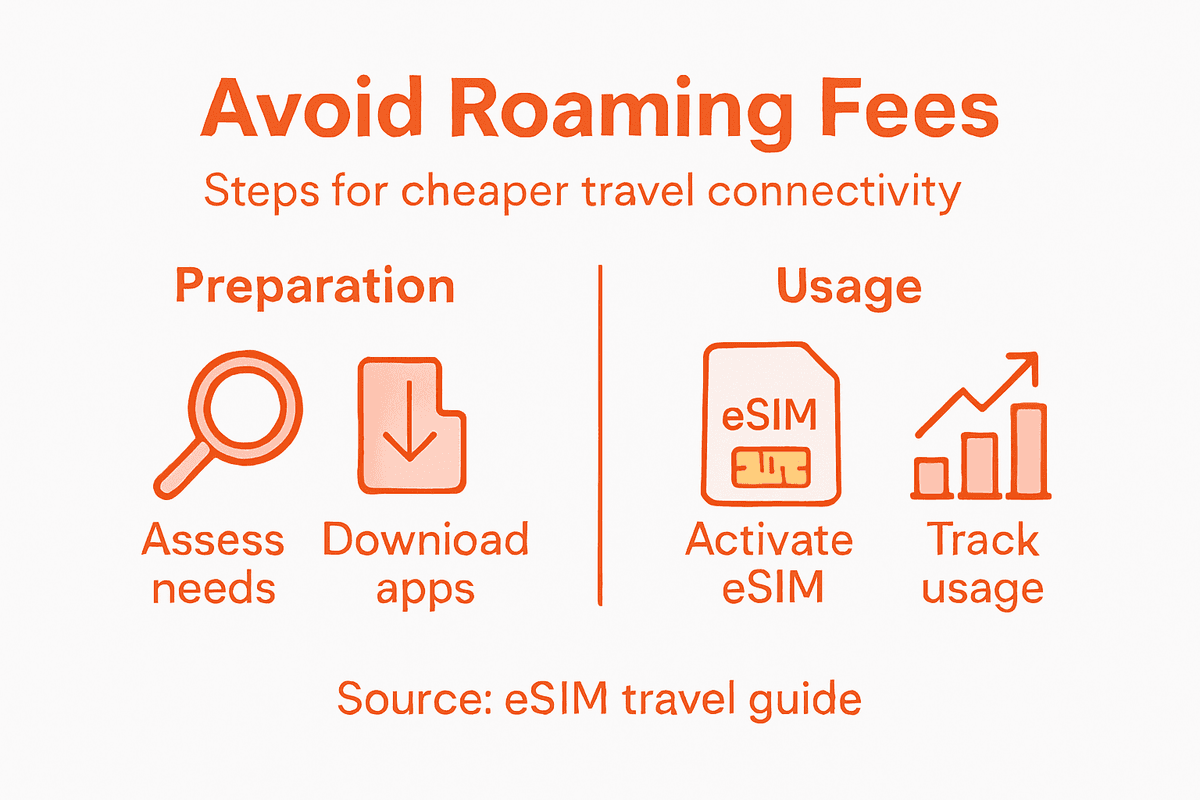
Waiting for a flight in a crowded European airport, you glance at your phone and realize the impact of soaring roaming fees. Flexible eSIM solutions now let travelers instantly switch providers and skip costly charges, making global connectivity much simpler. This guide shows how to assess your data needs, choose strong global coverage, and activate seamless eSIM plans, so you can stay connected from France to Germany without missing a beat.
Table of Contents
- Step 1: Assess Your Travel Connectivity Needs
- Step 2: Select An eSIM Provider With Global Coverage
- Step 3: Install And Activate Your eSIM Profile
- Step 4: Switch To Local Carriers At Your Destination
- Step 5: Verify Connectivity And Track Data Usage
Quick Summary
| Key Point | Explanation |
|---|---|
| 1. Assess your connectivity needs | Evaluate duration, destinations, and data habits before traveling to choose the right eSIM plan. |
| 2. Choose a reliable eSIM provider | Select a provider based on network coverage, pricing, and customer support for optimal international connectivity. |
| 3. Activate your eSIM quickly | Install and activate your eSIM in minutes using QR codes or activation codes for seamless travel connectivity. |
| 4. Switch to local carriers easily | Research and select local carriers upon arrival to reduce data costs and maintain connectivity without hassle. |
| 5. Monitor your data usage actively | Keep track of mobile data consumption and set limits to avoid unexpected charges during travel. |
Step 1: Assess your travel connectivity needs
Determining your mobile data requirements is crucial before heading abroad. Travelers need to carefully evaluate their digital connectivity needs to avoid unexpected roaming charges and stay connected efficiently. International travel connectivity demands have transformed dramatically with eSIM technology, offering unprecedented flexibility.
To assess your travel connectivity needs effectively, consider these key factors:
- Duration of travel: Calculate total days abroad
- Destinations: List specific countries you’ll visit
- Data consumption habits:
- Email checking
- Social media usage
- Navigation and maps
- Streaming requirements
- Video conferencing needs
Carefully mapping out your digital requirements helps you select the most appropriate eSIM data plan. Different destinations have varying data costs and network availability, so understanding your specific usage pattern is critical. A business traveler will have vastly different connectivity needs compared to a casual tourist.
Here’s how data needs differ for common traveler types:
| Traveler Type | Typical Data Usage | Key Connectivity Priority |
|---|---|---|
| Business Traveler | Heavy: video calls, files | Strong, secure connections |
| Casual Tourist | Moderate: social, maps | Cost savings, basic coverage |
| Digital Nomad | High: streaming, uploads | Flexible, multi-country use |
| Family Traveler | Mixed: varied by member | Shared plans, parental tools |
Accurate connectivity planning can save you up to 70% on traditional roaming expenses.
Pro tip: Use offline apps and download critical content before travel to minimize unexpected data consumption.
Step 2: Select an eSIM provider with global coverage
Choosing the right eSIM provider is a critical step in ensuring seamless international connectivity. Top global providers offer comprehensive coverage that can transform your travel experience by eliminating traditional roaming complexities.
When selecting an eSIM provider, consider these essential evaluation criteria:
- Network coverage: Verify countries supported
- Pricing structure:
- Transparent per-country rates
- Flexible data packages
- No hidden fees
- Device compatibility
- Activation speed
- Customer support quality
Prioritize providers that offer multi-country plans with robust security features. Digital nomads and frequent travelers should look for providers supporting multiple device profiles and offering easy online management. The ideal provider will balance comprehensive global coverage with affordable, flexible data options.
A quality eSIM provider can reduce your international connectivity costs by up to 70%.
Pro tip: Compare at least three eSIM providers and read recent user reviews before making a final selection.
Step 3: Install and activate your eSIM profile
Activating your eSIM profile is a straightforward process that can be completed in just a few minutes. Enterprise device configuration platforms have simplified the activation process, making it accessible for travelers worldwide.
To install and activate your eSIM profile, follow these key steps:
- Verify device compatibility:
- Check smartphone supports eSIM
- Confirm carrier compatibility
- Obtain activation method:
- QR code from provider
- Digital activation code
- Mobile app installation
- Backup existing cellular settings
- Disable existing cellular plan temporarily
Most modern smartphones now support eSIM technology, allowing you to add a digital cellular plan without a physical SIM card. The activation process typically involves scanning a QR code or entering a provided activation code directly in your device settings. Cellular providers have streamlined this process to make international connectivity seamless and user-friendly.

Compare the main benefits of using eSIM over traditional SIM cards:
| Feature | eSIM | Physical SIM Card |
|---|---|---|
| Activation Speed | Instant, digital setup | Delayed, manual swap needed |
| Plan Flexibility | Easy to switch plans | Limited, physical change |
| Travel Convenience | Multiple profiles | One plan per card only |
| Loss Risk | No loss risk | Physical loss possible |
Digital eSIM activation can be completed in under 5 minutes from anywhere in the world.
Pro tip: Always keep your original physical SIM card as a backup in case of unexpected activation issues.
Step 4: Switch to local carriers at your destination
Navigating local carrier options becomes simple with modern eSIM technology that allows for seamless network switching. Multiple active mobile profiles enable travelers to optimize their connectivity instantly upon arriving in a new country.
When switching to local carriers, consider these strategic steps:
- Research local carrier options:
- Check coverage maps
- Compare data rates
- Verify network speeds
- Evaluate prepaid plan availability
- Confirm device compatibility
- Compare pricing structures
The activation process typically involves selecting a local carrier plan through your eSIM provider’s app or website. Most travelers can complete the switch within minutes, maintaining uninterrupted internet access. Digital nomads and frequent international travelers appreciate the flexibility of instantly changing mobile networks without physical SIM card swaps.
Switching carriers with eSIM can reduce data costs by up to 60% compared to traditional roaming.
Pro tip: Download carrier apps and compare plans before leaving your home country to streamline the switching process.
Step 5: Verify connectivity and track data usage
Staying on top of your mobile data consumption is crucial when traveling internationally to avoid unexpected charges. Modern devices offer sophisticated data tracking capabilities that make monitoring your digital usage easier than ever.
To effectively verify connectivity and manage data usage, follow these steps:
- Check device settings:
- Navigate to cellular/mobile data section
- Select eSIM profile
- Review current data consumption
- Enable data usage alerts
- Understand tracking differences:
- Device-reported usage
- Carrier-reported consumption
- Set data limits
Most smartphones provide granular tools to monitor data across different networks and eSIM profiles. You can typically view real-time usage statistics, set warnings for approaching data limits, and even restrict background data for specific applications. This proactive approach helps prevent bill shock and ensures you stay within your planned data budget.
Tracking data usage can help you save up to 40% on potential overage charges.
Pro tip: Download a third-party data tracking app as a backup to cross-reference your device and carrier usage reports.
Unlock Seamless Global Connectivity and Avoid Roaming Fees Today
Travelers looking to sidestep expensive roaming charges face challenges like limited local carrier options and confusing data plans. This guide highlights how eSIM technology can provide flexible, multi-country solutions that match your unique data habits and travel style. If you want to take control of your international data usage with instant activation and transparent pricing across over 160 countries consider exploring Lumo’s all-in-one eSIM solution.
Act now to experience effortless switching between local carriers and enjoy reliable high-speed 5G/4G connectivity. With Lumo you will benefit from multiple eSIM profiles across devices, instant QR code activation, and 24/7 customer support designed by travelers for travelers. Don’t let unexpected data costs disrupt your journey. Visit Lumo to get started on smart global connectivity and avoid roaming fees the easy way.
Frequently Asked Questions
How can I assess my travel connectivity needs before using eSIM?
Determining your connectivity needs involves evaluating your travel duration, destinations, and data usage habits including email, social media, and navigation. Make a list of your expected data consumption to choose the right eSIM data plan that fits your requirements.
What factors should I consider when selecting an eSIM provider?
Look for an eSIM provider that offers global network coverage, transparent pricing without hidden fees, and device compatibility. Prioritize providers that have robust customer support and flexible data packages for a better travel experience.
How do I install and activate my eSIM profile?
To activate your eSIM, verify your device’s compatibility, obtain the activation method such as a QR code, and follow the prompts in your mobile settings. Typically, this process can be completed in under 5 minutes, allowing you to stay connected immediately.
What steps should I take to switch to a local carrier at my destination?
Research local carrier options for coverage and data rates, then use your eSIM provider’s app or website to select a plan. This switch can usually be done within minutes, helping you save significantly on data costs.
How can I effectively track my data usage while traveling?
Check your device’s settings to view data consumption and set data usage alerts for your eSIM profile. Monitoring usage regularly can help prevent unexpected overage charges and keep your data use within budget.
Recommended
- Roaming Fees vs eSIM – How Modern Travelers Save | Lumo eSIM Store
- 7-Step Avoid Roaming Charges Checklist for Global Travelers | Lumo eSIM Store
- International Roaming Explained: Avoiding Costly Mistakes | Lumo eSIM Store
- How to Avoid Roaming Fees and Stay Connected Abroad | Lumo eSIM Store
- Tesco Mobile Switzerland: EU Roaming Impact
- 7 Smart Ways to Find the Cheapest International Health Insurance - Unparalleled Global Benefits
Related Topics
Stay Connected Anywhere
Prepaid eSIM data plans for 180+ countries and territories. No physical SIM required.