How to Avoid Roaming Fees and Stay Connected Abroad

More than half of American travelers end up paying steep roaming fees when moving between European and Asian countries. Staying connected can get expensive and complicated, especially for digital nomads with work needs across borders. Finding a reliable eSIM solution helps you avoid surprise costs and ensures you have high speed internet wherever your journey takes you. This article breaks down simple steps that make choosing, activating, and managing eSIM plans straightforward and stress-free.
Table of Contents
- Step 1: Assess Your Travel Destinations And Data Needs
- Step 2: Select A Suitable Esim Plan For Each Region
- Step 3: Activate Your Esim And Configure Device Settings
- Step 4: Switch To Local Networks Using Your Esim
- Step 5: Verify Connectivity And Monitor Usage Abroad
Quick Summary
| Key Point | Explanation |
|---|---|
| 1. Assess communication needs before travel | Map out your itinerary and analyze data consumption to avoid unexpected charges. Understand local connectivity to make informed decisions. |
| 2. Choose a targeted eSIM plan | Compare eSIM options that match your travel route, focusing on coverage, validity, and data volume to ensure seamless connectivity. |
| 3. Activate eSIM prior to departure | Activate your eSIM using the provided QR code and configure settings for optimal data usage to mitigate connectivity issues abroad. |
| 4. Manage data usage effectively | Set alerts for data consumption limits, download essential resources offline, and utilize secure WiFi connections to avoid overages. |
| 5. Regularly check connectivity upon arrival | Verify active network connections as soon as you arrive in a new country to ensure reliable mobile service during your trip. |
Step 1: Assess Your Travel Destinations and Data Needs
Before embarking on international travel, understanding your specific connectivity requirements is crucial for avoiding unexpected roaming fees. Selecting the right data plan starts with a comprehensive evaluation of your travel destinations and anticipated mobile data consumption. Travelers should carefully map out their international routes and analyze their digital communication needs across global destinations to make informed connectivity decisions.
Begin by creating a detailed itinerary that includes each country you will visit, considering the duration of your stay and the type of digital activities you anticipate. Not all destinations have identical mobile network infrastructures, so research local cellular capabilities and potential connectivity challenges. Determine whether you will need consistent high speed internet for work tasks like video conferences, casual browsing, social media updates, navigation, or occasional email checks. Calculate your estimated daily data requirements by reviewing your typical smartphone usage patterns and adjusting for potential increased consumption during travel.
Your preliminary research should also factor in the availability of wifi hotspots at hotels, cafes, and public spaces in your destination countries. While free wifi can supplement mobile data, it cannot always be relied upon for secure or continuous connectivity. Understanding potential network limitations will help you select an appropriate mobile data package that ensures uninterrupted communication.
Pro tip: Create a spreadsheet tracking your expected data needs per destination to precisely estimate your required mobile data allocation and avoid overpaying for unnecessary data plans.
Step 2: Select a Suitable eSIM Plan for Each Region
After thoroughly assessing your travel destinations and data needs, the next critical step is selecting an appropriate eSIM plan that provides flexible and cost effective mobile connectivity. Each international destination presents unique network requirements, making it essential to choose targeted data plans that match your specific travel itinerary and communication demands.

Begin by comparing regional eSIM options that offer comprehensive coverage across the countries you will visit. Pay close attention to data volume, validity periods, and pricing structures for each destination. Some regions may require multiple country specific plans or regional packages that provide seamless connectivity across multiple neighboring nations. Prioritize plans that offer high speed data, reliable network performance, and the ability to easily switch between local carriers without additional roaming charges.
Consider factors beyond just data allocation when selecting your eSIM plan. Evaluate the activation process, customer support availability, compatibility with your specific device, and the flexibility to purchase additional data if needed. Some travelers might benefit from regional plans that cover multiple countries, while others may require country specific packages tailored to their exact travel route. Look for transparent pricing models that allow you to manage your mobile expenses proactively without unexpected fees.
Pro tip: Always purchase your eSIM plans in advance and test activation before departing to ensure smooth connectivity during your international travels.
Here’s a summary of factors to consider when selecting an international eSIM plan:
| Consideration | Why It Matters | Example Impact |
|---|---|---|
| Coverage Area | Ensures service in all visited countries | Regional plan avoids gaps |
| Data Allowance | Meets usage needs without excess cost | Sufficient for business calls |
| Validity Period | Matches travel dates for continuous access | Plan lasts full trip duration |
| Activation Process | Reduces setup time and stress abroad | QR code enables instant activation |
| Device Compatibility | Prevents technical problems on arrival | Plan works with your smartphone |
| Cost Transparency | Helps avoid surprise charges | No hidden roaming fees |
| Support Access | Provides assistance if issues arise | 24/7 support aids problem-solving |
Step 3: Activate Your eSIM and Configure Device Settings
Activating an eSIM requires a systematic approach to ensure seamless mobile connectivity during your international travels. Understanding the precise activation methods for mobile devices will help you quickly set up your digital mobile plan and avoid potential connectivity issues before departing.
The activation process typically involves scanning a QR code provided by your eSIM carrier or using a digital activation method specific to your device manufacturer. For smartphones, navigate to your cellular settings and select the option to add a new cellular plan. Most modern devices support quick transfer methods that allow instant eSIM configuration without complex manual steps. Verify your device compatibility beforehand and ensure you have a stable internet connection during the activation process to prevent potential interruptions.
After successful activation, configure your device settings to optimize data usage and roaming preferences. Select which cellular plan you want to use as your primary data source and set up automatic switching between available networks. Review your data limits, adjust roaming settings, and confirm that your preferred cellular plan is active for your specific travel destinations. Some devices allow you to designate specific plans for calls, messages, and data separately, providing granular control over your mobile connectivity.
Pro tip: Always keep a screenshot of your eSIM activation details and carrier support contact information stored securely in your cloud storage or travel documents for quick reference during your trip.
Step 4: Switch to Local Networks Using Your eSIM
Successfully switching between local networks during international travel requires understanding the nuanced process of managing multiple eSIM profiles. Navigating different network profiles efficiently ensures you remain connected while avoiding unnecessary roaming charges and maximizing your mobile data usage.
To switch between local networks, access your device’s cellular settings and review available eSIM profiles. Most smartphones allow you to select a preferred cellular plan for data and calls with a simple toggle. When entering a new country, manually select the corresponding local network profile to ensure optimal connectivity. Pay attention to network compatibility, data limits, and connection speeds specific to each regional plan. Some advanced eSIM configurations permit automatic network switching based on signal strength and available local carriers.
Carefully monitor your data consumption and network performance as you transition between different local networks. Some travelers prefer creating a dedicated travel profile that automatically manages network selection based on predefined preferences. Verify your device settings support multiple active eSIM profiles simultaneously and understand the specific procedures for your smartphone model. Always maintain a backup communication method in case of unexpected network transitions or connectivity challenges.
Pro tip: Download offline maps and communication apps before traveling to ensure you can navigate and communicate effectively even during temporary network transitions.
Step 5: Verify Connectivity and Monitor Usage Abroad
Ensuring reliable mobile connectivity during international travel requires proactive monitoring and strategic data management. By implementing a systematic approach to tracking your mobile usage, you can prevent unexpected service interruptions and avoid potential overcharges that could disrupt your travel experience.
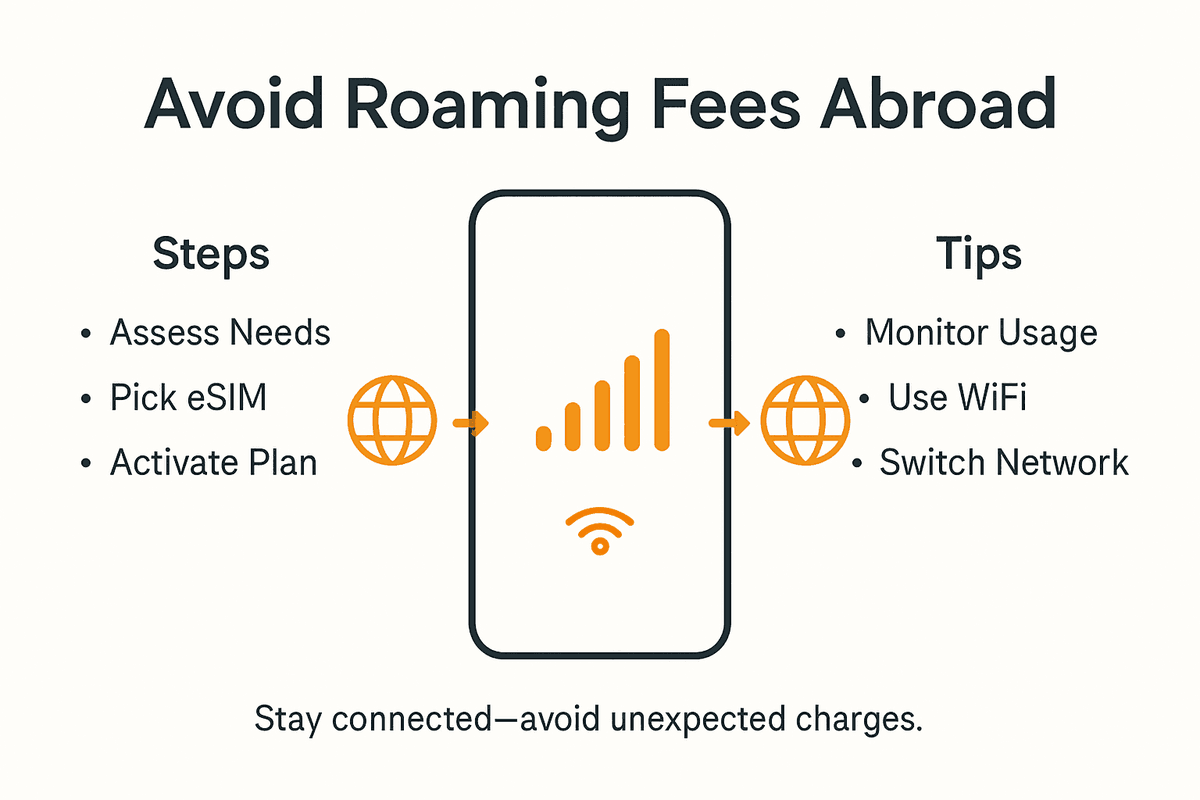
Start by checking your device settings and confirming active network connections immediately upon arriving in a new country. Most smartphones provide detailed data usage tracking tools that display real time consumption, allowing you to set alerts for approaching data limits. Configure your device to provide notifications when you reach specific data thresholds, typically 50%, 80%, and 100% of your purchased data plan. Pay close attention to background app refresh settings and disable automatic updates or cloud syncing to conserve your international data allocation.
Regularly review your data consumption patterns and adjust your usage accordingly. Some travelers find it helpful to download offline maps, translation apps, and essential documents before departure to minimize live data consumption. Consider using wifi networks when available, but always verify their security before transmitting sensitive information. Maintain a backup communication strategy that includes offline resources and alternative connectivity methods in case of unexpected network challenges.
Here is a quick reference of methods for tracking and managing mobile data while abroad:
| Method | Description | Benefit |
|---|---|---|
| Data Usage Alerts | Set phone to notify at set thresholds | Prevent unexpected overages |
| Offline Resource Prep | Download maps and apps before travel | Minimize live data use |
| WiFi Network Security | Confirm hotspot safety before use | Protect sensitive information |
| Roaming Controls | Adjust app and roaming settings | Conserve plan data efficiently |
Pro tip: Use airplane mode with wifi enabled as a strategic way to control data usage and prevent accidental roaming charges while still accessing essential offline resources.
Stay Connected Everywhere and Avoid Roaming Fees with Lumo
International travel can bring unexpected roaming charges and connectivity headaches. This article explains how travelers face challenges like managing multiple local network profiles, estimating data needs, and activating eSIM plans smoothly to stay online without surprises. Feeling overwhelmed by complicated setups or worried about sudden data overages is common among globetrotters aiming for seamless communication.
Lumo is designed to solve exactly these problems. It offers an all-in-one eSIM solution that provides instant activation and flexible data plans tailored for over 160 countries. With Lumo, you can easily switch between local carriers, manage multiple eSIM profiles on your smartphone or tablet, and enjoy reliable 5G/4G coverage without roaming fees. Its simple QR code activation and 24/7 customer support help you stay connected without stress.
Stop worrying about roaming fees and complex activation steps. Visit Lumo today and discover how effortless international connectivity can be. Get your personalized eSIM plan now and take control of your global data usage at https://lumo.to. Explore how Lumo supports travelers who value freedom and affordability on the go with confidence.
Frequently Asked Questions
How can I assess my data needs before traveling?
Before traveling, evaluate your expected mobile data consumption by creating a detailed itinerary that includes the countries you will visit. Determine the types of activities you will engage in, such as video conferencing or social media updates, to calculate your estimated daily data requirements.
What should I consider when selecting an eSIM plan for international travel?
When selecting an eSIM plan, prioritize coverage area, data allowance, and validity period. Compare different plans that fit your travel route and confirm that the plan allows for easy switching between local networks without incurring extra fees.
How do I activate my eSIM once I arrive in a new country?
To activate your eSIM, scan the QR code provided by your eSIM carrier or use your device’s settings to add a new cellular plan. Ensure you have a stable internet connection during the activation to avoid interruptions in service.
What steps can I take to monitor my data usage while abroad?
Monitor your data usage by checking your device settings for active connections and using data tracking tools available on your smartphone. Set alerts for specific data thresholds, like 80% of your data limit, to avoid unexpected overages.
How do I switch between local networks using my eSIM?
To switch between local networks, access your device’s cellular settings and select the appropriate eSIM profile for the country you are in. Manually choosing the local network will ensure better connectivity and help you avoid roaming charges.
What precautions should I take when using public WiFi abroad?
When using public WiFi, always verify the network’s security to protect sensitive information. Consider downloading offline maps and essential documents before travel to minimize your reliance on live data during your trip.
Recommended
Related Topics
Stay Connected Anywhere
Prepaid eSIM data plans for 180+ countries and territories. No physical SIM required.