Defining Local vs Global Data Plans: Key Differences for Travelers

Crossing into France only to lose your connection is a hassle no digital nomad wants. Reliable, high-speed data is the backbone of remote work and smooth travel, but choosing between a local or global data plan can impact everything from cost to your peace of mind. Discover the key practical differences that help you stay online affordably—whether you’re setting up in one city or working across multiple countries in Europe and beyond.
Table of Contents
- What Are Local and Global Data Plans?
- Core Features and Coverage Explained
- When to Choose Local vs Global eSIMs
- The Hidden Cost of Local Plans
- Comparing Costs, Risks, and Flexibility
Key Takeaways
| Point | Details |
|---|---|
| Local Data Plans Best for Extended Stays | For those staying in one country for 2+ weeks, local plans provide the highest speed and lowest cost per gigabyte. |
| Global Data Plans Ideal for Frequent Travelers | Global plans are preferable for individuals crossing multiple borders regularly, offering seamless connectivity and a single account. |
| Consider Cost and Productivity | While local plans may seem cheaper, the setup time and potential disruptions can lead to lost productivity. Global plans can save time and provide hassle-free management. |
| Evaluate Your Travel Scenarios | Your choice between local and global plans should align with your specific travel patterns, balancing costs with connection stability and flexibility. |
What Are Local and Global Data Plans?
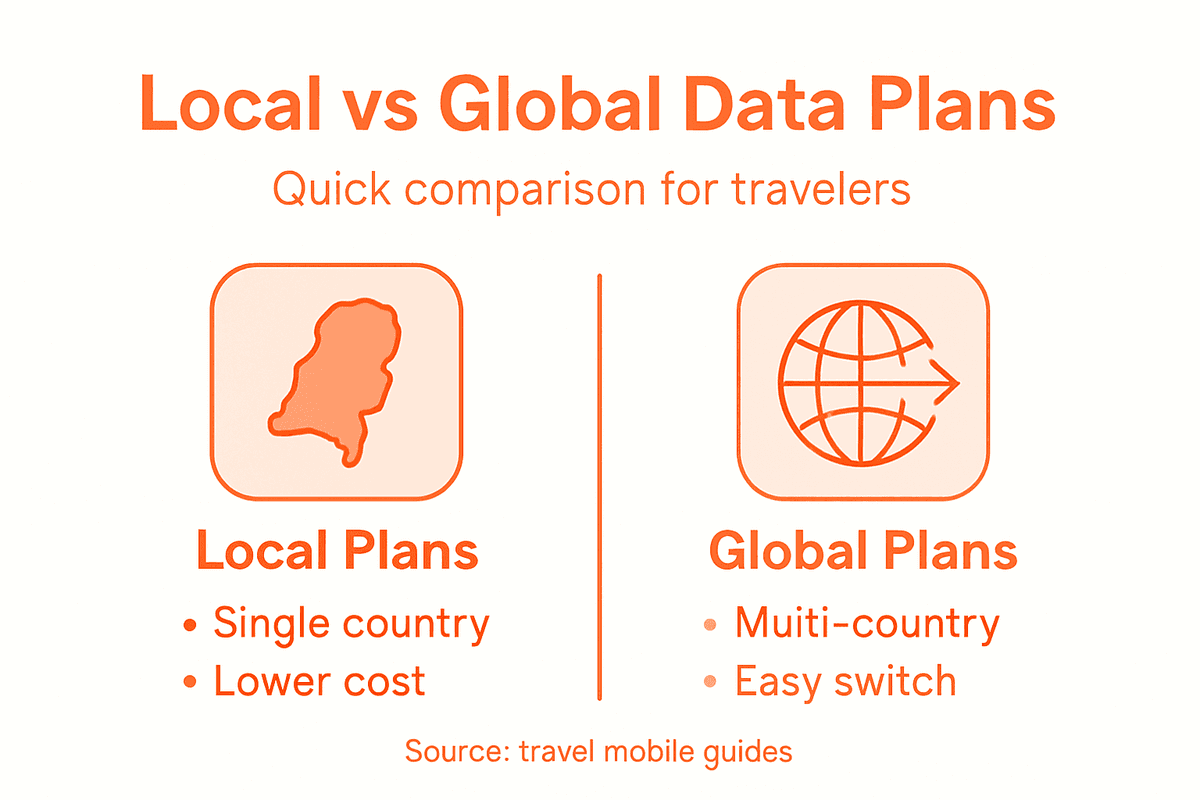
Data plans fall into two distinct categories, and understanding the difference is crucial for your travel strategy. A local data plan operates within a single country, while a global data plan works across multiple countries or regions. Think of it like choosing between a gym membership at one location versus a chain with access everywhere.
Local data plans are specifically designed for users staying in one country for extended periods. They typically offer high-speed connectivity at lower costs because the coverage area is limited to a single nation’s network infrastructure. These plans work well if you’re setting up a base in one city and exploring from there.
Global data plans, by contrast, provide connectivity across numerous countries without switching providers. Priority service across multiple countries remains consistent, meaning you maintain the same connection quality as you move between nations. This eliminates the hassle of managing different SIM cards or constantly searching for new carriers.
Here’s how they differ in practice:
- Coverage: Local plans limited to one country; global plans work in 160+ destinations
- Switching: Local requires carrier changes at borders; global keeps you connected seamlessly
- Cost structure: Local pricing varies by country; global pricing stays consistent worldwide
- Speed: Local offers high-speed access within borders; global prioritizes reliability over speed sometimes
- Device support: Local plans support single devices; global plans often support multiple devices per account
Key Practical Differences
When you’re working remotely from Barcelona, a local Spanish plan offers blazing-fast speeds at rock-bottom prices. But the moment you cross into France, that plan becomes useless. You’d need to buy a new French plan, transfer your number, update contacts, and hope everything syncs properly.
A global plan sidesteps this entirely. Your connection works the same way in Spain, France, Germany, and 157 other destinations without any transition period or manual setup.
Local plans excel for long-term stays in one location, while global plans eliminate friction when you’re bouncing between countries weekly.
The trade-off: global plans typically cost more per gigabyte than local plans in developed countries. A local plan in Germany might be significantly cheaper than a global plan covering 160 countries. However, what constitutes a data plan and why it matters abroad shows that global plans save time, eliminate overage charges from roaming, and provide consistent support across destinations.
For digital nomads working in three countries per month, global plans are non-negotiable. For someone spending three months in one city, a local plan usually wins on cost.
Pro tip: Calculate your actual per-gigabyte cost across your travel destinations, not just monthly price—a global plan often becomes cost-competitive when you factor in avoided roaming charges and time saved managing multiple carriers.
Core Features and Coverage Explained
Local and global data plans operate on fundamentally different architectures, each designed for specific travel patterns. Understanding what each offers helps you pick the right plan before you book your flight.

Local data plans prioritize depth over breadth. They focus on delivering high-speed, reliable coverage within a single country’s network infrastructure. You get network priority and consistent performance because you’re not competing with international roaming traffic. The trade-off is obvious: step across a border and you’re cut off.
Global data plans distribute your connection across multiple carriers worldwide. Instead of relying on one country’s network, you’re routed through whichever carrier has the strongest signal in your current location. This coordinated access to networks happens automatically.
Here’s what separates them functionally:
- Network architecture: Local uses one carrier; global uses multiple carriers per region
- Activation: Local requires manual setup per country; global works instantly at borders
- Data protection: Both encrypt your connection, but data governance frameworks ensure global plans meet stricter standards across jurisdictions
- Service consistency: Local varies by country operator; global maintains uniform standards everywhere
- Speed variability: Local delivers consistent speeds; global speeds depend on local network conditions
Coverage Across Destinations
Local plans work like buying a ticket for one specific airline route. You get excellent service on that exact route, but you can’t use your ticket anywhere else. A Spanish local plan covers Spain flawlessly but becomes worthless the moment you land in Portugal.
Global plans work like having a frequent flyer membership with every airline. You access different carriers depending on which country you’re in, but you’re always flying.
Global plans excel when you’re moving between countries regularly; local plans shine when you’re stationed in one place for weeks or months.
Access to 160+ destination networks with global plans means you don’t memorize which carrier works where. The system figures it out automatically based on your location. You maintain one account, one billing cycle, one customer support line across all destinations.
Local plans force you to research, compare, and purchase separate plans in each country. This takes time you could spend working or exploring. For remote workers in three countries per quarter, that overhead adds up quickly.
Pro tip: Check your planned destinations against your provider’s coverage map before purchasing, then test your connection in the first location to confirm expected speeds before relying on it for critical work.
When to Choose Local vs Global eSIMs
Your travel pattern determines which plan wins. There’s no universal “best” choice, only the best choice for your specific situation. Understanding your trip profile helps you pick the option that saves money and eliminates headaches.
Choose a local eSIM if you’re staying in one country for an extended period. You get the highest speed and lowest cost per gigabyte because you’re using a single country’s infrastructure without international routing overhead. A two-week stay in Portugal? Local eSIM is your answer. You’ll pay less and get faster speeds than any global plan can deliver.
Local eSIMs also make sense for business travelers making brief stops in specific countries. Your meetings are in Berlin, your hotel is in Berlin, your work is in Berlin. A German local plan costs pennies and delivers blazing-fast 5G without the premium you’d pay for global coverage you don’t need.
Choose a global eSIM if you’re crossing multiple borders regularly. Regional and global eSIMs offer broader coverage without requiring constant plan switches. You land in France, then Spain, then Italy, then back to France. A global plan handles this seamlessly while local plans force you to buy, activate, and manage three separate accounts.
Here’s the decision framework:
Here’s a quick overview of which data plan suits different travel scenarios:
| Travel Scenario | Ideal Plan Type | Reason |
|---|---|---|
| One country, 2+ weeks | Local Plan | Best speed and lowest cost |
| Multiple countries, frequent moves | Global Plan | Seamless transitions, single account |
| Business trip to one city | Local Plan | Fastest connection, minimal expense |
| Remote work in 3+ countries/month | Global Plan | Saves setup time, avoids disruptions |
| Spontaneous continental travel | Global Plan | Flexibility for route changes |
- Single country, 1-4 weeks: Local eSIM wins on cost and speed
- Two countries, 1-2 weeks each: Could go either way; compare pricing first
- Three-plus countries, moving weekly: Global eSIM eliminates setup friction
- Digital nomad lifestyle: Global eSIM saves hours of admin time monthly
- Business trips to one city: Local eSIM is fastest and cheapest
- Continental road trips: Global eSIM worth the premium for convenience
The Hidden Cost of Local Plans
Local eSIMs seem cheaper initially. But add up your actual expenses. You’re buying three local plans across three countries at fifteen dollars each. That’s forty-five dollars. Now factor in setup time, activation delays, and potential compatibility issues per plan. You’ve spent two hours managing connectivity instead of working.
For remote workers charging fifty to one hundred dollars per hour, that’s one hundred to two hundred dollars in lost productivity. A global plan costing thirty dollars suddenly becomes the fiscally sensible choice.
Global plans are ideal for extended multi-region travel, even though per-gigabyte costs exceed local plans—the time savings and single account management justify the premium.
The real question isn’t “Which plan is cheaper?” It’s “Which plan maximizes my time and minimizes my stress?” For someone bouncing between countries weekly, that answer is always global.
Pro tip: Before committing, use your provider’s cost calculator to compare actual expenses across your planned destinations for your exact travel dates, then add fifteen percent to account for convenience value.
Comparing Costs, Risks, and Flexibility
Cost is just one factor in this decision. You also need to weigh flexibility, reliability risks, and regulatory compliance. The cheapest option isn’t always the smartest choice.
Local plans cost less upfront. You’re paying for connectivity in one country using one carrier’s infrastructure. A Portuguese plan runs around eight to twelve dollars for 10GB. That’s significantly cheaper than global plans covering 160 countries.
But here’s what’s hidden: managing multiple local plans across countries introduces operational complexity and compatibility risks. You’re switching SIM profiles, updating settings, potentially losing messages during transitions. Each new country means activating a new plan, verifying coverage, and troubleshooting unexpected issues.
Global plans cost more per gigabyte but eliminate hidden expenses. You’re paying for seamless switching, unified billing, and the infrastructure supporting 160 countries simultaneously. One account. One support line. One invoice. For remote workers, that’s worth measurable money.
Here’s the actual cost breakdown:
- Local plans: Cheaper per GB, but add setup time costs and productivity losses
- Global plans: Higher per GB, but eliminate switching overhead and support fragmentation
- Regulatory compliance: Local data plans require compliance with different national regulations, increasing operational complexity
- Data sovereignty risks: Global plans face cross-border data transfer regulations in certain countries
- Flexibility: Local plans lack adaptability; global plans support spontaneous route changes
Risk and Speed Tradeoffs
Local plans offer superior consistency. You’re on one carrier’s network in one country. Speeds are predictable. Service quality is stable. But if that carrier experiences outages, you’re stranded.
Global plans distribute your connection across multiple carriers. This adds flexibility but occasionally reduces speed consistency. You might get 100 Mbps in one city and 45 Mbps in another, even with the same provider, because you’re routed through different local partners.
Global data plans provide more flexibility across borders but occasionally offer less consistent speeds due to varied network partners. That trade-off matters less for casual browsing but impacts video conferencing and file uploads for remote workers.
Choose local plans if predictable speeds matter more than flexibility; choose global plans if border-crossing freedom matters more than speed consistency.
Regulatory risks differ too. Local plans operate within single jurisdictions, making compliance straightforward. Global plans navigate varying privacy laws, data localization requirements, and cross-border regulations simultaneously. Most travelers never encounter these issues, but they exist.
Here is a summary of risk and flexibility considerations for local vs global plans:
| Factor | Local Plans | Global Plans |
|---|---|---|
| Regulatory challenges | Varies by country | Navigates multiple jurisdictions |
| Connectivity reliability | Stable, but only in one country | Consistent access, speed may vary |
| Support channels | Country-specific | Unified global support |
| Admin overhead | High with frequent border crossings | Minimal, single billing and setup |
Pro tip: Test your plan’s actual speeds in your first destination before relying on it for critical work, then compare your real per-gigabyte cost against your time value to confirm you picked the right option.
Simplify Your Global Connectivity with Lumo Today
Traveling across multiple countries often means juggling local data plans, costly roaming charges, and time-consuming setups. The article highlighted the challenge of balancing speed, cost, and seamless connectivity when switching between local and global data plans. For travelers and remote workers seeking consistent, high-speed internet without the headache of managing multiple carriers, the key is finding a flexible solution that adapts as you cross borders.
Unlock hassle-free global data with Lumo. Our platform offers instant activation and extensive coverage across more than 160 countries so you can stay connected effortlessly. Whether you move weekly between countries or settle longer in one location, Lumo’s all-in-one eSIM solution supports multiple devices and eliminates roaming fees. Experience rapid 5G/4G connectivity, unified billing, and 24/7 customer support designed by travelers for travelers. Visit Lumo now to discover how easy global data plans can be and take control of your international connectivity at https://lumo.to.
Frequently Asked Questions
What is the difference between local and global data plans?
Local data plans provide coverage within a single country, offering high-speed connectivity at lower costs but require switching providers when crossing borders. Global data plans offer connectivity across multiple countries, maintaining the same connection quality without needing to switch carriers.
When should I choose a local data plan?
Choose a local data plan if you are staying in one country for an extended period, as it typically provides the best speed and lowest cost per gigabyte, making it suitable for longer stays or business trips.
What are the advantages of global data plans for travelers?
Global data plans offer seamless connectivity across multiple countries, eliminating the need to manage different SIM cards or accounts, saving time and avoiding roaming charges, making them ideal for frequent travelers.
How do I decide between local and global eSIMs?
Consider your travel pattern: if you’re staying in one country for weeks, a local eSIM is best for cost and speed. If you plan to move between multiple countries frequently, a global eSIM will save you time and hassle in managing connectivity.
Recommended
Related Topics
Stay Connected Anywhere
Prepaid eSIM data plans for 180+ countries and territories. No physical SIM required.