Affordable Travel Data Plans: Smart Global Connectivity

Every frequent flyer knows the frustration of juggling SIM cards or facing surprise roaming fees when landing in a new country. Staying connected across the globe is a real need for digital nomads and international travelers, but the cost and hassle of traditional plans can quickly ruin your budget. With flexible eSIM options and careful cost-per-gigabyte analysis, you can enjoy reliable global connectivity without overpaying, matching your data use to your travel style so you waste less and save more.
Table of Contents
- Defining Affordable Travel Data Plans
- Types of Travel Data Plans Explained
- How eSIM Technology Powers Connectivity
- Comparing Roaming, Local SIMs, and eSIMs
- Cost Factors and Common Pitfalls
Key Takeaways
| Point | Details |
|---|---|
| Evaluate Affordability | Affordable travel data plans should balance cost per gigabyte, network coverage quality, and flexibility based on actual usage. |
| Consider eSIM Advantages | eSIM plans allow for easy activation and management, often offering better pricing and convenience compared to local SIM cards and roaming. |
| Identify Usage Patterns | Calculate your typical data usage while at home and factor in potential increases due to travel uncertainty to choose the right plan. |
| Beware of Hidden Costs | Understand and read the fine print of data plans to avoid unexpected fees or data throttling that could inflate overall costs. |
Defining Affordable Travel Data Plans
Affordable travel data plans aren’t just about finding the cheapest option. They’re about getting reliable connectivity at prices that make sense for how you actually travel. Think of it like the difference between buying the smallest coffee and buying a coffee that you’ll actually finish before it gets cold. What matters is the fit between what you’re paying and what you’re getting.
At its core, an affordable travel data plan balances three key elements: cost per gigabyte, network coverage quality, and flexibility to match your actual usage patterns. According to research on cost-effective connectivity structures, affordability in travel data involves ensuring you get adequate internet access at reasonable rates, with network availability and plan flexibility as critical factors. This means you’re not paying for data you won’t use, but you also aren’t getting throttled speeds when you actually need to upload files or stream a video call with clients back home.
When you’re working from a café in Barcelona one week and then bouncing to Bangkok the next, traditional roaming charges can easily run $10 to $15 per gigabyte. Compare that to a proper travel data plan that costs $2 to $5 per gigabyte, and you’re looking at genuine savings. But affordability goes beyond the headline price. You need plans that let you pause service if you’re staying in one place with WiFi, switch between local carriers without buying new SIM cards each time, and add data mid-trip without waiting for physical delivery. Understanding how data roaming expenses accumulate helps you recognize just how much the right plan actually saves you.
The real-world benefit becomes clear when you calculate your actual usage. A digital nomad streaming podcasts and checking email uses dramatically less data than someone uploading raw video files daily. An affordable plan recognizes these differences instead of forcing everyone into standard buckets that don’t match their needs. Plans with rollover data, flexible activation windows, and coverage across 100+ countries represent the modern definition of affordable travel connectivity. You’re paying for what you need, when you need it, without penalty fees for unused allowances or surprise charges when you cross a border.
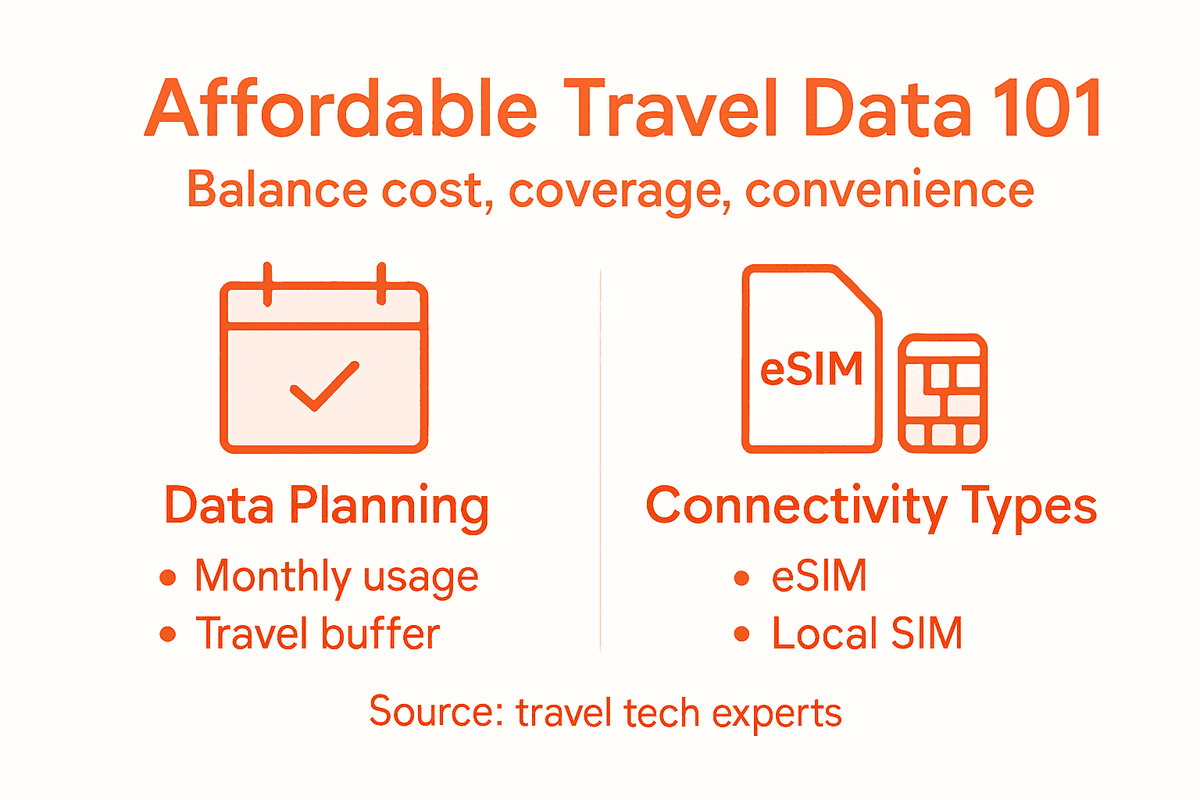
Pro tip: Calculate your typical monthly data usage at home, then add 20% for travel uncertainty, and compare that specific number against plan options rather than simply picking the lowest price available.
Types of Travel Data Plans Explained
When you’re preparing for international travel, you’ll encounter several different ways to stay connected. Each option serves different needs depending on how long you’re traveling, where you’re going, and how much data you actually use. Understanding these options helps you avoid overpaying for coverage you don’t need or scrambling for connectivity because you chose the wrong plan.
The three main categories of travel data plans are prepaid local SIM cards, international roaming plans from your home carrier, and eSIM solutions that offer both single and multi-country coverage. Prepaid local SIM cards remain popular because they offer competitive rates within a specific country or region. When you arrive in Thailand, you walk into any convenience store, grab a local SIM, and immediately get Thai carrier pricing that’s a fraction of what your home carrier would charge. The downside? You need a phone that accepts physical SIM cards, you’ll get a new phone number each time you switch countries, and you’re constantly buying new cards and managing multiple contacts. It works fine for a two-week beach vacation in one location. It becomes frustrating when you’re moving between countries every few days.
International roaming plans from your home carrier sound convenient because you don’t need to do anything. You arrive in Paris, your phone still works on your home network, and you stay connected without touching a thing. That convenience comes at a steep price. Your carrier charges premium rates for data, messaging, and calls overseas. Understanding how these roaming structures operate reveals why they’re widely considered the most expensive option available to travelers. You’ll pay three to five times more per gigabyte compared to local options, and surprise overage charges happen faster than you’d expect. Some travelers use roaming plans for true emergencies or very short trips where the simplicity justifies the cost. Most experienced travelers avoid them entirely.
eSIM plans represent the modern solution that splits the difference. Unlike physical SIM cards, eSIM data plans operate as digital profiles that you activate remotely, often through an app or QR code. You can activate coverage for a specific country before you land, switch between providers without waiting for physical delivery, and keep your home phone number active simultaneously on many devices. You get local carrier pricing without the hassle of finding shops or managing multiple SIM cards. Multi-country plans let you cover 10, 20, or even 100+ countries with a single eSIM profile, automatically connecting to local carriers as you cross borders. The flexibility comes without penalty fees for unused data in most cases, and you can pause service if you’re staying somewhere with WiFi for an extended period.

Comparing Your Options
| Feature | Local SIM Cards | Home Carrier Roaming | eSIM Plans |
|---|---|---|---|
| Cost per gigabyte | Low | High | Low |
| Activation speed | 15-30 minutes | Automatic | 5-15 minutes |
| Country flexibility | Single country | All countries | Single or multi-country |
| Device compatibility | Older and newer phones | All devices | Newer phones and tablets |
| Phone number | New number each time | Keeps home number | Keeps home number |
| Mid-trip changes | Physical purchase required | Immediate | Instant via app |
| Setup complexity | High | None | Low |
Your choice depends on your travel style. Single-destination trips of one to two weeks? A prepaid local SIM card works fine and saves you money. Business travelers moving between countries frequently? An eSIM plan eliminates friction and keeps you on budget. Emergency-only backup coverage? Home carrier roaming exists for that purpose, despite the cost. Most digital nomads and frequent international travelers settle on eSIM plans because they eliminate the constant decision-making and let you focus on your actual work or trip instead of managing connectivity logistics.
Pro tip: Before your trip, test your eSIM activation and connection at home rather than discovering incompatibilities after landing in a new country with unreliable WiFi.
How eSIM Technology Powers Connectivity
eSIM technology fundamentally changes how you stay connected while traveling internationally. Instead of hunting for shops to buy physical SIM cards or paying premium roaming charges, you activate a digital profile on your device and connect to local networks instantly. The shift from hardware to software represents one of the most practical innovations in mobile connectivity for travelers. Understanding how this technology works helps you appreciate why it’s become the preferred solution for anyone who travels frequently across borders.
At its core, eSIM stands for embedded SIM, a programmable chip already built into modern smartphones, tablets, and laptops. Unlike traditional SIM cards that store a single carrier profile and require physical replacement to switch providers, eSIM technology replaces physical cards with software that can hold multiple carrier profiles simultaneously. You can store profiles for carriers in 50 different countries on a single device without touching any hardware. When you land in a new country, you simply activate the appropriate profile through your device settings or an app, and your phone connects to that local carrier within seconds. The magic happens because the eSIM is remotely provisioned, meaning carrier profiles download to your device over the internet rather than requiring a physical card insertion.
Here’s what makes eSIM practical for your travel lifestyle. First, you eliminate the friction of finding local SIM card vendors in unfamiliar places. No more arriving at midnight in a new city and searching for a convenience store that sells SIM cards. Second, you keep your home phone number active on one profile while maintaining a local number or data-only plan on another profile simultaneously. Your family can still reach you on your regular number while you use a local profile for data and regional calls. Third, you switch between countries without any hardware changes. Walking from Spain into Portugal? Simply tap a button and activate your Portugal profile. No SIM card removal, no lost cards, no device downtime. The process takes less time than it takes to get through airport immigration.
The carrier flexibility that eSIM provides works because multiple carrier profiles can coexist on a single device, and you control which one is active at any moment. This means you’re not locked into one provider’s coverage or pricing for your entire trip. If you discover that your initial choice doesn’t have great coverage in your current location, you switch to a competing carrier with better signal strength. You can compare multiple carriers’ pricing and choose the one offering better value for the number of days you’re staying. This kind of flexibility was impossible with physical SIM cards because switching required purchasing and installing a new card. With eSIM, switching is instantaneous.
The Technical Advantage
The shift toward eSIM adoption is accelerating globally. eSIM technology is projected to reach 76% device penetration by 2030, making it increasingly the standard rather than the exception. This matters for travelers because wider adoption means more carriers offer eSIM plans, prices become more competitive, and device manufacturers include eSIM as standard equipment. The infrastructure supporting eSIM continues improving, with faster activation times and broader geographic coverage. Understanding how eSIM profiles function helps you recognize the advantages over older technology and appreciate why switching to eSIM-based travel connectivity makes financial and practical sense.
From a practical standpoint, eSIM solves the core problem that frustrated travelers for decades. You no longer need to choose between paying premium roaming fees or spending time sourcing local SIM cards in each new location. You activate a plan before departure, land in a new country, and stay connected using local carrier pricing without any additional setup. Your device handles the carrier switching automatically as you cross borders if you’re using a multi-country plan. The technology reduces the friction between you and reliable connectivity, letting you focus on your actual travel or work rather than managing connectivity logistics.
Pro tip: Download your eSIM profile onto your phone while still connected to WiFi before your flight so activation happens instantly upon landing, even if airport WiFi is congested or unreliable.
Comparing Roaming, Local SIMs, and eSIMs
When you’re preparing for international travel, you face a fundamental choice that affects both your budget and your experience. You can stick with your home carrier’s roaming service, buy a local SIM card at your destination, or activate an eSIM plan before you leave. Each option has real trade-offs, and choosing the wrong one can cost you hundreds of dollars or leave you without reliable connectivity when you need it most. Understanding the actual differences between these three approaches helps you make the decision that fits your specific travel pattern.
Roaming through your home carrier is the path of least resistance. Your phone works exactly as it does at home, calls and texts come through to your regular number, and you don’t need to do anything before departure. The trade-off is brutal pricing. Your carrier charges premium rates for everything you do abroad. Data typically costs $5 to $15 per gigabyte depending on your carrier and destination. A casual afternoon of video calls, email downloads, and social media browsing can easily rack up $50 to $100 in charges. You don’t even get the benefit of knowing you’ve crossed a cost threshold because charges accumulate silently in the background. Roaming works best for true emergencies where you need connectivity for a few hours, not for sustained travel or work. Most experienced travelers avoid roaming except as a backup option.
Local SIM cards flip the equation entirely. When you arrive at your destination, you buy a physical SIM from a local carrier at a convenience store, airport, or supermarket. You pay $5 to $20 for the SIM card itself, then activate a plan with data, calls, and texts at local pricing. A gigabyte of data costs $1 to $3 when you buy it from a local Thai carrier versus $10 to $15 through American roaming. That’s a dramatic savings. The downside is friction. You need to find a shop to buy the card, figure out the local language to understand what plan you’re purchasing, and swap physical SIM cards in your phone. You get a new phone number each time you switch countries, which means your family and colleagues can’t reach you on your regular number without you telling them the new one. If you’re staying in a single country for two or three weeks, a local SIM makes complete sense. If you’re moving between countries every few days, the constant buying and swapping becomes exhausting.
eSIM plans bridge the gap between convenience and cost. You activate a plan before departure through an app or QR code, and your phone connects to local carriers in your destination countries without any physical changes. eSIM technology offers instant activation across multiple profiles, eliminating the need for physical SIM swaps while providing global coverage at local pricing. You keep your home phone number active on one profile while using a local or data-only profile for your travels. Multi-country plans let you cover dozens of destinations with a single activation. You pay $2 to $5 per gigabyte, far less than roaming but often comparable to or slightly higher than the absolute cheapest local SIM cards. The real value comes from flexibility. You don’t hunt for shops, you don’t swap cards, you don’t get stuck without connectivity because you bought a SIM for a carrier with poor coverage in your current location. You can pause service when you’re on WiFi and resume when you need data again.
Side by Side Comparison
| Factor | Roaming | Local SIM | eSIM |
|---|---|---|---|
| Cost per gigabyte | $5-15 | $1-3 | $2-5 |
| Monthly cost estimate | $300-500 for light use | $20-50 | $30-80 |
| Setup required | None | Find shop, buy SIM, swap | Download app, activate |
| Phone number | Keep home number | New number each country | Keep home number |
| Multi-country use | Works everywhere | Need new SIM per country | Single profile covers all |
| Activation time | Automatic | 15-30 minutes | 5-15 minutes |
| Speed of carrier switching | Automatic by location | Requires physical change | Instant via app |
| Best for | Emergencies only | Single destination trips | Multi-country travelers |
The data tells a clear story. If you’re moving between multiple countries or staying abroad for more than a week, eSIM delivers the best combination of affordability and convenience. eSIM connectivity eliminates the expense and complexity that plague both roaming and local SIM approaches. You get local pricing without hunting for shops, and you keep your home number active simultaneously. Roaming exists for moments you genuinely need it, not as a primary connectivity strategy. Local SIMs still make sense for single-destination trips to countries with excellent coverage and reliable SIM vendors, but most travelers moving between countries find eSIM removes enough friction to justify the slightly higher per-gigabyte cost.
Below is a quick reference guide to ideal plan types based on different travel scenarios:
| Travel Situation | Best Plan Type | Reason |
|---|---|---|
| Single country, short trip | Local SIM card | Lowest local rates, easy to purchase |
| Multi-country tour | eSIM plan | Flexible use across borders |
| Business travel, frequent moves | eSIM plan | Instant switching, keeps main number |
| Emergency backup | Roaming | Works everywhere, simple setup |
Pro tip: Before booking any plan, check your specific phone model’s eSIM compatibility at the carrier’s website, as some older devices only support physical SIM cards while most phones from 2020 onward include eSIM capability.
Cost Factors and Common Pitfalls
When you’re comparing travel data plans, the advertised price tells only part of the story. The actual cost depends on multiple factors working together, and missing even one detail can turn an affordable plan into an expensive mistake. Understanding what drives costs and recognizing the hidden pitfalls helps you avoid the common traps that catch unprepared travelers.
The primary cost drivers are straightforward on the surface but complex in practice. Data consumption varies dramatically based on your usage patterns. Streaming video consumes 500 megabytes to 1 gigabyte per hour, while checking email and messaging uses almost nothing. A digital nomad uploading client work consumes far more data than a tourist checking maps and messaging family. Plan duration matters because some providers charge more for shorter activations and less per day for longer commitments. A 7-day plan might cost more per gigabyte than a 30-day plan, but you don’t need 30 days. Network coverage quality affects your actual experience even if coverage technically exists. A plan with coverage in remote areas might connect to slower 3G networks in rural regions, while another plan offers faster 4G in the same location. Key cost factors include data consumption rates, plan duration, network coverage quality, and additional fees that can accumulate quickly without clear visibility. Additional fees hide in plan terms. Activation fees cost $2 to $10. Setup fees another $1 to $5. Some plans charge for pausing service or switching between profiles mid-trip. These small charges stack up fast.
The common pitfalls trip up even experienced travelers. Underestimating data needs happens constantly. You think you’ll use 2 gigabytes per week because that’s your home usage, but traveling involves navigation apps constantly running, video calls with people back home, uploading photos to cloud storage, and unexpected downloads. You end up needing 4 to 5 gigabytes instead. You’re stuck either paying overage charges at premium rates or dealing with throttled slow speeds. Ignoring data throttling terms causes frustration. Some plans advertise unlimited data but throttle your speed to 2G after a certain threshold. You technically have unlimited data, but at 2G speeds, you can barely load a webpage. The plan worked fine until day 10 of your 14-day trip, then became unusable. Choosing plans without verifying destination coverage is surprisingly common. You buy a plan because it advertises coverage in 100 countries, then arrive in a rural area of your destination and discover coverage doesn’t actually extend there. The plan works in the capital city just fine, but you’re in the mountains with no signal. Missing data expiration windows catches travelers who buy plans expecting to use them for future trips. Data purchased expires 30 or 60 days after activation. You plan to use it on a trip 90 days away and discover the data expired before you needed it.
The Hidden Cost Scenarios
Consider a realistic example. You book an eSIM plan advertised at $3 per gigabyte for a two-week trip. The math seems simple: buy 5 gigabytes for $15. But the activation fee adds $5, bringing you to $20. You underestimate usage and run out of data after 10 days, so you purchase 2 more gigabytes at the overage rate of $5 per gigabyte instead of $3 per gigabyte, adding $10. You pause service for three days while staying with friends near WiFi, and discover that pausing costs $2. By the end of your trip, a plan that seemed to cost $15 actually cost $37. Common pitfalls like insufficient coverage verification and data throttling terms cause costs to balloon beyond initial estimates.
Avoiding these pitfalls requires a disciplined approach. Start by tracking your actual data usage at home for two weeks. Multiply that number by 1.5 to account for travel usage, then add another 20 percent as a safety buffer. That’s your actual data need, not the rounded number you guessed. Read plan terms completely before purchasing. Search for words like “throttle,” “overage,” “expiration,” and “fee” to find the cost surprises. Verify coverage in the specific areas where you’ll spend time, not just the country name. Use coverage maps provided by the carrier and zoom in to your actual destinations. Compare the total cost including all fees, not just the per-gigabyte rate. A plan that costs $3.50 per gigabyte with a $10 activation fee might actually be more expensive overall than a plan costing $4 per gigabyte with no fees, depending on your data needs.
Here are common pitfalls and recommended solutions when choosing a travel data plan:
| Common Pitfall | Typical Consequence | How to Avoid |
|---|---|---|
| Underestimating data needs | Overage charges or slow speeds | Track usage at home, add 20% buffer |
| Ignoring data throttling | Unusable connection mid-trip | Read plan terms for throttling limits |
| Skipping coverage checks | No signal in remote areas | Verify carrier maps for destinations |
| Overlooking hidden fees | Unexpected extra costs | Compare total cost incl. all fees |
Pro tip: Before departure, send yourself a test message through your plan to verify activation, then calculate your daily data burn rate for the first two days of travel to catch any surprises while you’re still able to buy additional data without premium overage charges.
Experience True Freedom with Affordable Global Data Plans
Traveling internationally can quickly become frustrating when traditional roaming fees drain your budget or juggling multiple local SIM cards wastes your valuable time. This article highlights the real challenges travelers face like unpredictable roaming charges, limited plan flexibility, and the hassle of swapping SIM cards every time you cross a border. If you want to stay connected effortlessly with affordable per-gigabyte rates, reliable coverage across dozens of countries, and simple activation without hidden fees, you need a smarter solution designed for today’s digital nomads and global explorers.
Lumo is that solution. Our all-in-one eSIM platform offers instant activation for over 160 countries with no physical SIM swaps needed. Keep your home phone number active while seamlessly switching between local carriers to avoid roaming surcharges. Enjoy flexible data plans tailored to your real usage and avoid unexpected fees that inflate your cost. Join thousands of travelers who trust Lumo for high-speed 4G and 5G connectivity backed by 24/7 customer support. Don’t let expensive roaming or confusing local SIM management disrupt your next trip. Discover how easy affordable global connectivity can be at Lumo and start your journey with confidence today.
Frequently Asked Questions
What are affordable travel data plans?
Affordable travel data plans provide reliable internet connectivity at reasonable prices, balancing cost per gigabyte, network coverage quality, and flexibility to match different travel usage patterns.
How do eSIM plans differ from traditional SIM cards?
Unlike traditional SIM cards, eSIM plans are digital profiles that can be activated remotely, allowing users to switch between carriers without needing to physically change SIM cards, providing greater flexibility and convenience.
What should I consider when choosing a travel data plan?
When choosing a travel data plan, consider your typical data usage, the plan’s cost per gigabyte, network coverage quality, flexibility for pausing or switching, and any hidden fees that may apply.
How can I avoid extra costs with my travel data plan?
To avoid extra costs, track your data usage prior to traveling, verify coverage maps for your specific destinations, read the plan terms for throttling and fees, and purchase enough data to meet your actual needs.
Recommended
Related Topics
Stay Connected Anywhere
Prepaid eSIM data plans for 180+ countries and territories. No physical SIM required.