Best SimLocal.com Alternatives for International Travelers

TL;DR:
- Lumo is a leading alternative to SimLocal.com, offering instant activation and coverage in over 160 countries. Travelers should choose their plan based on itinerary type, such as regional for border crossings or single-country for local stays. Picking plans anchored to local carriers and confirming device unlock ensures reliable connectivity and avoids activation issues.
For most international travelers, Lumo is the strongest SimLocal.com alternative: instant QR activation, coverage across many countries, 4G/5G speeds, and 24/7 support with no contracts required. If you want to compare your options before committing, here’s the short version.
Top three alternative categories to consider:
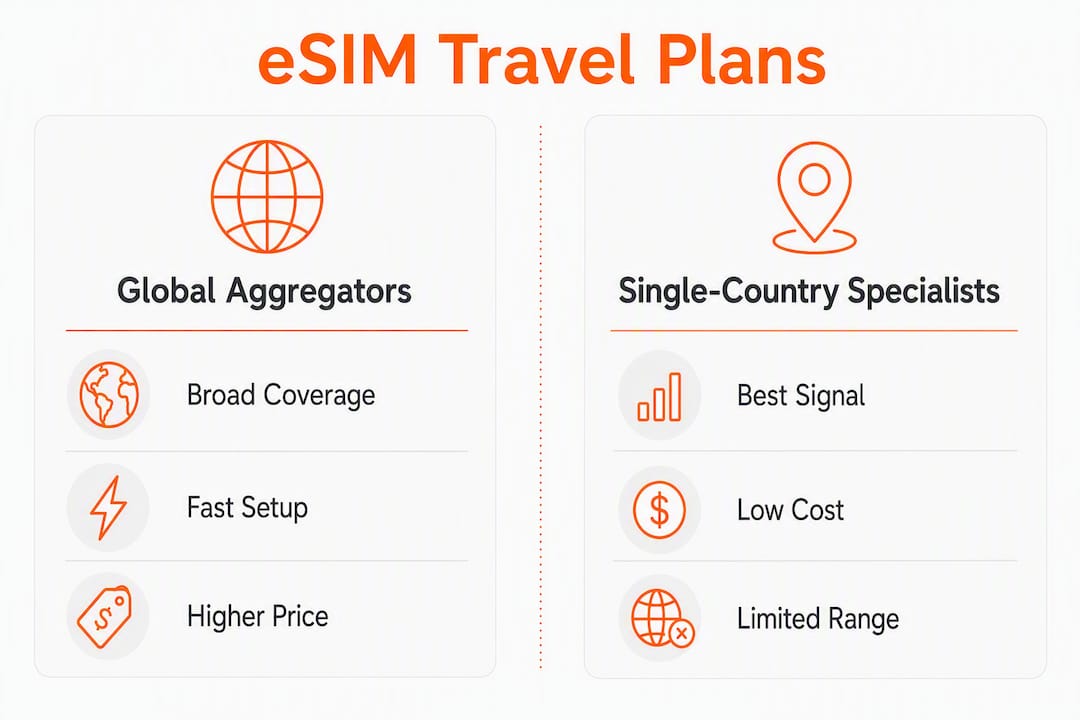
- Global aggregator apps (like Lumo): Best for travelers hitting multiple continents or making last-minute plans. One account, one checkout, works before you board.
- Regional specialists: Best for a focused trip through neighboring countries, say a road trip through Canada, the US, and Mexico, where a single regional plan covers all three without border headaches.
- Single-country specialists: Best for a long stay in one destination where you want the strongest possible local signal and the lowest per-GB cost.
Your itinerary should drive the decision, not the price tag. More on that below.
Table of Contents
- How do SimLocal.com alternatives actually compare?
- Which SimLocal.com alternatives are worth your time?
- How do these alternatives compare to SimLocal.com directly?
- How do you pick the right alternative for your trip?
- What you need to check before activating an eSIM
- What should you expect to pay, and which plan type fits your trip?
- What the research says about choosing a travel eSIM
- Key Takeaways
- The part most eSIM guides get wrong
- Lumo: a direct alternative worth considering
- Useful sources
- FAQ
How do SimLocal.com alternatives actually compare?
| Provider category | Best for | Typical price range | Coverage scope | Plan types | 5G available | Voice & SMS | Activation ease | Refunds & support |
|---|---|---|---|---|---|---|---|---|
| Global aggregator | Multi-continent, last-minute trips | US$10–25 (short plan) | a wide range of countries | Single / regional / global | Varies by country | Data-only (most) | QR or app | Varies widely |
| Regional specialist | Multi-country road trips, border crossings | — | One region (e.g., North America, Europe) | Regional only | Often yes | Sometimes included | Usually QR | Moderate |
| Single-country specialist | Long stays, rural coverage priority | US$10–25 | One country | Single-country | Often yes | Rare | QR or manual | Limited |
| Multi-country bundle | Planned itinerary, 3–6 countries | — | Fixed country list | Bundle | Varies | Rare | QR | Moderate |
| Carrier travel pass | Occasional travelers, existing plan holders | Varies | Carrier-dependent | Add-on | Sometimes | Yes | Automatic | Strong |
Quick takeaways by trip type:
- Single-city trip: A single-country specialist gives you the best signal and the lowest cost.
- Multi-country road trip: A regional plan prevents border bleed and eliminates the hassle of buying a new eSIM at every crossing.
- Long stay or digital nomad: Look for a plan with a high fixed-GB allowance or a regional bundle with a generous daily cap.
- Short trips across many countries: A global aggregator like Lumo is the most practical choice.
Which SimLocal.com alternatives are worth your time?
Global aggregator apps
Global aggregators let you browse, buy, and activate a plan from a single app or website before you leave home. Lumo sits in this category, offering plans for many countries with instant QR activation, no registration, and flexible durations. The convenience is real: you can be connected within minutes of landing.

The tradeoff is that aggregators often resell access through roaming partnerships rather than native carrier agreements. That means signal quality in rural areas can lag behind a local SIM. For city travel, you’ll rarely notice the difference.
Pros: Huge country coverage, fast setup, one account for multiple trips, often multi-device capable. Cons: Higher price per GB than local SIMs, signal may be weaker in remote areas, most are data-only.
Pricing examples vary depending on data and duration; check current pricing before buying.
Regional specialists
Regional specialists anchor to a handful of carriers across a defined geography, typically a continent or trading bloc. For North American travel, a regional plan that covers the US, Canada, and Mexico in one purchase is genuinely useful. Border bleed near international borders can cause unintended roaming charges or data dropouts; a regional eSIM that auto-switches between carriers prevents that.
Pros: Seamless border crossing, often better signal than a global roaming plan, predictable cost. Cons: Useless outside the covered region, limited plan flexibility.
Typical cost varies for a regional bundle.
Single-country specialists
These are eSIMs provisioned directly on a destination carrier. Local eSIMs provisioned on a destination carrier generally receive higher signal priority than roaming-based bundles anchored to a foreign carrier. If you’re spending two weeks in Japan or Mexico City and want the best possible speeds, a single-country plan is worth the extra setup step.

Pros: Best in-country signal, lowest per-GB cost, often includes local number options. Cons: Useless the moment you cross a border, requires buying a new plan for each country.
Pricing: roughly US$10–25 for a 7-day plan.
Multi-country bundles
A step up from single-country plans, bundles cover a fixed list of countries under one purchase. They work well when your itinerary is set and the bundle matches it exactly. The risk: if your trip changes and you add a country not on the list, you’re stuck buying a second plan.
Pros: Predictable cost, decent coverage for planned routes. Cons: Inflexible, coverage gaps if your itinerary shifts.
Carrier travel passes
Your existing carrier (AT&T, T-Mobile, Verizon) may offer a daily international add-on. These are convenient because voice and SMS work automatically, but the daily fees add up fast on longer trips, and data speeds are often throttled.
Pros: No new account, voice included, familiar billing. Cons: Expensive for trips longer than a few days, speed limits common.
Pro Tip: Before buying any plan, use a comparison database like eSIMDB to filter by destination, data amount, and validity. It surfaces price-per-GB and carrier partner details side by side, which saves you from overpaying for a plan that looks cheap but delivers less data.
How do these alternatives compare to SimLocal.com directly?
SimLocal.com operates as a marketplace that aggregates eSIM plans from multiple providers, similar to how a flight aggregator works. The alternatives above each take a different approach.
| Dimension | SimLocal.com model | Global aggregator | Regional specialist | Single-country specialist |
|---|---|---|---|---|
| Coverage | Wide (marketplace) | a wide range of countries | One region | One country |
| Plan types | Single / regional / global | All three | Regional only | Single-country |
| 5G availability | Varies by plan | Varies by country | Often yes | Often yes |
| Voice & SMS | Rare | Data-only (most) | Sometimes | Rare |
| Activation ease | QR or app | QR (usually instant) | QR | QR or manual |
| Refunds & support | Varies by provider | Varies | Moderate | Limited |
| Multi-profile support | Limited | Yes (some) | No | No |
| Validity | Flexible | Flexible | Fixed | Fixed |
Key insight: The marketplace model SimLocal.com uses means plan quality depends on which underlying provider you pick. A direct provider like Lumo gives you a consistent experience because you’re dealing with one company’s support team, one activation flow, and one refund policy, not a patchwork of vendor policies.
One practical difference worth calling out: when you buy through a marketplace and something goes wrong with activation, support can bounce you between the marketplace and the underlying provider. With a direct provider, there’s one contact point. For travelers who’ve never activated an eSIM before, that simplicity matters.
Single-country local eSIMs often outperform roaming-based bundles in rural areas because local eSIMs receive higher signal priority from the destination carrier. If your trip involves remote areas, a local plan beats a global bundle on signal, even if it costs slightly more per GB.
How do you pick the right alternative for your trip?
Work through these steps in order. Skipping step one and jumping straight to price is the most common mistake travelers make.
- Map your itinerary first. List every country you’ll enter, including brief transits. A single-country plan fails the moment you cross a border.
- Estimate your daily data needs. Maps and messaging use roughly 100–300 MB per day. Video calls or streaming push that to 1–3 GB daily. Your usage pattern determines whether a fixed-GB or unlimited plan makes sense.
- Check your device. Confirm your phone is carrier-unlocked and eSIM-compatible. Check how many eSIM profiles your device supports simultaneously.
- Match plan type to itinerary. One country, short stay: single-country plan. Multiple neighboring countries: regional bundle. Many countries across continents: global plan.
- Read the fine print. Check the Fair Use Policy on any “unlimited” plan, confirm the carrier partner in your destination, and verify whether top-ups are available if you run out.
Questions to ask any provider before you buy:
- What carrier(s) anchor the plan in my specific destination?
- Is there a Fair Use Policy, and what’s the daily high-speed allowance?
- Can I top up if I run out of data mid-trip?
- What’s the refund policy if I can’t activate?
- Is customer support available 24/7, and through what channels?
Red flags to watch for:
- No carrier partner listed for your destination
- “Unlimited” with no FUP details anywhere on the site
- No refund or top-up option
- Activation guides that contradict each other across the site
- Support only available by email with 48-hour response times
For a deeper decision framework, the choosing the right travel SIM guide walks through itinerary-based selection in detail.
What you need to check before activating an eSIM
Activation failures are almost always preventable. Run through this checklist before you buy, not after.
Before purchase:
- Confirm your phone is carrier-unlocked (call your carrier or check Settings > General > About on iOS)
- Verify eSIM compatibility (most iPhones from XS onward and Android flagships from 2019+ support eSIM)
- Check how many eSIM profiles your device allows simultaneously (some phones support only one active at a time)
- Confirm you have a stable Wi-Fi connection for the activation download
At activation:
- Scan the QR code in Settings > Cellular > Add eSIM (iOS) or Settings > Connections > SIM Manager (Android)
- Do not scan the QR code more than once; most codes are single-use
- Keep your home SIM active during activation so you retain SMS for bank verification
If activation fails:
- Restart the device and toggle airplane mode on and off
- Re-enter the activation details manually if a QR option exists
- Check that your device’s date and time are set to automatic
- Contact provider support immediately; don’t wait until you land
Carrier locks are the leading cause of unusable eSIM purchases. A locked device simply won’t accept a third-party eSIM profile, no matter how good the plan is.
One often-overlooked tip: keep your home SIM physically in the device while traveling. It preserves your home number for bank SMS and two-factor authentication while your travel eSIM handles data. For more troubleshooting steps, the eSIM connectivity troubleshooting guide covers the most common error messages and fixes.
What should you expect to pay, and which plan type fits your trip?
Price ranges shift constantly, so treat these as benchmarks rather than guarantees. Always verify live pricing before checkout.
Sample price ranges by trip type:
- Weekend city trip (1–3 days, one country): The cost for a single-country plan with 3–5 GB varies.
- Week-long trip (one country): The cost for a 7-day single-country plan varies.
- Multi-country road trip (2–4 countries, 10–14 days): The cost for a regional bundle varies.
- Long stay or digital nomad (30+ days): The cost for a high-GB or unlimited regional plan varies; verify the FUP carefully.
- Short multi-continent sprint (5+ countries, under 2 weeks): The cost for a global short plan varies.
Decision rules:
- Single-country plan: You’re staying in one country, the trip is under two weeks, and you want the best possible signal. Local plans win on speed and cost per GB.
- Regional bundle: You’re crossing two or more neighboring borders. Regional plans for multi-country trips are often more efficient and cost-effective than buying separate single-country plans, and they eliminate the setup time at each border.
- Global plan: You’re visiting four or more countries, some of which may be last-minute additions. The higher price per GB buys you flexibility.
Pro Tip: “Unlimited” rarely means unlimited at full speed. Most unlimited plans include a daily high-speed allowance, often 1–2 GB, after which speeds drop to rates suitable for messaging and maps but not video calls. If you need sustained high-speed data for remote work, a fixed high-GB plan is more reliable than an unlimited plan with a low daily cap.
For practical strategies to stretch your data further, the global data usage tips guide covers app settings and background data controls that make a real difference.
What the research says about choosing a travel eSIM
The single most consistent finding across eSIM research is this: travelers who choose a plan based on itinerary first consistently get better connectivity than those who choose on price alone.
Choosing regional plans for multi-country trips is often more efficient and cost-effective than buying separate single-country plans. It saves setup time and prevents data gaps when crossing borders. — How To Choose The Best Travel eSIM In 2026
That finding holds up in practice. A traveler who buys the cheapest single-country plan for a road trip through the US, Canada, and Mexico will spend more time managing three separate plans than a traveler who pays slightly more for a North American regional bundle.
Three expert tips backed by research:
-
Estimate data by activity, not by gut. Maps and messaging run on roughly 100–300 MB per day. Video conferencing pushes that to 1–3 GB. Match your plan’s GB allowance to your actual usage pattern, not a round number that sounds comfortable.
-
Verify the carrier anchor before you buy. A plan that lists “North America” as its coverage area might anchor to a single carrier in each country. Check which specific carrier your eSIM will connect to, then look up that carrier’s coverage map for your destination.
-
Don’t skip the unlock check. Carrier locks are the leading cause of unusable eSIM purchases. Checking takes two minutes; fixing it after you’ve landed takes much longer.
One more thing worth flagging: the UK mobile carrier selection tips framework applies broadly to any carrier evaluation, including eSIM providers. The criteria (network coverage, contract terms, roaming policies) translate directly to the eSIM comparison process.
Key Takeaways
Lumo is the recommended pick for most travelers searching for SimLocal.com alternatives, offering instant QR activation, 160+ country coverage, and 24/7 support with no contracts.
| Point | Details |
|---|---|
| Itinerary first, price second | Choose your plan type based on countries visited and border crossings, not the lowest sticker price. |
| Match plan type to trip | Single-country for one destination, regional bundle for neighboring countries, global for 4+ countries. |
| Check device unlock before buying | Carrier locks are the leading cause of unusable eSIM purchases; confirm unlock status before checkout. |
| Read the FUP on unlimited plans | Most unlimited plans throttle after a daily high-speed allowance; fixed high-GB plans are more reliable for remote work. |
| Lumo for most travelers | Lumo covers 160+ countries with instant QR activation, flexible durations, and 24/7 support. |
The part most eSIM guides get wrong
There’s a framing problem in most eSIM comparison articles: they treat price as the primary variable and coverage as a secondary check. That’s backwards.
Coverage quality is binary in practice. Either your eSIM connects at usable speeds in the places you actually go, or it doesn’t. A plan that’s US$5 cheaper but anchors to a carrier with weak rural coverage in your destination isn’t a bargain. It’s a liability you won’t discover until you’re standing in a train station in a small town trying to pull up directions.
The marketplace model that SimLocal.com and similar aggregators use has a real advantage: breadth. You can compare dozens of plans in one place. But breadth creates a different problem. When you’re looking at 40 plans for the same country, the differences between them (carrier anchor, FUP details, activation method, support quality) are exactly the details that get buried in the comparison interface. Travelers end up filtering by price and star rating, which tells them almost nothing about whether the plan will work in the specific places they’re going.
The better approach is to start with the carrier anchor. Find out which local network the eSIM connects to in your destination, look up that carrier’s coverage map, and then compare prices among plans that use the same or equivalent carriers. That’s a ten-minute process that eliminates most bad purchases before they happen.
Lumo’s approach of combining direct plan access with clear carrier information and 24/7 support addresses exactly this gap. You’re not navigating a marketplace of third-party providers with inconsistent support policies. You get one activation flow, one support team, and transparent plan details.
Lumo: a direct alternative worth considering
If you’ve worked through the checklist above and want a provider that checks every box without the marketplace complexity, Lumo is worth a direct look. Coverage spans 160+ countries, activation is instant via QR code (no app install required), and plans are available for single countries, regions, and global itineraries with flexible durations and data limits.
Lumo maps directly to the criteria this article outlines: instant activation before you board, 4G/5G speeds, multi-device eSIM profile support, no contracts or registration, and 24/7 customer support when something goes wrong. Refund and top-up options are available, which matters when your itinerary changes mid-trip.
Browse Lumo’s current eSIM plans to compare coverage, pricing, and plan durations for your specific destination before you book.
Useful sources
- How To Choose The Best Travel eSIM In 2026: Research-backed framework for itinerary-first eSIM selection; informed the decision rules and expert tips throughout this article.
- 2026 Global eSIM Buying Guide: Unlimited vs Daily FUP vs Fixed GB: Detailed breakdown of plan types, FUP mechanics, and signal-priority differences between local and roaming eSIMs.
- Travel eSIM: Easy Essential Guide to Avoid Costly Mistakes: Practical checklist for device compatibility and carrier lock verification; sourced the activation failure data.
- Best eSIM for North America: Regional analysis of border bleed and carrier auto-switching for North American travel.
- eSIMDB: Find and Compare Best Travel eSIMs for Your Trip: Searchable plan database useful for comparing price per GB, validity, and carrier partners across providers.
- USA eSIM vs Roaming Canada in 2026: Which Option Saves More?: Analysis of hybrid SIM setups for preserving home-number SMS while using a travel eSIM for data.
FAQ
Is SimLocal.com a legitimate service?
Yes, SimLocal.com is a legitimate eSIM marketplace that aggregates plans from multiple providers. Plan quality and support experience vary depending on which underlying provider you select through the platform.
What’s the difference between SimLocal.com and Airalo?
Both operate as eSIM marketplaces aggregating plans from third-party providers. The main differences are in the provider mix, pricing, and the app experience. Neither is a direct eSIM provider; plan quality depends on the underlying carrier partner in your destination.
Which eSIM is best for international travel?
For most travelers, a global aggregator with direct provider support, like Lumo, is the most reliable choice. It combines wide country coverage (160+), instant QR activation, and a single support contact, which matters most when something goes wrong abroad.
Is there anything better than Airalo for multi-country trips?
For multi-country trips, a regional specialist or a direct provider with regional plans often outperforms a marketplace. Regional plans prevent border bleed and eliminate the need to buy separate plans at each crossing. Lumo offers regional and global plans that cover this use case with instant activation and 24/7 support.
Do I need to unlock my phone before buying a travel eSIM?
Yes. A carrier-locked phone cannot accept a third-party eSIM profile. Check your unlock status before purchasing any eSIM plan, regardless of provider.
Recommended
Related Topics
Stay Connected Anywhere
Get instant eSIM data plans for 160+ countries. No physical SIM required.