Choosing the right travel SIM: reliable data for global travelers

TL;DR:
- eSIMs offer quick activation, multi-profile storage, and convenience for multi-country travel.
- Local physical SIMs are cost-effective for single-country stays, but require physical swapping.
- Combining a dual SIM setup with regional eSIMs and local SIMs maximizes connectivity and savings.
Pulling out your phone at a foreign airport and watching your data bill climb by the minute is one of travel’s most avoidable mistakes. Millions of travelers still pay $10 to $15 per day in roaming charges when faster, cheaper options are sitting right in front of them. Whether you are a digital nomad juggling client calls across time zones or a frequent flyer who just needs reliable maps and messaging, your SIM card choice shapes your entire trip. This guide walks you through every major option, compares today’s top providers, and gives you a clear framework for picking the plan that actually fits how you travel.
Table of Contents
- Comparing SIM types: eSIM, physical SIM, and roaming
- How to assess your travel SIM needs and usage
- Top travel SIM and eSIM providers for 2026
- Expert strategies for maximizing connectivity and savings
- A fresh take: Why provider flexibility beats one-size-fits-all
- Stay connected worldwide with global eSIM plans
- Frequently asked questions
Key Takeaways
| Point | Details |
|---|---|
| eSIMs maximize convenience | eSIMs offer instant activation, multi-country support, and let you keep your home SIM active. |
| Provider choice matters | Top eSIM providers like Airalo, Holafly, and Saily cater to different budgets and usage needs. |
| Match your SIM to travel style | Choose your SIM solution based on data usage patterns, region, and whether you need calls, not just price. |
| Testing and flexibility save money | Mixing regional eSIMs with local SIMs often beats one-size-fits-all global plans, according to experts. |
Comparing SIM types: eSIM, physical SIM, and roaming
Now that you recognize the need for a better data solution, let’s clarify your main options. At the most basic level, you have three paths: a traditional physical SIM, an eSIM (embedded SIM), or relying on your carrier’s international roaming.
A physical SIM is the small chip you pop into your phone. You can buy one locally at your destination, which often gives you competitive local rates. The catch? You need to find a store, navigate potential language barriers, wait for activation, and physically swap out your home SIM. Lose that tiny card and you lose your number.
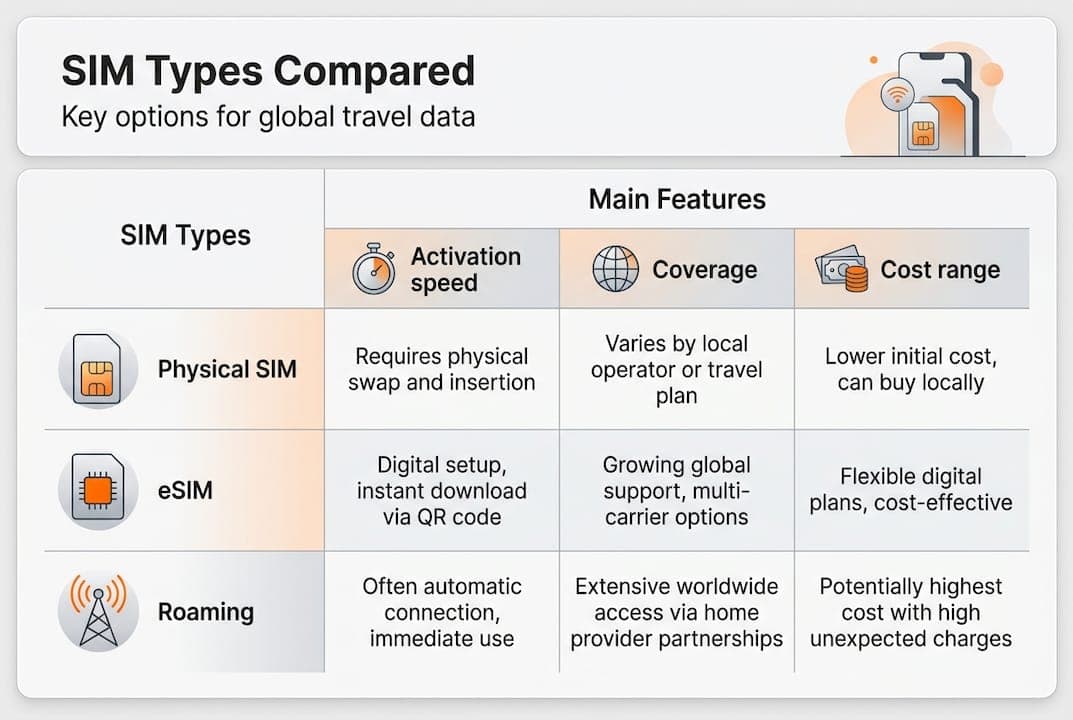
Roaming means your home carrier extends its service abroad. It is the most convenient option on paper. In practice, it is usually the most expensive. Carriers routinely charge premium day rates or per-MB fees that add up fast, especially if you stream video or join video calls.
An eSIM is a digital SIM built directly into your device. There is no chip to swap. You scan a QR code, and within minutes you are connected. eSIM benefits for travelers go well beyond convenience. As research confirms, eSIMs are preferred due to instant activation, the ability to hold multiple profiles, and the option to keep your home SIM active simultaneously.
Here is a quick side-by-side look:
| Feature | Physical SIM | eSIM | Roaming |
|---|---|---|---|
| Activation speed | Hours or days | Minutes | Instant |
| Cost | Low to moderate | Low to moderate | High |
| Coverage flexibility | One country at a time | Multi-country profiles | Carrier dependent |
| Device compatibility | Universal | Modern phones only | Universal |
| Home SIM retention | No | Yes (dual SIM) | Yes |
The advantages of eSIM over SIM are especially clear for multi-country trips. You can pre-load a regional plan before you even board the plane. No hunting for a kiosk in an unfamiliar terminal. No risk of dropping a SIM card into an airport drain.

Common pitfalls with local physical SIMs include stores that only sell to residents, activation processes that require a local ID, and plans that expire before you finish your trip. The eSIM vs physical SIM differences come down to trade-offs between upfront cost and convenience.
Pro Tip: If your phone supports eSIM, activate a travel eSIM for data while keeping your home SIM live for calls and two-factor authentication (2FA) messages. You get the best of both worlds without a single card swap.
How to assess your travel SIM needs and usage
Having seen how each SIM type works, let’s personalize your choice based on where and how you travel.
Start with your hardware. Not every phone supports eSIM. Check your settings under “About Phone” or “Cellular” to see if eSIM is listed. iPhones from XS onward and most flagship Android devices from 2020 onward support it. If your device is older, a physical travel SIM is your main option.
Next, think about your travel pattern:
- Single-country stays (1 to 4 weeks): A local physical SIM often wins on price.
- Multi-country regional trips: A regional eSIM plan covering Europe, Southeast Asia, or Latin America saves the most time and usually beats buying individual local SIMs.
- Constant global movement: A global eSIM with coverage across 100 or more countries is your safest bet for uninterrupted connectivity.
- US-based nomads: Google Fi or a global eSIM with North America coverage may simplify billing.
Estimate your monthly data use honestly. If your work involves daily video calls on Zoom or Google Meet, you likely burn 3 to 5 GB per hour of video. Messaging and maps use a fraction of that. A nomad doing light work remotely might need 10 GB per month. A video content creator could need 50 GB or more.
Here is how to check your compatibility and coverage in four steps:
- Go to your phone’s settings and search for “eSIM” or “Add Cellular Plan.”
- Confirm your device is unlocked. Carrier-locked phones may block third-party eSIMs.
- Browse regional eSIM plans that match your itinerary.
- Check coverage maps for each provider in every country on your route.
The ability to manage multiple eSIM profiles on a single device is a game-changer for frequent movers. You can store a Europe plan, a Southeast Asia plan, and a global backup, then switch between them in seconds. eSIMs let you store multiple profiles, making them ideal for nomads who move frequently between regions.
Statistic callout: Dual-SIM users report fewer dropped connections and lower monthly data bills compared to single-SIM roamers, because they can always default to the cheaper active plan.
Top travel SIM and eSIM providers for 2026
With your needs in mind, here is how today’s top travel SIM and eSIM providers compare.
| Provider | Starting price | Countries covered | Standout feature |
|---|---|---|---|
| Airalo | From $4.50 | 200+ | Best overall value |
| Holafly | From $6.90 | 160+ | Unlimited data plans |
| Saily | From $3.99 | 150+ | Lowest cost per GB |
| Nomad | From $4.00 | 100+ | Best regional value |
| Ubigi | From $5.00 | 190+ | Fastest 5G speeds |
As the data shows, top eSIM providers for 2026 include Airalo for best overall coverage across 200 or more countries, Holafly for unlimited plans, Saily for the lowest cost per gigabyte, Nomad for best value, and Ubigi for the fastest speeds.
“For travelers who want the widest safety net, Airalo’s global reach combined with Holafly’s unlimited option gives you a strong one-two punch for any itinerary.”
Here is what makes each provider stand out:
- Airalo: Massive country catalog, simple app, competitive pricing on short trips.
- Holafly: Unlimited data removes the stress of tracking usage, ideal for heavy streamers.
- Saily: Lowest entry price makes it great for budget travelers in Southeast Asia.
- Nomad: Strong regional bundles for Asia-Pacific and Middle East routes.
- Ubigi: Prioritized 5G access in key markets, best for speed-sensitive work.
For US-based nomads, Google Fi deserves a mention. It covers 200 or more countries, includes voice and SMS, and handles 2FA seamlessly. The trade-off is a 90-day continuous abroad usage cap, which matters if you are a full-time nomad. For those trips, pairing Google Fi with a data-only eSIM from Airalo or Saily covers the gap.
Explore top eSIMs for globetrotters and check out a global eSIM provider comparison to dig into more eSIM solutions comparison details before committing to a plan. More provider details are available if you want to compare pricing across specific regions.
Expert strategies for maximizing connectivity and savings
Now, apply these strategies so your travel connectivity is truly seamless.
Setting up a dual-SIM workflow is simpler than most travelers expect. Follow these steps:
- Purchase your eSIM plan before departure and download it via QR code while on your home Wi-Fi.
- Set the eSIM as your default data line and keep your physical home SIM active for calls and texts.
- Enable Wi-Fi calling on your home SIM so you can receive calls abroad without roaming charges.
- Download offline maps (Google Maps or Maps.me) as a backup for areas with weak signal.
- Set data roaming to “off” on your home SIM so it never accidentally connects and racks up charges.
Experts recommend that you test speeds and stability by reading recent reviews, and combine a data-only eSIM for internet with your regular SIM for calls and 2FA. This setup protects you from both connectivity gaps and surprise bills.
Pro Tip: Heavy users who stream video or run video calls all day often save money with an unlimited plan even at a higher daily rate. Light users who mostly check email and use maps save more with pay-as-you-go data. Know your usage before you buy.
Common mistakes to avoid:
- Skipping the coverage map check for rural or off-the-beaten-path destinations.
- Buying a plan after landing instead of activating it before you board.
- Forgetting to save your eSIM QR code offline in case you need to reinstall it.
- Assuming “unlimited” means no speed throttling after a data threshold.
- Using your home SIM for data abroad without checking the roaming rate first.
US nomads using Google Fi should note the 90-day abroad cap. After that limit, Google may suspend your service until you return to the US. Plan accordingly by keeping a backup eSIM ready. Understand how eSIM transforms travel and review the global eSIM plan advantages before your next trip. For deeper strategy, the best travel eSIM strategies resource covers advanced setups in detail.
A fresh take: Why provider flexibility beats one-size-fits-all
All the evidence considered, here is a perspective most travelers rarely hear. The loudest marketing noise in the travel SIM space pushes “one global plan to rule them all.” That pitch is appealing but often misleading.
The reality is that eSIMs are more convenient but can cost more than local SIMs long-term, while Google Fi outpaces eSIM in speed tests but hits that hard 90-day abroad limit. No single provider wins every scenario.
The travelers who stay best connected and spend the least are the ones who treat their connectivity like a toolkit, not a subscription. They run a regional eSIM as their primary data line, keep a local SIM option ready for long stays, and maintain a backup global profile for emergencies. That mix-and-match approach consistently outperforms any single unlimited plan on both price and uptime.
Our take at Lumo: true flexibility is the real advantage, not unlimited gigabytes. Test your setup on a short trip before committing to a long-term plan. Keep alternate eSIM profiles stored and ready. Follow eSIM adoption trends to stay ahead of network improvements in your most-visited regions. The traveler who adapts wins every time.
Stay connected worldwide with global eSIM plans
Ready to put reliable travel connectivity into action? Here’s an easy starting point.
Lumo makes it simple to find and activate the right plan for your exact itinerary. Whether you need coverage in a single country or across 160 or more destinations, you can browse curated global eSIM data plans with clear, upfront pricing and no surprise fees. Activation takes minutes via QR code, and 24/7 support is there if anything goes sideways.
Stop overpaying for roaming or wasting time hunting for local SIMs at the airport. Lumo’s plans are built for the way modern travelers actually move, with flexible data, instant setup, and coverage that keeps pace with your itinerary. Browse your options today and arrive at your next destination already connected.
Frequently asked questions
Is eSIM always better than a physical travel SIM for international travel?
eSIM offers the greatest convenience for frequent global travelers, but a physical local SIM can still be cheaper for long stays in a single country. eSIMs are preferred for instant activation and multi-profile support, but locals may be cheaper long-term.
What are the cheapest options for mobile data while traveling internationally?
Saily starts from $3.99 across 150 or more countries, making it one of the lowest-cost options per GB, while Airalo offers affordable regional and global plans for most itineraries.
Does Google Fi really outperform regular eSIMs for US-based travelers?
Google Fi Premium delivers higher speeds and all-in-one voice and data in testing, but its 90-day abroad limit makes it impractical for full-time international nomads without a backup plan.
How do I know if my phone supports eSIM?
Go to your phone’s settings and look for “eSIM” or “Add Cellular Plan” under the cellular or network menu. You can also check your phone manufacturer’s website for a confirmed list of eSIM-compatible models.
Can I use both my home SIM and an eSIM at the same time?
Yes. Most modern smartphones support dual SIM, so you can keep your home SIM active for calls and 2FA while your eSIM handles data. eSIMs enable multiple profiles and work seamlessly alongside a physical SIM on dual-SIM devices.
Recommended
- Affordable Travel Data Plans: Smart Global Connectivity | Lumo eSIM Store
- 7 Smart Global Data Usage Tips for Travelers and Remote Workers | Lumo eSIM Store
- Step-by-Step Guide to Global Data Plans for Travelers | Lumo eSIM Store
- Why switch carriers abroad for cheaper, reliable data | Lumo eSIM Store
- CryptoeSIM.io — Buy eSIMs with Crypto | 190+ Countries
Related Topics
Stay Connected Anywhere
Prepaid eSIM data plans for 180+ countries and territories. No physical SIM required.