Why eSIM adoption is rising: benefits for travelers 2026

The shift to eSIM technology is accelerating faster than most realize. By 2026, millions of international travelers and remote workers have embraced this digital alternative to physical SIM cards, fundamentally changing how we stay connected abroad. Traditional SIM cards create friction with their physical swapping requirements, limited flexibility, and often expensive roaming charges. This article explores the compelling reasons behind the surge in eSIM adoption and reveals how this technology delivers unprecedented convenience, cost savings, and control for anyone crossing borders. Understanding these drivers helps you make smarter connectivity choices for your next international journey.
Table of Contents
- Understanding eSIM Technology And Its Rise In Popularity
- Market Trends And Projections Fueling eSIM Adoption
- Privacy And Security Considerations Of The Growing eSIM Ecosystem
- Practical Benefits And How To Make The Most Of eSIM For International Travel And Remote Work
- Get Started With Lumo eSIM For Instant Global Data
- Frequently Asked Questions
Key takeaways
| Point | Details |
|---|---|
| Remote provisioning advantage | eSIMs eliminate physical SIM swaps, allowing instant activation through digital downloads anywhere in the world. |
| Device support explosion | Growing numbers of smartphones, tablets, and laptops now include built-in eSIM capabilities, making adoption seamless for travelers. |
| Privacy considerations | Online eSIM distribution lowers barriers for providers but introduces potential data routing and security concerns requiring careful provider selection. |
| Traveler flexibility gains | International users enjoy cost savings, multiple profile management, and hassle-free carrier switching without visiting physical stores. |
Understanding eSIM technology and its rise in popularity
An eSIM, or embedded SIM, represents a programmable chip soldered directly into your device that performs all functions of a traditional removable SIM card. Unlike physical SIMs requiring manual insertion, eSIM technology simplifies mobile connectivity through remote provisioning. You download carrier profiles digitally via QR codes or apps, activating service instantly without visiting a store or waiting for physical delivery.
The core difference lies in flexibility and convenience. Traditional SIM cards lock you into one carrier profile at a time, requiring physical swaps when changing networks or traveling internationally. eSIMs store multiple carrier profiles simultaneously, letting you switch between them through software settings. This capability transforms international travel by eliminating the frustration of finding local SIM vendors, dealing with incompatible card sizes, or losing your home country SIM during trips abroad.
For international travelers and remote workers, eSIMs deliver immediate practical benefits. You can research and purchase data plans before departure, activate service upon landing, and maintain your primary number while using local data rates. The technology supports instant connectivity in new countries without airport kiosk visits or language barriers. Remote provisioning means you control everything from your device, comparing plans and switching carriers based on coverage needs or pricing.
Industry adoption has surged as major smartphone manufacturers integrate eSIM capability into flagship devices. Apple, Samsung, Google, and others now ship phones with dual SIM functionality combining physical and eSIM slots, or exclusively eSIM models in some markets. This widespread device support removes technical barriers, making eSIM accessible to mainstream travelers rather than just early adopters.
The combination of technical maturity, device availability, and growing carrier support creates a perfect environment for rapid adoption. eSIM benefits for travelers extend beyond mere convenience to fundamentally reshape how we approach international connectivity.
Pro Tip: Before your next international trip, verify your smartphone supports eSIM by checking Settings > Cellular > Add eSIM on iPhone or Settings > Connections > SIM Manager on Android devices to confirm compatibility and avoid last-minute surprises.
Market trends and projections fueling eSIM adoption
The eSIM market is experiencing explosive growth that validates its position as the future of mobile connectivity. GSMA projects that 50% of all smartphones will be eSIM-enabled by 2028, representing a massive shift from the roughly 20% penetration observed in early 2024. This trajectory reflects both consumer demand and strategic industry alignment toward digital-first solutions.
Several converging factors drive this accelerating adoption curve. Device manufacturers recognize eSIM technology enables thinner phone designs by eliminating physical SIM trays, creating more space for batteries or additional components. Carriers benefit from reduced logistics costs associated with manufacturing, distributing, and managing physical SIM inventory. Consumers gain unprecedented flexibility and control over their mobile connectivity choices.
The travel sector particularly fuels eSIM growth as international movement rebounds post-pandemic. Business travelers and digital nomads seek seamless connectivity solutions that eliminate roaming charges and simplify multi-country itineraries. The availability of competitive eSIM data plans from specialized providers creates market pressure that traditional carriers must address, spurring broader adoption and better pricing across the ecosystem.
“The transition to eSIM represents the most significant evolution in mobile connectivity since the smartphone itself, fundamentally changing how billions of people access networks worldwide.”
Market data reveals the stark contrast between adoption trajectories:
| Year | eSIM-Enabled Smartphones | Traditional SIM Only |
|---|---|---|
| 2024 | 22% market share | 78% market share |
| 2026 | 38% market share | 62% market share |
| 2028 (projected) | 50% market share | 50% market share |
This data demonstrates eSIM moving from niche technology to mainstream standard within just four years. The 2026 snapshot shows more than one-third of smartphones now support eSIM, with the technology reaching parity with traditional SIMs by 2028. For travelers, this means broader compatibility, more competitive pricing, and enhanced service options as the market matures.
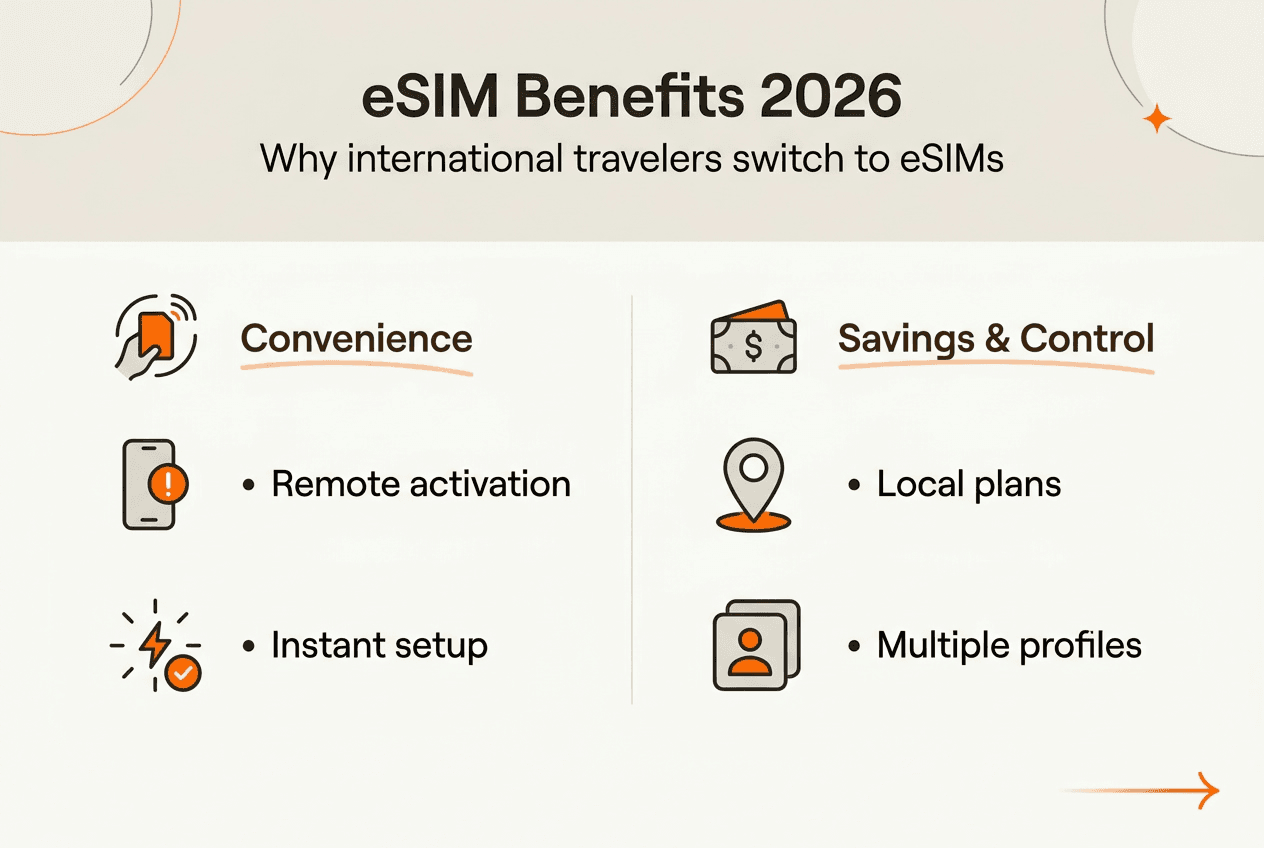
The eSIM impact on international travel extends beyond individual convenience to reshape entire segments of the telecommunications industry, forcing innovation and customer-centric improvements across carriers worldwide.
Privacy and security considerations of the growing eSIM ecosystem
While eSIM technology offers compelling benefits, the rapid growth introduces important privacy and security considerations that informed travelers must understand. The digital nature of eSIM distribution and activation creates new vectors for potential data exposure that differ fundamentally from traditional SIM card models.
Travel eSIMs often route user data through third-party infrastructure rather than directly through local carriers, potentially exposing browsing activity, location data, and communication metadata to additional parties. This routing architecture, while enabling the flexibility travelers value, creates opportunities for data collection beyond what occurs with conventional local SIM cards purchased directly from established carriers.
The ease of online eSIM distribution presents another challenge. Online distribution lowers barriers for unregulated or less reputable providers to enter the market without the physical presence requirements that traditionally accompanied SIM card sales. Some providers operate with minimal transparency about data handling practices, corporate ownership structures, or jurisdictional privacy protections.
Key privacy and security concerns include:
- Data routing through unknown intermediate networks before reaching final destinations
- Limited visibility into which entities access or store your connection metadata
- Potential for DNS hijacking or traffic inspection by eSIM providers
- Unclear data retention policies and cross-border data transfer practices
- Difficulty verifying the security practices of newer market entrants
- Reduced user control over profile management compared to physical SIM ownership
These risks do not negate eSIM benefits but require thoughtful provider selection. Established eSIM services with transparent privacy policies, clear corporate structures, and strong security certifications offer significantly better protection than anonymous providers with vague terms of service.
When evaluating eSIM options, prioritize providers that clearly disclose their data routing architecture, maintain certifications from recognized security organizations, and operate under jurisdictions with robust privacy regulations. Read privacy policies carefully, looking for specific commitments about data encryption, retention limits, and third-party sharing restrictions.
The eSIM for remote work explained guide provides additional context on balancing convenience with security when choosing connectivity solutions for professional use cases where data protection is paramount.
Pro Tip: Before purchasing any eSIM plan, verify the provider maintains ISO 27001 certification or equivalent security standards, and confirm they publish transparent privacy policies specifying data retention periods and prohibiting sale of user information to third parties.
Practical benefits and how to make the most of eSIM for international travel and remote work
Beyond the technical foundation and market trends, eSIM technology delivers tangible advantages that transform daily experiences for international travelers and remote professionals. Understanding these benefits and implementing best practices maximizes the value you extract from this connectivity solution.
eSIMs eliminate the anxiety of finding local SIM vendors upon arrival in new countries. You research plans before departure, purchase during your flight, and activate immediately after landing. This preparation removes the pressure of navigating unfamiliar airports while jet-lagged, dealing with language barriers at mobile shops, or accepting whatever overpriced tourist SIM happens to be available.

Cost savings represent another compelling advantage. Traditional roaming charges from home carriers often exceed $10 per day plus per-megabyte data fees. eSIM plans from specialized providers typically offer multi-gigabyte packages for $5 to $15 covering entire trips, reducing connectivity costs by 60% to 80% compared to conventional roaming.
The ability to maintain multiple active profiles simultaneously provides unprecedented flexibility. Keep your home number active for important calls and two-factor authentication while using a local eSIM profile for data. Switch between profiles instantly through settings without rebooting or physically swapping cards. This dual-profile capability proves invaluable for business travelers needing to remain reachable on their corporate number while accessing affordable local data.
Setting up and managing eSIM profiles requires just a few steps. First, verify your device compatibility through settings. Next, research eSIM providers offering coverage in your destination countries with data allowances matching your usage patterns. Purchase your selected plan, receiving a QR code via email. Scan this code through your device’s eSIM settings menu, following prompts to download and activate the profile. Finally, configure which profile handles calls, messages, and data through your dual SIM settings.
| Feature | Traditional SIM | eSIM |
|---|---|---|
| Activation time | 30-60 minutes (store visit) | 2-5 minutes (digital) |
| Physical handling | Required (swap cards) | None (software only) |
| Multiple profiles | One at a time | Several simultaneously |
| International flexibility | Low (new SIM each country) | High (instant switching) |
| Cost for travelers | High (roaming fees) | Low (competitive plans) |
To optimize your eSIM experience internationally, follow these best practices:
- Purchase eSIM plans 24 to 48 hours before departure to resolve any activation issues while still having reliable connectivity at home.
- Download carrier apps associated with your eSIM provider for easy balance checking and plan management during trips.
- Configure your device to use eSIM for cellular data while keeping your primary SIM for calls, preventing unexpected roaming charges.
- Monitor data usage through your device settings to avoid exhausting your plan allocation before your trip ends.
- Save multiple eSIM provider QR codes in your email or cloud storage for backup options if your primary plan experiences coverage issues.
- Test your eSIM activation at home before traveling to ensure you understand the process without time pressure at your destination.
- Keep your physical SIM card in a safe location as a backup option if technical issues arise with eSIM functionality.
The advantages of eSIM over SIM for global travelers extend across convenience, cost, and control dimensions. Combined with the eSIM cost savings for travelers achieved through competitive pricing, this technology represents a genuine upgrade over traditional connectivity approaches.
Managing multiple profiles becomes second nature after your first trip. You will quickly develop preferences for which providers offer the best coverage in specific regions, which plans provide optimal value for your usage patterns, and how to configure settings for different travel scenarios. This knowledge compounds over time, making each subsequent international journey smoother than the last.
Get started with Lumo eSIM for instant global data
Now that you understand why eSIM adoption is surging and how this technology benefits international travelers, taking the next step becomes straightforward. Lumo offers a trusted eSIM solution specifically designed for travelers and remote workers who demand reliable, affordable global connectivity without complexity.
Lumo provides instant activation across more than 160 countries, eliminating the research burden of finding reliable local providers in each destination. Flexible data plans scale from short weekend trips to extended multi-month stays, adapting to your specific travel patterns. Competitive pricing delivers the cost savings that make eSIM adoption worthwhile, while 24/7 customer support ensures you are never stranded without connectivity assistance.
The platform’s intuitive interface makes purchasing and activating plans simple, even for first-time eSIM users. Browse coverage maps, compare plan options, and complete purchases within minutes. Receive your activation QR code immediately, ready to scan and activate whenever your journey begins.
Visit Lumo eSIM global data plans to explore coverage options for your next destination and experience the convenience that is driving worldwide eSIM adoption. The combination of broad network access, transparent pricing, and traveler-focused features makes Lumo an ideal choice for anyone seeking hassle-free international connectivity.
Pro Tip: Use Lumo’s flexible multi-country plans to maintain consistent connectivity across entire regions like Europe or Southeast Asia without purchasing separate plans for each country, simplifying your travel logistics while maximizing cost efficiency.
Frequently asked questions
What is eSIM and how does it work?
An eSIM is a digital SIM embedded directly into your device that replaces traditional removable SIM cards. Instead of inserting a physical card, you download carrier profiles digitally through QR codes or apps, activating service instantly without visiting stores. The technology allows storing multiple carrier profiles simultaneously, letting you switch between them through software settings. This digital approach eliminates physical SIM management while providing greater flexibility for international travelers who need to change networks frequently. For detailed guidance, explore eSIM benefits explained to understand all advantages.
Why is eSIM adoption increasing among international travelers?
eSIM adoption surges among travelers because it eliminates the hassle of finding and purchasing physical SIM cards in every country visited. You can research plans before departure, activate service immediately upon arrival, and avoid expensive roaming charges from your home carrier. The technology provides instant connectivity without language barriers, airport kiosk visits, or concerns about losing your original SIM card. Cost efficiency plays a major role, with eSIM plans typically costing 60% to 80% less than traditional roaming fees. Growing device support from major manufacturers makes eSIM accessible to mainstream travelers rather than just tech enthusiasts.
Are there any privacy risks with using eSIM while traveling?
Yes, some privacy considerations exist with eSIM usage, particularly regarding data routing and provider transparency. Travel eSIMs may route your data through third-party infrastructure rather than directly through local carriers, potentially exposing browsing activity and location data to additional parties. The ease of online eSIM distribution allows less regulated providers to enter the market without the physical presence requirements of traditional SIM sales. To mitigate these risks, select reputable eSIM providers with transparent privacy policies, clear data handling practices, and security certifications from recognized organizations. Verify providers disclose their routing architecture and operate under jurisdictions with strong privacy regulations.
Can I use eSIM if my smartphone doesn’t support it?
If your smartphone lacks eSIM capability, you cannot use eSIM technology on that specific device. Check your phone’s specifications in Settings > Cellular or Settings > Connections to confirm whether eSIM support is available. Devices manufactured before 2018 typically lack eSIM functionality, while most flagship smartphones from 2020 onward include this feature. If your current device is incompatible, you have two options: continue using traditional physical SIM cards for your travels, or consider upgrading to a newer smartphone model that supports eSIM. Contact your device manufacturer or mobile carrier for specific compatibility details and guidance on available alternatives for your situation.
Recommended
Related Topics
Stay Connected Anywhere
Get instant eSIM data plans for 160+ countries. No physical SIM required.