7 Key Advantages of eSIM Over SIM for Global Travelers

Traveling abroad with your smartphone often means wrestling with physical SIM cards, unpredictable network coverage, and costly roaming fees. Simple mistakes like losing a SIM card or struggling with activation can disrupt your plans and drain your budget. But there’s a smarter way to stay connected no matter where your journey takes you.
This list reveals how eSIM technology solves real travel headaches with instant activation, flexible local carrier choices, and security benefits. You’ll discover actionable tips that make switching networks and saving on data charges effortless. Get ready to unlock practical strategies that make international mobile connectivity smoother, safer, and more affordable than you might think.
Table of Contents
- 1. Instant Activation With QR Code Convenience
- 2. No Physical SIM Card Swapping Needed
- 3. Support For Multiple eSIM Profiles On Devices
- 4. Seamless Global Coverage In Over 160 Countries
- 5. Easy Switching Between Local Carriers
- 6. Cost Savings By Avoiding Roaming Charges
- 7. Stronger Security And Less Risk Of SIM Loss
Quick Summary
| Takeaway | Explanation |
|---|---|
| 1. Instant eSIM activation via QR code | Scan a QR code upon arrival for immediate cellular connectivity without physical SIM cards. |
| 2. Supports multiple eSIM profiles on one device | Easily switch between local and home carrier profiles without swapping physical cards. |
| 3. Avoid roaming charges with local rates | Activate local carriers for much lower data costs compared to home carrier roaming fees. |
| 4. Enhanced security with embedded profiles | eSIMs are less prone to theft and loss, as there are no physical cards to handle. |
| 5. Easily switch between local carriers | If one network is slow, quickly choose another carrier with better coverage directly from your settings. |
1. Instant Activation With QR Code Convenience
Imagine landing at an airport in Tokyo, Bangkok, or Madrid and having cellular data within seconds. That’s exactly what QR code activation delivers. Instead of hunting for a physical SIM card, fumbling with tiny chips, or waiting for mail delivery, you simply scan a code and you’re connected.
The way this works is surprisingly straightforward. Your eSIM provider generates a unique QR code that contains all the activation information needed to download your data plan directly to your device. When you scan that code with your phone’s camera or a QR code reader, your device immediately recognizes the eSIM profile and begins the setup process. Instant eSIM activation happens in real time, often completing in under 30 seconds.
What makes this particularly powerful for travelers is the elimination of timing hassles. You don’t need to arrange delivery dates, worry about local customs offices holding your package, or plan your connectivity ahead of time with rigid timelines. Land at the airport, scan the code in your airline lounge, and you’re ready to navigate, message, and stream the moment you exit security.
The technical elegance here runs deeper than convenience alone. QR code activation uses a group profile template that supports quick activation, meaning multiple travelers can use the same code without conflicts. This is ideal for group trips or corporate travel where your entire team needs connectivity simultaneously. The process also includes digital identity validation, which handles SIM registration requirements in markets like India, Mexico, and Indonesia where local laws mandate it.
Practically speaking, this changes how you approach travel logistics. You can book your flight at 11 PM, receive your eSIM QR code instantly via email, and activate it while sitting on the tarmac. No advance planning required. No backup plans needed. When you land, you already have local mobile coverage ready to use.
The beauty of this method particularly shines for spontaneous travel or last-minute trips. A colleague asks you to join them in Barcelona tomorrow. You accept, get your QR code that same day, and arrive with active data instead of scrambling to find a SIM card vendor who has your phone’s size and your carrier’s compatibility.
Pro tip: Save your eSIM QR codes as images in your cloud storage or email them to yourself before traveling, so you have backup access to reactivate your profile if you switch devices or need to reinstall it during your trip.
2. No Physical SIM Card Swapping Needed
Remember the last time you switched phones and had to dig out that tiny SIM card ejector tool? Or worse, you lost a SIM card between trips. With eSIM technology, those frustrations disappear entirely. Your phone’s embedded chip stores your mobile plan digitally, so there’s no physical card to insert, remove, or misplace.
Traditional SIM cards require a physical swap every time you change devices or switch carriers. You remove one card, insert another, and wait for activation. It’s a process that sounds simple until you’re at a train station in Berlin with no ejector tool, or you accidentally drop your SIM card in an airport bathroom. eSIM profiles store mobile carrier information digitally, eliminating these physical hassles entirely. Instead of fumbling with hardware, you simply download a new data plan to your device’s embedded chip.
The practical benefit here transforms how you travel. You can have three different carriers’ plans on your phone simultaneously. Need local data in Thailand for a week? Download that profile. Heading to Vietnam next? Add Vietnam’s carrier without removing anything. Want to keep your home carrier’s plan active? It stays right there. You switch between plans by tapping a few buttons in your phone’s settings. No mechanical removal, no risk of damage, no lost cards.
Consider what happens when you travel with multiple devices. A smartphone, a tablet, an iPad, a smartwatch. With physical SIM cards, you’d need separate cards for each device, or constantly swap one card around. This becomes a logistical nightmare for digital nomads juggling work across multiple screens. With eSIM, you provision the same plan across all your devices instantly. Your phone connects to data while your tablet accesses the same network using the same plan.
The durability advantage is often overlooked but genuinely valuable. Physical SIM cards have moving parts and contact points that degrade over time. They corrode from moisture, bend from pocket pressure, and develop poor connections. eSIM technology removes this damage risk by eliminating the physical contact entirely. Your plan lives in a chip that can’t be bent, can’t accumulate dust on contacts, and won’t fail from humidity. This matters especially for long-term travelers spending months in tropical climates where moisture is constant.
Another practical reality shows up when you lose or damage a phone. With a traditional SIM, you’re stuck without your plan until you get a replacement card and wait for activation. With eSIM, you can restore your plan to a replacement phone almost instantly using just your account credentials. You’re back online minutes after getting a new device, not days after ordering a replacement SIM.
The psychological relief shouldn’t be underestimated either. One less thing to worry about. One less item that can be lost, damaged, or left behind. One less obstacle between you and the mobile connectivity you need to work, navigate, and stay connected across the globe.
Pro tip: Before traveling, take screenshots of all your eSIM QR codes and store them in your password manager or cloud service, so you can quickly restore your plans to a replacement device without needing to contact your provider.
3. Support for Multiple eSIM Profiles on Devices
Here’s a scenario that changes everything for frequent travelers. You’re working in Singapore for two weeks, then flying to Indonesia for one week, then heading back home to Canada. With traditional SIM cards, you’d need to physically swap cards or carry multiple phones. With eSIM, you simply keep all three carrier profiles on your phone simultaneously and switch between them as needed.
Modern devices support what’s called multiple enabled profiles, which means your phone’s embedded chip can store and activate multiple carrier plans at the same time. This isn’t theoretical. Android 13 and higher versions support this feature natively, and newer Apple devices offer similar functionality. You can have your home carrier, a Thai carrier, and an Indonesian carrier all active on one device. When you’re in Thailand, you activate that profile. Cross into Indonesia, activate the Indonesian profile. It’s seamless switching without any physical manipulation.
The practical implications are transformative for digital nomads and business travelers. Imagine maintaining your work number from your home country while simultaneously using a local number in your current location. Clients can reach you on your Canadian number. Local businesses you’re working with can reach you on your Singapore number. Both work simultaneously without conflicts or dropped calls.
Let’s break down how this actually works in daily life. You land in Bangkok. Instead of searching for a SIM card vendor or waiting for an eSIM activation, you simply open your phone’s settings and activate your Thailand profile that you already downloaded weeks ago. Your phone immediately connects to Thai networks. Meanwhile, your Canadian number stays active in the background. A client in Toronto calls your Canada number while you’re navigating Bangkok streets. You answer. Both profiles are active, both numbers are functional, one device handles everything.
For business travelers managing multiple markets, this becomes invaluable. You’re a sales consultant handling accounts across Europe. Your primary SIM is your office number in London. But you also maintain profiles for Germany, France, and Spain. When video calling a German client, they see your German number on their caller ID. When checking in with your London office, they see your UK number. This level of local presence builds trust and professionalism without requiring multiple devices.
How to manage multiple eSIM profiles on your device is straightforward through your phone’s settings menu. You simply toggle between profiles as needed. The switching happens in seconds. No downtime. No waiting for activation. No technical complexity. Your phone handles the network switching instantly.
The financial advantage is significant too. Instead of paying premium roaming rates from your home carrier while abroad, you use a local profile at local prices. But you keep your home number active for incoming calls. You’ve eliminated roaming charges without sacrificing accessibility. Family, friends, and colleagues can still reach you on your permanent number while you’re enjoying dramatically cheaper local data rates.
For remote workers spanning multiple time zones, this feature solves a genuine problem. Your team in Los Angeles can call you on your US number while you’re physically in Thailand. Your clients in Singapore can reach you on your Singapore number. You’re not juggling multiple devices or paying international roaming fees. One phone, multiple active numbers, zero friction.
Think about the friction points this eliminates. No more explaining to international contacts why you have a new number. No more wondering if important calls will reach you. No more choosing between having a local number or keeping your home number accessible.
The technology works because your device’s embedded SIM chip has the capacity to store multiple profiles simultaneously. Each profile contains the necessary information to connect to that specific carrier’s network. Your phone manages the switching automatically based on which profile you activate. It’s like having multiple valid passports and choosing which one to use at each border crossing.
Pro tip: Set up your most frequently used profiles on your home screen’s control center or quick settings so you can switch between them with a single tap, saving seconds during transitions between countries and making profile management feel effortless.
4. Seamless Global Coverage in Over 160 Countries
Imagine traveling from Tokyo to Bangkok to Dubai to Barcelona without ever worrying whether your phone will have coverage. With eSIM technology offering connectivity across more than 160 countries and territories, that scenario becomes reality rather than anxiety.
Traditional roaming creates a genuine problem for global travelers. You land in a new country and immediately face a choice between three bad options. Pay exorbitant roaming charges from your home carrier. Hunt for a local SIM card vendor and wait for activation. Stay disconnected and hope you find WiFi. None of these solutions actually work well when you’re traveling frequently across multiple countries.
eSIM providers have solved this by partnering with local carriers in over 160 countries worldwide. When you subscribe to an eSIM plan, you’re not subscribing to a single carrier. You’re gaining access to a network of thousands of carriers across the globe. This means the moment you land in a new country, your device automatically connects to a local partner network at local prices. No searching for vendors. No waiting for activation. No roaming charges.
Here’s what this actually means in practice. You’re a business consultant traveling to twelve different countries over six months. Your home carrier would charge you $10 to $15 per megabyte of roaming data. That’s thousands of dollars for basic connectivity. With a global eSIM plan covering 160 countries, you pay consistent local rates regardless of which country you’re in. Thailand costs the same per gigabyte whether you’re there for three days or three weeks. Indonesia, Vietnam, Philippines, Malaysia all work seamlessly without rate changes or surprise overages.
The coverage depth in these 160 countries varies, but the principle remains consistent. You get access to that country’s network infrastructure. In densely populated areas like Singapore, Hong Kong, and major European cities, you’ll find 4G and 5G networks. In more remote regions, you’ll have 3G backup coverage ensuring you stay connected even in less developed areas. The network automatically selects the strongest available signal in each location.
What’s remarkable is how transparent this becomes for you as a user. You don’t think about network switching. You don’t monitor which carrier you’re connected to in each country. You simply activate your eSIM plan, and as you travel across borders, your device automatically connects to available local networks. Your data works. Your messaging works. Your voice calls work. The complexity of managing 160 different carrier relationships becomes invisible.
For remote workers managing clients across multiple regions, this changes everything. You’re working with teams in London, Sydney, and São Paulo. In previous travel scenarios, you’d need separate phone numbers or deal with expensive roaming. With global eSIM coverage, you maintain your primary number while getting reliable, affordable data in all three cities simultaneously. Conference calls, client emails, file uploads all happen at local data rates rather than international roaming prices.
The network selection technology behind this works automatically. Your phone recognizes which country you’re in based on cellular signals and automatically activates the appropriate local partner network. When you cross into a new country, it drops the previous connection and picks up the new one, often without you even noticing the transition. You might glance at your phone and realize you’ve been connected to a different carrier for an hour without any disruption to your service.
Comparing available eSIM solutions for travelers helps you understand which provider offers the best network coverage for your specific travel patterns. Some providers focus on tourist hotspots. Others emphasize coverage in developing nations. Your choice depends on where you actually travel most frequently.
Consider the peace of mind this provides. You book a spontaneous trip to Morocco. You don’t stress about finding a SIM card vendor in Marrakech. You don’t calculate how much roaming will cost. You land, your phone connects to local networks automatically, and you start using data immediately at predictable local rates. The friction disappears entirely from international travel connectivity.
The redundancy built into global coverage also matters. Most countries have multiple carrier partners available through your eSIM provider. If one network is congested, your phone can switch to another. If you’re in an area with weak signals from one carrier, another partner network might have stronger coverage just blocks away. This automatic switching happens behind the scenes, giving you more reliable coverage than relying on a single home carrier’s roaming agreement.
Business travelers particularly benefit from this setup. You’re flying into Jakarta for three days of meetings. Your home carrier’s roaming rates would turn three days into an expensive lesson. With global eSIM coverage, you pay Jakarta rates for your data. Your colleagues can reach you on your normal number. You can upload presentations, join video calls, and stay productive without watching data charges accumulate.
Pro tip: Before traveling to less common destinations, check your eSIM provider’s coverage map to confirm 4G or 5G availability in your specific cities, and have a backup WiFi plan or offline maps downloaded in case you encounter any coverage gaps in remote areas.
5. Easy Switching Between Local Carriers
You’re sitting in a coffee shop in Berlin. Your phone shows weak signal. You glance at your settings and realize you’re connected to a carrier that’s congested in this neighborhood. With a traditional SIM, you’re stuck. With eSIM, you simply switch to a different local carrier with better coverage, all from your phone’s settings menu.
Most countries have multiple mobile networks operating simultaneously. Germany has Vodafone, Deutsche Telekom, and O2. Thailand has AIS, DTAC, and TrueMove. Japan has NTT Docomo, SoftBank, and KDDI. Each network has different coverage strengths depending on location and time of day. A single network might have excellent coverage downtown but weak signal in suburban areas. eSIM providers connect to several of these local mobile networks within each country, giving you flexibility traditional SIM cards never offered.
Here’s where this becomes genuinely useful. You arrive in a new city and your eSIM automatically connects you to one of the partner networks. If that network feels slow or unreliable where you’re located, you don’t wait and hope. You open your phone’s settings and manually switch to a different local network. The switch happens instantly. Within seconds, you’re connected to a stronger network in your area.
This control transforms how you experience coverage reliability. Imagine you’re in a region with varied signal strength, like rural areas or areas undergoing network maintenance. Instead of being forced to use whichever single network your traditional SIM provided, you can test multiple local networks and pick the one delivering the strongest signal. This isn’t technical complexity. It’s straightforward switching that any user can do through their device’s standard settings menu.
Automatic network selection and manual switching is supported on both Android and iPhone platforms through their native device settings. You don’t need special apps or technical knowledge. Android users access carrier settings through their network settings menu. iPhone users do the same through their cellular settings. The switching works the same way on both platforms because it’s a fundamental feature of modern eSIM technology.
The practical benefit becomes clear in specific scenarios. You’re a freelancer working from different cities across Southeast Asia. In Bangkok, AIS might offer better upload speeds for your video conference calls. In Ho Chi Minh City, Viettel might have superior coverage in your specific neighborhood. Rather than being locked into whichever carrier your eSIM randomly connected to, you can choose based on your actual experience and needs. Work gets done faster with better connectivity.
Business travelers particularly appreciate this flexibility. You’re presenting to clients at a conference center in Singapore. You need reliable video streaming for your product demo. If the default network your phone selected feels sluggish, you can switch to a competing carrier without losing your data connection or your phone number. Your demo runs smoothly because you have the flexibility to optimize your connectivity in real time.
The technology behind this works because eSIM providers maintain agreements with multiple carrier partners in each country. When you activate your eSIM in a country, your device receives information about all available partner networks. Your phone automatically selects one and connects. But you always have the option to manually override that choice and pick a different network. It’s like having multiple valid parking passes for different parking companies in the same city and choosing which one to use based on availability and quality.
This flexibility solves a problem that plagued traditional SIM card users. You were locked into whatever single carrier provided your SIM. If that carrier had coverage issues in your area, you had no options. With eSIM, you have choices.
Consider the real world experience of switching carriers. You’re at an airport that has poor signal from your automatically selected network. Twenty seconds. That’s all it takes to open settings, see available networks, select a different one, and be connected. During those twenty seconds, you’re not without service. Your phone simply switches over. It’s seamless from the user perspective.
For extended stays in a region, this becomes even more valuable. You’re spending three weeks in Indonesia and notice that one carrier handles video streaming better while another handles messaging faster. You can switch throughout your stay based on what you’re doing at that moment. Quick messaging to your team? Use one carrier. Video call with your family? Switch to another that you’ve found delivers better streaming quality.
The coverage optimization also matters for battery life. Some carrier networks might be more efficient on your specific device, delivering similar connectivity with better battery performance. You can test different local networks and stick with whichever one gives you the best combination of signal strength and battery efficiency for your particular phone model.
Remote workers spanning multiple time zones find this particularly valuable. You’re working across projects with different data demands. A morning spent handling emails and messaging might use one carrier optimized for data efficiency. An afternoon spent uploading large files might benefit from switching to a carrier known for faster upload speeds in your area. You’re not making these complex technical decisions. You’re simply optimizing your connectivity based on your actual experience.
Pro tip: When arriving in a new country, spend your first hour testing different available local carriers by checking signal strength and speed in your actual location, then save the best performing carrier as your preferred network so your phone automatically reconnects to it if the signal drops.
6. Cost Savings by Avoiding Roaming Charges
Here’s a number that will make you wince. Your home carrier charges $10 per megabyte for international roaming data. You spend two weeks traveling and use 5 gigabytes of data. That’s $50,000 in charges. Yes, that’s actually happened to travelers who weren’t paying attention. With eSIM, that same 5 gigabytes costs you less than $50.
International roaming represents one of the most exploitative pricing structures in telecommunications. Your home carrier knows you’re traveling and unlikely to switch providers mid-trip. They know you need connectivity. They leverage that vulnerability into fees that are literally 100 to 500 times higher than local rates. You’re paying $10 per megabyte while locals in that same country pay $0.02 per megabyte. The disparity is staggering.
eSIM eliminates this entire pricing trap. Instead of using your home carrier’s roaming rates, you connect to local networks at local prices. When you arrive in Thailand, you activate a Thai carrier’s plan. You pay Thai prices. When you head to Vietnam, you activate a Vietnamese carrier’s plan. You pay Vietnamese prices. These aren’t premium international rates. They’re the exact same rates locals pay for the same service.
The math becomes genuinely transformative when you travel frequently. A digital nomad spending six months traveling across Southeast Asia would pay thousands in roaming charges using a home carrier. With eSIM, that same traveler spends a few hundred dollars total. Savings of up to 90% compared to traditional roaming are realistic for travelers using multiple countries.
Consider actual pricing examples. In the United States, your carrier might charge $2 per megabyte for data roaming in Mexico. That’s $2,048 for just one gigabyte. Mexico’s local carriers offer gigabyte plans for $3 to $5. You’re looking at a 400 to 680 fold price difference. eSIM lets you pay Mexican prices instead of United States roaming rates.
The cost benefit extends beyond just data. Many eSIM plans include voice and messaging at local rates as well. Calling home from abroad on your home carrier’s roaming plan costs $2 to $3 per minute. With a local eSIM profile, calling home through apps like WhatsApp or Viber uses your data connection, not premium voice rates. You’re eliminating another massive cost category entirely.
Business travelers see particularly dramatic savings. A company executive traveling to 12 countries over a year could rack up $15,000 to $25,000 in roaming charges alone. With eSIM, that same executive’s connectivity costs might total $2,000 to $3,000. That’s a difference of $12,000 to $22,000 annually. When multiplied across a team of traveling employees, these savings fund entire departments.
eSIM helps travelers avoid expensive roaming fees by connecting to local data plans activated before or during travel. You can purchase a plan days before arriving in a country, ensuring immediate access to affordable connectivity without any gap in service. This also provides clarity about costs because you know exactly what you’re paying upfront rather than discovering shock bills weeks later.
The hidden cost elimination matters just as much as the rate reduction. Traditional roaming often includes surprise overage charges. You think you’re using $50 of data but hit a limit and suddenly face $200 in charges. You receive international texting notifications that cost money to receive. You forget to turn off data roaming and burn through your limit within hours. With eSIM’s pay as you go pricing model, you see exactly what you’re spending as you spend it. No surprises. No hidden charges buried in your bill.
Consider the psychological relief this provides. You’re traveling and checking work emails, messaging family, navigating new cities. With roaming charges, every email download creates anxiety about cost. With eSIM and local rates, you use data freely without worrying about hidden charges. You’re simply paying local prices that align with what everyone else in that country pays.
The money you save using eSIM instead of roaming charges can be redirected toward actual travel experiences. That $5,000 you save on roaming over six months of travel becomes more food, better accommodations, or additional destinations.
Frequent flyers see cumulative savings that become genuinely substantial. A consultant taking 15 international trips per year might save $30 to $50 per trip on data costs alone by avoiding roaming. Multiply that across a career spanning 20 years and you’re talking about thousands of dollars in savings. That’s a car down payment, a vacation, or a meaningful investment in your future.
The comparison becomes even clearer when you think about work efficiency. If you’re a remote worker earning $100 per hour, expensive roaming that costs $500 per week is actually costing you far more than $500. It’s costing you time because you avoid using bandwidth intensive tools. It’s costing you productivity because you work offline instead of collaborating in real time. It’s costing you quality because you postpone uploads or sync operations. eSIM’s affordable local rates mean you work efficiently without bandwidth anxiety limiting your output.
Small business owners traveling for client work find this particularly liberating. You’re visiting three countries to meet with clients and provide services. Your home carrier’s roaming rates would consume 10 to 15 percent of your travel budget just for connectivity. With eSIM, connectivity becomes negligible. Those savings go directly to your bottom line.
The predictability of eSIM costs also simplifies business travel budgeting. You know exactly what you’re paying before you leave home. You purchase a plan, you know the price, and there are no surprises. Your CFO can accurately forecast international travel costs without mysterious roaming charges appearing on invoices weeks after trips conclude.
Pro tip: Purchase your eSIM plans at least two days before traveling so you have time to test connectivity and activate backup profiles if needed, and always opt for plans with clear daily or weekly data limits rather than unlimited plans to avoid accidentally using expensive overage rates.
7. Stronger Security and Less Risk of SIM Loss
You’re rushing through an airport in Bangkok when you realize your SIM card is missing. Maybe it fell out of your pocket. Maybe a pickpocket targeted you specifically for it. Either way, your mobile connectivity is gone and someone potentially has access to your accounts. With eSIM, that scenario becomes impossible because your mobile profile is embedded directly into your phone’s hardware.
Physical SIM cards represent a genuine security vulnerability. They’re small objects that can be lost, stolen, or damaged. More importantly, they can be removed and used in someone else’s phone. This creates an attack vector called SIM swapping, where criminals steal your SIM card or convince your carrier to issue a replacement and transfer your number to their device. Once they have your SIM in their phone, they can access your accounts, reset passwords, and drain your bank accounts.
eSIM technology eliminates this entire class of attacks because there’s nothing to steal or swap. Your mobile profile exists as embedded code within your phone’s secure element. To access it, an attacker would need to physically disassemble your phone or possess your authentication credentials. They can’t simply remove a card and stick it in another device. The security architecture makes that impossible.
Consider what happens if you lose your phone. Yes, that’s terrible. But with a physical SIM, it’s worse because someone has both your phone and your SIM card. They can use your phone number to impersonate you. They can reset your passwords. They can drain your cryptocurrency wallets if you use SMS based two factor authentication. With eSIM, losing your phone means the SIM is lost with it. The attacker can’t separate them and use your number from another device.
eSIM security includes embedded hardware protection that makes the profile impossible to remove or steal independently from the device. The architecture utilizes tamper resistant secure elements and encryption protocols that prevent unauthorized access or cloning. Your mobile profile is protected by the same security standards used in credit cards and government documents.
The digital provisioning process also adds security layers that physical SIM cards never had. When you activate an eSIM, your identity is verified through multiple authentication methods. Your carrier confirms it’s actually you requesting the activation. They verify your device is genuine. They check for suspicious patterns. This entire process is encrypted and logged. If someone tries to activate a fraudulent eSIM in your name, the authentication process catches it and alerts you.
For business travelers carrying sensitive information, this matters enormously. You’re traveling with client data, proprietary information, and work credentials. A stolen physical SIM card could expose all of that if someone gains phone access and uses your number to reset passwords. An eSIM stays locked within your device. Only you can authorize changes through your phone’s security settings.
The risk reduction extends to account security across your entire digital life. Many services use SMS based two factor authentication. A stolen SIM card lets attackers receive the SMS codes meant for you. They reset your email password, access your bank account, drain your investments. With eSIM embedded in your phone, they’d need the phone itself to intercept those SMS messages. The security has improved dramatically.
Remote workers and digital nomads particularly benefit from this enhanced security. You’re working from coffee shops across multiple countries. Your device contains work credentials, client information, and financial data. The risk of losing a physical SIM card and having someone exploit it increases with how much you move and travel. eSIM’s embedded nature means one less thing to lose and one less attack vector to worry about.
The security benefit isn’t just about preventing loss. It’s about preventing the specific class of fraud that comes with physical SIM cards being separated from your device.
Consider the peace of mind this provides. You’re traveling through crowded markets in Morocco. You’re on crowded subways in Tokyo. You’re in unfamiliar neighborhoods. With a physical SIM card, you’re constantly aware that something small and valuable could be stolen. With eSIM, you don’t carry anything extra. Your connectivity exists in your phone’s hardware. The same hardware protecting your phone protects your mobile profile.
The authentication mechanisms built into eSIM provisioning also protect you from social engineering attacks. A criminal can’t call your carrier and claim they lost their SIM card to request a replacement. The carrier’s system knows you’re an eSIM user. It can’t issue a physical SIM as a replacement without going through specialized procedures that trigger fraud detection. This makes SIM swapping attacks dramatically harder or impossible against eSIM users.
Business connectivity improves when you eliminate SIM loss risks. Your organization doesn’t need to maintain emergency procedures for employees who lose SIM cards abroad. You don’t need backup physical SIMs shipped to multiple countries. You don’t need to manage the security incident of a lost SIM potentially being used fraudulently. eSIM removes all of that complexity and risk.
The durability advantage also matters for security. Physical SIM cards degrade from repeated insertion and removal. Contact corrosion can develop. This degradation can make them unreliable at exactly the moment you need connectivity most. An unreliable SIM might get swapped without proper security procedures. An eSIM embedded in your phone never degrades because it’s never mechanically manipulated. The connection remains secure and reliable throughout your device’s lifespan.
Personal data protection becomes stronger with eSIM technology. Your carrier holds less information about your physical location and identity because they don’t need to track physical SIM card shipments or replacements. The digital provisioning creates encrypted records that are harder to breach than databases tracking SIM card distribution. Your privacy is better protected because there are fewer points where your information could be exposed.
For frequent international travelers, the compounding security benefit is significant. You travel to 20 different countries per year. Each physical SIM swap represents a security risk. Each lost SIM card is a potential disaster. After 20 trips using physical SIMs, you’ve exposed yourself to 20 opportunities for theft, loss, or fraud. With eSIM, you travel 20 times with the same embedded security. The accumulated risk is dramatically lower.
Pro tip: Enable biometric authentication on your phone’s SIM settings so that even if someone steals your device, they cannot change your eSIM profile or authorize new SIM activations without your fingerprint or face recognition.
Below is a comprehensive table summarizing the key features and benefits of eSIM technology as discussed in the article.
| Feature | Description | Benefits |
|---|---|---|
| Instant Activation with QR Code | QR codes enable travelers to quickly activate eSIM profiles upon scanning. | Eliminates delays and offers immediate connectivity. |
| No Physical SIM Issues | eSIM profiles are stored digitally on devices, negating physical SIM handling. | Prevents loss, damage, or swapping issues and enhances usability. |
| Multiple Profiles Supported | Devices can store and switch between multiple eSIM profiles. | Offers seamless connectivity across different countries. |
| Global Coverage | eSIM providers offer access in over 160 countries worldwide. | Ensures consistent connectivity and avoids roaming charges. |
| Enhanced Security | Embedded eSIMs are tamper-resistant, reducing the likelihood of theft and fraud. | Protects user data and prevents unauthorized access. |
This table encapsulates the innovations and conveniences brought by eSIM technology, demonstrating its advantages for frequent travelers and international users.
Discover Effortless Global Connectivity with Lumo
Traveling across multiple countries without worrying about expensive roaming fees or the hassle of physical SIM cards is no longer a dream. As highlighted in the article “7 Key Advantages of eSIM Over SIM for Global Travelers,” managing multiple eSIM profiles, instant QR code activation, and seamless switching between local carriers dramatically improve your travel experience. These solutions tackle common pain points like losing SIM cards, facing unpredictable roaming charges, and lacking reliable coverage.
Lumo embraces these advantages by offering an all-in-one eSIM platform designed for modern travelers and remote workers. Benefit from instant activation, access to extensive 5G/4G coverage in over 160 countries, and simple management of multiple eSIM profiles across your devices. Say goodbye to the stress of swapping physical SIM cards or waiting for activation in unfamiliar places.
Ready to simplify your international mobile connectivity and save significantly on roaming costs?
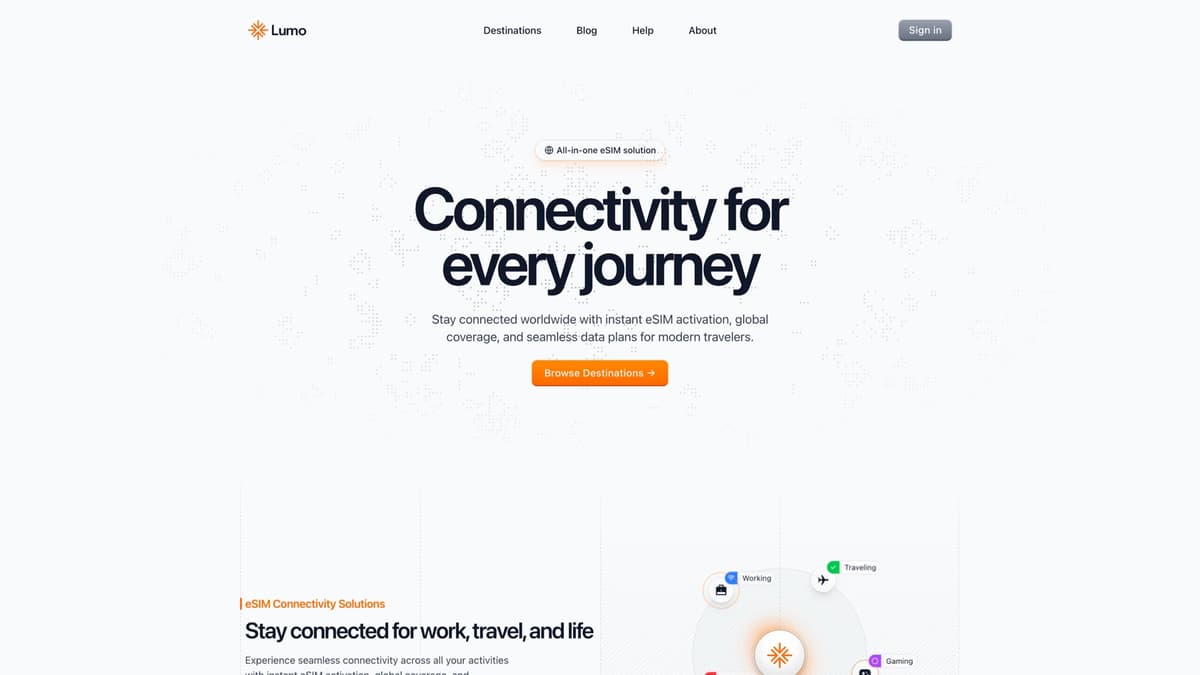
Take control of your travel connectivity today by visiting Lumo’s eSIM solution. Explore how easy it is to activate your eSIM instantly, switch between local carriers effortlessly, and stay connected wherever your journey takes you with Lumo. Don’t let outdated SIM technology hold you back—upgrade your travel experience now.
Frequently Asked Questions
What are the main advantages of using eSIM over traditional SIM cards for global travel?
Using eSIM provides several benefits for global travelers, including instant activation through QR codes, the ability to switch between multiple carrier plans without physical SIM swaps, and enhanced security. Start enjoying seamless connectivity as soon as you land, without delays or hassle.
How does eSIM activation work when I arrive in a new country?
eSIM activation is quick and easy; you simply scan a QR code provided by your eSIM service when you arrive, and your data plan downloads to your device in real-time—often within 30 seconds. Ensure you have your QR codes saved digitally before traveling to activate your plan immediately upon arrival.
Can I keep my home number while using local eSIM plans?
Yes, with eSIM technology, you can maintain your home number active while simultaneously using local carrier profiles. To manage this effectively, download the necessary local eSIM profiles in advance and switch between them as needed.
How can eSIM help me save costs on international roaming?
Using eSIM allows you to connect to local networks at local rates instead of high international roaming charges from your home carrier. By switching to a local eSIM plan, you could potentially save up to 90% on data costs when traveling in multiple countries.
Is eSIM more secure than traditional SIM cards?
Yes, eSIM technology significantly enhances security by embedding your mobile profile directly into your device, making it resistant to theft or loss. Protect your accounts by using eSIM to eliminate risks associated with physical SIM cards, such as SIM swapping.
How do I switch between local carriers using eSIM?
Switching between local carriers with eSIM is simple; just go to your device’s settings menu and select a different available network. Start testing networks as soon as you arrive in a new location to ensure optimal connectivity.
Recommended
Related Topics
Stay Connected Anywhere
Prepaid eSIM data plans for 180+ countries and territories. No physical SIM required.