Cost Savings With eSIM: Why Travelers Benefit

Juggling work calls while crossing from France to Germany used to mean scrambling for overpriced roaming plans. Now, the search for smoother, more affordable mobile data has never felt more urgent, especially for professionals who rely on uninterrupted connectivity for remote work. Discover how eSIM technology empowers you to stay productive across borders, switch networks in minutes, and sidestep costly roaming fees with smart data choices tailored to your travel style.
Table of Contents
- Understanding eSIM: What It Means and How It Works
- Comparing eSIM Types: Local, Regional, and Global Plans
- Switching Providers Instantly to Avoid Roaming Fees
- Real Travel Scenarios: Calculating eSIM Cost Savings
- Common Mistakes to Avoid When Choosing eSIM Plans
Key Takeaways
| Point | Details |
|---|---|
| Understanding eSIM Technology | eSIM offers a flexible, digital alternative to physical SIM cards, allowing easy switches between carriers without swapping cards. |
| Choosing the Right eSIM Plan | Travelers should evaluate local, regional, or global eSIM options based on their travel habits and budget for optimal connectivity. |
| Avoiding Roaming Fees | Instant provider switching with eSIM helps eliminate expensive roaming charges, providing access to local data plans at competitive rates. |
| Common Mistakes to Avoid | Ensure device compatibility and compare plan details carefully to prevent connectivity issues and unexpected costs during travel. |
Understanding eSIM: What It Means and How It Works
An eSIM (embedded SIM) represents a revolutionary digital alternative to traditional physical SIM cards, enabling seamless mobile connectivity without swapping physical chips. Unlike conventional SIM cards, eSIMs are tiny digital chips permanently integrated directly into devices like smartphones, tablets, and smartwatches.
The core functionality of eSIM technology centers around remote SIM provisioning capabilities. This means travelers can switch mobile carriers and data plans instantly through digital profiles, without needing to physically replace a SIM card. The technology works through these key mechanisms:
- Digitally embedded chip integrated directly into device hardware
- Remote network profile downloading and activation
- Ability to store multiple carrier profiles simultaneously
- Instant switching between mobile networks
- Enhanced security through built-in encryption
From a technical perspective, eSIM architecture allows devices to connect to cellular networks through software-based authentication. Carriers can provision network access through QR codes or digital download methods, eliminating the need for physical intervention. This digital approach dramatically simplifies mobile connectivity, especially for international travelers who previously struggled with roaming charges and complex SIM swapping.
Pro tip: Before traveling internationally, check your device’s eSIM compatibility and research local carrier options to maximize connectivity flexibility.
Comparing eSIM Types: Local, Regional, and Global Plans
Travelers today have multiple eSIM plan options designed to meet varying connectivity needs across different geographic scopes. Global eSIM types range from localized solutions to comprehensive international coverage, each with distinct advantages for different travel scenarios.
The three primary eSIM plan categories include:
-
Local Plans: Designed for single-country coverage
- Ideal for short trips within one specific destination
- Typically most cost-effective for extended stays in one location
- Limited network flexibility
-
Regional Plans: Covering multiple countries within a specific continent or geographic zone
- Perfect for travelers exploring neighboring countries
- More flexible than local plans
- Generally more affordable than global plans
- Suitable for extended regional travel
-
Global Plans: Comprehensive coverage across multiple continents
- Maximum flexibility for frequent international travelers
- Consistent connectivity across diverse destinations
- Higher cost but most convenient for digital nomads
- Eliminates need for multiple SIM purchases
Choosing the right eSIM plan depends on your specific travel patterns, budget, and connectivity requirements. Business travelers might prefer global plans for seamless international communication, while budget travelers could optimize costs with local or regional options.
The key is selecting a plan that balances coverage needs with financial considerations.
Pro tip: Analyze your typical travel routes and frequency before selecting an eSIM plan to maximize cost-effectiveness and connectivity.
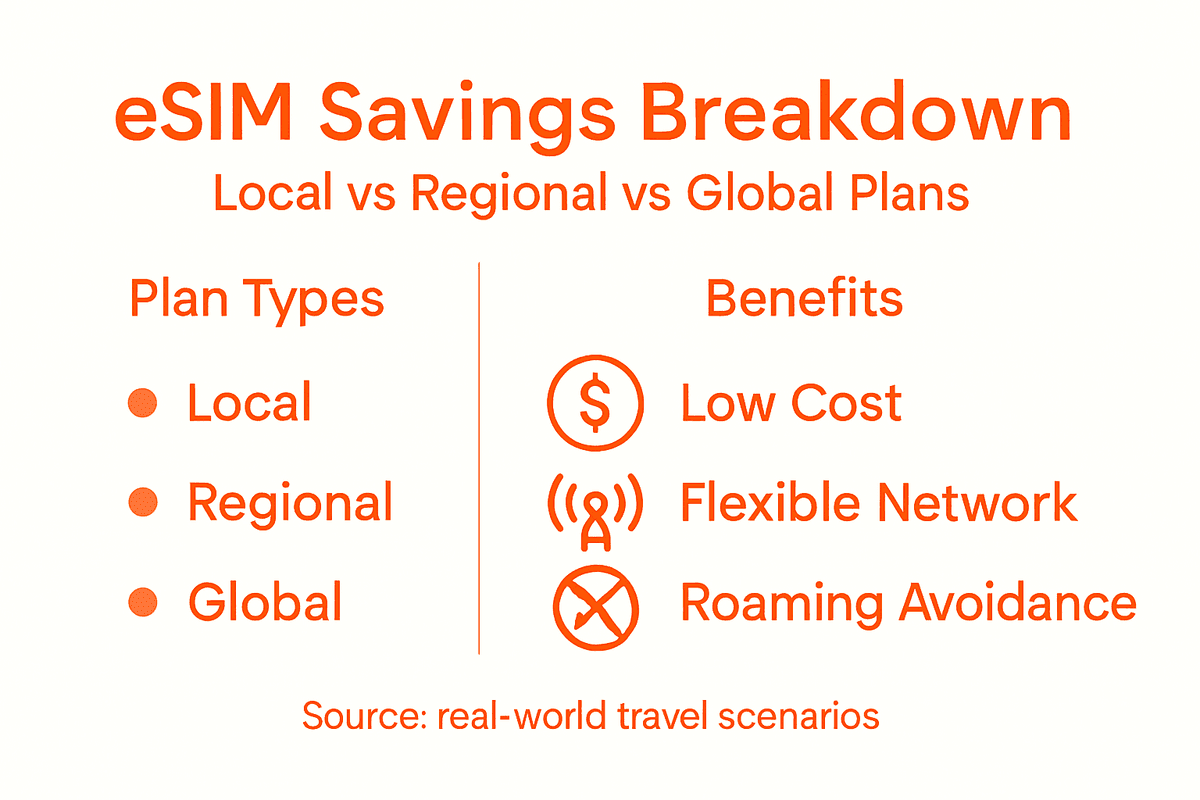
Here’s a quick comparison of Local, Regional, and Global eSIM plans to help you decide which suits your travel needs best:
| Plan Type | Ideal For | Cost Efficiency | Network Flexibility |
|---|---|---|---|
| Local | Single-country trips | Most affordable for one area | Limited, tied to one nation |
| Regional | Several neighboring states | Moderate, covers grouped area | Good for multi-country travel |
| Global | Worldwide or nomads | Pricier but wide coverage | Maximum, covers many regions |
Switching Providers Instantly to Avoid Roaming Fees
The traditional nightmare of exorbitant roaming charges is quickly becoming obsolete, thanks to eSIM technology that enables travelers to switch providers instantaneously. Avoiding roaming charges has never been easier or more cost-effective for international travelers.
The key advantages of instant provider switching through eSIM include:
- Eliminating expensive roaming fees
- Accessing local network rates
- Purchasing data plans directly on your device
- Activating new networks within minutes
- Maintaining consistent global connectivity
Traditional mobile plans typically lock travelers into expensive international roaming packages with hefty per-minute or per-megabyte charges. With eSIM technology, you can purchase local or regional data plans digitally, connecting directly to local networks at significantly reduced rates. This approach transforms how travelers manage mobile connectivity, providing unprecedented flexibility and cost savings.
Switching providers with eSIM is as simple as selecting a new network profile on your device.
The process of switching providers is remarkably straightforward. Travelers can browse available local data plans, compare prices, and activate a new plan instantly without visiting a physical store or dealing with physical SIM cards. This digital approach not only saves money but also dramatically reduces the complexity of staying connected while traveling.
Pro tip: Always research local carrier options before traveling and pre-download alternative eSIM profiles to ensure seamless connectivity.
Real Travel Scenarios: Calculating eSIM Cost Savings
Travelers can realize substantial financial benefits by understanding how eSIM technology transforms mobile connectivity costs. Global eSIM adoption trends demonstrate significant savings across various international travel scenarios.
Let’s explore three realistic travel scenarios comparing traditional roaming versus eSIM costs:
-
European Backpacking Trip
- Traditional Roaming: $15-20 per day
- eSIM Regional Plan: $5-10 per day
- Potential Savings: Up to 50% on data expenses
-
Business Trip to Asia
- Traditional Roaming: $25-35 per day
- eSIM Global Plan: $10-15 per day
- Potential Savings: Approximately 55-60% on connectivity
-
Digital Nomad Monthly Travel
- Traditional Roaming: $300-500 monthly
- eSIM Flexible Plans: $100-250 monthly
- Potential Savings: Up to 66% on annual mobile expenses
The most significant cost reductions occur when travelers select location-specific data plans that match their exact connectivity needs. Instead of paying premium international rates, eSIM users can purchase precise data packages tailored to their specific destination and duration.
Intelligent data plan selection can reduce mobile expenses by over 50% during international travel.
Additionally, eSIM technology eliminates hidden fees like activation charges, contract minimums, and unexpected roaming surcharges. Travelers gain complete transparency and control over their mobile spending, with the ability to adjust plans in real-time based on actual data consumption.

Pro tip: Calculate your expected data needs before traveling and select a plan that closely matches your specific usage to maximize cost savings.
Common Mistakes to Avoid When Choosing eSIM Plans
Choosing the right eSIM plan requires careful consideration to prevent unexpected connectivity issues and unnecessary expenses. Common mistakes in online eSIM purchasing can significantly impact your travel communication experience.
Here are the most critical mistakes travelers must avoid:
-
Neglecting Device Compatibility
- Not checking if your device supports eSIM technology
- Assuming all smartphones have eSIM capabilities
- Failing to verify specific carrier network requirements
-
Overlooking Geographic Coverage
- Purchasing plans without confirming exact country coverage
- Assuming global plans work identically everywhere
- Ignoring regional network performance variations
-
Misunderstanding Data Limitations
- Selecting plans without understanding data caps
- Failing to estimate actual data consumption needs
- Not considering speed restrictions on different plans
Budget-conscious travelers must look beyond price tags and evaluate comprehensive plan characteristics. Cheap plans might seem attractive but could result in poor connectivity, unexpected charges, or insufficient data allocation during critical travel moments.
Not all eSIM plans are created equal - thorough research prevents costly mistakes.
Successful eSIM selection involves understanding your specific travel requirements, analyzing multiple plan options, and prioritizing flexibility and reliability over minimal cost savings. Comprehensive comparison of plan features, network coverage, and data allowances is essential for making an informed decision.
Pro tip: Create a detailed travel itinerary and calculate precise data requirements before selecting an eSIM plan to avoid overpaying or experiencing connectivity gaps.
The table below summarizes the most common eSIM pitfalls and their real-world consequences:
| Mistake | Impact on Travel | How to Prevent It |
|---|---|---|
| Skipping compatibility check | Device won’t activate eSIM | Verify device/carrier support |
| Ignoring coverage details | Connectivity gaps abroad | Confirm countries/networks covered |
| Underestimating data needs | Run out of mobile data | Estimate data & choose wisely |
Unlock Massive Savings and Seamless Connectivity with Lumo
Travelers face the challenge of costly roaming fees and complicated SIM swaps, as highlighted in “Cost Savings With eSIM: Why Travelers Benefit.” Key pain points include navigating multiple carrier profiles, managing connectivity across regions, and avoiding unexpected charges while on the move. The article emphasizes concepts like instant switching between providers and choosing the right eSIM plan to maximize cost efficiency and network flexibility.
Lumo answers these challenges with an all-in-one eSIM solution designed for global travelers. With instant activation across over 160 countries, the platform allows you to effortlessly switch between local carriers and avoid roaming fees. Lumo supports multiple eSIM profiles for all your devices and offers flexible data plans tailored to your travel style. Experience high-speed 5G and reliable connectivity backed by 24/7 customer support.
Discover the freedom of truly flexible mobile connectivity and take control of your international mobile expenses today.
Explore how easily you can stay connected by visiting Lumo’s official website. Get started with instant activation now and transform the way you travel.
Make your next trip simpler and more affordable with Lumo’s digital eSIM technology. Don’t wait until roaming bills surprise you. Visit Lumo to activate your global eSIM plan instantly and start saving today. Learn more about our flexible plans and how we put connectivity control back in your hands at https://lumo.to.
Frequently Asked Questions
How can eSIM technology help me save on international roaming fees?
Using eSIM technology allows travelers to switch to local or regional data plans instantly without incurring high roaming charges, providing significant cost savings.
What are the different types of eSIM plans available for travelers?
Travelers can choose from local, regional, and global eSIM plans, each designed to accommodate various connectivity needs and travel patterns, allowing for better cost management.
What are some common mistakes to avoid when choosing an eSIM plan?
Common mistakes include neglecting device compatibility, overlooking geographic coverage, and misunderstanding data limitations, which can lead to unexpected connectivity issues or expenses.
How can I calculate potential savings when using an eSIM?
To calculate potential savings, compare the daily costs of traditional roaming versus eSIM plans based on your travel habits and data needs, identifying the most cost-effective options for your trips.
Recommended
Related Topics
Stay Connected Anywhere
Prepaid eSIM data plans for 180+ countries and territories. No physical SIM required.