Why switch carriers abroad for cheaper, reliable data

Have you ever returned from a trip to discover a mobile bill exceeding $200 just for checking maps and emails? Roaming charges reach $12 daily or $2.99 per megabyte, turning a simple week abroad into a financial headache. Frequent travelers and digital nomads face this costly reality every time they cross borders. Switching carriers abroad using eSIMs, local SIM cards, or global plans slashes these expenses by up to 90% while delivering faster speeds and better coverage. This guide reveals exactly how to choose and activate the right mobile solution for your travel style, keeping you connected without the shock bills.
Table of Contents
- Key takeaways
- Why roaming charges make switching essential for travelers
- How switching carriers abroad works: eSIMs, local SIMs, and global plans explained
- Comparing cost and performance: choosing the right carrier option abroad
- Advanced tips for seamless mobile connectivity and avoiding roaming pitfalls abroad
- Explore Lumo’s global eSIM solutions for travelers
- FAQ
Key Takeaways
| Point | Details |
|---|---|
| Reduce roaming costs | Switch to eSIM, local SIM, or global plans to cut international roaming bills by up to 90 percent. |
| eSIM quick setup | eSIM profiles activate via QR codes in minutes with no physical SIM handling needed. |
| Local SIMs rural coverage | Buying a local SIM on arrival provides the strongest local networks, especially in rural areas. |
| Dual SIM keeps home number | A dual SIM setup lets you maintain your home number while using a travel data connection for internet access. |
Why roaming charges make switching essential for travelers
Traditional carrier roaming fees drain your budget faster than almost any other travel expense. Most major carriers charge between $10 and $12 per day for international roaming packages, which means a single week in Europe costs $84 just for basic connectivity. Without these packages, rates hit $2.99 per megabyte, turning a few video calls or social media scrolls into hundred-dollar mistakes. A typical traveler streaming music, using navigation apps, and checking email can easily burn through $100 to $150 weekly on roaming charges alone.
The math becomes even more painful for digital nomads and frequent business travelers who spend weeks or months abroad. Consider these real-world comparisons:
- Traditional roaming: $84 for seven days in Europe with 1GB daily limit
- eSIM alternative: $22 for seven days with 10GB total data
- Local SIM option: $15 for 30 days with 20GB in most countries
- Google Fi: $70 monthly base plus $10/GB with no roaming fees
Many travelers remain unaware of these rates until they receive shocking bills weeks after returning home. Carriers often bury roaming details in fine print, and automatic roaming activation catches people off guard. The financial impact extends beyond data costs too. Roaming plans typically throttle speeds after hitting daily caps, making video calls pixelated and map loading painfully slow exactly when you need reliable connectivity most.
“Avoiding excessive roaming charges ranks as the number one reason travelers switch carriers or adopt eSIM solutions when going abroad.”
The good news? You have multiple practical alternatives that deliver faster speeds, more generous data allowances, and dramatically lower costs. Understanding these options transforms international connectivity from a budget drain into an affordable, reliable travel tool. Comparing roaming fees vs eSIM solutions reveals just how much you can save with a simple carrier switch.
How switching carriers abroad works: eSIMs, local SIMs, and global plans explained
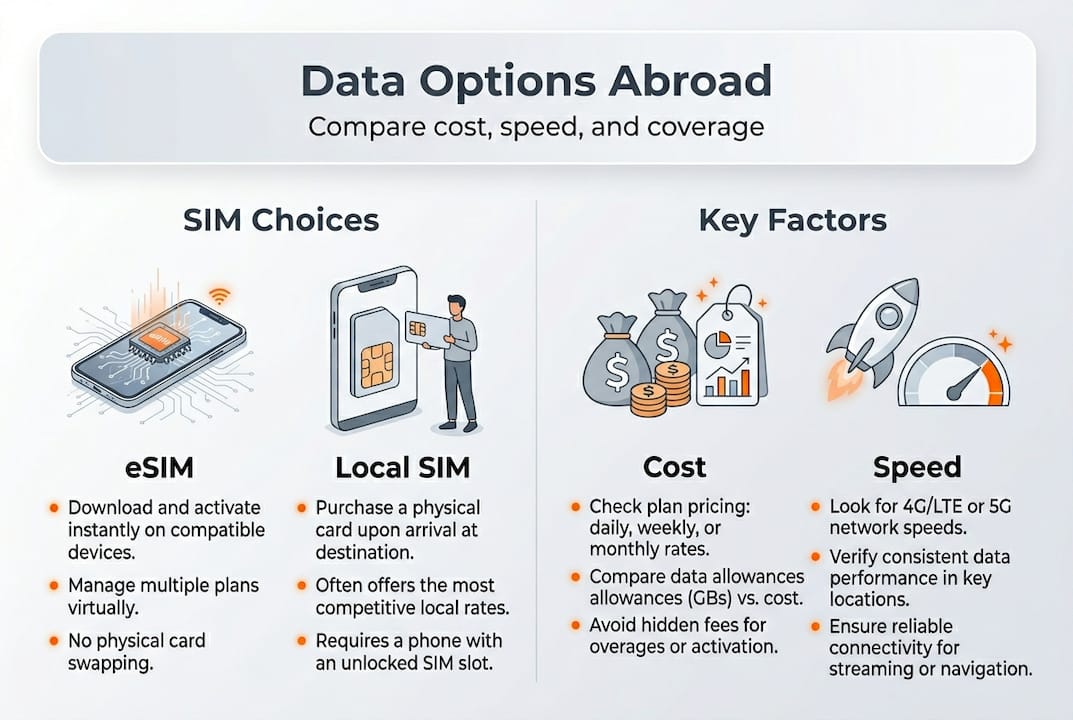
Switching carriers abroad sounds complex, but modern technology has simplified the process into three main approaches. Each method offers distinct advantages depending on your travel duration, destination, and device capabilities.
eSIM technology represents the most convenient option for compatible devices. These digital SIM profiles activate instantly through QR codes or confirmation codes, eliminating physical SIM card handling entirely. You purchase a plan online, receive activation credentials via email, and scan the QR code in your phone settings. The entire process takes five minutes, and you can store multiple eSIM profiles simultaneously, switching between them as you move across countries. Most smartphones released after 2020 support eSIM functionality, including iPhones, Samsung Galaxy devices, and Google Pixels.

Local physical SIM cards require visiting a carrier store or airport kiosk upon arrival. You’ll typically need to present your passport, purchase a prepaid plan, and swap out your existing SIM card. This approach works best for extended stays in a single country, offering the deepest local network coverage and often the cheapest per-gigabyte rates. Rural areas particularly benefit from local SIMs since they connect to native networks without roaming partnerships. The main drawback? You lose access to your home phone number unless you use a dual-SIM device.
Global carrier plans like Google Fi provide a middle ground. These services offer data in 200+ countries under a single monthly subscription, treating international usage identically to domestic connectivity. You keep your existing phone number, avoid activation hassles, and enjoy predictable billing. However, these plans cost more than regional eSIMs or local SIMs, and some impose fair-use limits for extended international stays.
Pro Tip: Dual-SIM phones let you run your home SIM for calls and two-factor authentication while using a separate eSIM or local SIM for data. This setup keeps your number active without triggering roaming charges, perfect for maintaining banking apps and receiving verification codes.
Activating any of these options requires an unlocked phone. Carrier-locked devices refuse connections to other networks, so contact your current provider to request an unlock before traveling. Most carriers comply once your contract obligations are met. For detailed activation steps, check this eSIM activation guide covering common phone models and troubleshooting tips. The instant eSIM activation process has become remarkably straightforward, making carrier switching accessible even for less tech-savvy travelers.
Comparing cost and performance: choosing the right carrier option abroad
Raw pricing tells only part of the story. Network performance, coverage quality, and usage flexibility separate mediocre connectivity from truly reliable travel data. Let’s break down how each option performs across key metrics that matter to frequent travelers.
| Option | Weekly Cost | Speed | Rural Coverage | Activation Time | Best For |
|---|---|---|---|---|---|
| Home Roaming | $70-$84 | Throttled after 1GB | Limited | Automatic | Emergency backup only |
| eSIM Plans | $18-$35 | Full 4G/5G | Good in cities | 5 minutes | Multi-country trips |
| Local SIM | $10-$25 | Full 4G/5G | Excellent everywhere | 30-60 minutes | Single-country stays |
| Google Fi | $70+ base | 300Mbps average | Very good | Instant | Frequent short trips |
Cost savings become dramatic once you travel longer than three days. eSIM and local SIM options cost 70-90% less than traditional roaming for trips exceeding 72 hours. A two-week European adventure that would cost $168 in roaming fees drops to just $35 with a regional eSIM or $20 with sequential local SIMs. Digital nomads spending months abroad save thousands annually by avoiding roaming entirely.
Speed differences matter more than many travelers realize. Google Fi consistently delivers faster connections than T-Mobile’s international roaming, averaging 300Mbps versus 50Mbps on the same networks. This performance gap affects video call quality, cloud backup speeds, and overall productivity for remote workers. eSIMs and local SIMs provide full-speed access to native networks without the throttling common in roaming agreements.
Coverage patterns reveal important distinctions:
- Local SIMs excel in rural and remote areas, connecting directly to primary towers without roaming partnerships
- eSIMs perform excellently in cities and tourist zones but may show gaps in countryside regions
- Google Fi offers consistent coverage across urban and suburban areas but relies on roaming agreements that occasionally create dead zones
- Traditional roaming provides the most unpredictable coverage, depending entirely on carrier partnerships
Pro Tip: Google Fi suspends service after 90 consecutive days abroad, making it unsuitable for true digital nomads. If you’re living overseas rather than vacationing, local SIMs or regional eSIMs provide more sustainable long-term solutions without arbitrary cutoffs.
Your ideal choice depends on travel patterns. Weekend city breaks favor eSIMs for instant activation and multi-country flexibility. Month-long stays in one location justify the effort of buying local SIMs for maximum savings and coverage. Frequent short international trips benefit from Google Fi’s seamless experience despite higher costs. Understanding these tradeoffs helps you match connectivity solutions to your specific needs, optimizing both budget and reliability. Explore more about how to avoid roaming charges and discover eSIM benefits for travelers in our detailed guides.
Advanced tips for seamless mobile connectivity and avoiding roaming pitfalls abroad
Mastering carrier switching requires understanding nuances that separate frustrated travelers from connectivity experts. These advanced strategies help you avoid common mistakes while maximizing savings and reliability.
Dual-SIM management transforms how you handle international connectivity. Modern dual-SIM phones let you designate one SIM for cellular data and another for calls and SMS. Set your home SIM to calls only while routing all data through your eSIM or local SIM. This configuration keeps your number active for banking verification codes and important calls without triggering roaming charges. Remember to disable cellular data completely on your home SIM in phone settings, not just turn off data roaming, since some apps ignore roaming settings.
Regional eSIMs solve a problem frequent border-crossers face constantly. Instead of buying separate plans for France, Germany, and Italy, regional eSIMs cover entire continents under one activation. A Europe-wide eSIM lets you cross from Portugal to Poland without touching your phone settings. These plans cost slightly more per gigabyte than single-country options but eliminate the hassle of daily SIM management for multi-country itineraries.
Critical phone settings prevent accidental charges:
- Disable data roaming on your home SIM even when using dual-SIM setups
- Turn off automatic app updates and cloud photo backups until connected to WiFi
- Enable WiFi calling on your home SIM to make free calls over data connections
- Set your eSIM or local SIM as the default data line in cellular settings
- Download offline maps before arrival to reduce data consumption
Voice and SMS cost management requires creative solutions since many eSIM plans include data only. WiFi calling through your home carrier works when you have internet connectivity, routing calls over data instead of cellular networks. Apps like WhatsApp, Telegram, and FaceTime provide free calling and messaging over your data connection. For receiving verification codes, keeping your home SIM active for SMS while blocking its data prevents expensive text message roaming fees.
Pro Tip: Purchase eSIM plans before departure while still on reliable home internet. Airport WiFi often proves too slow or unstable for smooth activation, and you’ll want connectivity immediately upon landing. Pre-activation lets you step off the plane already connected.
Data usage planning prevents mid-trip scrambles for more connectivity. Estimate your daily consumption based on typical activities. Streaming video burns through 3GB per hour, video calls use about 500MB hourly, and navigation apps consume roughly 5MB per hour. A conservative estimate for moderate use (email, messaging, maps, social media) runs about 1GB daily. Heavy users streaming content or uploading work files should budget 3-5GB daily. Most eSIM providers let you top up data mid-trip if you underestimate, though buying larger initial plans usually offers better per-gigabyte rates. Learn more about travel data management and review our global mobile data setup process for comprehensive preparation strategies. Our essential guide to avoiding roaming fees covers additional money-saving tactics.
Explore Lumo’s global eSIM solutions for travelers
Now that you understand carrier switching strategies, implementing them becomes straightforward with the right tools. Lumo provides instant eSIM activation across 160+ countries with flexible data plans designed specifically for travelers and digital nomads. Whether you’re taking a weekend city break or embarking on a multi-month adventure, Lumo’s regional and global eSIM options eliminate roaming charges while delivering reliable high-speed connectivity.
The platform simplifies everything covered in this guide. Purchase a plan, receive your QR code instantly, and activate within minutes without hunting for local SIM cards or dealing with carrier stores. Multi-country regional plans align perfectly with the border-crossing tips discussed earlier, letting you travel across entire continents without touching your phone settings. Lumo’s affordable pricing matches the cost savings highlighted in our comparisons, typically running 70-90% cheaper than traditional roaming. Explore Lumo’s instant global plans to see how easy international connectivity can be.
FAQ
How do I activate an eSIM when traveling abroad?
Activation involves scanning a QR code or entering a confirmation code after purchasing your eSIM plan online. Your phone must be unlocked to accept eSIMs from carriers other than your home provider. The process takes about five minutes in your device’s cellular settings menu. For detailed instructions covering various phone models, review this eSIM activation guide with screenshots and troubleshooting tips.
Is a local SIM better than an eSIM for long stays abroad?
Local SIMs typically offer cheaper rates and superior rural coverage for stays exceeding six weeks in one country. You’ll get the best network access and lowest per-gigabyte costs. However, eSIMs provide unmatched convenience with instant activation and no physical card handling. For stays under a month or multi-country trips, eSIMs usually make more sense. Extended single-location stays favor local SIMs despite the setup effort. Learn more about eSIM benefits for travelers to help decide.
How can dual-SIM phones help avoid roaming charges?
Dual-SIM devices let you keep your home SIM active for receiving calls and two-factor authentication texts while routing all data through a local SIM or eSIM. This setup prevents roaming charges since your home carrier only handles voice and SMS, not data. Disable cellular data completely on your home SIM in phone settings to ensure no accidental data roaming occurs. Your eSIM or local SIM handles all internet connectivity at local rates.
What happens to my home phone number when I switch carriers abroad?
Your home number remains active and can receive calls and texts if you keep that SIM card in your phone or use a dual-SIM setup. With single-SIM devices, removing your home SIM means you’ll miss calls and messages until you reinsert it. Many travelers forward their home number to a VoIP service or simply inform contacts they’ll be unreachable at that number temporarily. Dual-SIM phones solve this completely by keeping both numbers active simultaneously.
Do all smartphones support eSIM technology?
Most smartphones released after 2020 include eSIM capability, including iPhone XS and newer, Samsung Galaxy S20 and newer, and Google Pixel 3 and newer models. Check your phone’s specifications or look for an eSIM option in cellular settings to confirm compatibility. Older devices require physical SIM cards, but you can still switch to local carriers by purchasing SIM cards at your destination. eSIM adoption continues expanding, making this the future of international connectivity.
Recommended
- How to Avoid Roaming Fees and Stay Connected Abroad | Lumo eSIM Store
- Affordable Travel Data Plans: Smart Global Connectivity | Lumo eSIM Store
- What is data roaming in 2026: avoid $6,000 bills abroad | Lumo eSIM Store
- International Data Plan Checklist 2026: Save 40% on Travel | Lumo eSIM Store
- CryptoeSIM.io — Buy eSIMs with Crypto | 190+ Countries
Related Topics
Stay Connected Anywhere
Get instant eSIM data plans for 160+ countries. No physical SIM required.