What is data roaming in 2026: avoid $6,000 bills abroad

One traveler discovered the hard way what unmanaged data roaming can cost: over $6,000 in a single day from background apps silently consuming international data. Data roaming remains one of the most misunderstood aspects of mobile connectivity, yet it’s essential for anyone traveling abroad. This guide cuts through the confusion by explaining exactly what data roaming is, how it works, and proven strategies to manage costs while staying connected across borders.
Table of Contents
- Introduction To Data Roaming
- How Data Roaming Works Technically
- Domestic Vs International Roaming: Key Differences
- Cost Structures And Carrier Plans For Data Roaming In 2026
- Regional Policies Impacting Roaming Costs: The Eu Example
- Common Misconceptions And Risks Of Data Roaming
- Alternatives To Traditional Roaming: Esim And Local Sims
- Practical Tips For Managing Data Roaming And Avoiding Charges
- Explore Smart Global Connectivity With Lumo Esim
- Frequently Asked Questions About Data Roaming
Key takeaways
| Point | Details |
|---|---|
| Data roaming enables global mobile data | Your device automatically connects to foreign networks when traveling, allowing you to use data abroad through your home carrier. |
| International roaming costs significantly more | While domestic roaming is typically free, international roaming can cost $2 to $3 per MB without special plans. |
| EU eliminated roaming charges for members | Since 2017, EU travelers enjoy free roaming within member states, though the UK and other countries don’t participate. |
| eSIMs offer cheaper alternatives | Modern eSIM technology and local SIM cards provide cost-effective solutions that often reduce roaming expenses by 70 to 90 percent. |
| Smart settings prevent surprise bills | Configuring device settings, monitoring usage, and choosing appropriate plans help avoid unexpected charges. |
Introduction to data roaming
Data roaming occurs when your mobile device uses cellular data outside your home carrier’s network coverage area. Data roaming is the process where your SIM card searches for allowed partner networks abroad and authenticates your device to establish connectivity. This technology matters enormously for international travelers and remote workers who need reliable connectivity across borders.
Typical roaming scenarios include business trips to foreign countries, vacation travel through multiple destinations, or remote work assignments abroad. Each time you cross into a new country, your device automatically scans for available networks and connects through roaming agreements your carrier maintains with foreign providers.
The cost implications of roaming data usage vary dramatically based on your carrier, destination, and whether you’ve activated a special travel plan. Understanding these basics before departure helps you avoid financial surprises and maintain connectivity when you need it most. Learning about international roaming explained provides additional context for managing global connectivity.
Common roaming situations that catch travelers off guard include:
- Checking emails or social media immediately after landing
- Using navigation apps while driving in unfamiliar cities
- Streaming music or video content during international flights with connectivity
- Automatic app updates and cloud backups running in the background
For more detailed explanations of data roaming meaning wikiHow offers accessible guides that complement this overview.
How data roaming works technically
The technical process behind data roaming happens automatically but understanding it helps you troubleshoot connectivity issues during travel. When you arrive in a foreign country, your device initiates a sophisticated handshake process that establishes data connectivity within seconds.
Here’s the step by step process:
- Your SIM card continuously scans for available cellular networks in range
- The device identifies networks your home carrier has roaming agreements with
- Your SIM sends authentication credentials to the foreign network
- The foreign carrier verifies your credentials with your home carrier
- Mobile devices automatically scan for local networks and connect within seconds of arrival abroad via SIM authentication
- Once authenticated, data flows through the foreign network back to your home carrier
Network handoff occurs seamlessly when crossing borders. Your phone constantly monitors signal strength and available networks, automatically switching to the strongest authorized signal. This process happens without user intervention, which explains why many travelers don’t realize they’ve activated roaming until they receive their bill.
Roaming agreements between carriers form the backbone of this system. Your home carrier negotiates wholesale rates with foreign operators, then adds markup when billing you. These partnerships determine which networks your device can access and at what cost. Understanding eSIM terminology helps clarify how modern connectivity options differ from traditional roaming.
Pro Tip: If your device struggles to connect abroad, manually selecting a different authorized network in your phone settings often resolves the issue faster than waiting for automatic connection.
For deeper technical details, this technical data roaming explanation covers network authentication protocols and carrier relationships.
Domestic vs international roaming: key differences
Many travelers confuse domestic and international roaming, leading to costly misunderstandings about when charges apply. Domestic roaming usually free and within home country; international roaming occurs abroad and usually incurs fees marks the fundamental distinction between these two types of connectivity.

Domestic roaming happens when you travel within your home country but outside your carrier’s owned network coverage. For example, a T-Mobile customer using AT&T towers in a rural area engages in domestic roaming. Most modern plans include unlimited domestic roaming at no additional cost because carriers maintain reciprocal agreements within the same country.
International roaming crosses national borders and almost always triggers additional fees. Your carrier must pay foreign operators for network access, and these costs get passed to you with substantial markup. A data session that costs pennies domestically might run several dollars per megabyte internationally.
| Roaming Type | Coverage Area | Typical Cost | Network Access | Billing |
|---|---|---|---|---|
| Domestic | Within home country | Usually free | Partner carriers in same country | Included in plan |
| International | Foreign countries | $2 to $3+ per MB | Foreign carrier networks | Extra charges |
| EU Roaming | EU member states | Free for EU residents | Any EU network | Included in plan |
| Premium International | Select countries | $5 to $10 per day | High-speed priority access | Daily pass fee |
International roaming costs more because foreign carriers charge higher wholesale rates, currency exchange adds complexity, and limited competition reduces pricing pressure. Your home carrier also adds profit margin on top of wholesale costs.
Common traveler misunderstandings about roaming include:
- Believing airplane mode prevents all roaming charges
- Thinking roaming only applies to phone calls, not data
- Assuming all countries have the same roaming rates
- Expecting domestic plan features to work identically abroad
Avoiding these international roaming mistakes requires understanding how your specific plan handles cross-border connectivity. Always check roaming differences wikiHow before international travel to clarify your carrier’s policies.
Cost structures and carrier plans for data roaming in 2026
Roaming costs in 2026 vary dramatically depending on your carrier, destination, and whether you’ve purchased a travel pass. Pay-per-use roaming typically charges $2 to $3 or more per MB abroad outside special plans, making even moderate data usage expensive without preparation.
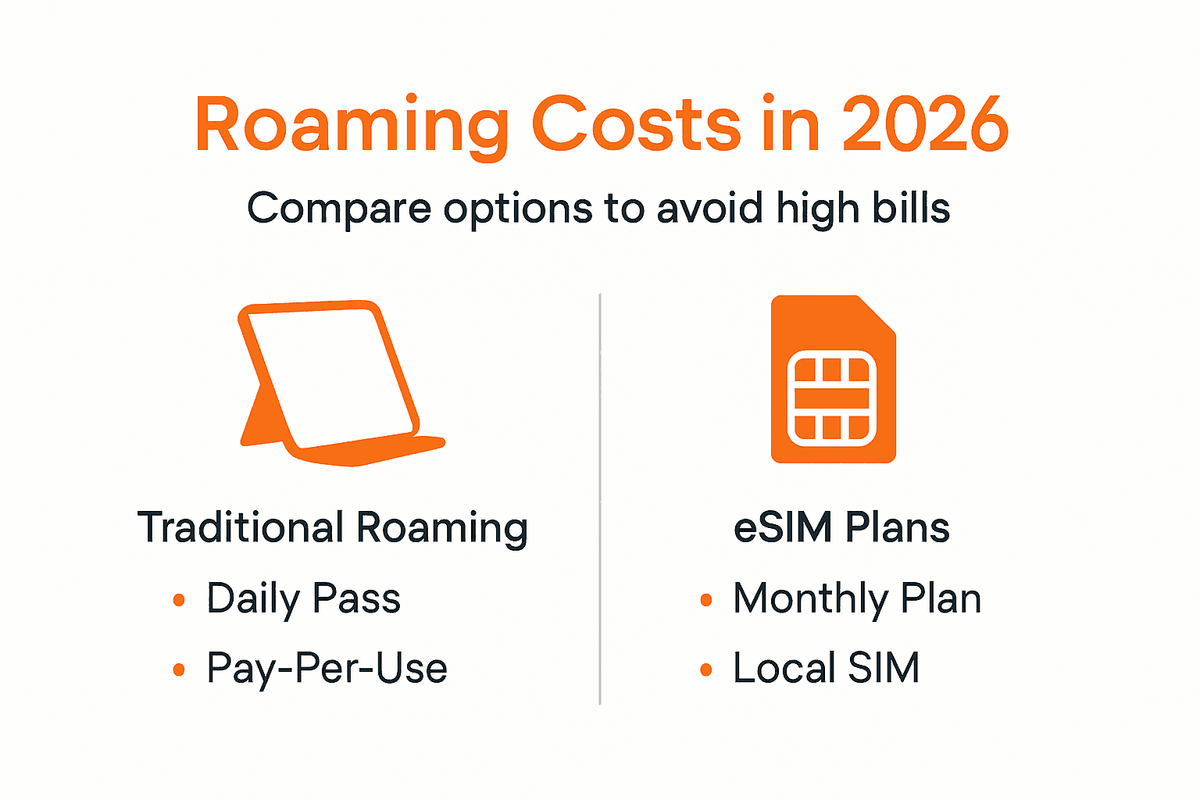
Major US carriers offer several roaming options. Verizon’s TravelPass charges $12 per day in most countries, allowing you to use your domestic plan abroad. AT&T International Day Pass runs $10 daily for similar functionality. T-Mobile includes unlimited international data in many plans but throttles speeds to 2G unless you purchase high-speed passes.
Monthly international plans provide better value for frequent travelers. These packages typically cost $30 to $100 monthly and include set data allowances across multiple countries. Daily passes work better for short trips, while monthly plans suit digital nomads and business travelers.
Per megabyte pricing without any plan can reach extreme levels. Some carriers charge $15 per MB in certain destinations, meaning a single hour of video streaming could cost thousands. Always activate a travel option before departure.
| Region | Pay-Per-Use Rate | Daily Pass | Monthly Plan | eSIM Alternative |
|---|---|---|---|---|
| Europe | $2.50 per MB | $10 per day | $70 per month | $15 for 5GB |
| Asia | $3 per MB | $12 per day | $85 per month | $20 for 5GB |
| Latin America | $2 per MB | $10 per day | $65 per month | $12 for 3GB |
| Middle East | $3.50 per MB | $15 per day | $95 per month | $25 for 5GB |
Pro Tip: Calculate your expected data usage before choosing a plan. If you’ll use less than 1GB over a week, daily passes often cost more than prepaid eSIM alternatives.
Comparing roaming fees vs eSIM options reveals significant potential savings. This roaming cost guide from T-Mobile explains how major carrier plans structure their international offerings.
Regional policies impacting roaming costs: the EU example
Regional policies dramatically reshape roaming economics in certain parts of the world. The EU roaming free policy since 2017 removed charges for data roaming within member states, creating a unified connectivity zone across 27 countries that benefits millions of travelers annually.
This policy means EU residents can use their domestic mobile plans in any member country without additional charges. A Spanish traveler in Germany pays the same rates as they would in Madrid. The regulation applies to calls, texts, and data, eliminating the previous patchwork of expensive roaming fees that plagued European travel.
Important limitations affect this policy. The UK exited the EU and no longer participates in roaming-free zones, so British travelers now face charges in Europe and vice versa. Switzerland, Norway, and Iceland negotiated separate agreements with varying terms. The policy also includes fair use provisions preventing permanent roaming abuse.
Key facts about EU roaming policy travelers should know:
- Applies only to temporary travel, not permanent relocation
- Carriers can impose data caps matching your domestic plan limits
- Some premium services may still incur charges
- Non-EU visitors don’t benefit from this policy
- Individual countries can’t opt out once policy applies
This regulatory approach shows how government intervention can reduce consumer costs and simplify international connectivity. Other regions have explored similar frameworks but none have implemented as comprehensive a solution as the EU.
Understanding which countries participate helps you plan connectivity needs accurately. The avoid roaming fees guide explains how to leverage regional policies and alternative solutions. Review the official EU roaming free policy documentation before European travel to confirm current terms.
Common misconceptions and risks of data roaming
Misconceptions about data roaming create expensive surprises for unprepared travelers. Many travelers mistakenly believe data roaming is always expensive, but regional policies or prepaid plans can make it affordable or free demonstrates how outdated assumptions lead to poor decisions.
The belief that roaming inevitably costs thousands prevents some travelers from enabling it even with appropriate plans. In reality, EU roaming is free, many carriers offer affordable daily passes, and eSIM alternatives provide budget-friendly options. The key lies in choosing the right solution for your situation, not avoiding roaming entirely.
Background app usage causes many extreme roaming bills. Apps automatically sync data, update content, and backup files without your active involvement. Email apps fetch messages, social media refreshes feeds, and cloud services upload photos. These processes continue even when your phone sits in your pocket.
“A traveler once racked up over $6,000 in a single day of roaming data charges due to unchecked background apps silently consuming international data while they slept, unaware their device was set to automatic updates and cloud backups.”
This scenario repeats frequently because travelers don’t configure data roaming settings before departure. Understanding and controlling these settings prevents financial disasters. Your device offers granular controls over which apps can use data while roaming.
Common myths corrected:
- Myth: Airplane mode eliminates all charges. Reality: It prevents roaming but you need connectivity for many travel functions.
- Myth: Roaming only affects phone calls. Reality: Data typically generates the highest charges.
- Myth: Your carrier will warn you before large bills. Reality: Warnings often arrive after significant charges accrue.
- Myth: Hotel Wi-Fi eliminates roaming needs. Reality: Wi-Fi gaps and security concerns make cellular backup essential.
- Myth: Disabling roaming means no international connectivity. Reality: eSIMs and local SIMs provide alternatives.
Learning from these avoid roaming mistakes helps you maintain connectivity without financial shock. Additional context about roaming misconceptions clarifies how modern options have transformed the roaming landscape.
Alternatives to traditional roaming: eSIM and local SIMs
Modern technology offers compelling alternatives to traditional carrier roaming. eSIM functionality allows travelers to instantly activate local or regional data plans without physical SIM cards, dramatically reducing costs while maintaining full connectivity. This digital approach has revolutionized how frequent travelers manage international data needs.
eSIMs work through embedded chips in your device that can store multiple carrier profiles simultaneously. You download a carrier profile via QR code or app, activate it when needed, and switch between profiles without swapping physical cards. Most smartphones manufactured after 2020 support eSIM technology.
Benefits include instant activation within minutes of purchase, significantly lower costs compared to traditional roaming, no need to locate physical SIM card shops, and the ability to maintain your home number while using local data. You can have multiple eSIM profiles active simultaneously, switching between them based on which offers better coverage or pricing in your current location.
| Option | Setup Time | Typical Cost | Coverage | Convenience | Best For |
|---|---|---|---|---|---|
| Traditional Roaming | Instant | $10 to $15 per day | Home carrier network | High | Short trips, business travel |
| Local Physical SIM | 30 to 60 minutes | $10 to $30 total | Local networks | Medium | Extended stays, single country |
| eSIM Regional Plan | 5 minutes | $15 to $40 for 5 to 10GB | Multiple countries | Very High | Multi-country trips |
| eSIM Global Plan | 5 minutes | $50 to $80 for 10 to 20GB | 100+ countries | Very High | Frequent travelers, digital nomads |
Local physical SIM cards still offer value in some situations. They typically provide the absolute lowest per-gigabyte costs and access to the full local network infrastructure. However, they require finding shops, dealing with language barriers, and physically swapping cards each time you change countries.
Advantages of eSIM and local SIM alternatives:
- Cost savings of 70 to 90 percent compared to traditional roaming
- Greater control over data usage and spending
- Access to local network speeds without throttling
- No surprise bills from background data consumption
- Flexibility to purchase only the data you need
Pro Tip: Use eSIMs for short multi-country trips to reduce costs and hassle while maintaining seamless connectivity across borders without hunting for physical SIM shops.
Exploring avoiding roaming fees with eSIM reveals practical implementation strategies. The eSIM benefits for travelers guide details specific advantages for different travel styles. Direct comparisons of roaming fees vs eSIM demonstrate concrete savings across various destinations.
Practical tips for managing data roaming and avoiding charges
Managing data roaming effectively requires configuring device settings correctly before departure. Your smartphone offers multiple layers of control over how and when data roaming occurs, preventing unwanted charges while maintaining essential connectivity.
Device settings start with the master data roaming toggle in your cellular settings menu. Turning this off completely prevents roaming but also eliminates international connectivity. A better approach involves enabling roaming only after activating an appropriate travel plan or eSIM. iOS and Android devices both allow you to restrict which apps can use cellular data while roaming.
Monitoring data usage becomes critical during international travel. Both operating systems include built-in data tracking that shows which apps consume the most data. Check this daily to identify unexpected usage patterns. Many carriers also offer apps that track international data consumption in real time.
Background app restrictions prevent silent data drainage. Disable automatic app updates, cloud photo backups, email push notifications, and social media auto-refresh before crossing borders. Configure apps to update only over Wi-Fi. This single step prevents most surprise roaming charges.
Prepaid travel data plans and eSIM solutions provide cost-controlled alternatives to traditional roaming. Enabling data roaming without a suitable travel plan or eSIM alternative almost always results in costly fees that can reach thousands of dollars for moderate usage. Purchase and activate these options before departure for immediate connectivity upon arrival.
Top practical management tips:
- Set data usage warnings and hard limits in your device settings
- Download offline maps for navigation before traveling
- Identify Wi-Fi locations at airports, hotels, and common destinations
- Use messaging apps like WhatsApp or Signal that work over Wi-Fi
- Keep your home carrier SIM active in dual SIM phones for important calls
- Screen record your data settings before travel to restore them easily later
Pro Tip: Always enable roaming with a cost-controlled plan or eSIM, never blindly leave default roaming on without protection, as background processes will generate charges even when you’re not actively using your phone.
Implementing these strategies from eSIM benefits for travelers maximizes connectivity while minimizing costs. Follow this comprehensive guide to avoid roaming fees for step-by-step configuration instructions. T-Mobile’s managing data roaming guide offers carrier-specific tips applicable across providers.
Explore smart global connectivity with Lumo eSIM
Now that you understand how data roaming works and the risks of traditional carrier charges, consider how modern eSIM technology transforms international connectivity. Lumo eSIM eliminates expensive roaming fees by providing instant access to local networks in over 160 countries through a single digital platform.
Activation takes minutes through a simple QR code scan, and you maintain full control over your data spending with transparent prepaid plans. Whether you’re traveling for business across multiple countries or enjoying an extended vacation, Lumo’s flexible options adapt to your specific connectivity needs without the complexity of physical SIM cards or surprise bills.
Learn more about eSIM benefits that make international travel seamless and affordable. Discover proven strategies to avoid roaming fees while maintaining reliable connectivity. Explore Lumo eSIM instant plans designed specifically for modern travelers who demand both convenience and cost control.
Frequently asked questions about data roaming
What happens if I leave data roaming on by mistake?
Leaving data roaming enabled without a travel plan or eSIM typically results in pay-per-use charges that can accumulate rapidly. Background apps will consume data automatically, potentially generating hundreds or thousands of dollars in fees before you notice. Contact your carrier immediately if this occurs to request charge review or negotiate reduced fees.
Can I use my home carrier plan for data roaming everywhere?
Your home plan’s roaming coverage varies significantly by carrier and destination. Some providers include free roaming in specific countries or regions, while others charge extra everywhere outside your home country. Always verify your specific plan’s international coverage and associated costs before traveling to avoid surprise charges.
Is eSIM compatible with all devices and countries?
Most smartphones manufactured after 2019 support eSIM technology, including recent iPhone, Samsung Galaxy, and Google Pixel models. However, older devices and some budget phones lack eSIM capability. Check your device specifications before purchasing an eSIM plan. Coverage spans over 160 countries but availability in specific destinations varies by provider.
How do I know if roaming charges apply in a specific country?
Contact your carrier directly or check their website for a country-specific roaming rate chart. Most carriers provide online tools where you enter your destination to view applicable charges. For EU residents traveling within member states, roaming is typically free. Always verify before departure rather than assuming based on geographic proximity.
Are Wi-Fi hotspots a viable alternative to roaming data?
Wi-Fi can reduce roaming data consumption but rarely eliminates the need for cellular connectivity entirely. Hotel and cafe Wi-Fi often has security vulnerabilities, speed limitations, and availability gaps. You’ll need cellular data for navigation, ride-sharing apps, emergency communication, and situations where Wi-Fi isn’t accessible. A balanced approach combining both works best for most travelers.
Recommended
- International Roaming Explained: Avoiding Costly Mistakes | Lumo eSIM Store
- Mobile Data Roaming: Costs, Risks, and Smarter Choices | Lumo eSIM Store
- 7-Step Avoid Roaming Charges Checklist for Global Travelers | Lumo eSIM Store
- International Data Plan Checklist 2026: Save 40% on Travel | Lumo eSIM Store
Related Topics
Stay Connected Anywhere
Prepaid eSIM data plans for 180+ countries and territories. No physical SIM required.