eSIM Terminology: Essential Concepts for Global Travelers

Switching from a bulky SIM card to an eSIM can feel like upgrading from paper maps to a GPS for your travels. For digital nomads and frequent flyers, the days of hunting for local SIM cards or wrestling with tiny ejector tools are over. Now, you can manage multiple data plans directly on your device, enjoy seamless carrier switches, and keep your information protected—all while keeping roaming costs under control. This guide breaks down what makes an eSIM different, highlights key terms, and helps you find the best solution for staying connected worldwide.
Table of Contents
- Defining eSIM and Related Terms
- Types of eSIM Profiles and Devices
- Activation Processes and QR Code Management
- Switching Carriers and Managing Data Plans
- Security Concerns, Costs, and Common Mistakes
Key Takeaways
| Point | Details |
|---|---|
| eSIM Technology | eSIMs enable instant activation and carrier switching without physical SIM cards, allowing for multiple profiles stored on a single device. |
| Remote Profile Management | eSIM profiles can be activated or switched remotely, simplifying connectivity while traveling and eliminating wait times for new SIM cards. |
| Device Compatibility | Not all devices support eSIM; check compatibility before purchasing a plan, especially when traveling. |
| Security Best Practices | Use secure WiFi for activation, employ strong passwords, and enable two-factor authentication to minimize risks associated with eSIM technology. |
Defining eSIM and Related Terms
An eSIM (embedded subscriber identity module) is a digital SIM card built directly into your device as software. Unlike traditional plastic SIM cards you physically insert, an eSIM sits on an eUICC chip embedded in your phone, tablet, or laptop during manufacturing.
Think of it this way: a physical SIM is like a key card you carry. An eSIM is the same key built into your device’s foundation. You still get all the same functionality—connecting to mobile networks, storing your carrier information, managing your identity on the network—but without the card.
Here’s what makes eSIMs different from traditional SIMs:
- No physical swapping required when changing carriers or plans
- Multiple profiles stored simultaneously on one device
- Instant activation via QR code or download link
- Reduced security risk since there’s nothing physical to lose or steal
- Support for hybrid setups (physical SIM plus eSIM on compatible devices)
Key Terms You’ll Encounter
Profile refers to the carrier information and plan details stored on your eSIM chip. You can have multiple profiles and switch between them instantly—one for your home country, another for work travel, a third for vacation.
Remote SIM Provisioning is the technology that lets carriers activate or switch your profile without any physical interaction. You download your carrier’s profile via internet, and within minutes you’re connected to their network.
eUICC (embedded Universal Integrated Circuit Card) is the actual chip inside your device. It’s roughly the size of a grain of rice—about 6mm × 5mm—yet stores everything a traditional SIM card does, plus the ability to hold multiple carrier profiles at once.
Understanding eSIM data plans helps you see how these technical elements connect to your actual travel needs. Different plans activate different profiles, each optimized for specific regions or usage patterns.
Multiple profiles mean zero downtime between carriers. Switch plans instantly without replacing hardware or waiting for activation.
Pro tip: When traveling internationally, download your eSIM profile before leaving home while connected to reliable WiFi. This ensures your connection activates immediately when you land, avoiding that crucial first-hour connectivity gap.
Types of eSIM Profiles and Devices
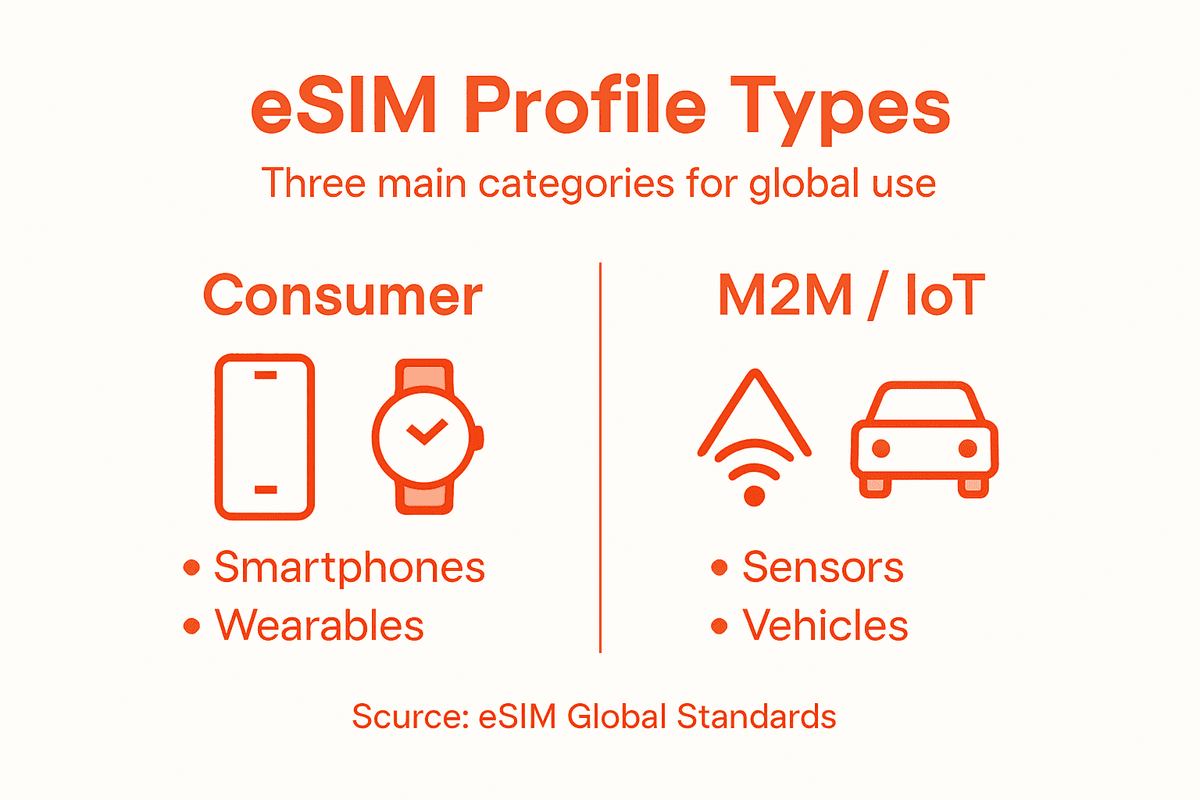
eSIM profiles come in three distinct types, each designed for different use cases and device categories. Understanding which type applies to your device helps you know what features and management options you’ll have when traveling.
Consumer eSIM Profiles
Consumer eSIM profiles power the devices you carry daily—smartphones, tablets, smartwatches, and laptops. These profiles are user-managed, meaning you control when to activate, switch, or delete them on your device.
Consumer profiles contain critical identifiers and security information:
- IMSI (International Mobile Subscriber Identity) uniquely identifies you on the carrier’s network
- ICCID (Integrated Circuit Card Identifier) acts as the profile’s unique serial number
- Network configuration data that connects you to the carrier’s infrastructure
- Operator credentials stored securely on the eUICC chip
The beauty of consumer eSIM management is that you can store multiple profiles simultaneously, but only activate one at a time. Switch between them instantly when your travel plans change or you need different coverage.
Machine-to-Machine (M2M) eSIM Profiles
M2M eSIM profiles serve autonomous devices that operate independently—connected vehicles, industrial sensors, security systems, and fleet management devices. These profiles are operator-managed, not user-controlled. The carrier handles activation and configuration remotely.
M2M profiles prioritize reliability and continuous connection over flexibility. They’re built for devices that must stay connected without human intervention, making them ideal for mission-critical applications.
IoT eSIM Profiles
IoT eSIM profiles target low-throughput devices with limited processing power—environmental sensors, smart meters, tracking devices, and wearables with minimal data needs. IoT eSIM architectures are optimized for minimal battery drain and reduced data consumption.
These profiles work with devices that transmit small bursts of data periodically, not constant streams.
Here’s a quick comparison of eSIM profile types and their core functions:
| Profile Type | Managed By | Main Use Cases | User Control Level |
|---|---|---|---|
| Consumer eSIM | Device owner | Phones, tablets, laptops | Full control; flexible |
| M2M eSIM | Network operator | Autonomous vehicles, sensors | Limited; remote managed |
| IoT eSIM | Device owner/operator | Wearables, smart meters, trackers | Minimal; basic management |
Device Compatibility Overview
Not every device supports eSIM yet, but adoption is accelerating. Current device categories include:
- Flagship smartphones (iPhone 14+, Samsung Galaxy S24+, Google Pixel 9+)
- Premium tablets and iPad models
- Modern smartwatches and fitness trackers
- Certain laptops and portable routers
- Industrial and IoT devices
The key advantage across all devices: eliminating the physical SIM tray means more internal space for battery, better waterproofing, and more flexible device design.
Your device can hold multiple profiles but activate only one carrier at a time. This separation ensures security while enabling instant carrier switching.
Pro tip: Before traveling, check your device’s eSIM compatibility on your carrier’s website and verify that your target destination has network coverage with your chosen eSIM provider.
Activation Processes and QR Code Management
Activating an eSIM is faster than waiting for a physical SIM card to arrive in the mail. Most activation happens through a simple QR code scan or direct download link, taking just minutes from start to network connection.

How QR Code Activation Works
QR code activation is the quickest way to get connected. Your eSIM provider generates a unique QR code linked to your profile. You open your device’s eSIM settings, select “Add Cellular Plan,” and scan the code with your camera.
Here’s what happens behind the scenes:
- Your device reads the QR code and extracts an activation link
- The link connects securely to the carrier’s provisioning server
- Your device downloads and installs your carrier profile automatically
- Your device receives your IMSI, ICCID, and security credentials
- You’re connected to the network within seconds
Role of QR codes in eSIM activation simplifies what would otherwise be a complex technical process into a single camera tap.
Alternative Activation Methods
Not every situation calls for a QR code. Some providers use direct download links sent via email or SMS. You tap the link on your phone, and the profile downloads automatically without needing to scan anything.
Manual entry is another option, though less common. You enter activation codes or server addresses directly into your device settings if you don’t have access to a QR code.
One-Time Activation Codes
Activation codes support bulk deployment of eSIM profiles, especially useful for business teams or remote workers managing multiple devices. Each code works only once, ensuring security.
These codes typically arrive via email or through your provider’s app. They expire after a certain period, so activate your eSIM soon after receiving the code.
Managing Your Profiles After Activation
Once activated, your profile lives on your device’s eUICC chip. You can switch between multiple profiles instantly without reactivating—just select a different profile in your settings and you’re connected to that carrier.
Key management features include:
- Switch profiles instantly without downloading anything new
- Delete profiles you no longer need to free up chip space
- Rename profiles for easy identification (“Work Travel” vs. “Home”)
- Lock profiles to prevent accidental deletion
QR codes transfer your entire carrier profile in seconds. One scan replaces the week-long wait for physical SIM delivery.
Pro tip: Take a screenshot of your QR code before traveling, in case you need to re-activate but lack stable internet connectivity to scan a new code on arrival.
Switching Carriers and Managing Data Plans
Switching carriers with eSIM takes seconds. No more hunting for a SIM card slot, no waiting for a physical card to arrive, no fumbling with tiny ejector pins. Just tap your phone’s settings and you’re connected to a new network.
The Instant Carrier Switch
Switching carriers is the killer feature of eSIM for travelers. You had a different plan in Thailand? Switch to a new carrier for Vietnam instantly. Your work plan isn’t getting signal? Activate your backup plan in seconds.
Here’s the workflow:
- Open Cellular Settings on your device
- Select the carrier profile you want to activate
- Confirm the switch
- You’re connected within 10-30 seconds
Dual SIM functionality with eSIMs lets you keep multiple active plans and designate which one handles calls versus data. You don’t have to switch at all if your device supports dual eSIM profiles.
Managing Multiple Data Plans
Data plans sit on your eSIM profiles like different apps on your home screen. Each plan contains its own pricing, data limits, coverage area, and speed tier. You activate whichever one matches your current location and needs.
When managing multiple plans, track these details:
- Data allowance remaining on each plan
- Expiration dates so plans don’t lapse unexpectedly
- Coverage maps to ensure each plan covers your destination
- Rollover policies to understand if unused data carries over
Pricing Models You’ll Encounter
Pay-as-you-go charges only for data you consume. Perfect for occasional travelers or unpredictable usage patterns. You pay slightly higher per-gigabyte rates but avoid overpaying for unused data.
Monthly plans bundle fixed data amounts into recurring billing cycles. Best for digital nomads staying in one region for weeks. You know exactly what you’ll spend each month.
Tourist packages provide high data allowances for short periods. Ideal for 1-2 week trips where you need everything upfront without surprises.
To clarify eSIM data plan options, here’s a summary of typical pricing models:
| Plan Type | Ideal For | Commitment Level | Data Coverage Duration |
|---|---|---|---|
| Pay-as-you-go | Occasional travelers | No contract | Flexible, short term |
| Monthly | Long-term users | Recurring subscription | 1 month per cycle |
| Tourist | Vacation, business trips | Upfront, one-time | 1-3 weeks, expiration |
Avoiding Overage Charges
eSIM providers handle overages differently. Some throttle your speed to 2G once you exceed your limit. Others charge per-megabyte overage fees. A few let you purchase additional data blocks on demand.
Check your plan’s overage policy before traveling. Most reputable providers either throttle or let you top up data rather than surprise billing.
Multiple profiles mean zero switching costs or downtime between carriers. Your device handles carrier swaps faster than you can unlock your screen.
Pro tip: Purchase data plans with slightly more than you think you’ll need, then disable cellular data on background apps to avoid unexpected usage spikes during travel.
Security Concerns, Costs, and Common Mistakes
eSIM technology is secure, but like any connected service, it comes with real risks worth understanding. Most issues stem from user mistakes rather than technical failures, and the good news is that they’re all preventable.
Real Security Threats
Profile hijacking happens when unauthorized parties gain access to your eSIM profile and lock you out of your device. This is rare but serious. An attacker would need your phone number, activation codes, and access to your carrier account—multiple layers of security they’d have to breach simultaneously.
Remote provisioning risks exist because carriers download your profile over the internet. eSIM ecosystem security risks include unauthorized profile downloads if someone intercepts your activation link. This is why using secure WiFi matters when activating eSIMs.
Data routing concerns mean your data might travel through servers in countries you didn’t choose. Your carrier decides the routing path, which can create jurisdictional exposure depending on your privacy needs.
Protect yourself by:
- Using trusted WiFi networks for eSIM activation
- Keeping your carrier account password strong and unique
- Enabling two-factor authentication on your carrier portal
- Checking your carrier’s privacy policy before activating
Cost Pitfalls Travelers Face
Hidden markup charges happen when resellers add their own fees on top of carrier rates. The eSIM itself costs nothing, but some providers charge $5-15 activation fees or platform markups you don’t see until checkout.
Overage shock comes from exceeding your data limit and paying per-megabyte rates that dwarf your original plan cost. A 1GB overage at $10 per gigabyte adds up fast. Always buy more data than you think you’ll need.
Plan expiration is the silent budget killer. A $30 plan unused expires worthless. Purchase plans only when you’re certain you’ll use them within the validity window.
Mistakes That Cost Time and Money
Activating before arrival disconnects you from home networks, leaving you without data until your new carrier activates. Activate only when you’re ready to switch.
Forgetting to turn off cellular data on background apps drains your data allowance in hours. Disable cellular on every non-essential app before traveling.
Mixing up profiles causes you to activate the wrong plan for your destination. Label your profiles with the country or region they serve.
Deleting profiles accidentally permanently removes them. Some carriers charge fees to re-provision deleted profiles, so handle profile management carefully.
Unauthorized access requires breaching multiple security layers simultaneously. Strong account passwords and secure activation networks make hijacking economically impractical for attackers.
Pro tip: Before traveling, download your carrier account app and test two-factor authentication login from your destination’s timezone to ensure you can regain access if needed.
Unlock Seamless Global Connectivity with Lumo
Understanding complex eSIM terminology like profiles, remote provisioning, and QR code activation is crucial for travelers who want hassle-free mobile data worldwide. If switching carriers instantly or managing multiple eSIM profiles sounds overwhelming, Lumo simplifies these challenges with a single platform designed just for you. Whether you are a frequent flyer, remote worker, or digital nomad, you can enjoy flexible plans and instant activation in over 160 countries.
Experience the freedom of switching carriers without physical SIM cards or long wait times. With Lumo’s easy eSIM management tools, fast 5G/4G connectivity, and 24/7 support, your device’s multiple profiles are just a tap away from activation. Don’t wait until you land to connect. Activate your ideal travel data plan now at Lumo and stay confidently online wherever your journey takes you.
Frequently Asked Questions
What is an eSIM and how does it differ from a traditional SIM card?
An eSIM is an embedded subscriber identity module that is built directly into your device as software, unlike a traditional SIM card that you physically insert. It allows for multiple profiles and instant activation without the need for physical swapping.
How do I activate my eSIM?
You can activate an eSIM by scanning a QR code provided by your carrier or through a direct download link sent via email or SMS. The process is quick and usually takes just a few minutes to connect.
What are the types of eSIM profiles available?
There are three main types of eSIM profiles: Consumer eSIM profiles, which are user-managed for devices like smartphones; M2M eSIM profiles, which are operator-managed for autonomous devices; and IoT eSIM profiles, designed for low-throughput devices with limited processing power.
Can I switch between different carriers with an eSIM?
Yes, switching carriers with an eSIM is easy and takes seconds. You can open your device’s settings, select the carrier profile you want to activate, and confirm the switch, allowing for instant connectivity without needing a new physical SIM card.
Recommended
- Role of eSIM in Telecommunication – Transforming Global Connectivity | Lumo eSIM Store
- Role of eSIM in Connectivity – Why It Matters Now | Lumo eSIM Store
- eSIM Benefits for Travelers: Seamless Global Connectivity | Lumo eSIM Store
- How eSIM Transforms International Travel for Professionals | Lumo eSIM Store
Related Topics
Stay Connected Anywhere
Prepaid eSIM data plans for 180+ countries and territories. No physical SIM required.