Future of Business Travel Connectivity in 2026

TL;DR:
- Business travel connectivity will be revolutionized by the combination of LEO satellite internet, eSIM technology, and AI-driven management platforms. Reliable internet access has become essential for productivity and competitive advantage during international trips. These innovations enable seamless in-flight connectivity, cost-effective global data plans, and automated trip management, transforming how business travelers stay connected and efficient worldwide.
The future of business travel connectivity is defined by three converging technologies: Low Earth Orbit (LEO) satellite internet, embedded SIM (eSIM) technology, and AI-driven travel management platforms. 79% of business travelers now rate reliable internet on par with safety and punctuality. That single statistic reframes connectivity from a perk into a mission-critical utility. This guide breaks down exactly what is changing, why it matters, and how you can use these advances to stay productive on every international trip.
How does LEO satellite internet change in-flight connectivity?
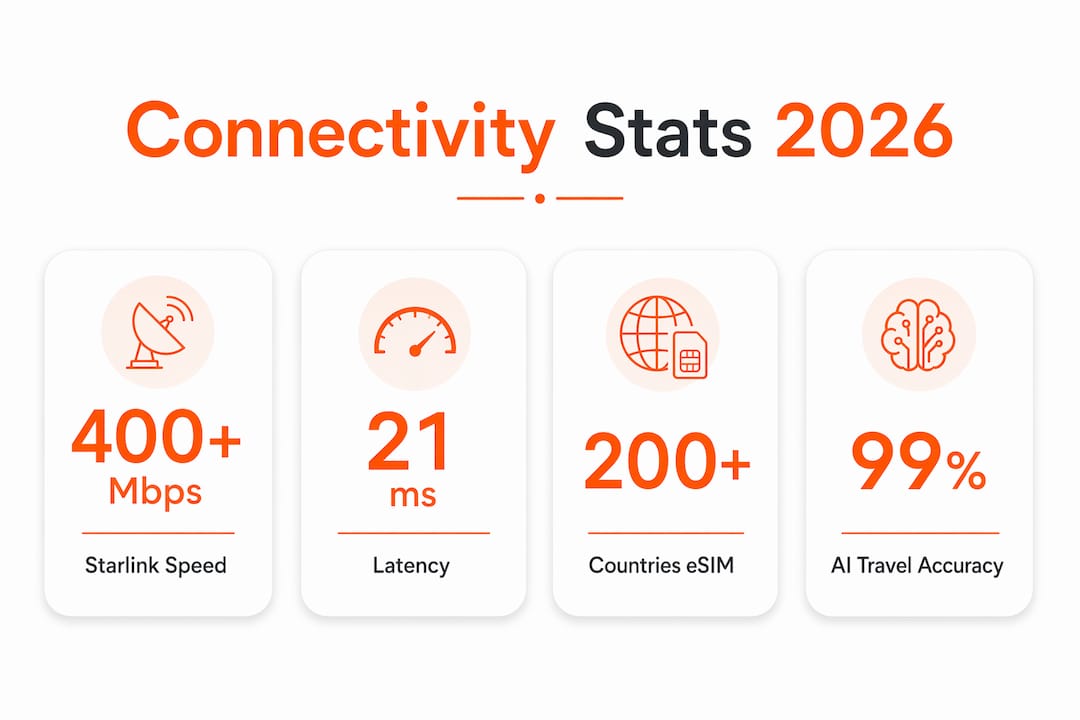
Low Earth Orbit satellite internet is the single biggest upgrade to in-flight connectivity in two decades. Starlink delivers over 400 Mbps download speeds with latency as low as 21 ms. Legacy geostationary (GEO) satellites, by contrast, deliver speeds in the low single-digit Mbps range with latency exceeding 500 ms. That gap is the difference between a live video call that works and one that freezes every 30 seconds.
Airlines are responding fast. United Airlines now offers free Starlink Wi-Fi on more than 25% of its daily flights as of mid-2026. In-flight connectivity has shifted from a paid add-on to a loyalty and retention tool targeting premium business travelers. Carriers that do not offer free, high-speed access are already losing ground in corporate travel programs.
The hardware side is evolving just as fast. Airbus’s HBCplus modular system lets airlines swap satellite network providers without replacing the entire antenna assembly. It supports LEO, Medium Earth Orbit (MEO), and GEO constellations simultaneously. That flexibility means airlines can upgrade their connectivity provider as better options emerge, without grounding aircraft for expensive retrofits.
| Technology | Speed | Latency | Best Use Case |
|---|---|---|---|
| GEO Satellite | Low single-digit Mbps | 500+ ms | Basic email |
| LEO Satellite (Starlink) | 400+ Mbps | ~21 ms | Video calls, cloud work |
| Modular (HBCplus) | Varies by provider | Varies | Multi-orbit flexibility |
Pro Tip: When booking flights for critical business trips, check whether the aircraft type on your route uses a LEO-capable system. United, Delta, and Qatar Airways have all announced or deployed Starlink or equivalent LEO partnerships.
What makes eSIM technology essential for global business travel?
eSIM technology is the most practical upgrade a business traveler can make right now. An eSIM is a digital SIM card embedded in your device that lets you activate a local or regional data plan without touching a physical card. eSIMs cover 200+ countries and can be managed entirely through an app or QR code scan. That means you can set up data for your next destination before you board the plane.

The financial case is straightforward. Traditional carrier roaming rates in markets like Japan, Brazil, or the UAE can run $10–$20 per day or more. A regional eSIM plan for the same destinations typically costs a fraction of that. For a road warrior doing 15 international trips a year, the savings are substantial.
The practical benefits go beyond cost:
- Instant activation: Scan a QR code and you are live in minutes, no airport SIM vendor required.
- Multiple profiles: Store plans for different regions on one device and switch between them digitally.
- Always-on backup: Automatic failover data activates across 70+ destinations when your primary connection drops, with no extra cost.
- Device flexibility: eSIMs work across smartphones, tablets, and laptops that support the standard.
The role of eSIMs in business travel extends beyond convenience. When a flight gets rerouted or a layover extends unexpectedly, an eSIM with automatic failover keeps you connected without any manual intervention. That is the definition of a connectivity safety net.
Pro Tip: Load your eSIM profile for your destination at least 24 hours before departure. Some plans require a brief activation window, and you do not want to troubleshoot at the gate.
How does AI unify business travel management and connectivity?
Agentic AI is the term the corporate travel industry uses for platforms that do not just assist but act. Sabre’s partnership with BizTrip AI is the clearest current example. These platforms autonomously handle rebooking, expense reconciliation, and policy compliance using your company’s travel rules and your personal preferences. You do not file an expense report. The system does it.
The practical impact on connectivity is direct. AI-driven predictive intervention identifies travel disruptions before they affect you and reroutes or rebooking proactively. If your flight is delayed and your hotel check-in window closes, the platform handles the call. That frees you to stay on a client call instead of managing logistics.
Integration with tools like Microsoft Teams and Outlook is what makes these platforms genuinely useful. Your travel itinerary, expense approvals, and communication threads live in the same environment where you already work. Switching between five separate apps to manage a trip is a problem agentic AI eliminates entirely.
Key capabilities of AI travel platforms in 2026:
- Policy enforcement: Flags out-of-policy bookings before they are confirmed.
- Disruption response: Automatically rebooking on delays or cancellations.
- Expense automation: Captures receipts and reconciles spend in real time.
- Unified communication: Integrates with Microsoft Teams, Slack, and Outlook.
Pro Tip: Before your next international trip, ask your corporate travel manager whether your company’s travel management system supports agentic AI features. If it does not, platforms like BizTrip AI or Spotnana offer integrations that work alongside existing booking tools.
Connectivity solutions compared: which technology fits your trip?
Not every trip needs every technology. The right combination depends on your route, device, and how much your work depends on real-time communication.
| Solution | Speed | Cost | Best For |
|---|---|---|---|
| GEO in-flight Wi-Fi | Low | Often paid | Casual email |
| LEO in-flight Wi-Fi (Starlink) | Very high | Free on select airlines | Video calls, live collaboration |
| Physical SIM (local) | High | Variable, often high | Single-country trips |
| eSIM (regional/global plan) | High | Predictable, lower cost | Multi-country itineraries |
| AI travel platform | N/A | Subscription or corporate | Full trip management |
The practical takeaway: LEO satellite Wi-Fi handles your in-flight hours, an eSIM handles ground connectivity across borders, and an AI platform handles the logistics that used to eat your time. These three layers work together, not in competition.
Practical tips for staying connected on every business trip
Reliable connectivity does not happen by accident. These steps make it consistent:
- Verify in-flight connectivity before booking. Check the aircraft type and whether the airline uses a LEO-capable system on your specific route.
- Activate your eSIM before departure. Load regional or global plans in advance and confirm the failover feature is enabled.
- Audit your travel tech stack. If you are using separate apps for booking, expenses, and communication, consolidate into a platform that integrates all three.
- Prioritize “Always On” providers. Choose eSIM providers that offer automatic failover coverage across 70+ destinations to prevent gaps during reroutes or layovers.
- Review mobile security practices. Public airport and hotel Wi-Fi remain high-risk environments. A 2026 enterprise mobile security review from SmishAlert outlines current threat vectors worth knowing before you travel.
Pro Tip: Carry a portable Wi-Fi hotspot as a tertiary backup on trips to markets with less mature eSIM infrastructure, such as parts of sub-Saharan Africa or Central Asia.
Key takeaways
The future of business travel connectivity depends on combining LEO satellite internet, eSIM technology, and AI-driven platforms into a single, reliable system that requires minimal manual management.
| Point | Details |
|---|---|
| LEO satellites set the new standard | Starlink delivers 400+ Mbps with 21 ms latency, making real-time work viable at 35,000 feet. |
| eSIMs eliminate roaming friction | Digital activation across 200+ countries removes the cost and delay of physical SIM management. |
| AI platforms reduce manual effort | Agentic tools like BizTrip AI automate rebooking, expenses, and policy compliance autonomously. |
| Modular aircraft hardware enables upgrades | Airbus HBCplus lets airlines swap satellite providers without costly full-system replacements. |
| Layered connectivity is the right strategy | Combining in-flight LEO Wi-Fi, eSIM ground data, and AI management covers every scenario. |
Why connectivity is now the real measure of a good trip
I have spent years watching business travelers treat connectivity as an afterthought, something to sort out at the hotel front desk or the airport SIM kiosk. That approach is expensive, stressful, and increasingly unnecessary.
The shift I find most significant is not the technology itself. It is the mindset change. Connectivity used to be a luxury you negotiated. Now it is a baseline expectation, and the travelers who treat it that way arrive better prepared, stay more productive, and waste far less time on logistics.
What I tell colleagues who travel frequently: build your connectivity stack the same way you build your travel wardrobe. You do not figure out what to wear when you land. You plan it before you leave. An eSIM loaded with the right regional plan, a flight booked on a LEO-equipped aircraft, and an AI platform handling your itinerary is the 2026 equivalent of packing smart.
The one thing I would push back on is the assumption that these tools are only for large enterprises. A solo consultant doing six international trips a year benefits from eSIM cost savings and AI-assisted rebooking just as much as a Fortune 500 road warrior. The technology is accessible. The only barrier is awareness.
— Bogdan
Stay connected everywhere with Lumo
Corporate travelers who want reliable ground connectivity without roaming surprises should look at what Lumo offers. Lumo provides instant global eSIM plans covering 160+ countries, with QR code activation that takes under five minutes. Plans are flexible, cost predictable, and include 5G/4G speeds on supported networks.
For travelers managing multi-country itineraries, Lumo’s regional bundles cut the cost and complexity of buying local SIMs at every destination. The platform supports smartphones, tablets, and laptops, and 24/7 support is available if anything goes wrong mid-trip. Explore the full range of eSIM travel plans and activate before your next departure.
FAQ
What is the future of business travel connectivity?
The future of business travel connectivity centers on LEO satellite internet for in-flight use, eSIM technology for ground data across borders, and AI-driven platforms that unify booking, communication, and expense management into one system.
How fast is Starlink Wi-Fi on flights?
Starlink delivers over 400 Mbps download speeds with approximately 21 ms latency, which is fast enough for live video calls and cloud-based work at cruising altitude.
Is eSIM worth it for business travel?
Yes. eSIMs activate instantly, cover 200+ countries, and cost significantly less than traditional carrier roaming. They also support automatic failover data in 70+ destinations, which prevents connectivity gaps during disruptions.
What does agentic AI do in corporate travel?
Agentic AI platforms like BizTrip AI autonomously rebook flights, reconcile expenses, and enforce corporate travel policies without manual input. They integrate with tools like Microsoft Teams and Outlook to keep everything in one place.
Which airlines offer free LEO satellite Wi-Fi?
United Airlines offers free Starlink Wi-Fi on more than 25% of daily flights as of mid-2026, with other carriers including Delta and Qatar Airways expanding similar programs across their fleets.
Recommended
Related Topics
Stay Connected Anywhere
Get instant eSIM data plans for 160+ countries. No physical SIM required.