Streamlining International Business Travel in 2026

TL;DR:
- Effective corporate travel management involves streamlining trip planning, enforcing policies within booking platforms, and leveraging automation to reduce costs and time. Implementing clear policies, utilizing automation tools, and preparing travelers in advance ensure compliance, efficiency, and safety during international trips. Advanced airport biometric technologies and comprehensive duty of care programs further enhance traveler experience and safety worldwide.
Effective corporate travel management is defined as the systematic process of optimizing trip planning, policy enforcement, and technology integration to reduce cost, time, and friction for international travelers. Streamlining international business travel means moving compliance upstream, embedding spending rules and approval workflows directly into booking platforms before a single flight is purchased. Platforms like Booking.com Business and travel management companies (TMCs) now automate up to 90% of planning tasks, freeing travel teams to focus on exceptions rather than manual execution. The professionals who get this right spend less, travel smarter, and arrive ready to work.
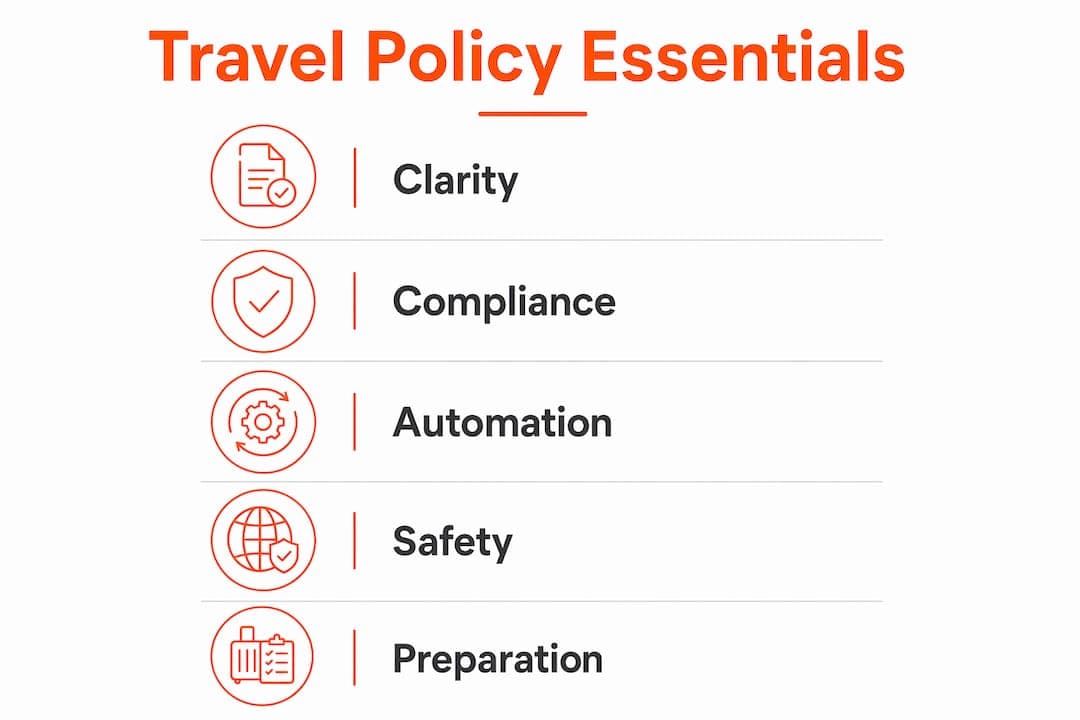
What are the essential components of an effective international business travel policy?
A travel policy is the single most powerful lever for controlling costs and protecting travelers. Without it, every booking decision defaults to individual judgment, which produces inconsistent spending and compliance gaps. With it, you create a repeatable system that scales across your entire organization.
The core components of a policy that actually works include:
- Spending limits by category: Set explicit caps for flights (economy vs. business class by route length), hotels (price per night by city tier), and meals (per diem by country).
- Booking rules and lead times: Require bookings at least 14 days in advance and mandate use of approved platforms to capture negotiated rates.
- Approval workflows: Define who approves what, at what cost threshold, and within what timeframe. Automated routing eliminates the email chain.
- Expense reconciliation: Integrated travel and expense platforms reduce reconciliation time by up to 75%, saving finance teams significant hours every month.
Policy clarity directly improves compliance. Travel policies improve compliance when designed for easy, everyday use, meaning the rules must be accessible inside the booking tool itself, not buried in a PDF on the intranet. Embedding policy enforcement into booking systems prevents out-of-policy spend before it happens rather than flagging it after the fact.
Pro Tip: Build a real-time spending dashboard that surfaces anomalies weekly. Travel managers who review live data catch budget drift early, before it compounds across a quarter.
How can automation technology transform business travel planning?

Automation is not a convenience feature. It is the mechanism that converts a reactive travel program into a proactive one. The numbers make the case clearly: travel automation reduces planning time by up to 90% and cuts travel budgets by over one-third. That means a travel coordinator who previously spent 40 hours a month on manual bookings now spends four.
Here is how a modern automated travel program operates end to end:
- Booking: The traveler selects from pre-approved options inside a managed booking tool. The system filters results by policy in real time, so non-compliant options never appear.
- Expense capture: Receipts are scanned via mobile app and matched automatically to the correct cost center. Automated expense tracking eliminates manual data entry and reduces fraud risk.
- Itinerary management: Virtual assistants monitor flight status, gate changes, and hotel confirmations, pushing alerts directly to the traveler’s phone.
- Disruption handling: When a flight cancels, the system surfaces rebooking options within policy and escalates to a human agent only when no automated solution fits.
Automation tools handle bookings and also provide virtual assistance, itinerary updates, and disruption management across every phase of the trip. The hybrid model, automation for routine tasks plus human oversight for edge cases, is the standard that high-performing corporate travel programs use in 2026.
What practical steps can business travelers take to prepare for international trips?
Preparation is where most international trips succeed or fail before the traveler ever reaches the airport. The gap between a smooth trip and a chaotic one is almost always a document check or a booking decision made too late.
- Book early: Booking flights and hotels up to 11 months in advance secures lower fares and better availability, particularly during major conferences or trade events when hotel inventory disappears fast.
- Check passport validity now: Many countries require passport validity of at least six months beyond your departure date. A passport that expires in four months is functionally invalid for most international destinations. Keep digital backups of all travel documents in a secure cloud folder.
- Arrive a day early: Landing the day before a critical meeting eliminates jet lag as a variable. It also gives you a buffer for delayed flights, lost luggage, or unexpected logistics.
- Enroll in trusted traveler programs: TSA PreCheck, Global Entry, and CLEAR reduce airport security and immigration wait times significantly. Global Entry alone can cut U.S. re-entry from 45 minutes to under five.
- Use a travel tech checklist: Confirm your mobile data plan, VPN access, and device charging adapters before departure, not at the gate.
Pro Tip: Store your itinerary, hotel confirmations, and visa copies in both Google Drive and a local offline folder. Airport Wi-Fi is unreliable, and you do not want to be searching for a confirmation number on a spotty connection.
How are advanced airport technologies improving the traveler experience?
Biometric processing is no longer a pilot program at a handful of airports. It is the new baseline at major international hubs, and the efficiency gains are substantial.
| Airport | Technology | Impact |
|---|---|---|
| Dubai International | AI-powered Red Carpet biometric system | Immigration processing in 3.4 seconds, 83% adoption among eligible travelers |
| Singapore Changi | Biometric facial and iris recognition | Passport-less immigration clearance, reduced cognitive load, faster passenger flow |
Dubai’s Red Carpet system processes 10 travelers simultaneously with no document presentation required. That is a structural change in how immigration works, not an incremental improvement. Singapore Changi pairs biometrics with predictive analytics to manage passenger flow before bottlenecks form.
“Aligning travel programs with airport biometric infrastructure at major hubs can drastically reduce traveler friction and waiting times.”
For corporate travel managers, this means routing frequent travelers through biometric-enabled hubs whenever possible. A traveler who connects through Changi or Dubai instead of a less-equipped airport saves real time on every trip. That compounds across a team of 50 road warriors traveling monthly.
How can organizations protect traveler safety while managing international travel?
Duty of care is not a checkbox. An ISO 31030-aligned duty of care program is a structured, ongoing risk management system that uses real-time monitoring, risk alerts, and emergency planning to protect employees abroad. The distinction matters because a static policy document does nothing when a traveler is in a city experiencing civil unrest at 2 a.m.
A functional duty of care program includes:
- Real-time traveler tracking: Know where every employee is at all times during international travel. Platforms that integrate with booking data provide automatic location updates without requiring travelers to check in manually.
- Risk alert distribution: Subscribe to country-level risk feeds and push alerts to travelers before and during trips. Services like enterprise mobile data platforms keep travelers reachable even when local carrier networks are congested.
- Emergency communication protocols: Define the escalation path clearly. Who calls whom, in what order, and with what authority to authorize evacuation or emergency rebooking.
- Evacuation planning: Pre-negotiate emergency rebooking terms with your TMC and airline partners. Waiting until a crisis to negotiate is too late.
Pro Tip: Test your emergency communication protocol with a tabletop exercise once a year. Most organizations discover gaps in their escalation chain only when they run a simulation, not during an actual incident.
Key takeaways
Effective international business travel management requires clear policy, automation, and proactive traveler preparation working together as a single system.
| Point | Details |
|---|---|
| Policy is the foundation | Embed spending limits and approval workflows directly into booking tools to prevent non-compliant spend. |
| Automation multiplies efficiency | Travel automation cuts planning time by up to 90% and reduces budgets by over one-third when fully integrated. |
| Preparation prevents disruption | Book 11 months out, verify passport validity early, and enroll in Global Entry or TSA PreCheck before your next trip. |
| Biometric hubs save real time | Routing through Dubai or Singapore Changi can cut immigration processing from minutes to seconds per traveler. |
| Duty of care requires live monitoring | ISO 31030-aligned programs use real-time tracking and pre-planned emergency protocols, not static policy documents. |
The efficiency trap most travel programs fall into
Most corporate travel programs I have seen focus almost entirely on cost reduction and treat traveler experience as a secondary concern. That is a mistake, and the data on compliance rates proves it. When travelers find a policy too restrictive or a booking tool too clunky, they book outside the system. Then you have no visibility, no negotiated rates, and no duty of care coverage.
The concept of controlled autonomy solves this directly. Allowing travelers to choose any 4-star hotel under $250 within five miles of a meeting location gives them real flexibility while keeping spend within bounds. That kind of policy design produces higher compliance than a rigid approved-hotel-only list, because travelers feel trusted rather than managed.
The other gap I see consistently is 24/7 support. A travel policy that works perfectly during business hours fails the moment a red-eye gets canceled at midnight in a foreign city. Partnering with a TMC that provides around-the-clock human support is not a luxury. It is the difference between a traveler who handles a disruption in 20 minutes and one who misses a critical meeting. Integrating traveler feedback into quarterly policy reviews closes the loop and surfaces friction points before they become compliance problems.
— Bogdan
Stay connected on every international trip with Lumo
Reliable mobile data is the infrastructure that makes every other travel efficiency tool work. Without it, your itinerary app, your expense platform, your risk alert system, and your communication with the home office all go dark.
Lumo provides instant global eSIM data plans across more than 160 countries, activated in minutes via QR code with no physical SIM required. Business travelers get high-speed 5G/4G connectivity, flexible plan options sized to trip length, and 24/7 support when something goes wrong. There are no roaming fees and no carrier lock-in. For teams managing eSIM solutions for business travel, Lumo removes one more variable from an already complex international trip. Visit Lumo to find the right data plan for your next trip.
FAQ
What does streamlining international business travel actually mean?
It means optimizing every phase of a corporate trip through clear policy, automation, and proactive preparation to reduce cost, time, and friction. The goal is a repeatable system where compliance happens automatically rather than through individual decision-making.
How much time can automation save on business travel planning?
Travel automation reduces employee trip planning time by up to 90% and can cut travel budgets by over one-third when booking, expense, and itinerary management are fully integrated.
What is the fastest way to clear immigration at international airports?
Enroll in Global Entry for U.S. re-entry and route connections through biometric-enabled hubs like Dubai International or Singapore Changi, where processing times drop to seconds rather than minutes.
How far in advance should international business flights be booked?
Booking flights and hotels up to 11 months in advance secures the lowest fares and best availability, particularly around major industry events when inventory tightens quickly.
What is duty of care in corporate travel?
Duty of care is a structured risk management program, aligned with ISO 31030, that uses real-time traveler tracking, risk alerts, and pre-planned emergency protocols to protect employees during international travel.
Recommended
- International travel tech tips for seamless connectivity | Lumo eSIM Store
- International Data Plan Checklist 2026: Save 40% on Travel | Lumo eSIM Store
- Business travel data management guide for global connectivity | Lumo eSIM Store
- The ultimate international travel tech checklist for 2026 | Lumo eSIM Store
Related Topics
Stay Connected Anywhere
Prepaid eSIM data plans for 180+ countries and territories. No physical SIM required.