Enterprise mobile data explained: global connectivity for travelers

TL;DR:
- Enterprise mobile data provides global multi-carrier access and enhanced security for travelers.
- Modern eSIM technology enables instant activation and seamless switching between networks worldwide.
- Adopting enterprise-style plans improves connectivity, security, and cost-efficiency for remote travelers.
Enterprise mobile data used to be something only IT managers and corporate travel departments cared about. That assumption is outdated. As remote work spreads and borders blur, the strategies that keep Fortune 500 employees connected are now directly relevant to solo travelers, digital nomads, and anyone who works from a laptop in a different country every few months. This guide breaks down what enterprise mobile data actually means, why it outperforms standard roaming, and how you can apply its principles to stay connected without overpaying or compromising your security.
Table of Contents
- What is enterprise mobile data?
- Key benefits of enterprise mobile data for travelers
- How enterprise data solutions work: eSIMs, coverage, and management
- Common pitfalls and how to avoid them
- Why travelers should think like enterprises about data
- Stay globally connected with enterprise-level mobile data
- Frequently asked questions
Key Takeaways
| Point | Details |
|---|---|
| Enterprise data redefined | Enterprise mobile data now empowers individual travelers and digital nomads with business-grade connectivity. |
| Global coverage made easy | Modern solutions like eSIMs allow seamless global internet access anytime, anywhere. |
| Security and savings | Travelers gain more security, flexibility, and cost savings using enterprise-level data tools and strategies. |
| Avoid common traps | Choosing the right settings and safeguards minimizes costly data mistakes and security risks. |
What is enterprise mobile data?
Enterprise mobile data refers to managed, scalable connectivity solutions designed to support organizations with multiple devices, users, and locations. Unlike a basic prepaid SIM or a standard carrier roaming add-on, enterprise plans are built around control, coverage, and consistency. They allow administrators to monitor usage, set data limits, switch carriers automatically, and maintain security policies across every connected device.
For travelers, the relevant part is not the corporate management layer. It is the underlying infrastructure. Business data management at the enterprise level means your connection does not depend on a single carrier in a single country. Instead, it draws from agreements with multiple networks worldwide, giving you broader and more reliable access wherever you land.
The core features that separate enterprise mobile data from standard options include:
- Global multi-carrier access: Automatic switching between local carriers to maintain signal quality
- Pooled data allocation: Multiple devices or users share a data pool, reducing waste and cost
- Centralized usage monitoring: Real-time dashboards showing data consumption across all devices
- Enhanced security protocols: VPN support, encrypted connections, and remote device management
- Flexible plan scaling: Add or reduce data without waiting for a billing cycle to end
“Mobile data is a cornerstone of global business travel, enabling real-time collaboration and productivity.”
Traditionally, these tools were locked behind enterprise contracts requiring large volumes and IT support. That has changed dramatically. Modern eSIM platforms now bring these same capabilities to individual travelers through top data plans for professionals that mirror enterprise-grade features without corporate overhead. If you have ever been stuck paying $15 per day for mediocre hotel Wi-Fi or watching your roaming bill climb after a week in Southeast Asia, enterprise-style connectivity is the answer worth understanding.
Key benefits of enterprise mobile data for travelers
Now that you know what enterprise mobile data is, let’s explore why travelers increasingly prefer these plans over standard options.
The financial case alone is compelling. Mobile data roaming costs from traditional carriers can reach shocking levels, particularly in regions like Africa, South America, or parts of Asia where roaming agreements are thin. Enterprise mobile solutions drastically reduce roaming costs and help maintain connection quality by routing you through local networks instead of expensive international roaming channels.
Here is a quick comparison of what enterprise-style data delivers versus standard consumer plans:
| Feature | Consumer roaming | Enterprise-style eSIM |
|---|---|---|
| Coverage | Single carrier per country | Multi-carrier, 160+ countries |
| Cost structure | Per-day or per-MB charges | Flexible pooled or regional plans |
| Security | Basic | VPN-ready, encrypted |
| Switching carriers | Manual, often impossible mid-trip | Automatic or one-tap |
| Scalability | Fixed plan | Adjust data anytime |
| Device support | Usually one SIM per device | Multiple profiles, multiple devices |
Beyond cost, consistency matters enormously when your livelihood depends on an internet connection. Enterprise-style plans tap into local networks, which means you get the same speed a local resident gets, not the throttled, deprioritized signal that roaming customers often receive.
Additional benefits worth noting:
- Seamless transitions between countries without buying a new SIM at every airport
- Reduced exposure to public Wi-Fi risks because you rely on your own cellular connection
- Access to flexible data plans that scale up during busy work periods and scale down when you are offline
Pro Tip: Before a trip, estimate your daily data needs honestly. Video calls consume roughly 1.5 GB per hour. Factor that into your plan size so you are not topping up every three days at a premium price.
How enterprise data solutions work: eSIMs, coverage, and management
Understanding the benefits, let’s break down the technology and processes behind enterprise mobile data for individuals on the move.

The foundation of modern enterprise connectivity is the eSIM, short for embedded SIM. Unlike a physical SIM card that locks you to one carrier, an eSIM is a programmable chip built into your device. You can store multiple carrier profiles on it and switch between them digitally. eSIMs enable instant activation and flexible management for business travelers, making device switching and plan updates seamless without ever visiting a phone store.
Here is how the coverage and management side works in practice:
| Capability | How it works |
|---|---|
| Multi-country coverage | eSIM connects to partner networks in each country automatically |
| Instant activation | Scan a QR code or tap in an app, connected in under five minutes |
| Profile switching | Switch between regional plans without powering off your device |
| Usage tracking | Monitor your remaining data in real time through a management app |
| Security integration | Plans can enforce encrypted tunneling for sensitive connections |
The activation process for an enterprise-style eSIM is far simpler than most people expect:
- Purchase a regional or global data plan through your provider’s platform
- Receive a QR code via email or in-app notification
- Scan the QR code in your device’s eSIM settings
- Confirm the profile and enable it as your data connection
- Arrive in your destination country and connect automatically to the strongest local network
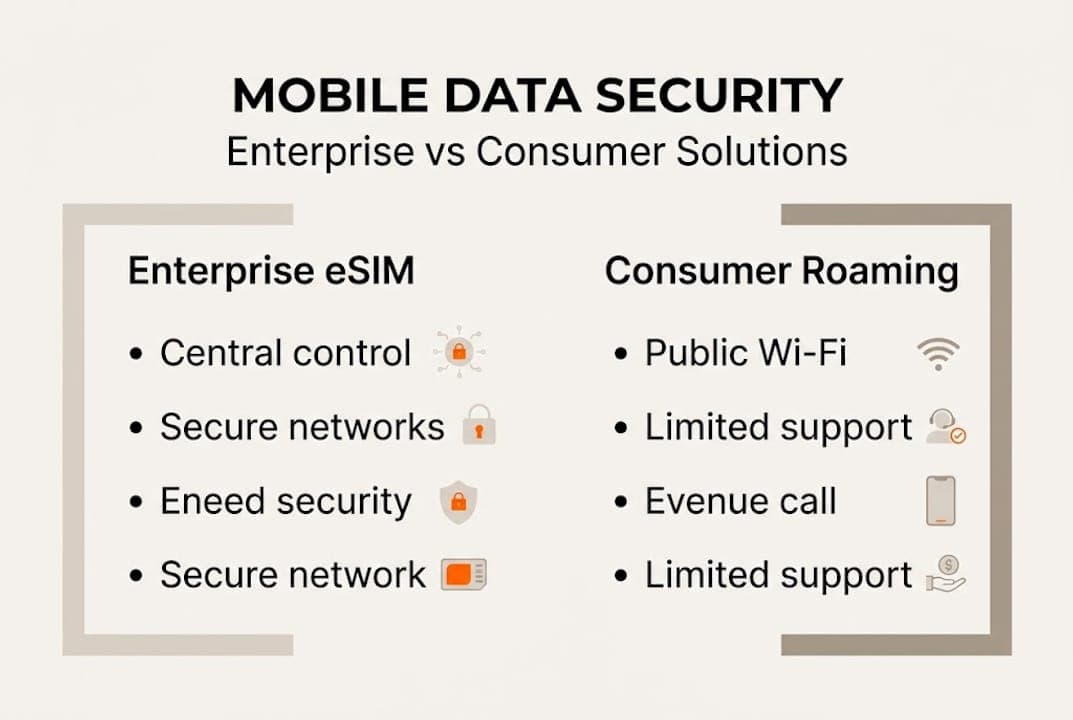
Mobile data security is another area where eSIM-based enterprise solutions shine. Because you are not relying on unknown public Wi-Fi networks, your baseline security posture improves immediately. For added protection, pairing your eSIM connection with a reputable VPN is straightforward, and some enterprise platforms include that functionality natively. Managing global mobile connectivity through a single app interface means you always know your status, your remaining data, and your current network, all from one place.
Common pitfalls and how to avoid them
While enterprise mobile data offers impressive advantages, there are still common mistakes travelers make. Here is how to steer clear of them.
Poor security and unmanaged connections remain top threats for mobile travelers, even when using enterprise-grade tools. Having a premium data plan does not automatically protect you if you habitually connect to hotel Wi-Fi for convenience or leave your hotspot broadcasting openly in a crowded airport lounge.
Common pitfalls include:
- Ignoring local network quality: Enterprise plans connect you to the best available local network, but in rural or remote areas, that network may still be 3G or even 2G. Check coverage maps before committing to a plan for a specific region.
- Choosing the wrong plan size: Buying too little data forces expensive top-ups. Buying a massive plan you do not use wastes money. Most providers let you adjust mid-trip, but plan ahead.
- Forgetting device compatibility: Not every smartphone or tablet supports eSIM. Older devices or some carrier-locked phones may be incompatible. Confirm compatibility before your trip, not at the airport.
- Neglecting background app data: Streaming services, automatic updates, and cloud sync can silently drain your data allowance overnight. Set your apps to Wi-Fi-only for large downloads.
- Skipping mobile security tips: Even on a private cellular connection, using unsecured apps or unencrypted messaging can expose your data to interception.
Pro Tip: Enable your device’s built-in data usage tracker and set a warning alert at 80% of your plan. This gives you time to top up or reduce usage without hitting your cap unexpectedly. Also check high-speed data options for your destinations ahead of time, since 5G availability varies significantly by country and city.
Why travelers should think like enterprises about data
Here is a perspective that most travel advice skips entirely: the smartest individual travelers are essentially running a personal IT operation, and they just do not know it yet.
Enterprises invest in connectivity because downtime costs money. That is equally true if you are a freelancer on a deadline in Lisbon or a remote employee joining a board call from Bali. The mindset shift is powerful. Stop thinking about data as a travel accessory and start treating it as critical infrastructure. Enterprises prioritize flexibility, security, and visibility into usage because those things protect productivity and reduce risk. The same logic applies to you.
Checking out travel tech essentials from a business traveler’s perspective reveals exactly this pattern. The tools that road warriors swear by, redundant connections, managed eSIMs, VPN habits, are not expensive or complicated. They are just deliberate. Most individual travelers never adopt them because they assume those tools are only for corporate accounts. That gap is where people overpay, lose connections at critical moments, and expose their data unnecessarily.
Stay globally connected with enterprise-level mobile data
Put these insights into action with solutions designed for global connectivity. Lumo eSIM brings enterprise-grade connectivity to every traveler, no corporate contract required.
With global eSIM coverage spanning 160+ countries, Lumo gives you instant activation, automatic local network switching, and transparent data management in one simple platform. Whether you are crossing three time zones in a week or settling into a new city for a month, the flexibility and security of enterprise-style data is now within reach. Explore Lumo eSIM plans and start your next trip with the kind of connectivity that keeps you productive, protected, and in control, no matter where work takes you.
Frequently asked questions
What is the main difference between enterprise and consumer mobile data?
Enterprise mobile data offers centralized management and security compared to standard consumer plans, along with wider multi-carrier coverage and flexible usage controls that most personal plans do not include.
Can a digital nomad use enterprise mobile data plans for personal travel?
Absolutely. Enterprise-grade eSIMs are increasingly available to independent travelers and digital nomads, offering the same flexibility, security, and broad coverage previously reserved for corporate accounts.
How does an eSIM help with global mobile data management?
An eSIM lets you instantly activate plans and switch between carriers in different countries without swapping physical SIM cards, making it ideal for frequent travelers managing connectivity across multiple destinations.
Are enterprise mobile data solutions more secure than standard roaming?
Yes. Enterprise mobile solutions include built-in protections such as encrypted connections, VPN compatibility, and usage monitoring tools that standard roaming plans simply do not offer.
Recommended
- Global Coverage Explained: Seamless Mobile Data for Travelers | Lumo eSIM Store
- Multi-device connectivity explained: seamless data for travelers | Lumo eSIM Store
- Global Data Plans: Seamless Travel Connectivity | Lumo eSIM Store
- Secure mobile data guide: Stay connected globally, risk-free | Lumo eSIM Store
Related Topics
Stay Connected Anywhere
Prepaid eSIM data plans for 180+ countries and territories. No physical SIM required.