What is high-speed mobile data: guide for travelers

Travelers and remote workers often assume mobile internet abroad is inherently slow or expensive, but that’s a misconception. High-speed mobile data, powered by 4G LTE and 5G networks, delivers fast, reliable connectivity across the globe without the burden of roaming charges when you use the right tools. This article explains what high-speed mobile data is, how it works, and how to leverage eSIM technology to access it effectively. You’ll learn to navigate network options, avoid costly fees, and maintain consistent connectivity wherever your work or adventures take you.
Table of Contents
- Key takeaways
- Understanding high-speed mobile data: technology and performance
- How travelers and remote workers access high-speed mobile data globally
- Performance nuances, challenges, and optimization tips for global high-speed mobile data
- Choosing the best high-speed mobile data solution for your travel and remote work needs
- Experience seamless global data with Lumo eSIM
- FAQ about high-speed mobile data for travelers and remote workers
Key Takeaways
| Point | Details |
|---|---|
| High speed data basics | High speed mobile data uses 4G LTE and 5G to deliver fast internet with generally low latency when conditions are favorable. |
| eSIM access abroad | eSIMs let you connect to local networks worldwide without roaming fees by loading carrier profiles remotely. |
| Latency matters too | Latency is crucial for real time tasks such as video meetings and remote work, sometimes more important than peak download speeds. |
| 5G SA tradeoffs | Standalone 5G networks can offer lower latency and better battery life, but coverage can be uneven in rural areas or while moving. |
| Practical eSIM tips | Pre activate eSIMs, monitor data usage, and fallback to 4G when 5G performance drops to maintain steady connectivity. |
Understanding high-speed mobile data: technology and performance
High-speed mobile data refers to internet connectivity delivered through 4G LTE and 5G cellular networks, offering download speeds typically ranging from 50 Mbps to over 300 Mbps depending on network type and location. These networks use advanced radio access technologies to transmit data wirelessly between your device and cell towers, enabling you to browse, stream, and work online without WiFi. For traveling professionals, understanding the technical capabilities of these networks helps you set realistic expectations and choose the right connectivity solutions.
4G LTE averages 57 Mbps, while 5G networks deliver median speeds between 124 and 300+ Mbps with latency under 50 ms in optimal conditions. Latency, the time it takes for data to travel between your device and the server, is just as important as raw speed for interactive tasks. Video conferencing, remote desktop access, and cloud-based collaboration tools require low latency to function smoothly. Anything above 50 ms starts to introduce noticeable lag, disrupting real-time communication and reducing productivity.
5G technology achieves these performance gains through innovations like Orthogonal Frequency Division Multiple Access (OFDMA), Massive MIMO antenna arrays, and millimeter wave (mmWave) spectrum. 5G peak speeds reach 20 Gbps with latency less than 5 ms in ideal lab conditions, though real-world performance varies widely based on network deployment, device capabilities, and environmental factors. OFDMA allows multiple users to share the same frequency band efficiently, while Massive MIMO uses dozens of antennas to serve many devices simultaneously without congestion.
For remote workers, these technical specifications translate into practical benefits. Downloading large files, joining video meetings, and accessing cloud applications become seamless experiences rather than frustrating bottlenecks. However, network performance can fluctuate based on tower proximity, user density, and whether the carrier has deployed 5G standalone (SA) or non-standalone (NSA) architecture.
Pro Tip: Choose networks supporting low latency and peak throughput for demanding remote work tasks. Check if your eSIM provider partners with carriers offering 5G SA networks in your destination countries for the best performance.
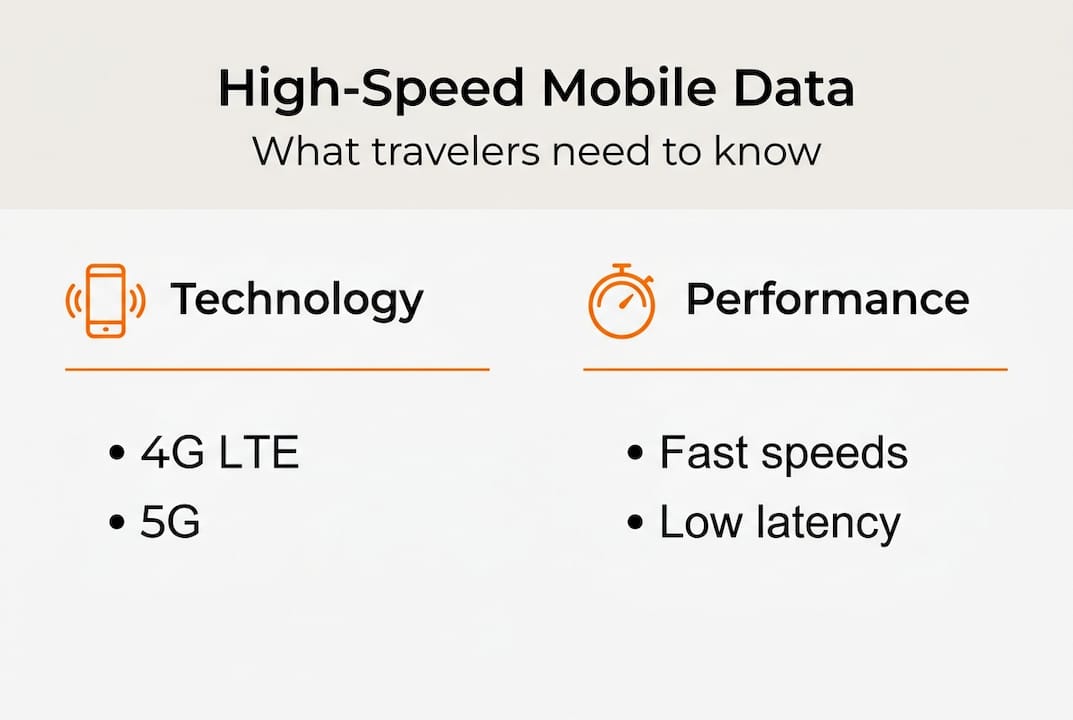
Understanding eSIM terminology for travelers helps you navigate technical specifications and make informed decisions about connectivity options.
| Network Type | Typical Speed | Latency | Best Use Case |
|---|---|---|---|
| 4G LTE | 20-100 Mbps | 30-50 ms | General browsing, email, standard video calls |
| 5G NSA | 100-300 Mbps | 20-40 ms | HD streaming, large downloads, multi-device use |
| 5G SA | 200-500+ Mbps | 10-20 ms | 4K streaming, real-time collaboration, cloud gaming |
How travelers and remote workers access high-speed mobile data globally
An eSIM is a digital SIM profile embedded in your device that you activate remotely using a QR code, eliminating the need for physical SIM cards. This technology lets you connect to local cellular networks worldwide without paying roaming charges or hunting for SIM card vendors at airports. For travelers and remote workers, eSIMs represent a fundamental shift in how you access mobile data, offering flexibility, cost savings, and instant activation from anywhere.

When you purchase an eSIM data plan, you receive a QR code via email or app. Scanning this code downloads the carrier profile to your device, allowing you to connect to partner networks in your destination country. These partner networks are typically Tier-1 carriers like Vodafone, T-Mobile, or Orange, giving you the same high-speed 4G and 5G access that local users enjoy. Because you’re connecting as a local subscriber rather than roaming, you avoid the inflated per-megabyte charges traditional carriers impose.
The eSIM benefits for travelers extend beyond cost savings. You can maintain multiple eSIM profiles on a single device, switching between them based on location or data needs. This flexibility is particularly valuable for frequent travelers who visit multiple countries in a single trip or remote workers who split time between different regions.
Here’s how to prepare and use eSIMs for seamless global data access:
- Purchase your eSIM plan before departure and receive the QR code via email
- Connect to WiFi and scan the QR code in your device settings to download the profile
- Enable data roaming only for your eSIM profile, keeping your primary SIM for calls and texts
- Monitor data usage through your device settings or provider app to avoid overages
- Top up or purchase additional data plans as needed without visiting physical stores
eSIMs enable access to local 4G/5G networks without roaming fees across 120 to 200+ countries, depending on your provider’s partnerships. This coverage spans major travel destinations and increasingly includes remote areas as carriers expand their networks. The key advantage is consistent, predictable pricing regardless of where you travel, making it easier to budget for connectivity costs.
Activate your eSIM before travel on WiFi, enable roaming only for the eSIM profile, and monitor usage via device settings to maintain control over your data consumption. Most modern smartphones support multiple eSIM profiles, allowing you to keep your home carrier active for calls while using the eSIM exclusively for data.
Pro Tip: Always check partner coverage maps to ensure Tier-1 network access and faster speeds. Some eSIM providers partner with secondary carriers in certain countries, which may offer slower speeds or limited coverage compared to premium networks.
The travel data management guide provides detailed strategies for optimizing your data usage and avoiding common pitfalls when using eSIMs abroad.
Performance nuances, challenges, and optimization tips for global high-speed mobile data
5G networks come in two architectural flavors: standalone (SA) and non-standalone (NSA). NSA networks use existing 4G infrastructure as an anchor, adding 5G radio access for faster speeds but maintaining 4G core network latency characteristics. SA networks deploy a fully independent 5G core, enabling true low-latency performance, better battery efficiency, and advanced features like network slicing. For travelers, this distinction matters because SA networks deliver measurably better performance for interactive applications.
5G standalone networks offer lower latency and better battery life but limited coverage compared to NSA, which is more widely deployed but sacrifices some performance benefits. Empirical testing shows latency improvements of 6 to 23 percent on SA versus NSA networks, directly impacting quality of experience for video calls and real-time collaboration tools. However, SA deployment remains concentrated in urban areas and major travel hubs, meaning you’ll often fall back to NSA or 4G in rural regions.
Real-world performance varies dramatically by location and carrier. The UAE achieves median 5G speeds of 1.24 Gbps on advanced networks, while US T-Mobile delivers median speeds around 309 Mbps in major cities. These benchmarks represent optimal conditions. In practice, you’ll encounter performance challenges that require tactical adjustments to maintain reliable connectivity.
Common challenges include:
- Limited rural and airport coverage where 5G infrastructure is sparse or non-existent
- Network congestion during peak hours in tourist areas and business districts
- High mobility scenarios like trains and highways where handoffs between towers degrade speeds
- Beamforming issues in open areas like airport tarmacs that reduce signal strength
Airport tarmacs suffer from slow 5G speeds due to beamforming issues and FAA regulations that limit tower placement near runways. This explains why your connection often drops or slows dramatically when boarding or deplaning, even in airports with otherwise excellent 5G coverage.
| Feature | 5G SA | 5G NSA | Traveler Impact |
|---|---|---|---|
| Latency | 10-20 ms | 20-40 ms | Better video call quality on SA |
| Battery Life | Optimized | Higher drain | Longer device runtime on SA |
| Coverage | Urban focus | Widespread | NSA more reliable in rural areas |
| Speed | 200-500+ Mbps | 100-300 Mbps | SA faster but less available |
Practical tactics for optimizing your mobile data experience:
- Fall back to 4G in weak 5G zones where signal strength is poor or speeds are inconsistent
- Test eSIM network modes (SA/NSA/4G) in device settings to find the best performance for your location
- Use a VPN for security on public WiFi, but be aware it may increase latency by 10 to 30 ms
- Monitor real-time network status through apps like OpenSignal to identify the strongest carrier in your area
- Switch between eSIM profiles if one carrier’s network is congested or underperforming
Consistent low latency and intelligent network selection matter more than peak speed for remote work. A stable 100 Mbps connection with 20 ms latency outperforms an unstable 300 Mbps connection with 60 ms latency for video conferencing and cloud applications.
Pro Tip: Monitor real-time network status and switch between modes for optimum performance. Many devices allow you to manually select 4G or 5G in settings, giving you control when automatic selection fails to optimize for your needs.
The top global data solutions comparison helps you evaluate providers based on network quality and performance rather than just price.
Choosing the best high-speed mobile data solution for your travel and remote work needs
Selecting the right eSIM provider and data plan requires evaluating several factors beyond just price per gigabyte. Network quality, 5G access, coverage consistency, and activation ease all impact your real-world connectivity experience. Tier-1 network partnerships determine whether you get fast, reliable speeds or frustrating performance that hampers productivity.
Key criteria for evaluating eSIM providers:
- 5G access on Tier-1 networks like Vodafone, T-Mobile, Orange, and other premium carriers
- Coverage consistency across your destination countries, not just availability in capital cities
- Seamless eSIM activation via QR code without requiring app downloads or complex setup
- Device compatibility with your smartphone, tablet, or laptop models
- Responsive customer support available 24/7 for troubleshooting connectivity issues
- Transparent pricing with clear data allowances and top-up options
Price versus performance trade-offs depend on your travel patterns and data needs. Short trips with light usage favor pay-as-you-go plans with higher per-gigabyte costs but no monthly fees. Long trips or heavy remote work justify monthly unlimited or high-allowance plans that reduce per-gigabyte costs significantly. Calculate your typical daily usage (video calls, cloud sync, streaming) to estimate total trip requirements and compare plan options.
Checklist for evaluating providers:
- Verify coverage maps show Tier-1 carrier partnerships in your destination countries
- Confirm 5G access is included, not limited to 4G networks only
- Test device compatibility by checking supported eSIM models on the provider website
- Review customer support channels and response time guarantees
- Compare pricing across similar data allowances, factoring in validity periods
- Check for data management apps that track usage and allow easy top-ups
Must-have features for travelers and remote workers:
- Seamless top-up capabilities without requiring new QR codes or profile reinstallation
- Multi-country plans that work across regions like Europe or Asia without switching profiles
- Data management apps with real-time usage tracking and low-balance alerts
- Hotspot sharing support to connect laptops and tablets through your phone
- Flexible validity periods that match your travel duration without wasted days
Testing different network modes (SA/NSA/4G) helps you balance throughput and latency based on your specific location and tasks. Some devices automatically select the best mode, but manual control gives you optimization power when automatic selection underperforms. In areas with weak 5G coverage, forcing 4G mode often delivers more consistent speeds than struggling with a marginal 5G signal.
Avoid these common mistakes when choosing mobile data solutions:
- Ignoring latency specifications and focusing only on advertised download speeds
- Not pre-activating your eSIM before departure, risking connectivity issues upon arrival
- Relying on traditional roaming plans that charge inflated per-megabyte rates unnecessarily
- Choosing the cheapest option without verifying Tier-1 network partnerships
- Failing to test your eSIM setup before leaving home WiFi coverage
The top travel eSIMs for globetrotters and best eSIM solutions 2026 guides provide detailed comparisons of leading providers based on real-world testing and user feedback.
Experience seamless global data with Lumo eSIM
Lumo offers instant activation of global eSIM data plans supporting 4G and 5G on Tier-1 networks worldwide, giving you the high-speed connectivity you need without roaming charges. Our platform simplifies the entire process from purchase to activation, letting you focus on your work and travel rather than wrestling with connectivity issues.
Benefit from no roaming charges, easy top-ups, and multi-country coverage through a single eSIM that works in over 120 countries. Lumo partners with premium carriers to ensure you get consistent speeds and reliable coverage whether you’re in Tokyo, London, or São Paulo. Our data management tools let you monitor usage in real-time and switch networks optimized for your location, giving you control over your connectivity experience.
Pro Tip: Use Lumo’s data management tools to monitor usage and switch networks optimized for your location. This ensures you always connect to the fastest available network without manual configuration.
Explore Lumo eSIM global data plans to find the perfect solution for your travel and remote work needs.
FAQ about high-speed mobile data for travelers and remote workers
How fast is high-speed mobile data typically for travelers?
High-speed mobile data delivers 50 to 300+ Mbps depending on whether you connect via 4G LTE or 5G networks. Real-world speeds vary by location, carrier, and network congestion, but these speeds easily support video calls, streaming, and cloud work.
Can I use a single eSIM for multiple countries without extra roaming charges?
Yes, multi-country eSIM plans let you use one digital profile across entire regions like Europe or Asia without roaming fees. You connect to local partner networks in each country automatically, maintaining consistent speeds and pricing throughout your trip.
What should I do if 5G coverage is weak or unavailable during travel?
Switch your device to 4G mode in settings to force connection to more reliable networks. 4G often delivers more consistent speeds than weak 5G signals, especially in rural areas or during high mobility scenarios like train travel.
Is it safe to use public WiFi with high-speed mobile data plans?
Public WiFi poses security risks regardless of your mobile plan. Use your eSIM data connection instead of public WiFi for sensitive tasks, or employ a VPN to encrypt your traffic if you must use shared networks.
How do I monitor and control my mobile data usage when abroad?
Check your device settings for built-in data tracking, or use your eSIM provider’s app for real-time usage monitoring. Set alerts for when you approach your data limit and disable background app refresh for non-essential apps to conserve data.
Recommended
Related Topics
Stay Connected Anywhere
Get instant eSIM data plans for 160+ countries. No physical SIM required.