Flexible data plan selection guide for travelers 2026

International roaming fees can drain your budget faster than you realize. Many travelers and remote workers face patchy mobile connections and surprise charges that turn a smooth trip into a financial headache. Flexible data plans solve this by letting you stay connected across countries without overspending. This guide walks you through choosing the right plan in 2026, helping you assess your needs, compare options, and avoid costly mistakes while maintaining reliable global connectivity.
Table of Contents
- How To Prepare For Selecting Your Flexible Data Plan
- Step-By-Step Guide To Choosing The Best Flexible Data Plan
- Avoiding Common Mistakes And Optimizing Your Data Plan Usage
- Explore Lumo’s Flexible Global Data Plans For Travelers
- What Is A Flexible Data Plan And How Does It Work?
Key takeaways
| Point | Details |
|---|---|
| Cost savings potential | Understanding flexible data plans can save you up to 40% on roaming costs compared to traditional options. |
| Assessment first | Evaluate your travel habits and data consumption before selecting any plan to match your actual needs. |
| Plan variety | Compare local, regional, and global data options based on coverage areas, pricing structures, and data limits. |
| Selection process | Follow a systematic approach to avoid common pitfalls and choose the most suitable plan for your lifestyle. |
| Optimization tips | Use data-saving techniques and monitor usage regularly to maximize plan value and prevent overages. |
How to prepare for selecting your flexible data plan
Before diving into plan comparisons, you need a clear picture of your connectivity requirements. Start by tracking how often you cross borders for work or leisure. Someone visiting three countries monthly has different needs than a person taking one annual vacation. Your travel frequency directly impacts whether a global plan or individual country plans make financial sense.
Next, calculate your typical monthly data consumption. Check your phone settings for the past three months to see average usage. Streaming video eats through gigabytes quickly, while email and messaging use minimal data. This baseline helps you avoid paying for unused data or running out mid-trip. Flexible data plans help travelers save up to 40% in 2026 compared to traditional roaming, but only when matched correctly to your consumption patterns.
Deciding between prepaid and postpaid structures matters more than most travelers realize. Prepaid plans offer budget control since you pay upfront for specific amounts. Postpaid plans provide convenience but can surprise you with variable monthly bills. Remote workers with predictable data needs often prefer postpaid for simplicity, while occasional travelers favor prepaid to avoid ongoing commitments.
Network coverage deserves serious attention before committing to any provider. Pull up coverage maps for countries on your itinerary and verify the plan supports those regions. A cheap global plan means nothing if it lacks service in your primary destinations. Some providers excel in Europe but offer weak Asian coverage, while others specialize in specific continents.
Create a checklist covering these essential features:
- Multi-country coverage matching your travel destinations
- Easy top-up options through apps or websites
- Transparent pricing without hidden activation fees
- Customer support availability in your time zones
- Compatibility with your existing devices
Device compatibility closes the preparation phase. Modern smartphones support eSIM technology, allowing instant digital activation without physical cards. Older devices require traditional SIM cards, which limits flexibility and speed. Check your phone specifications to confirm eSIM capability, as this feature significantly expands your plan options. Tablets and laptops with cellular connectivity also benefit from eSIM support, letting you manage multiple devices under coordinated plans. Following this international data plan checklist 2026 ensures you enter the selection process fully prepared.
Step-by-step guide to choosing the best flexible data plan
Selecting the right plan requires a methodical approach that matches options to your specific situation. Start by categorizing plans into local, regional, or global types based on your itinerary. Local plans work best for extended stays in single countries, offering the lowest per-gigabyte rates. Regional plans cover continent-specific travel, ideal for European tours or Southeast Asian trips. Global plans provide worldwide coverage, perfect for multi-continent business travel or digital nomads.

Compare plan benefits using concrete criteria that affect your daily experience. Price per gigabyte varies wildly between providers, but cheaper isn’t always better if coverage suffers. Data limits range from capped plans with specific gigabyte allotments to unlimited options with speed throttling after thresholds. Recent technological advancements influence flexible data plan selection among travelers in 2026, particularly eSIM integration and 5G network expansion.
| Plan Type | Coverage | Typical Price | Best For | Key Limitation |
|---|---|---|---|---|
| Local | Single country | $10-20/month | Extended stays | No roaming |
| Regional | Continent | $25-40/month | Multi-country tours | Geographic bounds |
| Global | 160+ countries | $45-70/month | Frequent flyers | Higher base cost |
| Unlimited | Varies | $60-90/month | Heavy users | Speed caps |
Follow this systematic selection process to narrow down options:
- List five providers offering coverage in your primary destinations
- Filter plans matching your monthly data consumption estimate
- Calculate total costs including activation fees and potential overages
- Read recent user reviews focusing on connection reliability and customer service responsiveness
- Verify eSIM compatibility if your device supports digital activation
- Test the provider’s app interface and top-up process before committing
- Confirm cancellation policies and contract terms to avoid lock-in surprises
Validating plans through user experiences prevents nasty surprises. Look beyond star ratings to read detailed reviews mentioning specific countries you’ll visit. Connection quality varies significantly by region even within the same provider’s network. Someone praising European performance might experience frustration in South America on the identical plan.
Pro Tip: Prioritize eSIM-enabled plans even if slightly more expensive. The instant activation and ability to switch carriers without physical SIM swaps provides flexibility worth the premium, especially when crossing borders frequently or facing unexpected travel changes.
This step-by-step guide to global data plans offers additional decision frameworks, while understanding local vs global data plans helps clarify which category suits your travel patterns. The right choice balances cost, coverage, and convenience based on your unique connectivity requirements.
Avoiding common mistakes and optimizing your data plan usage
Even the best flexible data plan delivers poor value if you make preventable errors. The most expensive mistake involves failing to check network compatibility before purchasing. Your phone might support eSIM technology, but specific carrier bands matter for optimal speeds. A plan advertising 5G means nothing if your device can’t access those frequencies in your destination country.
Underestimating data needs ranks as the second costliest error. Travelers often calculate based on home usage, forgetting that navigation apps, translation tools, and increased photo uploads abroad consume significantly more data. Budget at least 30% above your domestic average to account for travel-specific applications. Running out of data mid-trip forces expensive emergency top-ups at inflated rates.
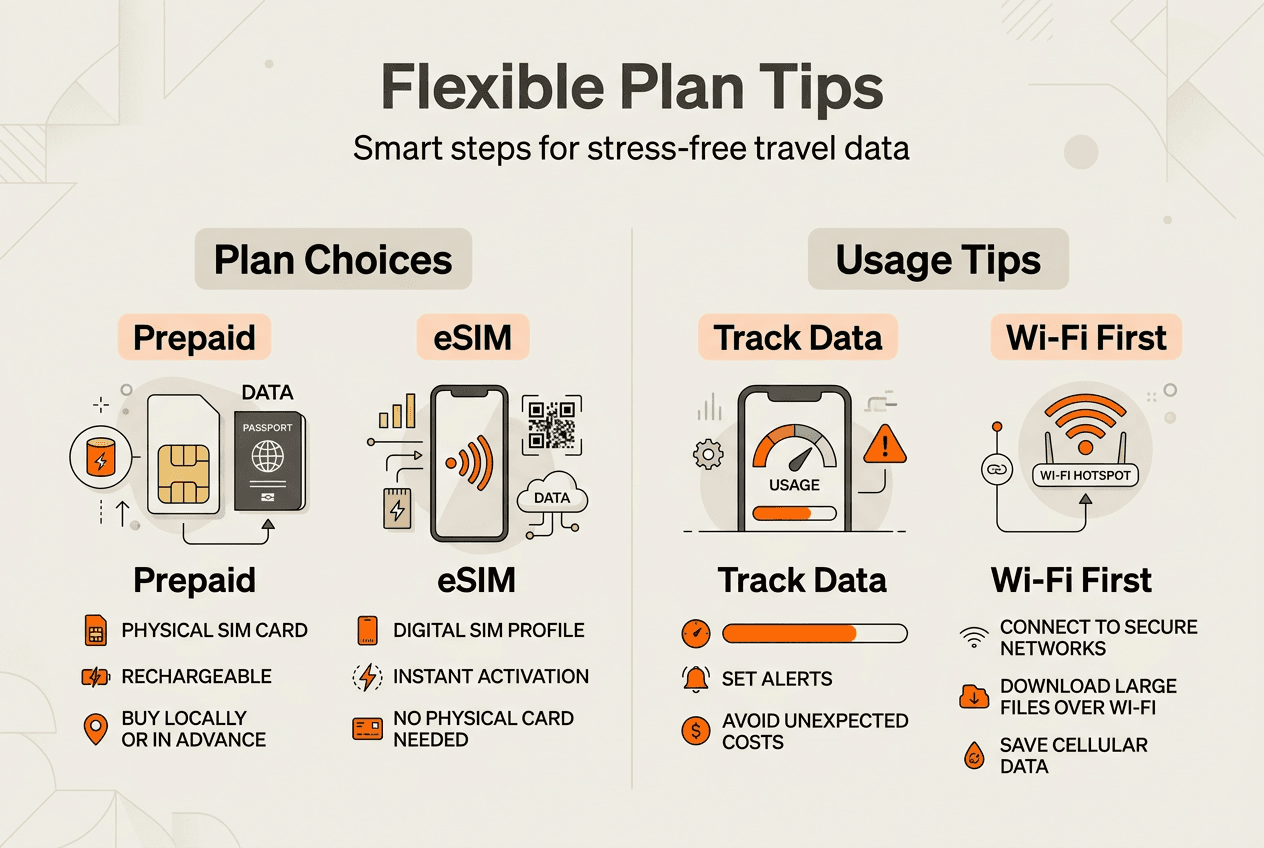
Accidentally activating roaming on your primary SIM creates the nightmare scenario flexible plans aim to prevent. Double-check that you’ve disabled cellular data on your home carrier’s line after installing your travel plan. One forgotten toggle can generate hundreds in roaming charges within hours. Most phones let you label SIMs clearly, so mark your travel line as the default data source.
Implement these data-saving settings before your trip:
- Disable background app refresh for non-essential applications
- Turn off automatic downloads and updates
- Switch email to manual fetch instead of push notifications
- Download offline maps for navigation instead of streaming
- Adjust streaming quality to standard definition on mobile networks
- Disable Wi-Fi assist to prevent cellular usage when Wi-Fi weakens
Pro Tip: Schedule weekly usage audits through your carrier’s app to track consumption patterns. Purchase top-ups just before running out rather than buying excess data upfront. Many plans offer better rates on add-ons than initial packages, and unused data often expires.
Overlooked roaming fees and wasted data from poor plan management cost international travelers an estimated $2.8 billion annually. Simple monitoring and proactive adjustments prevent most of these unnecessary expenses while maintaining reliable connectivity.
These 7 smart global data usage tips provide deeper optimization strategies for travelers and remote workers. Understanding what defining unlimited data plans actually means helps set realistic expectations about speed throttling and fair use policies. Smart usage habits combined with the right plan selection create a sustainable approach to global connectivity that saves money without sacrificing reliability.
Explore Lumo’s flexible global data plans for travelers
After evaluating your needs and understanding selection criteria, you need a provider delivering on flexibility promises. Lumo offers instant activation of global data plans through eSIM technology, eliminating the wait for physical SIM cards or complicated setup processes. The platform covers over 160 countries with transparent pricing and no hidden fees, designed specifically for travelers and remote workers who value straightforward connectivity.
The interface simplifies plan management, letting you purchase, activate, and monitor usage from a single dashboard. Whether you need coverage for a weekend trip or extended remote work across continents, Lumo’s range of local and global options adapts to your changing itinerary. The 24/7 customer support ensures help is available regardless of your time zone, while high-speed 5G/4G connectivity keeps you productive wherever work takes you.
What is a flexible data plan and how does it work?
Flexible data plans let you pay for mobile data only when and where you need it, typically covering multiple countries without traditional roaming fees. They work through eSIM or physical SIM cards that activate remotely, connecting to local networks in each destination. This approach avoids expensive roaming charges by using regional carriers instead of your home provider’s international rates. Most flexible plans offer prepaid or postpaid options with varying data limits and coverage areas. The international data plan checklist helps evaluate which type matches your travel patterns.
How do I know which flexible data plan suits my travel profile?
Evaluate your typical destinations and international travel frequency to determine plan type. Someone visiting one country for extended periods benefits most from local plans offering the lowest per-gigabyte rates. Multi-country trips within a single region work better with continental plans covering Europe, Asia, or the Americas. Frequent travelers crossing multiple continents need global plans despite higher base costs, as the convenience and comprehensive coverage justify the premium. Consider local vs global data plans to understand the tradeoffs between cost and coverage flexibility.
Can I use multiple flexible data plans simultaneously?
Yes, many travelers run multiple plans to optimize coverage and costs across different regions. Modern smartphones with eSIM support let you store several profiles and switch between them instantly based on your location. This strategy works well when combining a primary global plan for general coverage with local plans in frequently visited countries offering better rates. Using eSIM technology makes managing multiple plans seamless without juggling physical SIM cards. Understanding flexible data plans benefits shows how this multi-plan approach maximizes value for complex travel schedules.
What are essential tips for managing data usage on flexible plans?
Disable background app refresh and automatic updates when traveling abroad to prevent unnecessary consumption. Monitor your usage daily through your carrier’s app rather than waiting for alerts when data runs low. Download maps, entertainment, and work files on Wi-Fi before departing to reduce mobile data needs. Set data usage warnings at 75% of your limit to trigger proactive top-ups before running out. These global data usage tips provide additional strategies for extending plan value and avoiding expensive overages while maintaining reliable connectivity.
Recommended
- Why flexible data plans matter for travelers in 2026 | Lumo eSIM Store
- International Data Plan Checklist 2026: Save 40% on Travel | Lumo eSIM Store
- Defining Unlimited Data Plans for Global Travelers | Lumo eSIM Store
- Why flexible data plans save travelers 40% in 2026 | Lumo eSIM Store
- 5G Bolt Data Plans
Related Topics
Stay Connected Anywhere
Get instant eSIM data plans for 160+ countries. No physical SIM required.