Global Coverage Explained: Seamless Mobile Data for Travelers

TL;DR:
- Global coverage relies on multiple carrier partnerships, not a single network.
- Performance varies due to local infrastructure, network congestion, and device compatibility.
- Combining local, regional, and global plans optimizes connectivity and cost for travelers.
Global Coverage Explained: Seamless Mobile Data for Travelers
Most travelers assume that buying a “global” data plan means the same fast, reliable connection in Bangkok as in Berlin. That assumption gets people into trouble fast. The reality is that global mobile coverage is built on a web of carrier partnerships, roaming agreements, and local network deals that vary dramatically by region, provider, and even device. Understanding how it actually works gives you a real edge in staying connected without surprise bills or dead zones derailing your trip.
Table of Contents
- What does global coverage really mean?
- How global coverage works: The technology and partnerships
- Performance realities: Speed, reliability, and what impacts your connection
- Strategic tips: Maximizing global coverage for travelers and nomads
- Our unique perspective: What most guides miss about global coverage
- Get seamless global coverage with Lumo eSIM
- Frequently asked questions
Key Takeaways
| Point | Details |
|---|---|
| Global coverage demystified | It means broad but not universal mobile data access powered by carrier partnerships and roaming agreements. |
| Performance varies regionally | Connection speed and reliability depend on local networks, prioritization, and plan details. |
| Hybrid strategies work best | Mixing local, regional, and global eSIM plans helps travelers maximize coverage and value. |
| Smart planning prevents surprises | Always check coverage maps, device compatibility, and fair use policies before departure. |
What does global coverage really mean?
Let’s clear something up immediately: no single provider owns infrastructure in every country on earth. When a company advertises “global coverage,” what they actually mean is access to data through a patchwork of partnerships with local carriers around the world. Your device connects through those partners, not through a single all-powerful network.
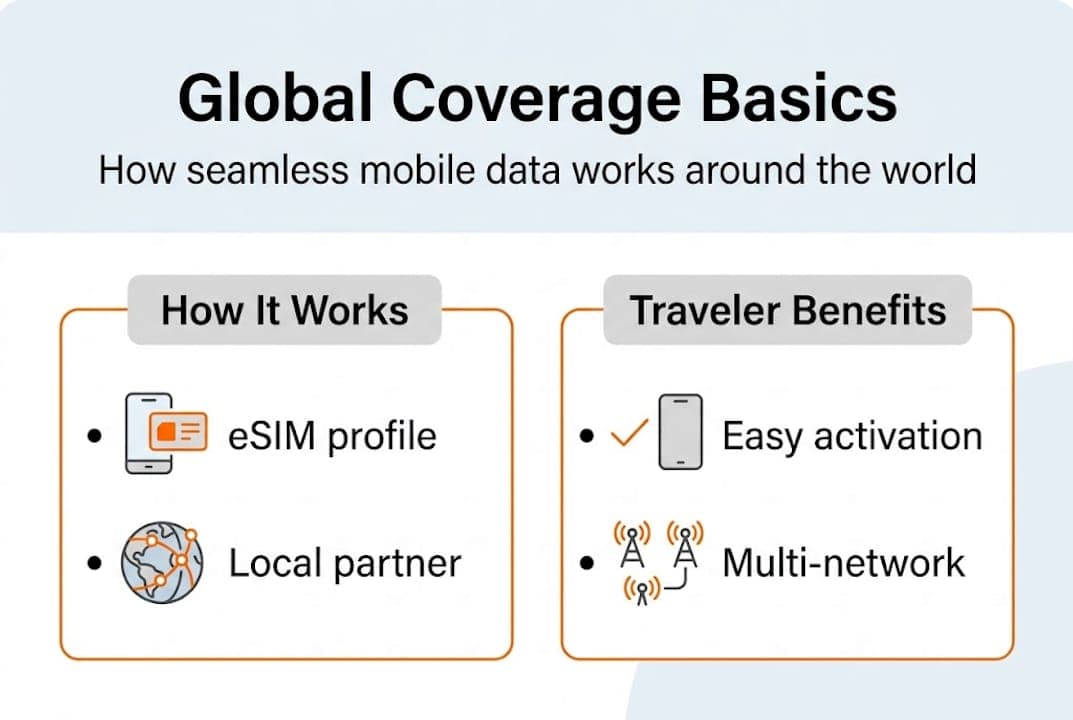
This is how eSIM benefits for travelers translate into real-world convenience. An eSIM profile carries a credential called an IMSI (International Mobile Subscriber Identity), and that credential is recognized by partner networks worldwide. So when you land in Japan, your device doesn’t need a new physical SIM. It uses a pre-loaded profile to authenticate on a Japanese carrier that has agreed to carry traffic for your provider.
The model powering this is called the MVNO model, short for Mobile Virtual Network Operator. Your eSIM provider doesn’t own towers. Instead, they lease network access from established local operators, bundle it into a single plan, and pass the convenience along to you. It’s clever, scalable, and nearly invisible when it works well.
Here’s what global coverage actually guarantees and what it doesn’t:
- Access in most countries: Coverage reaches the majority of popular destinations, but remote regions within those countries may have gaps.
- Variable service quality: Speed tiers, latency, and reliability depend on the local partner carrier and the deal your provider has negotiated.
- Device dependency: Not every phone supports all eSIM profiles or frequency bands, which can limit performance even in well-covered areas.
- No universal 5G: In many partnership arrangements, you may be limited to 4G LTE even if 5G exists locally.
Quick fact: Studies estimate that over 70% of travelers experience at least one connectivity issue when relying solely on their home carrier abroad, underscoring why understanding the mechanics matters before you board.
How global coverage works: The technology and partnerships
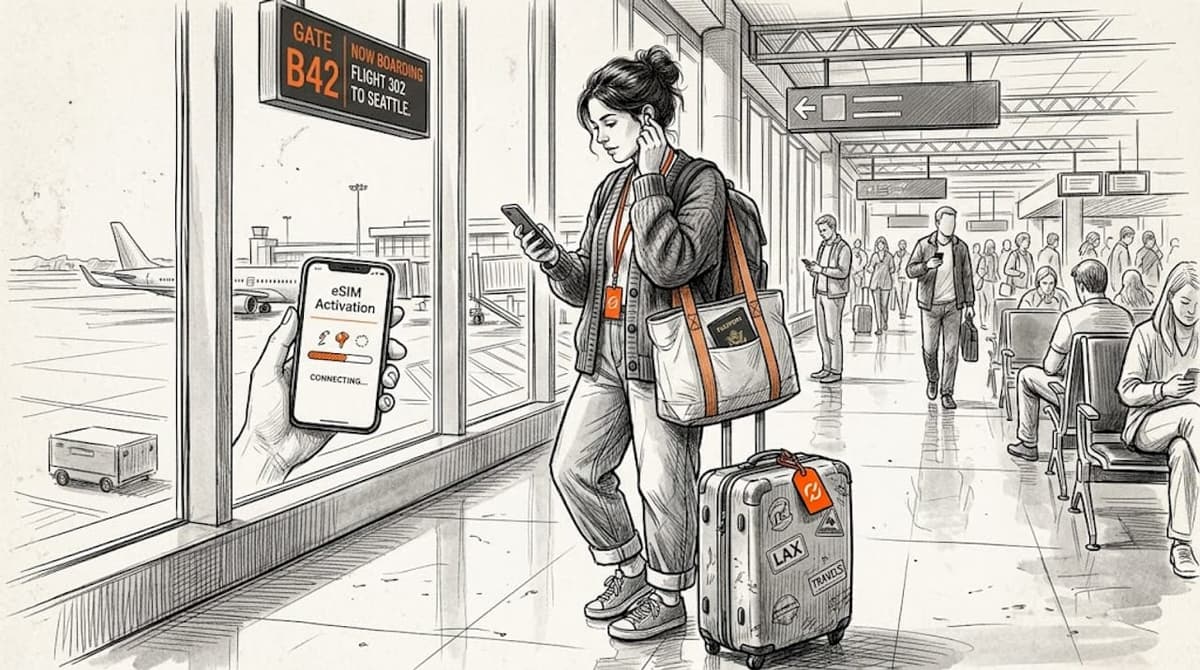
Picture your eSIM as a digital passport. When you cross a border, your phone performs what’s called an HLR lookup, short for Home Location Register check. It’s a quick handshake between your device and the local carrier’s system to verify your credentials and assign you to a network. This all happens in seconds, usually before you’ve cleared customs.
The routing of your actual data relies on a system called IPX, or IP Packet Exchange. Think of IPX as the private highway system for mobile data. It connects carriers across borders efficiently, securely, and with predictable speeds. Traditional roaming used slower, less efficient routing, which is why old-school international data felt sluggish even when signal bars looked fine.
One of the biggest advantages of modern eSIM platforms is multi-network selection. Instead of being locked to a single local carrier, advanced eSIM solutions can evaluate available networks and pick the one with the best signal, lowest latency, and least congestion at that moment. It’s dynamic, and it matters especially in countries where one carrier dominates urban areas but drops off the moment you leave the city.
Here’s a quick breakdown of how coverage scale works in practice:
| Feature | Standard Roaming | eSIM Global Plan |
|---|---|---|
| Activation | Requires physical SIM swap | Instant, over-the-air |
| Network partners | Usually 1-2 per country | Up to 750+ operators globally |
| Country reach | Varies by home carrier deals | 195+ countries typical |
| Network switching | Manual or none | Automatic, based on performance |
| Cost transparency | Often unpredictable | Fixed plan rates |
The scale of partnerships is what separates mediocre global plans from genuinely useful ones. Some providers have built global data plan travel connectivity options backed by 750+ operator deals across 195+ countries. That breadth is the difference between connecting reliably in rural Vietnam and staring at a “no service” message.
Performance realities: Speed, reliability, and what impacts your connection
Knowing the technology exists is one thing. Understanding how it performs under real-world conditions is where most guides fall short.
First, local breakout matters more than most people realize. When your data routes directly through a local carrier’s infrastructure rather than bouncing back through your home network overseas, latency drops significantly. A video call that stutters on traditional roaming can feel smooth with local breakout routing. This is a key eSIM plan advantage that saves real frustration during work calls or live streaming.
“Local breakout reduces latency versus traditional roaming; multi-carrier selection optimizes performance; deprioritization and throttling remain common in unlimited plans for nomads, where hybrid local and regional strategies prove optimal.”
Second, “unlimited” is not always unlimited. When local networks get congested, roaming traffic, including traffic from eSIM users, often gets deprioritized below local subscribers. You may have full bars and still find speeds that feel like dial-up during peak evening hours in a busy city. This is not a bug unique to eSIMs. It’s how mobile networks manage capacity globally.
Factors that affect your real-world connection speed and reliability:
- Time of day: Rush hour in major cities strains towers regardless of plan type.
- Urban vs. rural: Coverage maps show country-level reach, not village-level reach.
- Building density: Indoor coverage in concrete-heavy buildings can drop even on great networks.
- Plan tier: Budget plans sometimes receive lower-priority routing on partner networks.
- Device band support: A phone missing key frequency bands performs poorly even in well-covered areas.
Pro Tip: Before a major trip, cross-reference your eSIM provider’s coverage map with user reviews on travel forums specific to your destination. Maps show theoretical coverage; forums show reality.
Strategic tips: Maximizing global coverage for travelers and nomads
With a clear grasp of how global coverage functions and performs, let’s zero in on the best strategies to maximize your connection and value.
The single biggest mistake travelers make is buying one global plan and assuming it covers every scenario equally well. It rarely does. Hybrid local and regional eSIM strategies are optimal for both price and connectivity, especially for digital nomads who rotate between continents.
Here’s a practical approach to building your connectivity stack:
- Research your destinations first: Identify which countries you’ll spend the most time in and find a provider with the strongest partner networks in those specific regions.
- Use a global plan as your baseline: A broad global plan keeps you connected in transit and in new countries before you’ve had a chance to source local options.
- Add regional plans for data-heavy stays: If you’re spending two weeks in Southeast Asia, a regional eSIM focused on that area usually offers better speeds and lower cost per gigabyte.
- Check device compatibility before you leave: Confirm your phone supports eSIM, the frequency bands used in your destination countries, and that carrier locks won’t interfere.
- Read the fair use policy carefully: Every unlimited plan has a threshold where speeds get throttled. Know yours before you need it, not after.
- Use your provider’s coverage map and user communities: First-party maps are a starting point; traveler communities add ground-truth detail.
The avoiding roaming fees guide breaks down the math further, but the short version is that pairing plans strategically almost always beats a single global plan in both cost and reliability.
Pro Tip: Keep a local SIM option in your mental toolkit for destinations in sub-Saharan Africa, parts of Central Asia, or rural South America where even strong global eSIM providers have thinner partner agreements. For those zones, check out smart global connectivity options for region-specific guidance.
Our unique perspective: What most guides miss about global coverage
Here’s the part most explainers skip entirely: coverage promises and coverage reality are two different documents.
Providers advertise country counts. What they don’t always tell you is which local carrier you’ll actually land on, whether that carrier deprioritizes roaming users, or what their fair use thresholds actually look like in practice. Savvy travelers know to look past the headline number of countries and ask which operators in those countries carry the traffic.
The honest truth is that an eSIM vs physical SIM comparison often reveals that for a two-week stay in a single high-data-use destination, a local SIM or a local-focused eSIM beats a global plan on raw performance every time. Global plans win on convenience and breadth. Local plans win on depth and speed. The smartest approach pairs both, not because the technology forces it, but because no single provider has equal strength everywhere. Demand transparency from your provider on coverage specifics, and walk away from any plan that can’t show you exactly which carriers you’ll use by country.
Get seamless global coverage with Lumo eSIM
Now that you understand how global coverage actually works, you’re in a much better position to choose a plan that delivers on its promises rather than just its marketing.
Lumo eSIM global data plans give you access to 195+ countries and regions from a single account, with instant QR code activation and no hidden roaming fees. Whether you’re routing through three continents on a work trip or settling into a new city for a month, Lumo’s flexible plans let you scale your data up or down without contract headaches. Stop guessing about connectivity before you land. Activate before departure and travel with confidence.
Frequently asked questions
Does global coverage mean unlimited data everywhere?
No, global coverage provides access in most countries, but unlimited data plans are often subject to deprioritization or throttling on crowded networks, especially for roaming users.
Will my eSIM work in every country?
Most eSIM providers cover 190+ countries, but you should check your provider’s coverage map for specific gaps, restrictions, or partner carrier limitations in your destination.
How do eSIMs choose which local network to connect to?
eSIMs typically select local networks automatically based on signal strength, latency, and congestion levels at the time of connection, prioritizing the best available option.
Can I switch between local, regional, and global eSIMs?
Yes, and a hybrid eSIM approach typically offers the best balance of cost and connectivity, particularly for travelers moving frequently between regions or continents.
Recommended
Related Topics
Stay Connected Anywhere
Prepaid eSIM data plans for 180+ countries and territories. No physical SIM required.