Global mobile network access explained: roam without worry

TL;DR:
- Global mobile access involves international roaming or eSIM local options to stay connected abroad.
- eSIMs offer cheaper, faster connectivity compared to traditional carrier roaming with high daily fees.
- Choosing the right method depends on device compatibility, trip duration, and regional coverage.
Most travelers don’t realize they’re overpaying for mobile data until the bill arrives. A weekend in Europe or a week in Southeast Asia can cost hundreds in roaming fees simply because the options weren’t clear before departure. Global mobile network access isn’t complicated once you understand what it is, how it works, and which solution fits your trip. This guide cuts through the confusion so you can stay connected abroad, control your costs, and travel with confidence instead of anxiety.
Table of Contents
- What is global mobile network access?
- Traditional roaming vs. eSIM: How connectivity works abroad
- Key factors for choosing a global connectivity solution
- Common pitfalls and expert tips for global mobile access
- Our perspective: What most guides won’t tell you about global mobile access
- Ready to roam smarter? Try a global eSIM solution
- Frequently asked questions
Key Takeaways
| Point | Details |
|---|---|
| Seamless connectivity | Global mobile network access lets you use your phone abroad with minimal hassle and cost. |
| eSIM advantages | Switching to eSIM often means lower prices, instant activation, and better regional coverage for travelers. |
| Choose wisely | Consider your device, trip length, and usage needs to pick the best global mobile plan. |
| Beware restrictions | Carrier plans may have hidden limits; always read the fine print especially for long stays. |
What is global mobile network access?
At its core, global mobile network access means your phone can send and receive data, calls, and texts outside your home country. That sounds simple. In practice, it involves a web of international agreements between carriers, device technology, and the frequency bands your phone supports in different regions.
There are two main ways this happens today:
- International roaming: Your home carrier connects you through a partner network in the country you’re visiting. Your number stays the same, but you pay your carrier’s rates, which can be steep.
- eSIM local access: A digital SIM profile is loaded onto your device, letting it connect as if it were a local subscriber. No physical card swap required.
As the FCC describes it, global mobile network access refers to seamless connectivity through international roaming agreements or eSIM local access. Both methods provide voice, text, and data across borders. The difference is who controls the pricing and how fast you can get set up.
Modern smartphones support both options. The shift toward eSIM adoption benefits has been dramatic in the last few years, largely because it removes the physical barrier of finding and swapping a SIM card in a foreign airport.
The real unlock in global connectivity isn’t the technology itself. It’s understanding that you now have a choice between your carrier’s rates and local market rates, often for the exact same network infrastructure.
Traditional roaming vs. eSIM: How connectivity works abroad
Knowing the difference between these two methods directly affects how much you spend and how smoothly your trip runs.
Traditional roaming works like this: your carrier has agreements with foreign networks. When you land, your phone automatically connects to a partner network. Your home carrier bills you, usually at a premium. A high-cost roaming structure means you connect via partner networks at elevated rates, while eSIMs allow instant local activation at better rates. Many US carriers offer day passes (typically $10 to $12 per day) that give you a capped amount of service. It’s convenient, but the costs stack up fast on longer trips.
eSIMs flip this model. You download a digital profile from a provider before you leave home, activate it with a QR code, and your phone connects to a local network as if you bought a SIM card there. No roaming markup. You pay local or near-local rates.
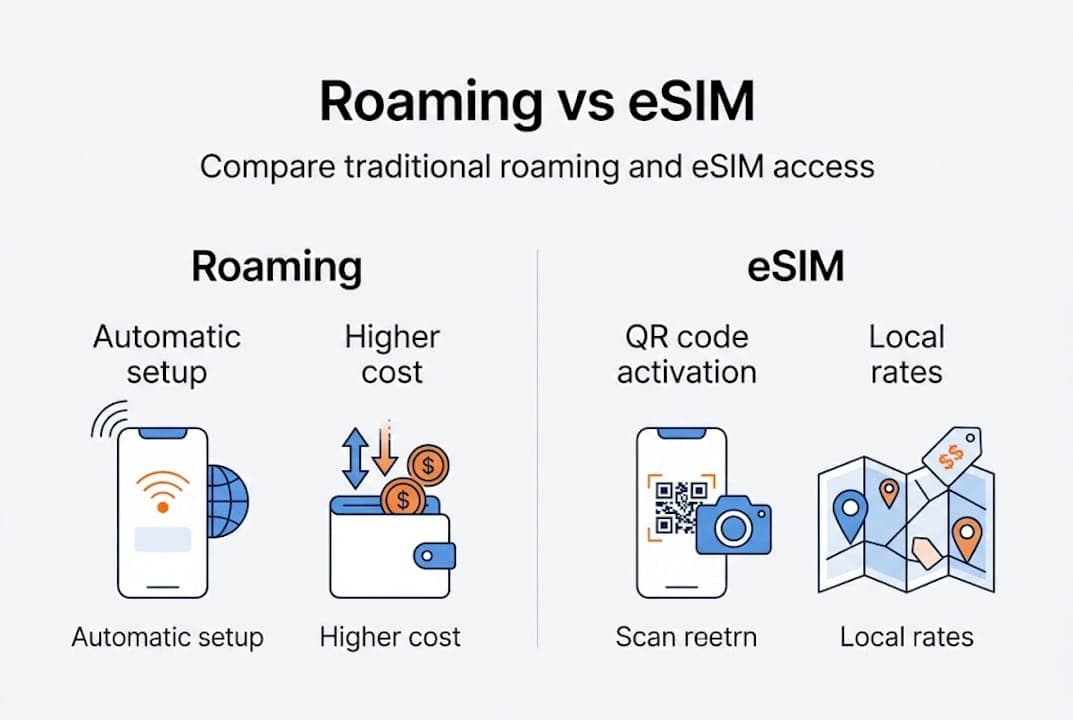
Here’s a quick side-by-side comparison:
| Feature | Traditional roaming | eSIM local access |
|---|---|---|
| Setup | Automatic | QR code scan (5 min) |
| Cost | $10-$12/day or per-MB | $3.50-$15/GB |
| Speed throttling | Common after limit | Plan-dependent |
| Number retention | Yes | Yes (dual SIM) |
| Flexibility | Low | High |
| Best for | Short trips, voice-heavy | Data-heavy, longer stays |
For a deeper breakdown, the roaming fees vs eSIM comparison covers real pricing scenarios. If you’re evaluating physical options too, a look at top data SIM cards for 2026 adds useful context.
Pro Tip: Keep your home SIM active for incoming calls and SMS while using a data eSIM for internet. This dual setup means you never miss a call from your bank or a two-factor authentication text.
Key factors for choosing a global connectivity solution
The right solution depends on your specific trip. Here’s what actually matters when you’re deciding:
- Device compatibility: Your phone must be unlocked and eSIM-capable. Most iPhones from XS onward and recent Android flagships qualify. A locked phone can’t use third-party eSIMs, period.
- Trip duration: Carrier roaming day passes make sense for two or three days. For a week or more, eSIM data plans are almost always cheaper. And if you’re staying longer than 90 days, carrier plans may restrict access after that point, making local eSIMs or physical SIMs the smarter long-term solution.
- Coverage by region: Not all eSIM providers cover every country equally. Check coverage maps before you buy, especially for less-traveled destinations in Africa, Central Asia, or remote Pacific islands.
- Actual cost math: Carrier day passes run $10 to $12 per day. A quality eSIM plan can go as low as $3.50 per GB in 2026, depending on the region and provider. On a 10-day trip using 3 GB of data, that’s roughly $120 via day pass versus potentially $15 to $30 via eSIM.
For a full walkthrough of these variables, choosing a travel SIM walks you through each decision point with real examples.
Common pitfalls and expert tips for global mobile access
Even experienced travelers make avoidable mistakes. Here’s what to watch for:
- Flying with a locked phone. If your device is carrier-locked, you can’t use any third-party eSIM or physical SIM. Call your carrier before you leave to request an unlock.
- Not enabling data roaming in settings. Even with an active eSIM, some phones default to the primary SIM for data. Go into your mobile data settings and manually assign data to the eSIM profile.
- Ignoring country-specific restrictions. China, for example, blocks many apps and has specific rules around foreign SIM use. Arriving without a workaround is a real problem for remote workers.
- Activating your eSIM after arrival. Always download and activate your eSIM profile while you still have Wi-Fi or your home connection. Airport Wi-Fi is unreliable and slow.
- Assuming data eSIMs include voice. They don’t. Most data-only eSIMs are exactly that: data only. Your original SIM handles calls and texts.
The hybrid approach for travelers, using a data eSIM alongside your home SIM for voice and SMS, is optimal for most use cases. It covers the bases without paying for features you may not need.

For remote workers managing multiple devices and productivity demands abroad, eSIMs for remote workers covers workflow-specific setups. And if you want to understand how eSIM changes work travel at a structural level, that resource gets into the practical impact on business trips.
Pro Tip: Before any international trip, save your eSIM provider’s support number and your data usage dashboard link as offline bookmarks. If connectivity drops, you need troubleshooting tools accessible without an internet connection.
Our perspective: What most guides won’t tell you about global mobile access
Most travel connectivity guides point you toward the most convenient option and call it done. The reality is that convenience is often just a more expensive word for lazy planning.
Carrier roaming passes feel safe because they come from a familiar brand. But we’ve seen firsthand how speed throttling kicks in after the daily limit, or how “unlimited” plans quietly deprioritize your data when the local network gets congested. That matters when you’re on a video call with a client at 9 AM local time.
The smartest approach is a hybrid one: global flexibility with eSIM for data, your home SIM for voice, and a habit of checking your usage before you hit a cap. Experimenting with newer eSIM offers as they launch is also worthwhile. The market is moving fast in 2026, and plans that didn’t exist six months ago may now be a much better fit for your destination.
Don’t lock yourself into any single provider out of habit. Connectivity is a tool. Use the one that actually fits the job.
Ready to roam smarter? Try a global eSIM solution
If this guide has made one thing clear, it’s that you have more options than your carrier wants you to know about. The right setup saves real money and eliminates a lot of travel stress.
Lumo eSIM global data gives you instant activation, coverage across more than 160 countries, and flexible plans that scale with your trip. Whether you’re a remote worker on a three-month stint or a frequent flyer making quick regional hops, compare eSIM solutions and find a plan built for how you actually travel. One QR code. No roaming shock.
Frequently asked questions
How do I check if my phone is eSIM compatible for global use?
Most modern unlocked smartphones, including iPhone XS or later and recent Samsung and Google models, support eSIM. Check your device settings under “Mobile Data” or visit the manufacturer’s website to confirm compatibility.
Will I lose my home number if I use an international eSIM?
No. eSIMs use dual-SIM functionality so you can keep your original SIM active for voice and SMS while the eSIM handles data abroad. Both profiles run simultaneously.
What are the best options for long stays abroad?
For stays longer than 90 days, local SIMs or eSIMs are the most reliable choice. Carrier roaming plans may suspend international access after this threshold, making local options the practical default.
Can I get voice and SMS on data-only eSIMs?
No. Data-only eSIMs do not include voice or SMS features. Keep your primary SIM active in dual-SIM mode to handle calls and messages while the eSIM manages your data connection.
Recommended
- Mobile Data Roaming: Costs, Risks, and Smarter Choices | Lumo eSIM Store
- International Roaming Explained: Avoiding Costly Mistakes | Lumo eSIM Store
- 7-Step Avoid Roaming Charges Checklist for Global Travelers | Lumo eSIM Store
- Secure mobile data guide: Stay connected globally, risk-free | Lumo eSIM Store
Related Topics
Stay Connected Anywhere
Prepaid eSIM data plans for 180+ countries and territories. No physical SIM required.