eSIM vs physical SIM: best global connectivity in 2026

Choosing between eSIM and physical SIM cards confuses many travelers who assume traditional cards always deliver better reliability abroad. That assumption overlooks how eSIM technology has transformed international connectivity, offering remote activation, multiple carrier profiles, and competitive pricing that often beats roaming fees. This guide clarifies the technical differences, cost implications, compatibility challenges, and practical scenarios where each option shines. You’ll discover when eSIMs streamline your trips and when physical SIMs remain the smarter backup, empowering you to optimize global connectivity in 2026.
Table of Contents
- Understanding The Basics: What Are Esims And Physical Sim Cards?
- Cost Comparison And Data Plan Flexibility For Global Travelers
- Compatibility, Coverage, And Technical Limitations To Consider
- Practical Tips For Choosing And Using Esim Or Physical Sim On Your Trips
- Explore Lumo’s Global Esim Plans For Seamless Travel
- Frequently Asked Questions About Esim And Physical Sim For Travelers
Key takeaways
| Point | Details |
|---|---|
| Remote provisioning | eSIMs activate instantly via QR codes without physical card swaps, while physical SIMs require manual insertion |
| Cost efficiency | eSIM travel plans typically cost less than daily roaming charges but may exceed local physical SIM prices for extended stays |
| Device compatibility | eSIMs work only on newer devices supporting the technology, whereas physical SIMs fit nearly all phones globally |
| Geographic restrictions | Some regions ban or limit eSIM use, making physical SIMs necessary for universal access |
| Profile flexibility | One eSIM chip stores multiple carrier profiles for quick switching, unlike physical SIMs limited to one active profile per card |
Understanding the basics: what are eSIMs and physical SIM cards?
An eSIM is an embedded digital SIM chip allowing remote programming, while a physical SIM remains a removable card you insert manually into your device. This fundamental difference shapes how you activate service, switch carriers, and manage connectivity across borders. Physical SIM cards have dominated mobile networks for decades, requiring you to visit stores, purchase cards, and physically swap them when changing providers. eSIM technology eliminates those steps by letting carriers provision your service remotely through QR codes or apps.
The GSMA standards enable this remote eSIM provisioning, creating a unified protocol carriers worldwide recognize. When you scan a QR code or download a carrier profile through an app, the eSIM chip reprograms itself to connect with that network. Physical SIMs lack this flexibility because each card holds fixed credentials tied to one carrier until you replace it entirely. This technical distinction becomes crucial when you travel frequently or need backup connectivity options.
One eSIM chip can store multiple carrier profiles simultaneously, though typically only one stays active for cellular data at a time. You might load profiles for your home carrier, a European travel plan, and an Asian data package onto the same eSIM, then toggle between them through settings. Physical SIMs restrict you to one profile per card, forcing you to carry multiple cards and swap them manually when crossing regions. Managing multiple eSIM profiles becomes effortless compared to juggling physical cards in your wallet.
Pro Tip: eSIM technology eliminates the risk of losing tiny physical cards during trips and accelerates carrier switches to seconds instead of minutes spent swapping cards.
Device compatibility varies significantly between these technologies:
- eSIM requires smartphones, tablets, or laptops manufactured after 2018 with embedded chips
- Physical SIM works with virtually any mobile device from the past two decades
- Dual SIM phones often combine one eSIM slot with one physical SIM tray for maximum flexibility
- Older travel phones and budget devices typically support only physical SIM cards
Form factors differ too. Physical SIMs come in standard, micro, and nano sizes, though nano dominates modern devices. You need the correct size or an adapter to fit your phone’s tray. eSIMs exist as soldered chips inside your device, invisible and impossible to remove, making them immune to physical damage or loss during travel.
Cost comparison and data plan flexibility for global travelers
Pricing structures reveal where each SIM type delivers better value depending on your travel patterns. Short international trips often favor eSIM plans because they undercut daily roaming fees charged by home carriers. Extended stays in one country may make local physical SIMs cheaper since you access domestic rates instead of tourist-focused eSIM packages. Understanding these cost dynamics helps you budget accurately and avoid bill shock.
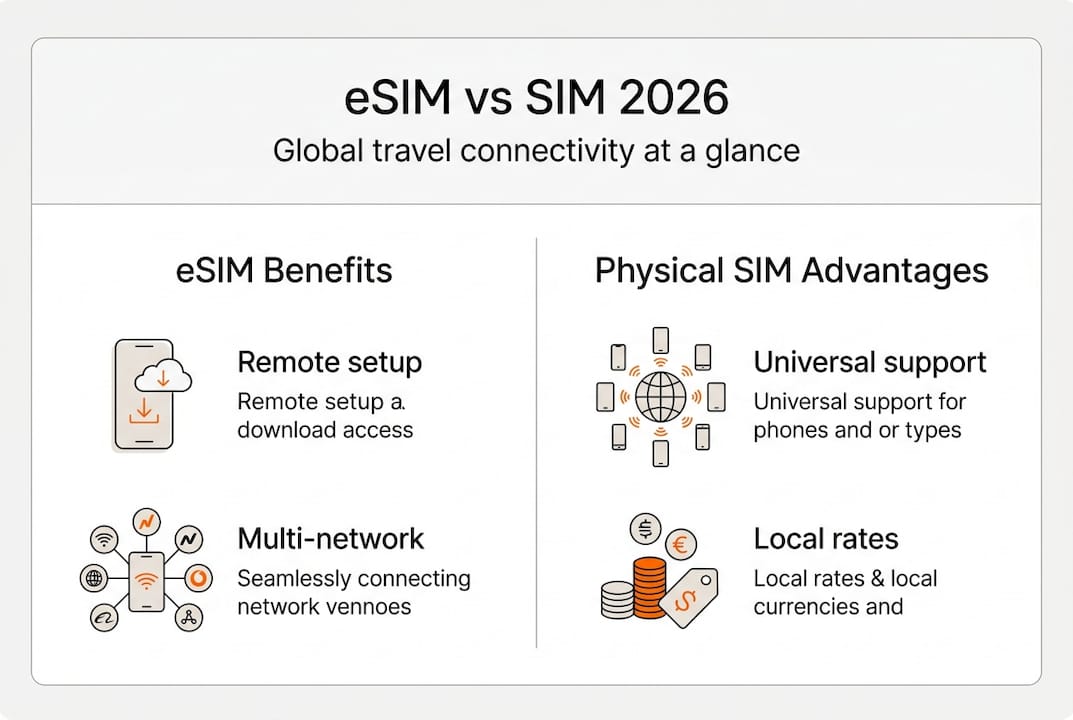
eSIM travel plans cost around $15 to $50 for 1GB to 10GB of data valid across multiple countries, while roaming charges from traditional carriers can hit $5 to $15 per day. A two-week European trip on roaming could cost $70 to $210 versus $25 to $40 for a comparable eSIM plan. Local physical SIMs purchased in-country often beat both options for long stays, offering monthly plans with 20GB or more for $10 to $30 depending on the region.
| Option | Typical Cost | Data Allowance | Best For |
|---|---|---|---|
| eSIM travel plan | $15 to $50 | 1GB to 10GB | Short trips across multiple countries |
| Home carrier roaming | $5 to $15 per day | Unlimited or capped daily | Occasional brief travel |
| Local physical SIM | $10 to $30 monthly | 20GB to unlimited | Extended stays in one country |
Instant activation gives eSIMs a convenience edge over physical cards. You purchase an eSIM plan online before departure, receive a QR code via email, scan it on arrival, and connect immediately. Physical SIMs require finding a local carrier store, navigating language barriers, providing identification, and waiting for activation, which can consume hours of your first travel day. Roaming fees versus eSIM comparisons show eSIMs save both money and time for typical tourist itineraries.
Flexibility matters when your plans change mid-trip. eSIM platforms let you top up data or switch regions through apps without visiting stores. Physical SIMs lock you into one carrier’s coverage area, forcing new card purchases if you cross borders frequently. Business travelers hopping between countries weekly find eSIMs far more practical than managing a collection of physical cards.
Pro Tip: Buying a local physical SIM becomes the most cost-effective choice when you plan stays exceeding three weeks with heavy data consumption for remote work or streaming.
Daily roaming fees accumulate quickly, turning a month abroad into a $150 to $450 connectivity expense. Fixed-cost eSIM or physical SIM monthly plans cap your spending predictably. Affordable travel data plans through eSIM providers often include regional bundles covering entire continents at flat rates, eliminating per-country pricing complexity.
Compatibility, coverage, and technical limitations to consider
Device eligibility creates the first major hurdle for eSIM adoption. eSIMs have limited support on older devices and face banned use in some regions, while physical SIMs provide universal compatibility across nearly all phones and countries. If your smartphone launched before 2018 or falls into the budget category, it likely lacks eSIM capability entirely. Physical SIM cards work with flip phones from 2005 and flagship devices from 2026 equally well.

Geographic restrictions complicate eSIM reliance in certain markets. China heavily restricts eSIM use for foreign visitors, requiring physical SIM cards for reliable connectivity. Some Middle Eastern and African nations limit eSIM activation to residents only, blocking tourist access. Physical SIMs remain available for purchase at airports and shops in these regions, providing guaranteed connectivity regardless of local eSIM policies.
Voice and SMS support varies dramatically between eSIM travel plans and physical SIMs. Many eSIM offerings provide data-only service, requiring you to use internet-based calling apps for voice communication. Physical SIMs from local carriers include traditional voice minutes and text messaging as standard features. If you need to receive verification codes via SMS or make calls to local businesses, confirm your eSIM plan supports these functions or carry a physical SIM backup.
| Feature | eSIM | Physical SIM |
|---|---|---|
| Activation method | QR code scan or app download | Insert card and restart device |
| Device requirement | Post-2018 eSIM-compatible phone | Any phone with SIM tray |
| Voice/SMS | Often data-only on travel plans | Full voice and SMS included |
| Regional restrictions | Banned in some countries | Universally accepted |
| Switching carriers | Instant through settings | Requires physical card swap |
Activation issues occasionally plague eSIM setups despite their digital convenience:
- QR codes may fail to scan properly in low light or with damaged screens
- Network provisioning can delay for hours if carrier systems experience outages
- Incorrect APN settings sometimes prevent data connections even after successful profile installation
- Some eSIM plans require stable WiFi during activation, creating chicken-and-egg problems at airports
Physical SIM cards avoid these digital complications. You insert the card, wait for network registration, and start using service within minutes. The tactile, mechanical process proves more reliable when you lack internet access for downloading eSIM profiles. Physical SIMs also serve as excellent backups, fitting into a second device or dual SIM slot to ensure you never lose connectivity completely.
Pro Tip: Confirm your specific device model supports eSIM technology before relying solely on it during international travel by checking manufacturer specifications or carrier compatibility lists.
eSIM security generally matches physical SIM protection since both use similar encryption for network authentication. The main difference lies in theft scenarios: stealing your eSIM requires compromising your device and account credentials, while physical SIMs can be removed from unattended phones. International travel tech tips recommend enabling device locks and two-factor authentication to protect eSIM profiles from unauthorized access.
Practical tips for choosing and using eSIM or physical SIM on your trips
Deciding between eSIM and physical SIM requires evaluating your specific travel patterns, device capabilities, and destinations. Follow this practical checklist to make informed choices that optimize connectivity and costs for your journeys in 2026.
Start by assessing your trip duration and data needs. Stays under two weeks across multiple countries strongly favor eSIM plans for their convenience and competitive regional pricing. Extended visits exceeding three weeks in one nation make local physical SIMs more economical, especially if you consume heavy data for work or entertainment. Weekend getaways may work fine with your home carrier’s roaming if daily fees stay reasonable.
Verify device compatibility before departure. Check your phone’s settings menu for eSIM or cellular plan options, or consult manufacturer documentation. Devices lacking eSIM support leave physical SIM as your only choice. Dual SIM phones offer the best flexibility, letting you combine a home physical SIM with travel eSIM profiles or run two eSIMs simultaneously on newer models.
Research destination restrictions and carrier availability. Some countries ban eSIM use for visitors or offer limited eSIM provider options, making physical SIMs necessary. Review travel forums and carrier websites to confirm eSIM services operate in your target regions. Physical SIMs remain the universal fallback when eSIM access proves uncertain.
Carry a physical SIM backup even if you primarily use eSIM technology. Purchase an inexpensive local SIM upon arrival and keep it as insurance against eSIM activation failures or network issues. This redundancy costs little but prevents complete connectivity loss if your eSIM encounters problems. Store backup SIMs in your wallet or passport holder for easy access.
Best practices for avoiding roaming charges in 2026 using eSIM technology:
- Purchase and install eSIM profiles before leaving home while connected to reliable WiFi
- Disable home carrier data roaming in settings to prevent accidental expensive charges
- Activate travel eSIM profiles immediately after landing to establish local network connections
- Monitor data usage through carrier apps to avoid exceeding plan limits and triggering overage fees
- Download offline maps and content before trips to reduce data consumption needs
- Switch between multiple eSIM profiles as you cross borders to maintain optimal rates
Pro Tip: Use your phone’s settings to quickly toggle between multiple eSIM profiles when hopping countries, selecting the profile with the best rates for each destination without visiting carrier stores.
Activating and switching eSIM profiles remotely happens through simple steps. Open your device’s cellular or mobile data settings, select add cellular plan or eSIM, then scan the QR code provided by your carrier or enter activation details manually. The profile downloads and installs within seconds over WiFi or existing data connections. Switching between installed profiles requires tapping your preferred plan in settings and designating it for cellular data use.
Avoiding roaming fees becomes straightforward when you plan ahead. Compare eSIM provider pricing against your home carrier’s roaming rates and local physical SIM costs for your destinations. Book eSIM plans offering the best value for your itinerary, install them before departure, and activate upon arrival. This proactive approach eliminates surprise charges and ensures reliable connectivity from the moment you land.
Consider your communication needs beyond data. If you must receive SMS verification codes for banking or two-factor authentication, confirm your eSIM plan supports SMS or maintain your home physical SIM active in a dual SIM setup. Data-only eSIMs work fine for travelers comfortable using internet-based messaging and calling apps exclusively.
Explore Lumo’s global eSIM plans for seamless travel
Now that you understand when eSIMs outperform physical SIMs and how to choose the right option, consider how Lumo’s instant global data plans simplify international connectivity. Lumo offers eSIM service covering over 160 countries with immediate activation through QR codes, eliminating the hassle of hunting for local SIM cards or paying excessive roaming fees.
The platform lets you purchase, install, and manage multiple eSIM profiles through intuitive apps, giving you the flexibility to switch carriers as you travel without visiting physical stores. This approach delivers significant cost savings compared to traditional roaming while maintaining high-speed 5G and 4G connectivity across diverse regions. You can manage multiple eSIM profiles effortlessly, loading plans for different countries before your trip and activating them as needed.
Pro Tip: Lumo helps travelers avoid roaming fees entirely while staying connected across borders, offering transparent pricing and instant activation that beats the complexity of physical SIM card purchases abroad.
Explore Lumo’s flexible data packages designed specifically for modern travelers and remote workers who demand reliable global connectivity without the traditional SIM card limitations. The service provides comprehensive guidance on avoiding roaming fees while delivering the convenience and affordability that make eSIM technology the preferred choice for frequent international trips in 2026.
Frequently asked questions about eSIM and physical SIM for travelers
Can I use both eSIM and physical SIM on the same phone?
Yes, most modern dual SIM phones let you run one eSIM and one physical SIM simultaneously, or even two eSIMs on newer models. You can designate which SIM handles cellular data, calls, and messages independently through settings. This setup provides excellent flexibility, letting you maintain your home number on a physical SIM while using an eSIM for affordable travel data.
Which is better for long-term stays abroad?
Local physical SIM cards typically offer better value for stays exceeding three weeks because you access domestic pricing instead of tourist-focused eSIM rates. Monthly plans from local carriers often include more data at lower costs than extended eSIM packages. However, eSIMs work well if you frequently move between countries during a long trip, avoiding the need to purchase new physical SIMs at each border.
Are there any countries where eSIM won’t work?
China heavily restricts eSIM use for foreign visitors, and several Middle Eastern and African nations limit eSIM activation to residents only. Always research your destination’s eSIM policies before relying exclusively on this technology. Physical SIM cards remain available and functional in these restricted regions, providing guaranteed connectivity regardless of local eSIM regulations.
How secure are eSIM profiles compared to physical SIMs?
eSIM profiles use the same encryption standards as physical SIMs for network authentication, providing equivalent security for your cellular connections. The main difference involves theft scenarios: physical SIMs can be removed from stolen phones easily, while eSIMs require compromising both your device and account credentials. Enable device locks and two-factor authentication to protect eSIM profiles from unauthorized access.
What should I do if my device doesn’t support eSIM?
Purchase local physical SIM cards at your destination or use your home carrier’s roaming services if your device lacks eSIM capability. Many airports and convenience stores sell prepaid physical SIMs with tourist-friendly data packages. Alternatively, consider upgrading to an eSIM-compatible device before your next major trip to access the convenience and cost benefits of modern eSIM technology.
Recommended
Related Topics
Stay Connected Anywhere
Get instant eSIM data plans for 160+ countries. No physical SIM required.