Network Coverage in 2026: What You Need to Know

Where does 5G and LTE coverage stand in 2026?
A large majority of the US population now lives in an area with 5G coverage. That headline number is real, but it obscures a more complicated picture worth understanding before you pick a plan or make a business connectivity decision.
- T-Mobile leads US 5G availability at 96.1%, followed by Verizon at 89.0% and AT&T at 88.2%, per RootMetrics testing across more than 3 million samples in the first half of 2026.
- Low-band 5G reaches over 300 million Americans, meaning virtually everyone in the country can get a 5G signal from at least one carrier.
- Mid-band 5G, the band that actually delivers fast speeds, covers 210–300 million people in the US. That gap between low-band and mid-band reach is where most real-world frustrations live.
- LTE remains the backbone in rural and underserved areas. A 5G icon on your phone does not guarantee standalone 5G; most connections still rely on non-standalone (NSA) architecture anchored to 4G infrastructure.
- Rural gaps persist. The FCC’s December 2025 Broadband Data Collection update confirmed that mid-band coverage drops sharply outside metro areas, leaving rural users on low-band 5G with speeds barely distinguishable from LTE.
- Urban performance is strong. Both T-Mobile and Verizon recorded median download speeds above 200 Mbps in 123 of 125 major US cities tested in the first half of 2026.
The combined nationwide median download speed across all three major carriers reached 334 Mbps in the first half of 2026, up from around 192 Mbps in the same period two years prior. Speed is no longer the bottleneck in most cities. The real story now is reliability, architecture, and the widening gap between urban and rural experience.
8 key trends shaping mobile networks in 2026
1. Standalone 5G is finally moving from pilot to production
The shift from non-standalone (NSA) to standalone (SA) 5G is the single most consequential network change of 2026. NSA 5G borrows a 4G core for signaling, which caps latency improvements and blocks features like network slicing. SA 5G operates independently, cutting latency and enabling dedicated connectivity lanes for specific applications. Verizon, for example, had 86.3% of its 5G samples using C-band in metro areas in Q2 2026 and is actively migrating to SA architecture. Globally, the number of commercial 5G SA network slicing offerings grew from 65 to 84 in just six months.
2. AI is changing how networks handle traffic
AI is not just a feature running on 5G networks. It is actively reshaping how those networks allocate resources. According to the Ericsson Mobility Report June 2026, uplink data is growing faster than downlink as AI-driven applications push more data from devices to the cloud. That flips the traditional assumption that networks should optimize for download speed, forcing carriers to rethink capacity planning from the ground up.
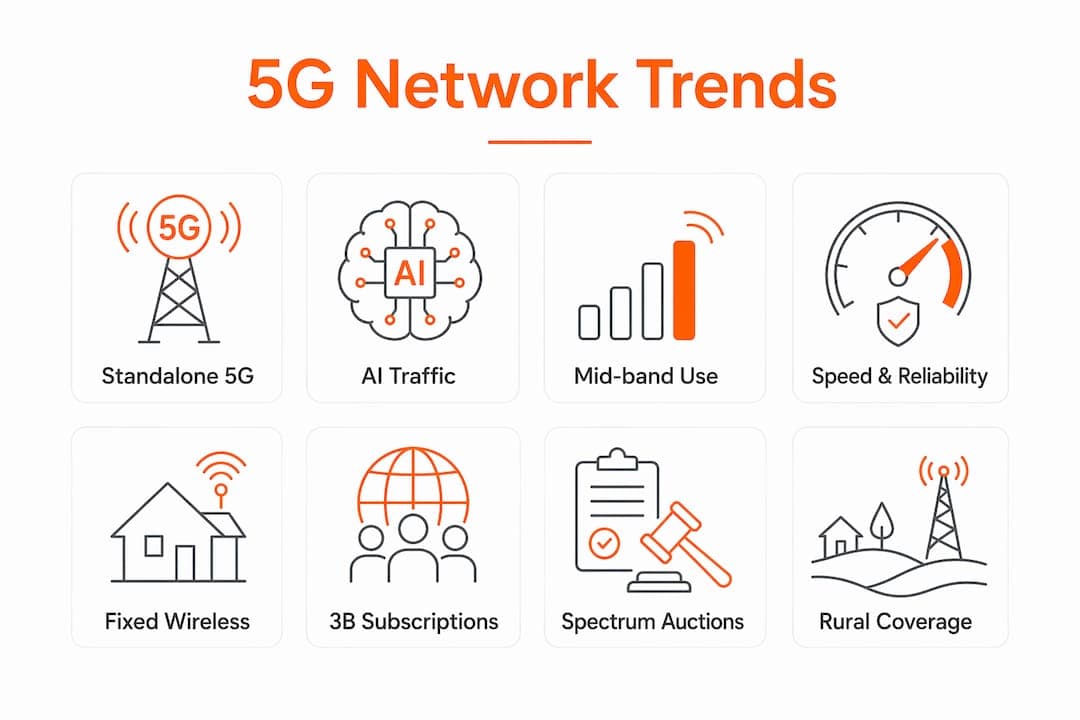
3. Mid-band spectrum is the competitive battleground
Low-band spectrum (600 MHz, 700 MHz) covers vast geography but tops out at modest speeds. mmWave delivers gigabit performance but barely penetrates walls and covers only a few city blocks. Mid-band, particularly the 2.5 GHz and C-band (3.7–3.98 GHz) range, hits the sweet spot. T-Mobile’s early acquisition of Sprint’s 2.5 GHz holdings gave it a structural mid-band advantage that competitors are still closing. AT&T has been deploying 3.45 GHz spectrum acquired from UScellular and is pursuing additional mid-band holdings from EchoStar to close that gap.
4. Speed records are being set, but reliability is what carriers now compete on
Median download speeds across the Big Three surpassed 300 Mbps nationally in the first half of 2026. At that level, raw speed stops being a meaningful differentiator for most users. The JD Power 2026 US Wireless Network Quality Study found that network problems per 100 connections reached a record low, and user priorities have shifted toward reliability and use-case-specific performance, such as consistent gaming latency or uninterrupted video calls, rather than peak download figures.

5. Fixed Wireless Access is growing into a real broadband alternative
Around 70% of FWA service providers now offer the service over 5G. For households in areas underserved by cable or fiber, 5G home internet has become a practical option, not a compromise. T-Mobile and Verizon have both pushed FWA aggressively, and the combination of mid-band speeds and SA architecture makes the product more competitive than it was even 18 months ago.
6. Global 5G subscriptions have crossed 3 billion
Globally, 5G subscriptions passed the 3 billion mark, and half of all mobile data traffic worldwide now runs over 5G. In North America specifically, 59% of smartphone subscriptions are already on 5G networks. That penetration figure will keep rising mechanically as pre-5G devices age out and every new flagship sold since 2020 is 5G-capable by default.
7. Spectrum auctions and acquisitions are reshaping carrier positions
AT&T’s deployment of EchoStar’s 3.34 GHz mid-band spectrum and its 3.45 GHz licenses from UScellular are already showing up in speed tests. Verizon was the top bidder in the FCC’s AWS-3 auction and is adding C-band capacity. T-Mobile acquired UScellular assets and is deploying additional C-band spectrum won at auction in 2021. These moves are not abstract; they translate directly into faster speeds and better indoor coverage in the markets where new spectrum goes live. Telecom infrastructure transformations like these are well documented in industry case studies tracking how carriers convert spectrum holdings into real-world network gains.
8. The rural coverage gap is a policy problem, not just a technical one
The FCC’s updated Broadband Data Collection maps make clear that the remaining unserved areas are not an oversight. They are geographically large but sparsely populated, making tower deployment economically difficult without public subsidy. Federal programs targeting rural broadband are pushing carriers to extend mid-band coverage beyond metro areas, but the pace is slow. A consumer in rural Kentucky may see a 5G indicator on their phone while experiencing speeds that a Chicago resident on T-Mobile’s 2.5 GHz network would find unrecognizable.
How do T-Mobile, Verizon, and AT&T compare in 2026?
The three major US carriers each lead in a different dimension, and the right choice depends entirely on where you use your phone.
| Carrier | 5G availability | Geographic land coverage | Median download speed (1H 2026) | Strength |
|---|---|---|---|---|
| T-Mobile | 96.1% | — | 334 Mbps | Population coverage, mid-band speed |
| Verizon | 89.0% | — | 334 Mbps | Rural reach, reliability, video performance |
| AT&T | 88.2% | Not publicly listed | — | Enterprise, southern/central US, reliability |
T-Mobile’s 96.1% 5G availability aligns with a nationwide median download speed of 334 Mbps in the first half of 2026, matching the combined performance across all carriers. Verizon leads in geographic land coverage across a significant portion of US territory, which matters most for travelers and rural residents. AT&T won the most Metro Area RootScore Awards for network reliability and call performance in the first half of 2026, and its FirstNet network gives it a structural advantage in enterprise and public safety markets.
“No carrier universally dominates, and the ‘best’ network depends largely on where a person or business operates.” — FCC Broadband Data Collection, December 2025
Urban performance has converged sharply. Both T-Mobile and Verizon hit median download speeds above 200 Mbps in 123 of 125 major cities, and AT&T crossed that threshold in 110 of the same markets. For someone living in a major metro, the practical difference between carriers is smaller than the marketing suggests. Local tower placement and spectrum holdings matter more than national averages, which is why city-specific testing tools like Ookla’s Speedtest or the FCC National Broadband Map give a more accurate picture than carrier coverage maps alone.
Pro Tip: Before switching carriers, run speed tests at your home, office, and regular commute points using Ookla’s Speedtest app. Carrier maps show coverage boundaries, not actual performance, and a neighbor’s experience on a different carrier is often more predictive than any map.
What 2026 network advances mean for you and your business
Near-universal 5G availability changes the baseline expectation for mobile connectivity. For most users in urban and suburban areas, 5G is now the default, not a premium feature. Understanding what that means in practice requires looking past the coverage percentage and into the architecture underneath. You can explore the full picture of what 5G connectivity actually delivers in real-world conditions.
- Standalone 5G unlocks real latency gains. SA architecture cuts round-trip latency significantly compared to NSA, which matters for video calls, cloud gaming, and real-time business applications. If your carrier has not yet deployed SA in your area, the 5G icon on your phone is not delivering the full benefit.
- Network slicing is an enterprise opportunity. SA 5G allows carriers to carve out dedicated connectivity lanes with guaranteed bandwidth and latency for specific applications. Logistics, healthcare, and manufacturing operations can negotiate service-level agreements that were impossible on shared LTE networks.
- Reliability metrics now outrank speed. The JD Power data showing record-low problems per 100 connections reflects a network maturity where dropped calls and stalled video streams are the real pain points, not whether you can hit 400 Mbps on a speed test.
- Device readiness still matters. Fifty-nine percent of North American smartphone subscriptions are on 5G, but that means roughly four in ten users are still on 4G devices. If you are on an older handset, upgrading to a 5G-capable device is the single fastest way to improve your mobile experience, regardless of which carrier you use.
- For travelers and remote workers, the shift to global 5G coverage means faster, more reliable data access across more destinations. Lumo’s eSIM platform lets you tap into local 5G and 4G networks in over 160 countries without swapping physical SIMs or paying roaming fees.
Pro Tip: When evaluating a plan for business use, ask your carrier specifically whether SA 5G and network slicing are available in your operating area. Most carrier sales conversations default to coverage maps, but the architecture question is what determines whether advanced enterprise features are actually accessible to you.
Key Takeaways
The defining story of network coverage in 2026 is not that 5G exists everywhere, but that the quality gap between urban mid-band 5G and rural low-band 5G has become the central challenge for carriers, regulators, and users alike.
| Point | Details |
|---|---|
| 5G availability exceeds 90% in the US | T-Mobile leads at 96.1%, with Verizon at 89.0% and AT&T at 88.2% nationally. |
| Mid-band coverage is the real differentiator | Low-band 5G covers 300 million Americans; mid-band reaches only 210–300 million, with rural gaps persisting. |
| Speeds have surged nationally | Combined median download speed across the Big Three reached 334 Mbps in the first half of 2026. |
| Standalone 5G unlocks new capabilities | SA architecture enables network slicing and lower latency, with commercial offerings growing from 65 to 84 globally in six months. |
| Reliability now drives carrier competition | JD Power data shows record-low network problems per 100 connections, shifting user focus from speed to consistency. |
Recommended
Related Topics
Stay Connected Anywhere
Prepaid eSIM data plans for 180+ countries and territories. No physical SIM required.