What is 5G connectivity: Complete guide for 2026

Most people think 5G just means faster download speeds on your phone. That’s a dangerous oversimplification. 5G represents a fundamental shift in how devices connect, communicate, and enable modern lifestyles. For travelers and remote workers, understanding what 5G connectivity truly means unlocks opportunities for seamless productivity across continents. This guide breaks down the core technologies powering 5G, explains how network architecture affects your real-world experience, and shows you how to leverage this connectivity revolution for travel and remote work in 2026.
Table of Contents
- Understanding The Core Technologies Behind 5G Connectivity
- 5G Network Architecture And Performance: What It Means For Travelers And Remote Workers
- Global 5G Speeds And Standalone (Sa) Network Availability In 2026
- Practical Applications Of 5G Connectivity For Travel And Remote Work In 2026
- Discover Hassle-Free Global Data With Lumo Esim
- Frequently Asked Questions About 5G Connectivity
Key takeaways
| Point | Details |
|---|---|
| Core technologies | 5G uses mmWave antennas, massive MIMO, and ultra-dense networks to deliver faster speeds and lower latency. |
| Network architecture | Standalone 5G (5G SA) delivers significantly better performance than non-standalone versions, with 52% faster median speeds globally. |
| Global performance | The GCC leads with 1.13 Gbps median speeds, while the US achieves 404 Mbps and Europe trails at 205 Mbps. |
| Real-world reliability | Signal reliability proves decent across major US interstate routes, though performance varies significantly by location and carrier. |
| Practical applications | 5G enables reliable video conferencing, faster file transfers, and efficient multi-device connectivity critical for remote work. |
Understanding the core technologies behind 5G connectivity
Three fundamental technologies power 5G’s performance leap over previous generations. Each addresses specific technical challenges that limited 4G networks.
Millimeter-wave (mmWave) antennas operate at high frequencies between 24 and 40 GHz, delivering the bandwidth needed for lightning-fast data rates. These antennas solve the spectrum congestion problem that plagued 4G networks in crowded urban areas. However, mmWave signals face significant challenges. High-frequency waves suffer from severe path loss, meaning they can’t penetrate buildings or travel long distances effectively.
Atmospheric conditions further complicate mmWave deployment. Rain, humidity, and even oxygen molecules absorb these signals. Engineers compensate using beamforming technology, which focuses radio waves into narrow, targeted beams rather than broadcasting in all directions. This technique dramatically improves signal strength and reliability where mmWave is available.
Massive MIMO technology deploys large antenna arrays with 64, 96, or even 128+ elements at cell sites. These arrays simultaneously serve multiple users while maintaining high signal quality for each connection. The technology increases network throughput without requiring additional spectrum, a critical advantage in crowded environments like airports, hotels, and conference centers where remote workers congregate.
Ultra-dense network (UDN) deployments place small cells every few hundred meters in urban areas. These compact base stations work together to blanket cities with consistent 5G coverage. Each small cell covers a smaller area than traditional cell towers but provides dramatically higher capacity. This architecture is essential for delivering reliable service in high-traffic zones.
Key technologies enabling 5G include:
- mmWave antennas for high-bandwidth connections at 24-40 GHz frequencies
- Beamforming to overcome signal loss and atmospheric absorption
- Massive MIMO arrays with 64-128+ antenna elements for improved throughput
- Ultra-dense small cell networks for comprehensive urban coverage
- Advanced signal processing to manage interference and optimize connections
Pro Tip: When traveling, prioritize accommodations and workspaces in downtown areas where ultra-dense small cell deployments provide the most reliable mmWave coverage, especially if you need consistent high-speed connectivity for video calls or large file transfers.
Understanding how the role of eSIM in future connectivity intersects with these technologies helps you maximize 5G benefits across different devices and locations.
5G network architecture and performance: What it means for travelers and remote workers
Network architecture determines whether you get true 5G performance or just a fancy icon on your phone. The distinction matters enormously for real-world use.
Standalone (SA) 5G networks represent the complete implementation of 5G technology. These networks use a 5G core infrastructure end to end, enabling all the advanced features the standard promises. Non-standalone (NSA) 5G networks rely on existing 4G infrastructure for core network functions, adding 5G radio access as an overlay. This hybrid approach was faster to deploy but compromises performance.

Latency defines how quickly your device communicates with network servers. Real-world 5G testing shows latencies below 58 ms on average, with occasional spikes up to 800 ms during handoffs or congestion. For comparison, 4G latency typically ranges from 30 to 50 ms. The improvement enables smoother video conferencing and more responsive cloud applications, though the difference feels less dramatic than speed increases.
Coverage reliability varies dramatically by location and carrier. Interstate testing across the US revealed generally good to decent signal reliability for major carriers on primary routes. However, performance drops significantly in rural areas and smaller highways. This geographic disparity creates challenges for digital nomads and road-tripping remote workers.
Network architecture influences deployment strategies and user experience more than raw speed specifications. Carriers prioritize different coverage areas and technologies based on their infrastructure investments. Some focus on mmWave deployments in major cities, while others emphasize broader mid-band coverage.
Critical network elements affecting your experience include:
- Core network infrastructure (SA versus NSA architecture)
- Spectrum bands deployed (low-band, mid-band, or mmWave)
- Small cell density in your location
- Backhaul capacity connecting cell sites to the internet
- Device compatibility with specific 5G frequency bands
Understanding the role of eSIM in connectivity becomes crucial when navigating these network variations across different countries and carriers during international travel.
Global 5G speeds and standalone (SA) network availability in 2026
Standalone 5G networks deliver the technology’s full potential by eliminating dependence on 4G infrastructure. These networks provide 52% faster speeds than non-standalone implementations globally, making them essential for bandwidth-intensive remote work tasks.
Global 5G SA deployment reached 17.6% availability in Q4 2025, with median speeds of 269.51 Mbps. This represents significant progress but highlights how much of the world still relies on slower non-standalone networks. Regional performance varies enormously based on infrastructure investment and government prioritization.
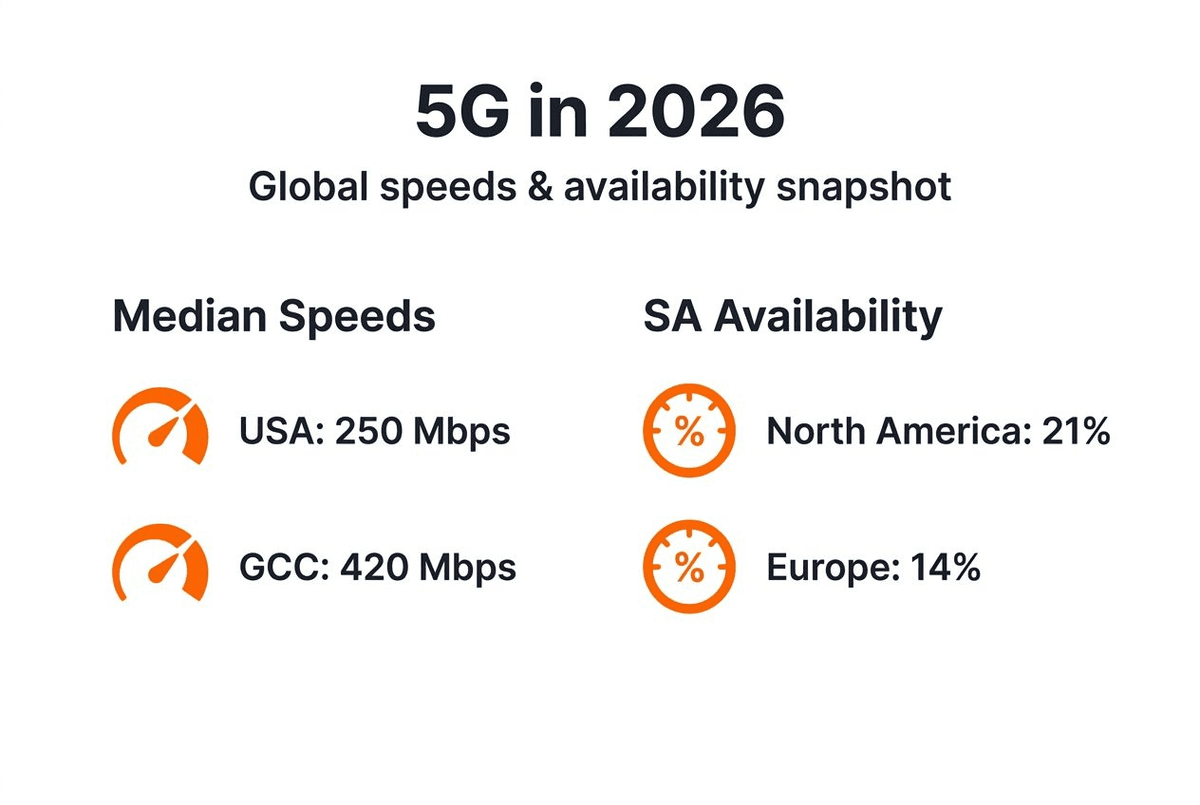
| Region | Median 5G SA Download Speed | 5G SA Availability | Notes |
|---|---|---|---|
| GCC (Gulf Cooperation Council) | 1.13 Gbps | ~25% | Fastest globally, aggressive deployment |
| South Korea | 767 Mbps | ~30% | Mature network, high device adoption |
| United States | 404 Mbps | ~15% | Mixed deployment, carrier variation |
| Europe | 205 Mbps | ~12% | Slower rollout, regulatory challenges |
These speed differences directly impact user experience. In the GCC, you can download a 4GB file in under 30 seconds on 5G SA. The same download takes over two minutes in Europe on typical 5G connections. For remote workers managing video projects, transferring design files, or backing up data, these differences translate to hours saved weekly.
Network maturity continues advancing rapidly in 2026. Countries with early 5G SA deployments now focus on expanding coverage beyond major cities. Second-wave markets accelerate deployment to remain competitive for business travel and digital nomad destinations. This creates a dynamic landscape where connectivity quality can vary dramatically between neighboring countries.
Travelers should research network performance at destinations before committing to extended stays. Exploring top global data solutions helps identify regions where 5G SA networks provide the connectivity quality essential for productive remote work.
Practical applications of 5G connectivity for travel and remote work in 2026
Theory matters little if technology doesn’t solve real problems. Here’s how 5G connectivity transforms daily experiences for travelers and remote professionals.
-
Lightning-fast file transfers and cloud synchronization: Upload client presentations, design files, or video content in seconds rather than minutes. 5G speeds eliminate the waiting game when sharing large documents from coffee shops or coworking spaces.
-
Crystal-clear video conferencing from anywhere: Stable, high-bandwidth connections support 4K video calls without freezing or pixelation. You can participate in critical meetings from hotel rooms, airports, or remote locations with professional quality.
-
Seamless multi-device productivity: 5G multi-connectivity supports simultaneous connections across laptops, tablets, and smartphones without performance degradation. Switch between devices mid-task without interrupting workflows or losing connection quality.
-
Reliable real-time collaboration tools: Low latency enables smooth use of cloud-based design software, collaborative documents, and project management platforms. Multiple team members can edit shared files simultaneously without lag-induced conflicts.
-
Consistent connectivity during transit: Advanced network handoff capabilities maintain connections as you move between cell sites on trains, buses, or as a passenger in vehicles. Work productively during commutes without constant disconnections.
-
Enhanced streaming and content consumption: Download entertainment for flights or stream high-quality content during downtime without buffering. This matters for maintaining work-life balance while traveling.
Data transmission optimization technologies like Kafka demonstrated superior performance over 5G networks, improving how applications handle data streams. This technical advancement translates to smoother app experiences and more efficient battery usage when connected to 5G.
Pro Tip: Leverage multi-device eSIM connectivity to maintain 5G access across all your devices without juggling multiple physical SIM cards or relying on hotspot connections that drain battery and reduce speeds.
The combination of high speeds, low latency, and reliable connectivity removes traditional barriers to remote work. You can maintain productivity standards anywhere with quality 5G coverage, expanding location options dramatically.
Discover hassle-free global data with Lumo eSIM
Understanding 5G technology means little without reliable access to these advanced networks wherever you travel. Traditional SIM cards create friction with physical swaps, carrier contracts, and coverage gaps.
Lumo eSIM eliminates these barriers with instant digital data plans across 160+ countries. Activate 5G connectivity within minutes using QR codes, no physical cards required. The platform supports multiple eSIM profiles, letting you switch between regional carriers to access the strongest 5G networks available.

Lumo’s multi-device support extends 5G benefits across smartphones, tablets, and laptops simultaneously. Access the same high-speed connectivity on every device without hotspot compromises. The role of eSIM in connectivity continues expanding as more devices integrate eSIM capability, making digital profiles the future-proof choice.
For remote workers and digital nomads, multi-device eSIM connectivity ensures consistent productivity across your entire tech ecosystem. Maintain video call quality, file transfer speeds, and cloud sync performance regardless of location.
Pro Tip: Before international travel, pre-load Lumo eSIM profiles for your destinations to guarantee immediate 5G access upon arrival, eliminating the stress of finding local SIM cards or dealing with expensive roaming charges.
Frequently asked questions about 5G connectivity
What distinguishes 5G from previous generations of mobile networks?
5G delivers dramatically higher speeds, lower latency, and greater device density than 4G networks. The technology uses advanced antenna systems, new frequency bands, and improved network architecture to support bandwidth-intensive applications. Where 4G maxed out around 100 Mbps in real-world conditions, 5G routinely exceeds 400 Mbps with peaks over 1 Gbps in optimal deployments.
How does 5G ultra-dense network deployment impact coverage?
Ultra-dense networks place small cells every few hundred meters in urban areas, dramatically increasing capacity and reliability. Each small cell covers less area than traditional towers but serves more users with higher speeds. This deployment strategy works best in cities and high-traffic zones but leaves rural areas dependent on traditional macro cell towers with more limited 5G capabilities.
What is the significance of 5G standalone (SA) versus non-standalone networks?
Standalone 5G networks use dedicated 5G infrastructure end to end, delivering full performance potential with lower latency and higher speeds. Non-standalone networks rely on existing 4G core infrastructure, limiting capabilities and performance. SA networks provide 52% faster speeds on average and enable advanced features like network slicing that NSA architectures cannot support.
How can travelers ensure continuous 5G connectivity while abroad?
Research network coverage at destinations before traveling, focusing on carriers with standalone 5G deployments. Use eSIM solutions that support multiple carrier profiles so you can switch to the strongest available network. Download coverage maps for your destination cities and plan accommodations near areas with confirmed 5G availability, particularly if you need reliable connectivity for work.
What role does eSIM technology play in accessing 5G networks?
eSIM technology enables instant switching between carriers without physical SIM cards, crucial for accessing the best 5G networks in each location. Most 5G-capable devices now support eSIM, allowing travelers to activate local carrier plans digitally within minutes. This flexibility ensures you can always connect to carriers with superior 5G coverage rather than being locked to a single provider’s network quality.
Recommended
Related Topics
Stay Connected Anywhere
Prepaid eSIM data plans for 180+ countries and territories. No physical SIM required.