Role of eSIM in Future Connectivity Explained

Constantly hopping between airports in Paris, New York, or Berlin often means scrambling for affordable data or swapping SIM cards at every border. Finding a truly seamless solution has become a priority for digital nomads and frequent travelers who make their living in fast-paced creative and tech fields. eSIM technology embeds a secure, programmable profile directly into your device, letting you switch networks and skip roaming hassles worldwide. Discover how adopting eSIM can simplify your connectivity and support work without interruptions no matter where your journey leads.
Table of Contents
- Defining eSIM And Its Core Technology
- Types Of eSIM Profiles And Devices
- How eSIM Enables Global Switching
- Integrating eSIM Into Digital Lifestyles
- Security, Privacy, And Cost-Saving Implications
Key Takeaways
| Point | Details |
|---|---|
| eSIM Technology | eSIM replaces physical SIM cards with an embedded chip, allowing seamless network management and enhanced security. |
| Variety of Profiles | eSIM supports multiple profile types, including Consumer, M2M, and IoT, catering to different connectivity needs. |
| Global Connectivity | eSIM enables instant switching between carriers without physical SIM cards, enhancing international communication capabilities. |
| Security Considerations | eSIM introduces new security challenges that require advanced protection strategies to safeguard user data and privacy. |
Defining eSIM and Its Core Technology
The embedded SIM (eSIM) represents a significant technological leap in mobile connectivity, replacing traditional physical SIM cards with a more flexible and sophisticated digital alternative. Unlike removable SIM cards, an eSIM is a tiny chip permanently integrated into device hardware, enabling seamless network profile management without physically swapping cards.
At its core, eSIM technology operates through a secure, programmable element that allows remote SIM provisioning across multiple mobile networks. This innovative approach provides several key advantages:
- Instant network profile downloads
- Remote carrier profile management
- Support for multiple network subscriptions simultaneously
- Enhanced device security through embedded encryption
- Simplified international mobile connectivity
The technical infrastructure behind eSIM relies on standardized protocols developed by the GSMA, which ensure compatibility and security across different devices and carriers. Standard APIs enable comprehensive eSIM profile management, allowing devices to store and switch between multiple mobile network subscriptions with unprecedented ease.
Network Compatibility is another crucial aspect of eSIM technology. Modern smartphones, tablets, smartwatches, and IoT devices can now support multiple digital carrier profiles, transforming how users interact with mobile networks worldwide.
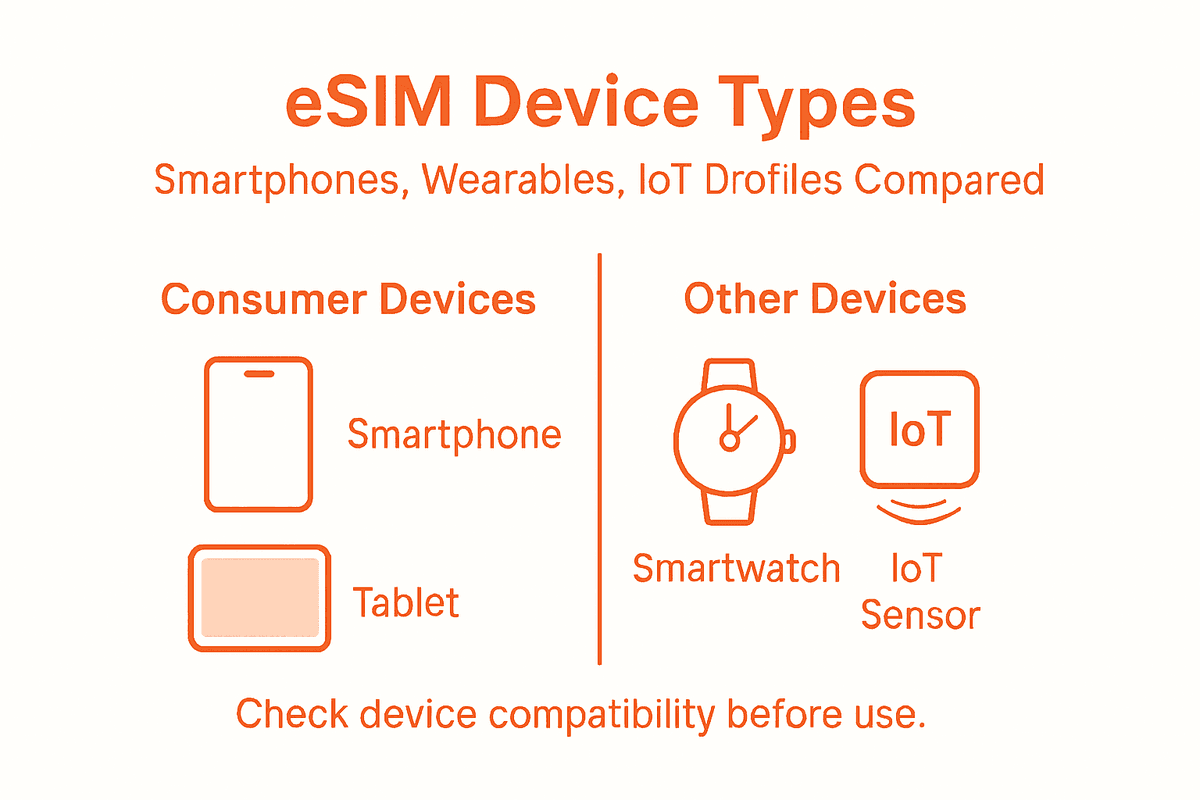
Pro tip: Always verify your device’s eSIM compatibility before traveling to ensure smooth international connectivity.
Types of eSIM Profiles and Devices
The evolution of eSIM technology has introduced multiple profile types tailored to different technological ecosystems and connectivity requirements. eSIM architectures range across three primary categories: Consumer, Machine-to-Machine (M2M), and Internet of Things (IoT), each designed to address specific connectivity challenges.
Consumer eSIM Profiles represent the most familiar type for everyday users, enabling seamless network switching on personal devices like:
- Smartphones
- Tablets
- Smartwatches
- Laptops
- Wireless earbuds
Machine-to-Machine (M2M) eSIM Profiles focus on automated device communication, supporting critical infrastructure and industrial applications such as:
- Automotive emergency communication systems
- Fleet management tracking
- Utility meters
- Remote monitoring equipment
- Agricultural sensors
Internet of Things (IoT) eSIM Profiles cater to low-power, minimal-interface devices requiring scalable and efficient connectivity. These profiles support devices with limited computational resources and network bandwidth.
The versatility of eSIM technology allows multiple network profiles to coexist within a single device, providing unprecedented flexibility for users and businesses alike.
Here’s a quick comparison of eSIM profile types and their typical device applications:
| eSIM Profile Type | Main Purpose | Device Examples | Connectivity Features |
|---|---|---|---|
| Consumer | Personal connectivity for users | Phones, tablets, wearables | Hassle-free switching, multi-profile |
| M2M | Automated communication for industries | Fleet trackers, meters, sensors | Remote management, scalable deployment |
| IoT | Scalable low-power networking | Smart home gadgets, sensors | Efficient bandwidth, minimal interface |
Pro tip: Always check your device manufacturer’s specific eSIM compatibility before purchasing international data plans.
How eSIM Enables Global Switching
Global connectivity transformation represents the core promise of eSIM technology, fundamentally reimagining how mobile networks operate across international boundaries. By embedding digital connectivity directly into device hardware, eSIM eliminates traditional roaming barriers and geographical limitations that have historically constrained mobile communication.
Key Mechanisms of Global Switching include:
- Instant digital network profile downloads
- Remote carrier configuration
- Seamless international signal transitions
- Automatic strongest signal selection
- Zero physical SIM card requirements
The technological breakthrough enables users to dynamically switch between cellular networks without physical intervention. Digital mobile connectivity transforms how travelers, remote workers, and global businesses manage their telecommunications infrastructure.

Network Flexibility emerges as a critical advantage, allowing devices to automatically connect to local carriers with optimal signal strength and most competitive data rates. This intelligent switching happens transparently, creating a frictionless experience for end-users who no longer need to manually configure international plans or purchase local SIM cards.
Pro tip: Research your destination’s cellular networks in advance to maximize your eSIM’s global switching capabilities.
Integrating eSIM into Digital Lifestyles
Digital mobility transformation represents a significant shift in how professionals, students, and global workers manage connectivity across diverse environments. eSIM technology eliminates traditional communication barriers by embedding flexible network profiles directly into personal devices, creating unprecedented opportunities for seamless global interaction.
Key Features of Digital Lifestyle Integration include:
- Instant network profile management
- Multiple carrier support on single device
- Simplified international communication
- Reduced roaming costs
- Enhanced device design flexibility
Universities and professional institutions are increasingly recognizing eSIM’s potential to support modern, mobile-first lifestyles. Borderless communication ecosystems enable students, researchers, and remote workers to maintain consistent connectivity without geographical limitations.
The technology transforms device functionality by removing physical SIM card constraints, allowing manufacturers to create more streamlined, water-resistant hardware. This design evolution supports the growing trend of compact, multifunctional devices that adapt seamlessly to users’ dynamic professional and personal needs.
Pro tip: Choose devices with multi-profile eSIM capabilities to maximize your global connectivity options.
Security, Privacy, and Cost-Saving Implications
Remote provisioning challenges introduce complex security and privacy considerations for eSIM technology. The software-based nature of digital network profiles creates new vulnerabilities that demand sophisticated protection strategies, fundamentally transforming how users and manufacturers approach mobile connectivity security.
Primary Security Concerns include:
- Third-party data routing risks
- Unauthorized profile access
- Potential user data exposure
- Profile lock-in vulnerabilities
- Network authentication challenges
The European cybersecurity landscape highlights critical security governance frameworks necessary to mitigate emerging digital threats. Potential risks such as eSIM swapping attacks and memory exhaustion require proactive management strategies that balance technological innovation with robust user protection.
Cost-saving implications emerge as a significant benefit, with eSIM technology eliminating traditional roaming charges and enabling more flexible, economical international communication. Users can now switch between carriers instantly, reducing expensive international data plans and creating more transparent, competitive mobile service markets.
Explore how eSIM impacts device design, security, and cost savings:
| Aspect | eSIM Impact | Business Benefit | User Benefit |
|---|---|---|---|
| Device Design | Enables compact hardware | Streamlined manufacturing, water resistance | Sleeker gadgets, more durability |
| Security | Requires advanced encryption | Prevent fraud, safeguard data | Protected identity, fewer breaches |
| Cost Savings | Reduces roaming costs | Competitive data rates, flexible plans | Instant switch, lower bills |
Pro tip: Always verify your device’s security settings and enable two-factor authentication when using eSIM technology.
Unlock Seamless Global Connectivity with Lumo’s All-in-One eSIM Solution
The article highlights how eSIM technology revolutionizes mobile connectivity by eliminating roaming barriers and enabling instant network switching across countries. If you struggle with high roaming charges, complex SIM swaps, or limited carrier options while traveling or working remotely, Lumo offers the perfect answer. Our platform supports multiple eSIM profiles on devices like smartphones, tablets, and laptops, giving you the freedom to switch to the best local networks without physical SIM cards or delays.
Experience the convenience of rapid QR code activation and reliable 5G/4G speeds in over 160 countries through Lumo. Say goodbye to costly roaming fees and complicated international plans. Discover how digital lifestyles thrive when connectivity is easy and affordable.
Ready to transform your global mobile experience today Choose Lumo’s innovative eSIM platform to simplify your travel and work connectivity needs. Explore our flexible data plans and enjoy instant activation wherever your journey takes you. Visit https://lumo.to now and take control of your global connections with freedom and confidence.
Frequently Asked Questions
What is eSIM technology and how does it work?
The embedded SIM (eSIM) is a digital alternative to traditional physical SIM cards, allowing remote provisioning and management of mobile network profiles without the need to swap out cards. It enables instant network downloads and supports multiple subscriptions simultaneously.
What types of devices typically use eSIM profiles?
eSIM profiles can be found in various consumer devices such as smartphones, tablets, smartwatches, and laptops, as well as industrial applications like fleet management systems and IoT devices requiring low-power connectivity.
How does eSIM technology facilitate global connectivity?
eSIM technology enables global connectivity by allowing users to easily switch between cellular networks without any physical intervention, automatically selecting the best signal strength and data rates for seamless international communication.
What security precautions should users consider when using eSIM?
Users should be aware of potential security concerns like unauthorized profile access and should implement protective measures such as enabling two-factor authentication and regularly updating their device’s security settings.
Recommended
- Role of eSIM in Telecommunication – Transforming Global Connectivity | Lumo eSIM Store
- Role of eSIM in Connectivity – Why It Matters Now | Lumo eSIM Store
- Remote Work and eSIM: Unlocking True Global Flexibility | Lumo eSIM Store
- Role of Customer Support in eSIM Success | Lumo eSIM Store
- What is Edge AI? Understanding Its Impact and Functionality
Related Topics
Stay Connected Anywhere
Prepaid eSIM data plans for 180+ countries and territories. No physical SIM required.