Mobile Connectivity Trends 2026: What Pros Need to Know

TL;DR:
- By 2026, mobile networks are shaped by mass-market 5G, widespread eSIM adoption, and confirmed 6G standards. Uplink traffic is growing rapidly, requiring carriers to re-balance infrastructure to avoid congestion. Long-term device and infrastructure planning will be crucial, especially for enterprise IoT and industrial applications.
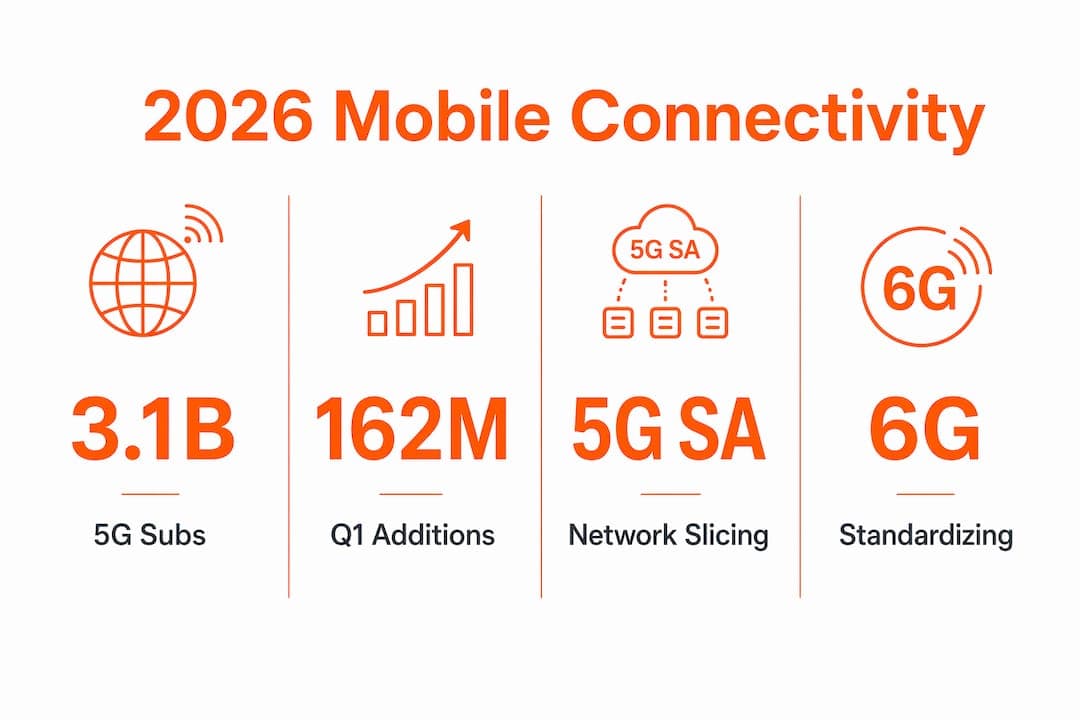
Mobile connectivity trends 2026 are defined by three forces reshaping global networks: 5G subscriptions topping 3.1 billion globally by Q1 2026, eSIM smartphone penetration projected to hit 10% by year’s end, and 6G standardization locked in through 3GPP Release 21. These are not projections anymore. They are operational facts that affect how carriers price services, how enterprises build networks, and how travelers stay connected. For tech professionals and enthusiasts tracking telecom trends in 2026, understanding all three shifts together is the only way to read where the industry is actually heading.
What are the biggest mobile connectivity trends in 2026?

5G is no longer a premium feature. With 162 million new 5G subscriptions added in Q1 2026 alone, the technology has crossed from early adopter territory into mass market reality. That pace of growth means carriers must now compete on service quality, not just coverage maps.
The shift that matters most for enterprises is 5G Standalone (SA) network slicing. Commercial network slicing offerings grew from 65 in late 2025 to 84 by mid-2026, marking a clear move from pilot programs to mainstream deployment. Network slicing lets carriers carve a single physical network into multiple virtual networks, each with guaranteed quality of service for a specific use case. A hospital can get a low-latency slice for remote diagnostics while a logistics firm gets a high-throughput slice for warehouse automation, all on the same infrastructure.
Traffic patterns are also shifting in a way most people have not noticed. Uplink traffic is outpacing downlink at many service providers, driven by collaboration apps, user-generated content uploads, and cloud storage. This matters because most network infrastructure was built assuming users download far more than they upload. Carriers that fail to rebalance their uplink capacity will face congestion exactly where their most active users are most active.
Key drivers reshaping 5G traffic in 2026:
- Collaboration platforms pushing constant video and file uploads during remote work sessions
- AI-driven applications that send data to cloud inference engines rather than processing locally
- User-generated content on short-form video platforms requiring sustained high-speed uplink
- Cloud backup services running continuously in the background on smartphones
Pro Tip: If you manage enterprise connectivity, request uplink capacity guarantees in your next carrier SLA. Most standard contracts still prioritize downlink metrics.
How is eSIM technology changing smartphone connectivity in 2026?
eSIM is the most structurally disruptive shift in smartphone connectivity 2026 has produced. The technology is moving from a niche feature to an operational standard, and the numbers confirm it. Three in four mobile network operators now commercially offer eSIM for smartphones, yet many have not fully activated or promoted it. That gap between launch and promotion is the defining tension in eSIM’s current growth phase.
The deeper technical story is about what eSIM actually enables when it works correctly. Compliant implementations using GSMA SGP.32 standards allow dynamic credential swapping, meaning a device can switch carriers without a physical SIM change and without relying on the home carrier’s roaming agreements. Without SGP.32 compliance, an eSIM-capable device is still functionally locked to its home carrier’s pricing. That distinction separates genuine flexibility from marketing language.
For travelers and globally mobile professionals, the practical steps to benefit from eSIM in 2026 are clear:
- Verify SGP.32 compliance before purchasing a data plan. Not all eSIM plans use dynamic provisioning.
- Check carrier activation status, not just commercial launch. A carrier may list eSIM support but not have activated it for your device model.
- Compare plans through aggregator tools, since the industry is now building a comparison layer for consumers to navigate more than 100,000 available plans.
- Test before you travel. Activate your eSIM profile at home and confirm data connectivity before you land abroad.
Pro Tip: Store a backup eSIM profile from a second carrier on your device before international trips. If your primary plan has a coverage gap, switching takes seconds rather than hunting for a local SIM vendor.
The eSIM vs physical SIM debate is largely settled for new flagship devices. The question now is whether carriers and plan providers have built the back-end infrastructure to deliver on eSIM’s actual promise.
What does 6G standardization mean for future mobile technology?
6G is not a vague future concept anymore. The International Telecommunication Union Radiocommunication Sector (ITU-R) agreed on performance requirements in february 2026, and 3GPP Release 21 confirmed the normative specification timeline: functional freeze in march 2027, final code freeze in march 2029. Device makers now have a firm planning horizon.
| Milestone | Date | Significance |
|---|---|---|
| ITU-R performance requirements agreed | February 2026 | Sets the technical baseline for 6G |
| 3GPP Release 21 functional freeze | March 2027 | Feature set locked for device development |
| 3GPP Release 21 code freeze | March 2029 | Final specs available for hardware production |
The decisions being made right now about 6G migration architecture are the ones that will matter most for long-lifecycle projects. Enterprise IoT deployments and industrial infrastructure planned today will still be running when 6G networks go live. Migration architecture choices in 2026 and 2027 will determine whether those systems can upgrade gracefully or require full replacement. For hardware teams, monitoring 3GPP plenary outcomes this year is not optional. It is a core planning input.
Spectrum considerations are also taking shape. 6G will likely use a combination of sub-6 GHz bands for coverage and higher millimeter-wave bands for capacity, building on lessons from 5G deployment. The exact band allocations will influence antenna design and chipset architecture for devices targeting 2029 and beyond.
How are global data solutions evolving for connected users?
The consumer experience layer of mobile connectivity is catching up to the technology underneath it. eSIM has become a tool for agile data management rather than a mechanism for carrier churn, and the industry’s focus has shifted accordingly. The fear that eSIM would cause mass customer defection has not materialized. Instead, carriers are competing on plan quality and price transparency.
The practical result for globally connected users is a growing set of global data solutions that treat connectivity as a flexible utility rather than a fixed contract. Key developments shaping this shift include:
- Plan aggregation platforms that index and compare plans across carriers in real time
- Regional data bundles that activate automatically when a device crosses a border
- Business-tier eSIM plans with centralized management dashboards for teams managing multiple devices
- Pay-as-you-go data top-ups that eliminate the need to commit to a monthly plan while traveling
The benefits for travelers are direct and measurable. Avoiding roaming fees by switching to a local carrier profile can reduce data costs significantly on international trips. The technology to do this exists today. The remaining barrier is consumer awareness of which plans actually support dynamic switching versus which ones are still tied to home carrier agreements.
Key Takeaways
The dominant force in 2026 mobile connectivity is the convergence of mass-market 5G, operationally scaling eSIM, and a locked 6G standardization timeline that gives the entire industry a clear planning horizon through 2029.
| Point | Details |
|---|---|
| 5G is mainstream | Over 3.1 billion subscriptions globally, with network slicing now commercially available from 84 operators. |
| eSIM has an activation gap | 73% of operators launched eSIM commercially, but many have not fully promoted or activated it for users. |
| GSMA SGP.32 compliance matters | Dynamic credential swapping only works with SGP.32-compliant plans. Verify before purchasing. |
| 6G planning starts now | The 3GPP Release 21 code freeze in march 2029 means hardware decisions made in 2026 will define 6G device readiness. |
| Uplink capacity is the new bottleneck | Uplink traffic is outpacing downlink at many carriers, driven by AI apps and cloud storage behavior. |
Why the eSIM hype cycle is finally over (and that’s good news)
I’ve watched eSIM go through the full hype cycle. The early years were dominated by breathless predictions about the death of physical SIMs and mass carrier churn. Neither happened on the predicted timeline, and that disappointed a lot of people who were tracking the technology closely.
What actually happened is more interesting. eSIM matured quietly into an operational standard while the industry figured out the hard parts: provisioning infrastructure, customer support workflows, and the GSMA SGP.32 compliance layer that makes dynamic switching real rather than theoretical. The technology is now genuinely useful, but only if the plan you buy actually supports what eSIM is supposed to do.
The 6G standardization news is the other thing I think gets underestimated. Most coverage treats the 3GPP Release 21 timeline as a distant future story. For anyone involved in enterprise hardware, IoT infrastructure, or long-cycle device development, the migration architecture decisions happening right now are the most consequential technical choices of the decade. Getting this wrong means expensive retrofits in 2030.
My honest read on 5G network slicing is that it finally makes 5G worth the enterprise investment. “Best effort” data was never going to displace wired infrastructure for critical applications. Guaranteed quality of service through slicing changes that equation completely.
— Bogdan
Lumo eSIM: global data plans built for 2026 connectivity
The shift toward flexible, carrier-independent connectivity is exactly what Lumo was built for. Lumo offers instant global eSIM plans across more than 160 countries, with activation via QR code and no physical SIM required. Plans are designed for travelers and professionals who need reliable data without committing to a single carrier’s roaming rates.
Lumo supports 5G and 4G connectivity depending on local network availability, and its 24/7 customer support means you are not troubleshooting a failed activation alone at an airport. For professionals tracking smart travel connectivity options in 2026, Lumo’s flexible plan structure aligns directly with how mobile data usage patterns are evolving. You pick the coverage you need, activate it instantly, and switch when your needs change.
FAQ
What is driving 5G growth in 2026?
Global 5G subscriptions surpassed 3.1 billion by Q1 2026, with 162 million added in that quarter alone. The primary drivers are expanding carrier coverage, falling device prices, and enterprise adoption of network slicing for guaranteed quality of service.
How does eSIM dynamic switching actually work?
eSIM dynamic switching uses GSMA SGP.32 standards to swap carrier credentials remotely without a physical SIM change. This only functions correctly when both the device and the plan provider support SGP.32 compliant provisioning.
When will 6G networks be available?
3GPP Release 21 sets the functional freeze for 6G specifications at march 2027 and the final code freeze at march 2029. Commercial 6G networks are not expected before 2030 at the earliest.
Why is uplink traffic growth significant for mobile networks?
Uplink traffic is now outpacing downlink at many carriers, driven by cloud storage, AI applications, and video uploads. Most network infrastructure was designed for the opposite pattern, creating a capacity mismatch that carriers must address.
What should travelers look for in an eSIM plan in 2026?
Travelers should verify that a plan supports GSMA SGP.32 dynamic provisioning, confirm the carrier has fully activated eSIM (not just launched it commercially), and test the profile before departing. Plans from providers like Lumo that cover 160-plus countries offer the most flexibility for multi-destination trips.
Recommended
Related Topics
Stay Connected Anywhere
Prepaid eSIM data plans for 180+ countries and territories. No physical SIM required.