Mobile Connectivity Best Practices for Global Travelers

TL;DR:
- Mobile connectivity best practices help travelers maintain reliable, secure, and affordable access worldwide.
- Using an eSIM, disabling battery saver, and reading dBm improve connection quality and stability abroad.
Mobile connectivity best practices are proven techniques that frequent travelers and digital nomads use to maintain reliable, secure, and affordable access worldwide. Poor connectivity abroad costs more than just money. It kills productivity, disrupts calls, and turns a simple video meeting into a frustrating ordeal. The good news is that most connectivity problems are fixable with the right device settings, network choices, and tools like Lumo eSIM. AI-driven carrier improvements from companies like KDDI and Ericsson are also reshaping what travelers can expect from mobile networks in 2026.
1. Disable battery saver mode before you need data
Battery saver mode is the silent killer of mobile connectivity. Modern devices restrict background network activity when battery saver is active, cutting off real-time apps, messaging, and navigation without warning. That means your maps stop updating and your Slack messages stop arriving, even when you have signal. Turn off battery saver whenever you need a stable connection, and manage power through screen brightness instead.
2. Use an eSIM for flexible, roaming-free coverage
Physical SIM cards lock you to one carrier. An eSIM lets you switch to a local data plan the moment you land, without hunting for a SIM shop or paying hotel-lobby prices for roaming. Lumo’s eSIM for digital nomads covers over 160 countries with instant QR code activation and flexible data plans. You keep your home number active on one profile while running local data on another.

Pro Tip: Activate your Lumo eSIM before you board. Airport Wi-Fi is unreliable, and you want data the moment you clear customs.
3. Force LTE mode in congested or obstructed areas
5G sounds faster, but it underperforms in dense cities, underground transit, and buildings with thick walls. Forcing LTE-only mode in congested or obstructed environments produces more stable connections because LTE frequencies penetrate walls and travel farther than millimeter-wave 5G. Go to your network settings and select “LTE only” when you notice 5G dropping calls or stalling data. Switch back to auto when you are outdoors in a strong coverage zone.
4. Read dBm, not signal bars
Signal bars measure raw power. They tell you nothing about error rates, noise, or actual usability. Field test mode on both iOS and Android shows your real signal strength in dBm. A reading of around -85 dBm is solid. Anything below -100 dBm means you are on the edge of coverage and should move or switch networks. Use this number to make real decisions, not the bars on your status bar.
5. Remove metal phone cases to recover lost signal
A metal or heavy phone case acts like a partial Faraday cage. Metal cases reduce signal by 5–10 dBm, which is enough to push a marginal connection into dropout territory. That is a meaningful loss when you are already in a weak-signal area. Swap to a slim plastic or silicone case when traveling. The signal gain is immediate and costs nothing.
6. Use a VPN on public and hotel Wi-Fi
Public Wi-Fi in airports, cafes, and hotels is convenient but unencrypted by default. VPN use gives digital nomads consistent encrypted routing across varied international networks, protecting credentials and keeping data stable. Choose a VPN with a kill switch so your traffic does not leak if the connection drops. Turn it off on your own trusted mobile data connection to avoid adding unnecessary latency.
Pro Tip: Split tunneling lets you route only sensitive apps through the VPN. This keeps your video calls fast while protecting banking and email.
7. Control background app data
Background apps consume bandwidth constantly. Social media apps, cloud backup services, and app update managers all pull data in the background, competing with the apps you actually need. Go to your phone’s data settings and restrict background data for every app that does not need real-time updates. On Android, use Data Saver mode selectively. On iOS, disable background app refresh for non-critical apps.
8. Apply exponential backoff retry logic in your apps
Network switching is one of the top causes of app failures while traveling. When a device moves from Wi-Fi to 4G or between carriers, apps that retry connections immediately flood the network and fail repeatedly. Exponential backoff retry logic spaces out retry attempts, reducing congestion and giving the network time to stabilize. If you build apps or choose tools for remote work, prioritize those that handle network switching gracefully. For travelers, this means choosing communication apps known for resilience over speed.
9. Optimize your Wi-Fi setup when working from accommodation
A single high-power router in a large apartment or villa creates dead zones. Multiple lower-power access points spread across a space provide better coverage, reduce interference, and use less battery on connected devices. When you cannot change the router, position yourself within 15 feet of the access point and connect to the 5 GHz band for speed, or the 2.4 GHz band for range through walls. A portable travel router can rebroadcast a hotel’s wired Ethernet as your own private Wi-Fi.
Pro Tip: Plug a travel router into the Ethernet port in your hotel room. You get a private, faster network and can connect all your devices without re-entering hotel Wi-Fi credentials.
10. Update carrier settings and restart your radio regularly
Carrier settings updates are small files that improve how your phone connects to local networks. Most travelers ignore them. On iOS, go to Settings, General, About, and accept any carrier update that appears. On Android, the update is usually automatic but worth checking after arriving in a new country. Restarting your phone’s radio by toggling airplane mode for 30 seconds forces it to re-register on the strongest available tower. Do this whenever your signal feels sluggish despite showing good bars.
Key takeaways
Reliable mobile connectivity abroad comes down to three things: the right SIM strategy, the right device settings, and the right habits. No single fix solves everything, but combining an eSIM with smart network settings and disciplined app management covers most scenarios travelers face.
| Point | Details |
|---|---|
| eSIM beats physical SIM abroad | Switch to local data plans instantly without roaming fees or SIM swaps. |
| LTE often outperforms 5G | Force LTE mode in buildings and dense cities for more stable connections. |
| Metal cases cost you signal | Removing a metal case recovers 5–10 dBm of signal strength immediately. |
| dBm beats signal bars | Use field test mode to read actual signal quality and make informed decisions. |
| Battery saver kills background data | Disable battery saver when you need real-time apps to stay connected. |
What I have learned after years of traveling with a laptop and a SIM tray full of regrets
The single most underrated fix I have ever found is removing a phone case. I spent two days in a rural part of Portugal convinced the local carrier was terrible. The moment I pulled off my aluminum case, I went from one bar to three. That 5–10 dBm difference is not theoretical. It is the difference between a dropped call and a finished one.
The second thing I stopped doing was trusting signal bars. They are a marketing graphic, not a diagnostic tool. Field test mode changed how I troubleshoot entirely. When I land somewhere new, I check my dBm before I complain about the network.
On the eSIM front, I used to waste 30 minutes at every new airport finding a SIM vendor, negotiating prices in a language I barely spoke, and hoping the card worked. Switching to a service like Lumo cut that ritual entirely. You activate before you fly, and you have data before the wheels touch down. The 2026 digital nomad setup has genuinely never been simpler, but only if you stop relying on your home carrier’s roaming plan.
One more thing: patience with network switching is a skill. When you move between Wi-Fi and mobile data, give your device 10–15 seconds before assuming the connection is broken. Apps that retry immediately make the problem worse. The ones built with exponential backoff logic recover on their own. Choose your tools accordingly.
— Bogdan
Lumo eSIM: global data without the roaming bill
Frequent travelers lose time and money every time they land in a new country without a local data plan. Lumo solves that with instant global eSIM plans covering over 160 countries, activated by QR code before you board. No physical SIM. No roaming surcharges. No carrier lock-in.
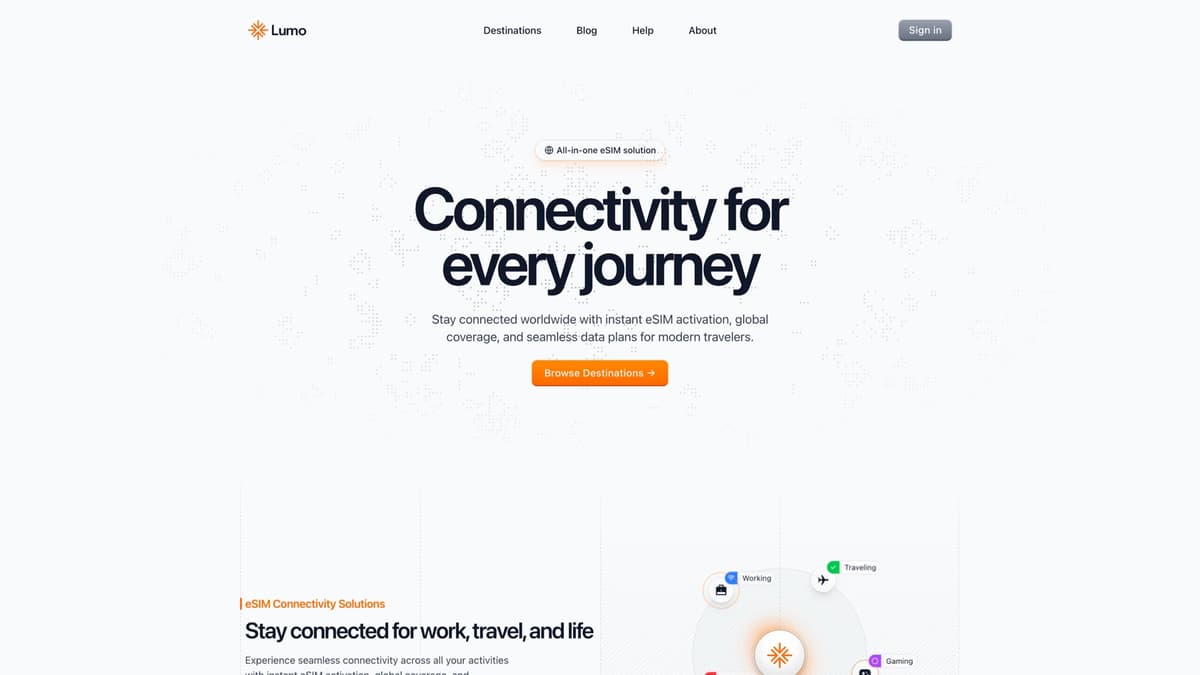
Lumo supports 5G and 4G connectivity across its network, with flexible plan sizes that match a weekend trip or a three-month work stint abroad. You can hold multiple eSIM profiles on one device, keeping your home number active while running local data. For travelers who want reliable connectivity without the complexity, Lumo is built around exactly that need. Check out smart connectivity savings to see how much you can cut from your current mobile bill.
FAQ
What are mobile connectivity best practices for travelers?
Mobile connectivity best practices are specific actions like disabling battery saver, using an eSIM, forcing LTE in congested areas, and reading dBm instead of signal bars to maintain reliable and affordable mobile access abroad.
Does a phone case really affect signal strength?
Yes. Metal and heavy cases reduce signal by 5–10 dBm, which is enough to cause dropped calls and slow data in marginal coverage areas. Switching to a slim plastic case fixes this immediately.
When should I use LTE instead of 5G?
Force LTE mode in dense urban areas, buildings, and underground transit where 5G signal penetration is weak. LTE bands travel farther and penetrate walls better, producing more stable connections in those environments.
Is a VPN worth using while traveling?
A VPN is worth using on public and hotel Wi-Fi because it encrypts your traffic and maintains consistent routing across varied international networks. Turn it off on your own mobile data to avoid adding unnecessary latency to video calls.
How does an eSIM help with roaming costs?
An eSIM lets you activate a local data plan in over 160 countries without a physical SIM swap, eliminating standard roaming fees. Lumo offers flexible plans with instant QR code activation, so you have data before you land.
Recommended
- Mobile Data Management Guide for Travelers and Pros | Lumo eSIM Store
- Smart mobile connectivity solutions for travelers: 35% savings | Lumo eSIM Store
- Enterprise mobile data explained: global connectivity for travelers | Lumo eSIM Store
- Stay connected abroad: Smart business travel data tips | Lumo eSIM Store
Related Topics
Stay Connected Anywhere
Prepaid eSIM data plans for 180+ countries and territories. No physical SIM required.