Role of eSIM in Digital Nomadism: Uninterrupted Connectivity

Landing in a new country and instantly connecting to high-speed data has become a real expectation for today’s digital nomads. For remote workers crisscrossing Asia and Europe, reliable mobile access no longer means juggling plastic cards or hunting for local vendors at every border. With remote provisioning now possible through eSIM technology, you can activate local profiles in seconds and enjoy seamless connectivity. Here, discover how this approach offers flexibility and control for uninterrupted work while embracing a borderless lifestyle.
Table of Contents
- Defining eSIM Technology in Global Mobility
- How eSIM Empowers the Digital Nomad Lifestyle
- Switching Networks and Managing Profiles
- Security, Reliability, and Coverage Concerns
- Costs, Alternatives, and Common Pitfalls
Key Takeaways
| Point | Details |
|---|---|
| Flexibility in Connectivity | eSIM technology allows digital nomads to switch between multiple mobile operator profiles instantly without physical SIM cards, enhancing productivity and connectivity. |
| Cost Efficiency | Using local data plans through eSIM can significantly reduce roaming charges, often turning high international costs into much lower local prices. |
| Proactive Management | eSIM enables travelers to maintain separate numbers for business and personal use on the same device, streamlining communication and operational efficiency. |
| Security Awareness | Users must be cautious about the security and reliability of their eSIM providers, as vulnerabilities can arise from remote provisioning processes. |
Defining eSIM Technology in Global Mobility
An eSIM is an embedded digital SIM that replaces the traditional plastic card you’ve carried in your phone for years. Instead of swapping physical SIM cards when you travel, your eSIM stores multiple operator profiles digitally on your device’s secure chip. This shift fundamentally changes how digital nomads manage connectivity across borders.
The core advantage is remote provisioning—you can activate a new mobile operator profile instantly without visiting a store or waiting for mail delivery. When you land in a new country, you simply scan a QR code or enter activation details, and you’re connected. No more hunting for local SIM vendors or juggling multiple cards.
eSIM technology enables remote provisioning of mobile operator profiles, making international connectivity seamless for travelers and IoT devices alike. This capability has reshaped how the mobile industry approaches global connectivity.
Key technical characteristics that matter to nomads:
- Stored digitally on an embedded chip rather than a physical card
- Supports multiple operator profiles on a single device simultaneously
- Activated through QR code, app, or direct provisioning by carriers
- Works on smartphones, tablets, smartwatches, and laptops
- Provides full 4G/5G speeds equal to traditional SIM cards
The role of eSIM extends beyond convenience. Understanding how eSIM transforms telecommunications helps explain why carriers worldwide are adopting the technology. The infrastructure shift reduces roaming fees, enables faster switching between networks, and gives you control over your connectivity rather than leaving you at the mercy of expensive home country roaming plans.
For digital nomads, eSIM means you’re no longer locked into single-carrier plans or forced to pay 10-15 times normal rates for roaming data.
Unlike traditional SIMs, eSIM gives you flexibility that directly impacts your work. You can maintain a primary number on one carrier while using a local data plan from another—all on the same device. When you move from Thailand to Portugal, you simply switch profiles instead of buying new cards.
Adoption patterns show eSIM penetration varies by region. Markets like the United States and Europe lead in smartphone eSIM support, while Asia-Pacific is catching up rapidly. By 2030, forecasts suggest 76% smartphone penetration globally, meaning eSIM will become the standard rather than the exception.
Pro tip: Before traveling, verify your device supports eSIM and your target destination has carrier coverage through your eSIM provider—some older phones lack the embedded chip needed for this technology.
How eSIM Empowers the Digital Nomad Lifestyle
eSIM transforms how you work remotely by removing the connectivity barriers that plague traditional SIM card users. Instead of spending hours finding local carriers or dealing with expired international roaming plans, you activate a new profile in seconds. This flexibility directly impacts your productivity and peace of mind.
The practical freedom starts the moment you arrive in a new country. You don’t need to visit a physical store, wait in lines, or figure out unfamiliar carrier websites. eSIM technology enables instant local data activation, meaning you’re online before you leave the airport.
What makes eSIM revolutionary for nomads:
- Switch between carriers without changing hardware or waiting for physical cards
- Maintain a home country number while using local data plans simultaneously
- Avoid expensive roaming charges that drain your monthly budget
- Work reliably across 160+ countries with consistent 4G/5G speeds
- Keep multiple profiles for personal, business, or backup connectivity
Consider the financial impact alone. Traditional roaming costs 10-15 times more than local rates. When you work across borders regularly, these expenses compound quickly. eSIM lets you pay local prices everywhere, turning what was once a significant operational cost into negligible spending.
The work-life balance improves too. You’re not tied to a single country’s carrier ecosystem or trapped by expensive roaming contracts. eSIM supports borderless remote work by providing seamless network access regardless of your location. This means you can stay longer in places you love without financial penalties.
eSIM removes the connectivity anxiety that shadows traditional nomads—no more dead zones, no more surprise roaming bills, just reliable work everywhere.
Multiple profiles on one device change your operational strategy. Your business number stays accessible while you use a local SIM for personal calls and data. You manage different aspects of your nomadic life without juggling devices or constantly swapping cards.
Speed matters when you’re managing client calls, uploading project files, or attending video conferences. eSIM connects you to high-speed 5G networks in major cities, keeping your remote work as fast as desk-based professionals. This consistency eliminates the “sorry, my connection dropped” excuses.
Pro tip: Before each trip, research your destination’s eSIM-compatible carriers and activate your profile 24 hours before travel to ensure smooth airport arrival connectivity.
Switching Networks and Managing Profiles
Switching between carriers on eSIM happens instantly without touching your device’s hardware. When you land in Bangkok and decide the local carrier isn’t fast enough, you simply activate a different provider’s profile. No waiting, no SIM card replacements, just seamless transitions that keep you working.
The technical backbone enabling this flexibility is Remote SIM Provisioning (RSP), which allows secure switching between operator profiles without physical SIM changes. This protocol manages the secure download and activation of new operator profiles directly to your device’s embedded chip, handling all authentication behind the scenes.
How profile management works in practice:
- Download multiple operator profiles onto your device before or during travel
- Switch between profiles within seconds through your device settings or carrier app
- Maintain separate numbers and data plans on the same device simultaneously
- Store up to 10+ profiles, though you typically activate only 1-2 at a time
- Keep a backup profile active if your primary carrier fails or speeds drop
The practical advantage becomes clear when you’re managing work communications. Your primary business number stays active on one carrier while you use local data from another. This separation keeps your professional and personal connectivity organized without device juggling.
Profile switching costs nothing beyond your chosen data plan. eSIM ecosystem security mechanisms ensure that switching between profiles involves encrypted authentication, meaning you’re protected even when rapidly changing carriers across borders.
The ability to maintain multiple active profiles transforms your connectivity strategy from reactive (finding a carrier) to proactive (choosing the best option available).
Real-world scenario: You’re in Portugal working for a European client. Your primary profile connects to a local carrier with excellent 5G coverage. Your secondary profile connects to a global roaming network as backup. If the primary signal drops, you manually switch profiles in 10 seconds. Meanwhile, your home country business line remains accessible through your carrier’s app.
Speed of switching matters when deadlines loom. Most carriers complete profile activation within minutes of your request. High-stakes situations demand immediate connectivity, and eSIM delivers this without requiring physical store visits or carrier support calls.
Pro tip: Before traveling, set up at least one backup profile on a global roaming carrier so you have instant fallback connectivity if your primary carrier’s local coverage disappoints.
Security, Reliability, and Coverage Concerns
eSIM adoption brings real security considerations that digital nomads need to understand before trusting their connectivity entirely to this technology. While eSIM offers tremendous flexibility, the remote provisioning infrastructure creates new attack surfaces that traditional SIM cards don’t have.

The primary security concern involves profile control and unauthorized access. Unlike physical SIM cards you physically control, eSIM profiles exist digitally on your device’s chip. eSIM ecosystem vulnerabilities include risks from opaque provisioning workflows where third-party servers handle profile downloads. If a provisioning server gets compromised, attackers could theoretically intercept or manipulate your profile data during activation.
Key security risks to be aware of:
- Unauthorized profile activation if someone gains access to your device
- Data routing through third-party networks with varying security standards
- Privacy exposure during profile provisioning with multiple intermediaries
- Potential compromise at provisioning servers handling profile downloads
- Difficulty identifying when profiles have been tampered with after installation
Reliability concerns exist too. Your eSIM depends on your device’s embedded chip remaining functional—if that chip fails, you lose access to all profiles simultaneously. Physical SIM cards can be swapped to a new phone in seconds; eSIM profile restoration requires contacting your carrier and waiting for reactivation.
Travel eSIMs introduce specific privacy risks when third-party providers manage profiles on your behalf. These providers see your location, usage patterns, and network transitions, creating data trails you might not expect. Some travel eSIM companies operate in jurisdictions with minimal data protection regulations.
Security with eSIM isn’t worse than traditional carriers—it’s different, requiring active user vigilance about which providers you trust.
Coverage gaps emerge in specific regions where eSIM adoption lags. Rural areas in developing countries often lack local carriers supporting eSIM profiles. You might arrive somewhere and discover that the only available carriers either don’t support eSIM or charge premium rates compared to physical SIM alternatives.
Network redundancy becomes critical for nomads. Activate backup profiles from different carriers operating on separate infrastructure. This prevents total connectivity loss if one carrier’s network fails or one profile gets corrupted.
Choosing trusted eSIM providers matters significantly. Platforms with transparent security practices, clear data policies, and strong encryption during provisioning reduce your risk profile considerably compared to unknown providers offering suspiciously cheap plans.
Pro tip: Before committing to eSIM entirely, test your chosen provider in low-stakes situations and maintain one backup physical SIM option for destinations where eSIM coverage or security practices remain unproven.
Costs, Alternatives, and Common Pitfalls
eSIM pricing varies wildly depending on your destination and chosen provider. Monthly data plans range from $5 to $50 depending on country, data allowance, and coverage type. Hidden costs emerge quickly if you don’t understand pricing structures before committing to a provider.
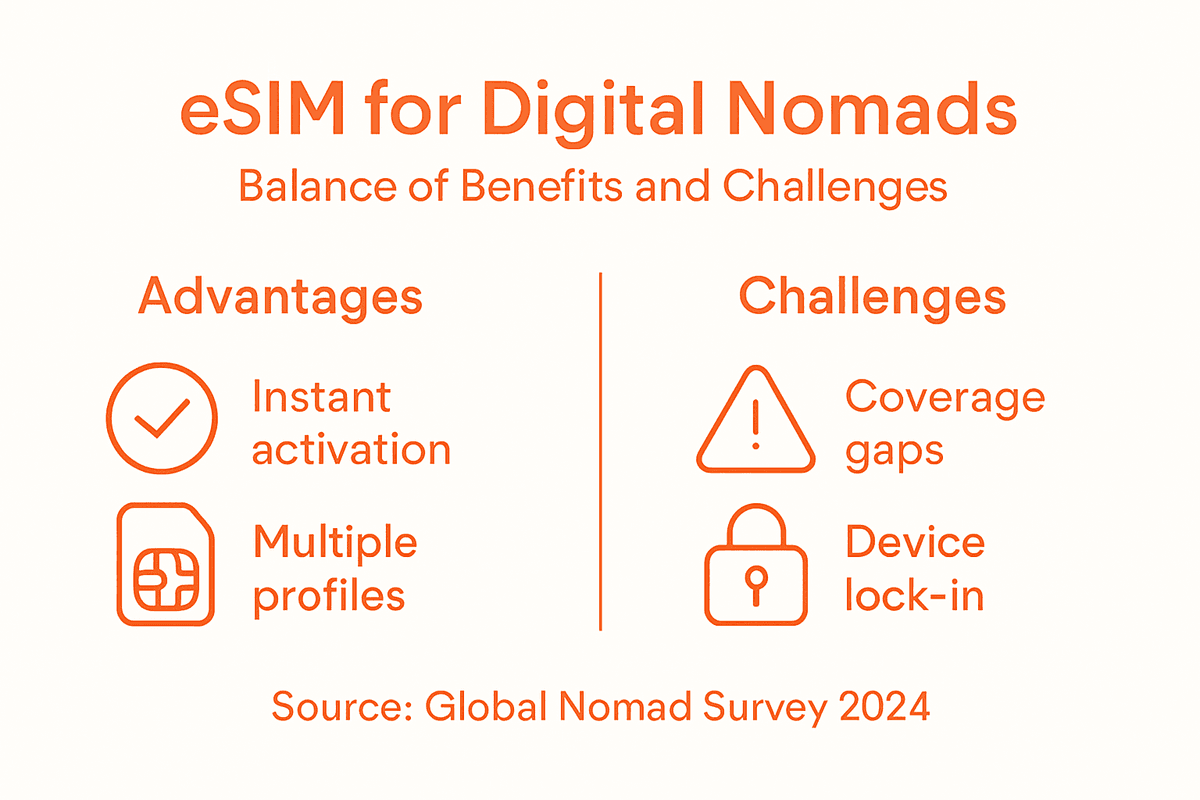
The real expense isn’t the eSIM itself—it’s the data and connectivity fees. Some nomads assume they’ll save money by switching to eSIM, then discover they’re paying 20-30% more than local physical SIM rates because they chose a convenience-focused provider over a budget alternative. Read the fine print carefully.
Common pricing pitfalls to avoid:
- Assuming all eSIM providers charge the same rates for a country
- Activating before verifying coverage quality in your specific location
- Purchasing data packages larger than needed due to marketing pressure
- Falling for “unlimited data” claims that include throttling after fair-use limits
- Ignoring expiration dates on unused eSIM profiles
Alternatives to eSIM still exist despite eSIM’s growth. Traditional physical SIM cards offer better rates in many countries and work on older devices. Dual SIM phones let you carry both physical and eSIM simultaneously, providing redundancy. International roaming plans from your home carrier cost more but eliminate switching hassles entirely.
Here’s how eSIM compares to traditional SIM options for global travelers:
| Aspect | eSIM | Physical SIM Card | International Roaming Plan |
|---|---|---|---|
| Profile Management | Multiple profiles, digital | One profile per card | Managed by home carrier |
| Activation Speed | Instant, remote provisioning | In-store or kiosk purchase | Automatic, no setup required |
| Cost Efficiency | Local rates, flexible choice | Often cheapest locally | Usually highest, premium rates |
| Device Compatibility | Recent devices only | All GSM-compatible devices | Any device with a SIM slot |
eSIM infrastructure investments and device compatibility remain inconsistent across regions. Not all devices support eSIM despite its growth. Many older phones, budget models, and certain rugged devices still lack embedded chips, forcing you back to physical SIM cards regardless of your preferences.
The biggest pitfall isn’t choosing eSIM—it’s assuming eSIM solves every connectivity problem without verifying it actually works in your specific travel destinations.
Regional fragmentation creates real headaches. Some countries regulate eSIM differently, requiring additional identity verification or limiting profile switching. European regulations differ from Asian requirements, which differ from African standards. What works flawlessly in Portugal might involve bureaucratic delays in Thailand.
Common implementation mistakes include activating profiles too early, losing access before you need them. Other nomads activate too late, arriving offline then waiting hours for profile activation. Timing matters more than you’d expect.
Below is a summary of common eSIM pitfalls and how to avoid them:
| Pitfall | Prevention Tip | Impact if Ignored |
|---|---|---|
| Choosing untested providers | Read community reviews | Higher costs, weak service |
| Ignoring device compatibility | Check device specs before purchase | Inoperable eSIM, lost access |
| Overpaying for data | Compare plans for each destination | Unnecessary expenses |
| Activating too early or late | Time activation close to arrival | Lost data or no coverage |
Device failures compound eSIM vulnerabilities. If your phone breaks while traveling, you can’t easily swap your eSIM to a replacement unless that replacement supports eSIM. Physical SIM cards work on virtually any phone.
Pro tip: Compare actual user reviews on Reddit and nomad forums for your specific destinations—pricing varies dramatically by provider, and travelers share the best budget options faster than provider marketing claims.
Experience Seamless Global Connectivity With Lumo
Navigating the challenges of digital nomadism means conquering connectivity hurdles like costly roaming fees, insecure or unreliable networks, and cumbersome SIM card swaps. The article highlights how eSIM technology empowers remote workers with instant activation, multiple profiles, and the freedom to switch carriers effortlessly across over 160 countries. If you want to eliminate connectivity anxiety and maintain uninterrupted high-speed 5G or 4G access while traveling, Lumo offers an all-in-one solution designed to meet these exact needs.
Join thousands of global travelers who trust Lumo for flexible local data plans, instant QR code activations, and 24/7 customer support tailored for your digital nomad lifestyle. Unlock the full potential of your device by managing multiple eSIM profiles on smartphones, tablets, or laptops — so you stay connected, productive, and in control wherever you go. Discover how easy global roaming can be when you visit Lumo’s platform today and take the first step toward borderless connectivity.
Frequently Asked Questions
What is an eSIM, and how does it differ from a traditional SIM card?
An eSIM is an embedded digital SIM that replaces the plastic SIM card. It stores multiple operator profiles digitally on your device’s secure chip, allowing for remote activation without the need to swap plastic cards.
How does eSIM technology enhance connectivity for digital nomads?
eSIM technology allows digital nomads to activate new mobile operator profiles instantly, avoiding the hassle of finding local SIM vendors or changing physical cards. This results in seamless connectivity across borders.
Can I use multiple network profiles simultaneously with an eSIM?
Yes, eSIMs support multiple operator profiles on a single device. You can maintain your primary number on one carrier while using a local data plan from another, all without juggling multiple devices or SIM cards.
What should I consider regarding security when using eSIMs?
While eSIMs offer flexibility, they come with security concerns such as unauthorized profile activation and reliance on provisioning servers. It’s important to choose trusted providers and be aware of potential vulnerabilities.
Recommended
Related Topics
Stay Connected Anywhere
Prepaid eSIM data plans for 180+ countries and territories. No physical SIM required.