Stay connected abroad: Smart business travel data tips

TL;DR:
- Business travelers often face costly, unreliable connectivity due to device incompatibility and coverage gaps abroad.
- Pre-trip planning, including checking device unlock status and using eSIMs or pocket WiFi, is essential for smooth international operations.
Business travel sounds glamorous until you land in Frankfurt, open your laptop for a client call, and realize your carrier is charging $15 per megabyte. Mobile connectivity abroad is rarely as plug-and-play as professionals expect, and the gap between “covered” and “truly connected” can cost companies thousands annually. Between carrier-locked phones, surprise roaming bills, and rural dead zones, even seasoned road warriors run into walls. This guide cuts through the confusion, comparing your real options and giving you a clear, practical path to reliable, affordable connectivity on every international trip.
Table of Contents
- Understanding business travel connectivity challenges
- Comparing your options: Roaming, eSIM, and pocket WiFi
- How eSIM technology transforms global business travel
- Best practices: Getting seamless connectivity on your next business trip
- Our take: What most travelers get wrong about global connectivity
- Explore seamless global data plans with Lumo eSIM
- Frequently asked questions
Key Takeaways
| Point | Details |
|---|---|
| Device compatibility matters | Check your phone’s unlock status and eSIM support before traveling internationally. |
| eSIM simplifies data access | eSIM lets you switch global data plans instantly, saving money and hassle. |
| No perfect solution | Match roaming, pocket WiFi, or eSIM to your trip length, group size, and priorities. |
| Plan for edge cases | Anticipate rural/border coverage gaps and prepare backup communication options. |
Understanding business travel connectivity challenges
After recognizing the need for reliable connectivity, let’s explore the obstacles professionals often overlook when traveling internationally.
Mobile data abroad seems straightforward until it isn’t. The most common trap is device incompatibility. Phones manufactured before 2018 typically lack eSIM support, meaning your only options are a physical SIM swap or roaming. If your company issues older or carrier-locked handsets, even the most competitive eSIM plan is off the table. This affects more business travelers than you’d expect, especially in organizations where device refresh cycles run three to five years.
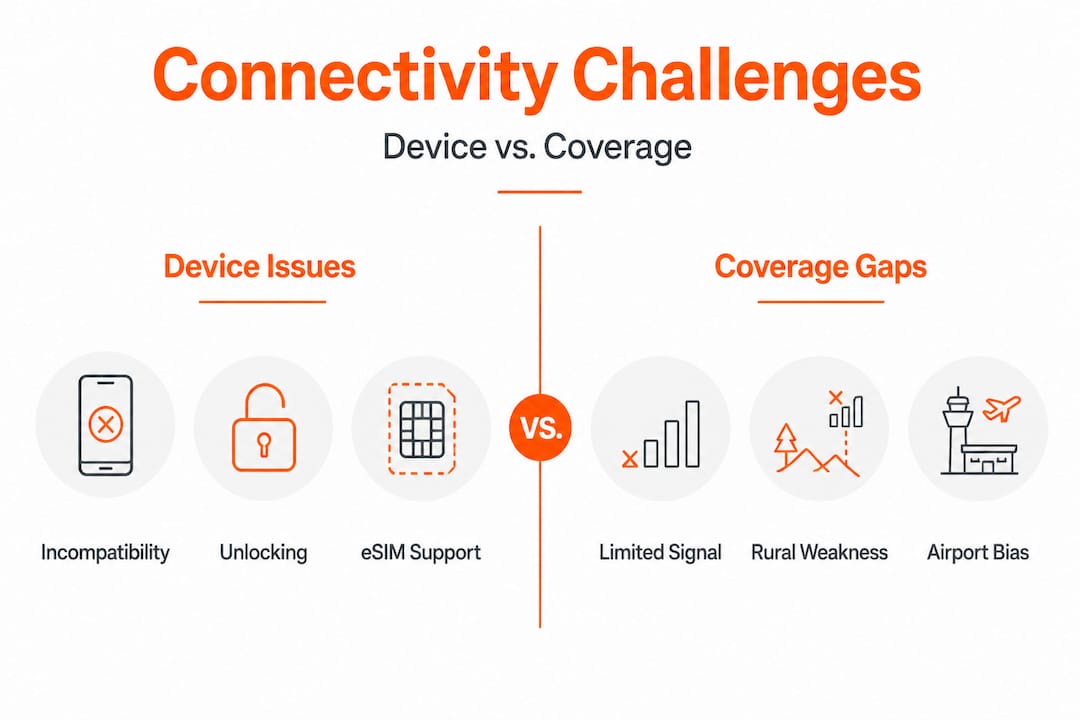
Coverage is another overlooked variable. Most business travelers test their connectivity in airports and hotels, which are optimized for mobile signals. Rural conference centers, manufacturing facilities outside city limits, and border crossings are a different story. Border re-registration delays of roughly four minutes are common as your phone searches for a new carrier, and in the middle of a live call, four minutes is an eternity. Poor rural and border handover is a known technical challenge, not a rare edge case.
Trip length also shapes the smartest strategy. A quick 36-hour deal-closing trip to Tokyo operates under very different economics than a three-week project rollout across Southeast Asia. Short trips often make traditional roaming the pragmatic choice despite the cost, simply because the setup time for alternatives doesn’t pencil out.
Here are the most common connectivity pain points business travelers face:
- Carrier-locked or older devices that block eSIM activation entirely
- Rural and border coverage gaps causing dropped calls and data interruptions
- Unexpected roaming overages from background app data usage
- Group travel complexity when five team members each need reliable data
- Time zone pressure leaving no window to troubleshoot before critical meetings
“The biggest connectivity mistake business travelers make isn’t picking the wrong plan. It’s not checking device compatibility until they’re already at the gate.”
Pro Tip: Before any international trip, dial your carrier’s customer service and ask specifically whether your phone is SIM-unlocked and eSIM-capable. Don’t assume. The five-minute call can save a five-hour headache.
For a deeper look at the gear that keeps professionals productive on the road, the business travel tech essentials guide covers devices, accessories, and connectivity tools worth packing. If you’re new to eSIM terminology, brushing up on eSIM key terms before comparing plans is a smart first move.
Comparing your options: Roaming, eSIM, and pocket WiFi
Having detailed the challenges, it’s crucial to evaluate which connectivity solutions best address each business travel need.
There is no single best option. The right choice depends on trip length, group size, device compatibility, and budget. Here’s a clean side-by-side view:
| Option | Best for | Cost level | Setup effort | Limitations |
|---|---|---|---|---|
| Roaming | Short trips under 2 days | High | None | Expensive for extended use |
| eSIM | Frequent solo travelers | Medium | Low | Data-only, device restrictions |
| Pocket WiFi | Groups, shared data needs | Low per user | Medium | Needs charging, device return |
| Local SIM | Long stays, single country | Low | Medium | Requires SIM swap, new number |
Short trips under two days often favor roaming purely for convenience. You land, your phone works, and you’re billed at the end of the month. For a day trip to close a deal in Toronto, the premium may be worth avoiding any setup friction.
For frequent solo business travelers, eSIM is the standout choice. Plans activate in minutes, you keep your home number for calls through VoIP (Voice over Internet Protocol, which routes calls through your data connection), and you avoid the physical hassle of swapping cards. Groups traveling together benefit more from pocket WiFi, where a single shared device distributes data to the whole team. The per-person cost drops significantly, and everyone stays on the same network without individual plan management.
Key considerations when choosing:
- eSIM requires an unlocked device made after 2018 and relies on VoIP for voice calls
- Pocket WiFi devices need daily charging and must be collected and returned if rented
- Roaming is seamless but generates the steepest bills on trips longer than two days
- Local SIM is the budget champion for extended stays but means managing a temporary number
Pro Tip: If your company runs frequent multi-person international projects, negotiate a pocket WiFi rental account with a provider. A corporate account often cuts rental rates by 20 to 30 percent compared to individual bookings.
Explore the key benefits of eSIM to understand where it outperforms traditional options, and see how eSIMs in business travel are reshaping how companies manage mobile costs.
How eSIM technology transforms global business travel
Now that options are compared, let’s look more deeply at what makes eSIM a game-changer for business travelers.
An eSIM (embedded SIM) is a digital SIM card built directly into your device. Instead of a physical card, carrier profiles are downloaded over the air in minutes. This seemingly small change has significant practical implications for anyone managing connectivity across multiple countries.
Here’s how the activation process works in practice:
- Confirm compatibility by checking your device settings for eSIM support
- Purchase a plan for your destination country or a regional bundle
- Download the profile via QR code or app before your departure
- Switch to the eSIM upon landing to access instant local data
- Use VoIP apps like WhatsApp, Skype, or Google Voice for calls and messages
eSIM offers instant local data plans with seamless switching between profiles, and it works across 180+ countries through partnered local networks. That means when you land in Singapore, your device connects to a local carrier at local rates, not the international roaming rates your home carrier charges. For a professional who travels to four countries in a month, the savings are substantial.
Countries where eSIM delivers the strongest combination of cost savings and network performance include the United States, United Kingdom, Japan, South Korea, Germany, Australia, and the UAE. These markets have robust eSIM infrastructure with wide 5G and 4G LTE coverage, meaning business-grade speeds for video calls, file transfers, and cloud-based workflows.
The primary constraint remains device compatibility. Only post-2018 devices support eSIM, and the device must be unlocked from your home carrier. iPhones from the XS generation onward, Google Pixel 3 and later models, and most Samsung Galaxy S20+ devices support eSIM natively.
Dive deeper into eSIM benefits for a full feature breakdown, and review eSIM adoption trends to understand why enterprise adoption is accelerating.
Best practices: Getting seamless connectivity on your next business trip
Armed with eSIM knowledge, let’s translate it into actionable steps for your next international assignment.
eSIMs are data-only by design, which catches many first-time users off guard. Voice calls and SMS messages require a VoIP application. This is not a weakness if you prepare for it. WhatsApp covers 90% of international business communication. Skype and Zoom handle formal voice and video calls. Google Voice or a similar app provides a virtual phone number for clients who need to reach you by traditional phone.
Follow these steps before every international business trip:
- Check device unlock status with your IT department or carrier, at least one week before departure
- Verify eSIM compatibility in your phone settings under “Mobile Data” or “Cellular”
- Compare regional eSIM plans for your specific destination, not generic global bundles if a regional option is cheaper
- Download and activate your eSIM profile at home before leaving, so you can troubleshoot on a stable connection
- Install and test your VoIP app by making a short call before you travel
- Check border and rural coverage for your itinerary using your provider’s coverage map
Common mistakes that derail even experienced travelers include forgetting to unlock a device before departure, skipping coverage checks for rural stops, and failing to disable automatic roaming on the home SIM after activating the eSIM.
Pro Tip: Keep your home SIM active in dual-SIM mode while using an eSIM for data. This lets you receive calls on your regular number while paying local eSIM rates for all data usage.
Review eSIM security tips to protect sensitive business data on foreign networks, and explore the case for why eSIM solutions for business are becoming a standard corporate travel tool.
Our take: What most travelers get wrong about global connectivity
The technology conversation around eSIM focuses almost entirely on features and pricing. Data speeds, plan sizes, country counts. These matter. But they’re not where most business travelers actually lose. The real failures come from mindset, not missing features.
Most professionals assume connectivity is handled by default. They book flights, hotels, and restaurants with meticulous care, then handle mobile data as an afterthought at the airport. This is backwards. A missed client call because of a dead zone in a rural factory district can unwind weeks of relationship building.
The other consistent failure is edge-case blindness. eSIM’s data-only nature and poor rural handover are predictable limitations, not surprises. Carrier-locked phones and older hardware are predictable blockers. Yet professionals encounter these as unexpected crises rather than anticipated variables to plan around.
The real competitive edge in global business travel is planning for the unexpected rather than assuming the expected will work. That means testing your eSIM at home before departure. It means mapping your itinerary against coverage data and identifying potential dead spots. It means having a backup plan, whether a local SIM option or a colleague’s pocket WiFi, before you need it.
Flexibility compounds preparation. The traveler who has checked device compatibility, pre-downloaded their eSIM profile, and installed a VoIP app handles a border delay like a minor inconvenience. The traveler who assumed everything would “just work” loses two hours and a meeting. How eSIM changes international travel goes far beyond swapping a card. It changes the entire approach to travel planning for professionals who take connectivity seriously.
Explore seamless global data plans with Lumo eSIM
The strategies in this guide only work as well as the connectivity partner behind them. You need a provider that matches the pace and demands of real business travel, not a consumer-grade solution with enterprise-level marketing.
Lumo’s global business data plans cover 180+ countries with instant eSIM activation, flexible plan sizes, and 24/7 support built for professionals who can’t afford downtime. Setup takes minutes through a QR code scan, 5G and 4G LTE speeds are available across major business destinations, and you can manage multiple profiles across your smartphone, tablet, and laptop from one account. Whether you’re in Tokyo for two days or Nairobi for three weeks, Lumo keeps your work moving without the roaming bill surprise.
Frequently asked questions
Will my company-issued phone work with eSIM while traveling abroad?
Only unlocked devices made after 2018 typically support eSIM, so check with your IT department before departure to confirm both compatibility and SIM lock status.
Do I need a separate app for calls and SMS if I use eSIM for business travel?
Yes, eSIMs are data-only, meaning you’ll need a VoIP app like WhatsApp, Skype, or Google Voice to make calls and send texts while abroad.
Is pocket WiFi better than eSIM for team business trips?
For groups, pocket WiFi is often more cost-effective since one device shares data across the team, reducing per-person costs and simplifying plan management.
What’s the main risk of relying on roaming for short international trips?
Roaming favors short trips for convenience, but background app data and video calls can generate surprising overages even within a one or two day stay.
Recommended
- Business travel data management guide for global connectivity | Lumo eSIM Store
- 6 Essential Data-Saving Tips for Travelers Abroad | Lumo eSIM Store
- Secure mobile data guide: Stay connected globally, risk-free | Lumo eSIM Store
- Enterprise mobile data explained: global connectivity for travelers | Lumo eSIM Store
- Top travel-friendly projector ideas for on-the-go Malaysians - Projector Display
Related Topics
Stay Connected Anywhere
Get instant eSIM data plans for 160+ countries. No physical SIM required.