eSIM security best practices: Protect your data globally
TL;DR:
- eSIMs are more secure than physical SIMs due to hardware and cryptographic protections.
- International eSIM routing through foreign networks poses jurisdictional privacy risks.
- Protect your eSIM by choosing GSMA-compliant providers and securing your carrier account with PINs and locks.
Switching to an eSIM feels like a security upgrade, and in many ways it is. But here’s what most travel blogs won’t tell you: the moment you activate an eSIM overseas, your data may start flowing through networks in countries you’ve never visited, governed by privacy laws you’ve never read. The hardware is harder to steal, but the vulnerabilities have simply moved somewhere less visible. This guide covers why eSIMs are more secure by design, where real risks still exist, and what concrete steps you can take to protect your connectivity across borders.
Table of Contents
- Why eSIMs are safer—but not invincible
- Real-world eSIM risks for international travelers
- Selecting a trustworthy eSIM provider
- Account-level locks and defenses: What works
- The uncomfortable truth: Why most eSIM guides aren’t enough
- Stay secure with a trusted global eSIM
- Frequently asked questions
Key Takeaways
| Point | Details |
|---|---|
| eSIMs improve physical security | They are not removable, making theft and cloning much harder for attackers. |
| Global travelers face unique risks | eSIM data can be routed via third countries, exposing info to various privacy laws. |
| Choose reputable providers | GSMA and GDPR compliance, transparent policies, and strong encryption are essential for safety. |
| Lock down your accounts | Set strong PINs, port-out locks, and app-based multi-factor authentication for best defense. |
| Go beyond checklists | Ask hard questions and understand network routing to maximize real-world eSIM security. |
Why eSIMs are safer—but not invincible
The core security advantage of an eSIM is physical. Unlike a traditional SIM card, there’s no removable chip to pocket, clone, or swap while your phone sits unattended on a café table. According to Apple Support, eSIMs are harder to steal because they cannot be physically removed, which eliminates a whole class of attacks that plague physical SIM users.
Beyond the hardware, eSIM technology is built on serious cryptographic foundations. The GSMA SGP.22 standard mandates AES-256 encryption and mutual authentication between your device and the carrier’s provisioning server. This makes man-in-the-middle attacks during profile download extremely difficult.
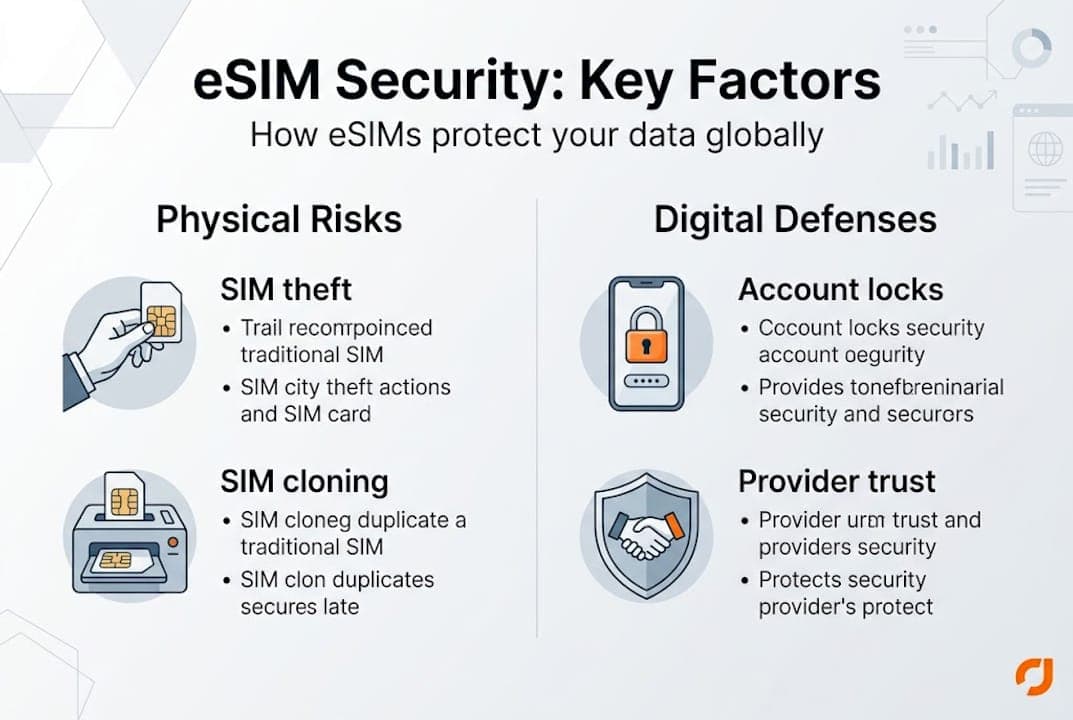
What does the real-world risk picture look like? Documented cases show eSIM users are better protected than physical SIM users during carrier-side breaches, with direct eSIM exploits remaining rare.
Here’s a quick comparison of how eSIM and physical SIM stack up on key security dimensions:
| Security factor | Physical SIM | eSIM |
|---|---|---|
| Physical theft risk | High | Very low |
| SIM cloning | Possible | Extremely difficult |
| Remote provisioning | Not possible | Yes, with encryption |
| Account-level attacks | Moderate | Moderate to high |
| Data routing control | Carrier-defined | Provider-defined |
The shift matters, but notice that account-level risk stays elevated for eSIM users. The attack surface has simply relocated from the physical chip to your online carrier account and to the networks handling your data traffic. Good eSIM data security practice means addressing both layers, not just celebrating that your SIM can’t be pried out.
A key takeaway: eSIMs give you a stronger starting position, but they don’t make you invincible. Think of them as a reinforced front door on a house that still has open windows. You still need to maintain smartphone security control over the rest of your digital perimeter.
“Security is not a product, it’s a process.” — Bruce Schneier. For eSIM travelers, that process starts with understanding what eSIM technology actually protects and what it doesn’t.
The security comparison between eSIM and physical SIM goes much deeper than hardware. Jurisdiction, routing, and account hygiene are where most modern risks live.
Real-world eSIM risks for international travelers
Here’s something that should genuinely concern any frequent traveler: research presented at USENIX Security 2025 found that eSIM traffic routes through foreign infrastructure, sometimes including Chinese networks, even when the user purchased a US-based plan. That creates real jurisdictional privacy risks because your data becomes subject to the laws of countries you didn’t choose.
Reseller marketplaces present another underappreciated problem. Many affordable travel eSIM plans are sold through intermediaries who may retain access to your metadata, including call records, location data, and browsing activity. That’s not a scare tactic. It’s a business model reality.
Here are the primary risks international travelers face specifically because of how eSIM provisioning works:
- Opaque network routing: Your traffic may transit networks outside your home country’s legal jurisdiction without any visible indicator on your device.
- Metadata retention by resellers: Third-party eSIM vendors often operate as middlemen and may log subscriber data beyond what you’d expect.
- Account takeovers: Because eSIM profiles are managed digitally, compromised carrier credentials can give attackers full control over your number, including redirecting calls and messages.
- Silent profile deletion failures: Research also found that profile deletion can fail silently when a device is offline, meaning an old eSIM profile may persist and remain accessible longer than intended.
The table below shows where risk concentration differs between travelers using local physical SIMs and those using international eSIM plans:
| Risk type | Local physical SIM | International eSIM plan |
|---|---|---|
| Physical SIM theft | High | Minimal |
| Jurisdictional data exposure | Low | Moderate to high |
| Reseller metadata access | Rare | More common |
| Account takeover | Low to moderate | Moderate |
| Profile management failures | Not applicable | Possible |
Following the right eSIM security tips reduces most of these risks, but only if you know they exist. Understanding your routing and provider policies is essential, not optional, especially when securing mobile data abroad. You can also save money by avoiding roaming risks while choosing providers with clearer data practices.
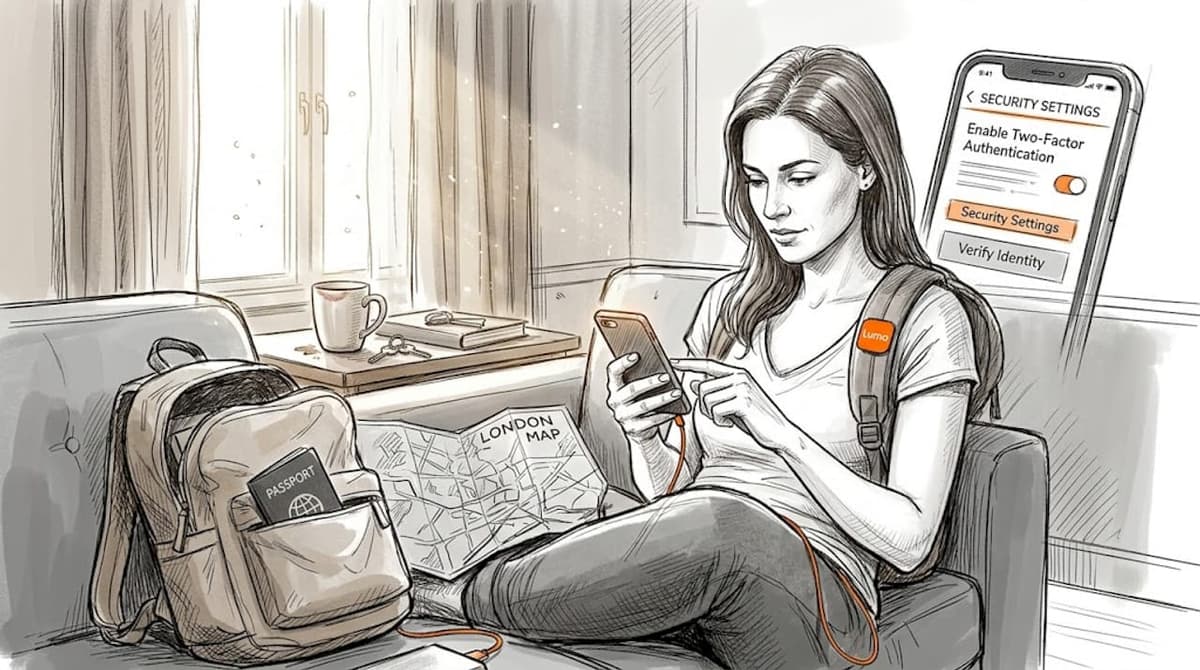
Travelers who apply common travel safety tips to their digital life, not just their physical belongings, will be significantly better positioned.
Selecting a trustworthy eSIM provider
Most travelers spend more time picking a hotel than vetting their eSIM provider. That’s a mistake. The provider you choose determines which networks your data crosses, who can access your subscriber metadata, and what happens if something goes wrong.
WTOP’s guidance on travel eSIM safety is clear: choose GSMA-compliant providers with strong encryption, verifiable GDPR compliance, and positive independent reviews. Avoid suspiciously cheap deals from anonymous resellers with no clear privacy policy.
What does a trustworthy provider actually look like? Use this checklist before committing:
- GSMA certification: Confirms the provider follows global standards for eSIM provisioning and data security.
- Transparent routing disclosure: Will the provider tell you which networks your data transits? If they can’t answer, that’s your answer.
- Clear GDPR or equivalent privacy compliance: Even if you’re not in Europe, GDPR compliance signals that a provider takes data protection seriously. Refer to GDPR compliance guidelines to understand what this requires.
- Readable privacy policy: If the privacy policy is vague, evasive, or buried in legal jargon, treat it as a red flag.
- Verifiable customer reviews: Look beyond the provider’s own website. Check independent forums, travel communities, and technology review sites.
- Responsive customer support: Security incidents need fast responses. A provider with 24/7 support has an operational advantage.
Here’s a quick-reference table for evaluating providers:
| Evaluation criterion | What to look for |
|---|---|
| GSMA compliance | Publicly confirmed SGP.22 adherence |
| Privacy policy | Clear, accessible, specific to data use |
| Routing transparency | Disclosed or available on request |
| Review quality | Independent, volume-backed, recent |
| Support availability | 24/7, multichannel |
Understanding eSIM compliance goes a long way in helping you ask the right questions before you spend any money.
Pro Tip: Before purchasing any eSIM plan, email or chat the provider and ask specifically: “Which networks will my data transit, and does any third party have access to my subscriber metadata?” The quality and speed of their answer tells you everything you need to know.
Account-level locks and defenses: What works
Even with a trustworthy provider and solid hardware security, your eSIM is only as safe as your carrier account. This is where most people leave the door open.
Setting a carrier account PIN and port-out lock is the single highest-impact step you can take against SIM swap attacks. A port-out lock prevents attackers from transferring your number to a different carrier without explicit authorization, which is the mechanism behind most SIM swap fraud.
Follow these steps in order:
- Set a unique carrier account PIN. Don’t use your birthday or a repeated digit. Treat it like a strong password.
- Enable a port-out lock. Call your carrier directly and request this. Not all carriers enable it by default.
- Switch to app-based two-factor authentication. SMS-based 2FA is the weakest form of multi-factor authentication because it depends on the very channel attackers target in SIM swaps. Use an authenticator app like Google Authenticator or Authy instead.
- Review account activity regularly. Most carriers let you see recent login history. Check it monthly, especially after international trips.
- Respond to unexpected notifications immediately. If you receive a verification code you didn’t request, act fast. Contact your carrier before an attacker does.
Never share your eSIM QR code or a one-time password with anyone who contacts you claiming to be customer support. Legitimate providers will never ask for these credentials reactively.
Building strong password habits across all your accounts reduces your exposure further. And revisiting more eSIM security tips periodically keeps your practice current as threats evolve.
Pro Tip: Store your eSIM QR code in an encrypted password manager, not in your camera roll or screenshots folder. If your device is ever compromised, that QR code is the key to your mobile identity.
The uncomfortable truth: Why most eSIM guides aren’t enough
Most consumer security guides stop at passwords and PINs. That’s useful, but it misses the bigger picture. The real risks for global eSIM travelers aren’t just about account hygiene. They live inside the infrastructure you can’t see: the routing decisions made by carriers, the metadata policies of resellers, and the legal jurisdictions your traffic enters without your knowledge.
The business model of many budget eSIM providers depends on selling aggregated subscriber data. That’s not speculation. It’s how some of these services remain cheap. When travelers ask about deeper eSIM security insights, they often find that the most important protections aren’t technical settings. They’re questions: Who runs these servers? Where does my traffic go? What data do they keep?
Security as a mindset means investigating the invisible layers, not just checking boxes. The travelers who stay safest are the ones who ask uncomfortable questions before they buy, not after.
Stay secure with a trusted global eSIM
Putting these practices into action starts with choosing the right provider, not just the right settings.
Lumo is built specifically for travelers who take their connectivity seriously. Every Lumo eSIM global plan is GSMA-compliant, backed by coverage in over 160 countries, and activated instantly via QR code without requiring a physical SIM swap. Lumo’s privacy-forward approach means you’re not compromising your data security for affordable global access. If you want a provider designed to meet the standards this article describes, Lumo is built to deliver exactly that.
Frequently asked questions
Are eSIMs really more secure than physical SIM cards?
Yes, eSIMs cannot be physically removed or swapped, making them less vulnerable to theft and SIM cloning than traditional SIM cards.
What’s the biggest eSIM privacy risk when traveling abroad?
Your data may be routed through foreign networks with different privacy laws. Research shows eSIM traffic routes through foreign infrastructure, including networks in countries the user never chose.
How can I avoid SIM swap and account attacks on my eSIM?
Use carrier PINs and port-out locks combined with app-based authentication rather than SMS codes to significantly reduce your SIM swap exposure.
What should I ask an eSIM provider before buying?
Ask about GSMA compliance, GDPR practices, and routing transparency. GSMA-compliant providers with verifiable privacy policies are the safest starting point.
Recommended
Related Topics
Stay Connected Anywhere
Prepaid eSIM data plans for 180+ countries and territories. No physical SIM required.