Why Mobile Connectivity Matters for Work and Travel

TL;DR:
- Mobile connectivity fuels approximately 5% of global GDP with 8.8 billion connections, enabling digital inclusion worldwide. It drives rural coverage, supports 5G innovation, and enhances travel safety through emergency alerts and eSIM technology. Closing the usage gap and expanding affordable access in underserved regions is critical for sustained economic and social growth.
Mobile connectivity is the infrastructure that makes modern digital life function, linking 8.8 billion wireless connections worldwide and contributing roughly $6.5 trillion to global GDP in 2024. That figure represents about 5% of total global economic output, which means the mobile industry now rivals entire national economies in scale. For professionals managing remote teams, travelers crossing time zones, and businesses running cloud-based operations, why mobile connectivity matters is not an abstract question. It is the difference between working and waiting.
Why mobile connectivity matters for economic and social growth
Mobile connectivity, or mobile broadband access as the industry formally defines it, is the single largest driver of digital inclusion across both developed and emerging markets. The economic case is direct: a 10% rise in mobile broadband penetration correlates with a 1.5 to 2.5% increase in GDP per capita in developing nations. That is not a marginal gain. It is the kind of growth that funds schools, hospitals, and infrastructure.
The social returns are equally concrete. Connecting schools to the internet improves student literacy and numeracy by 20% over five years. Closing the digital gender gap in low-income countries could unlock $700 billion for the global economy by 2030. These numbers make the importance of mobile connectivity a policy priority, not just a technology preference.
The digital divide remains the central challenge. Hundreds of millions of people in sub-Saharan Africa, South Asia, and rural Latin America have mobile devices but lack affordable data access. This “usage gap” is larger than the coverage gap, meaning the infrastructure often exists but the cost or digital literacy barriers prevent adoption.
Pro Tip: When evaluating the significance of staying connected in emerging markets, look beyond coverage maps. Affordable pricing and local-language digital literacy programs determine actual adoption rates far more than tower density.
What technologies actually make mobile networks work?
The quality of mobile connectivity depends on spectrum allocation, network generation, and infrastructure investment. These are not interchangeable variables. Adding 50 MHz of sub-1 GHz low-band spectrum increases 4G rural coverage by 7 percentage points and 5G rural coverage by 11 points, while boosting rural download speeds by up to 8%. Low-band spectrum travels farther and penetrates buildings better than high-band signals, making it the foundation of rural coverage.
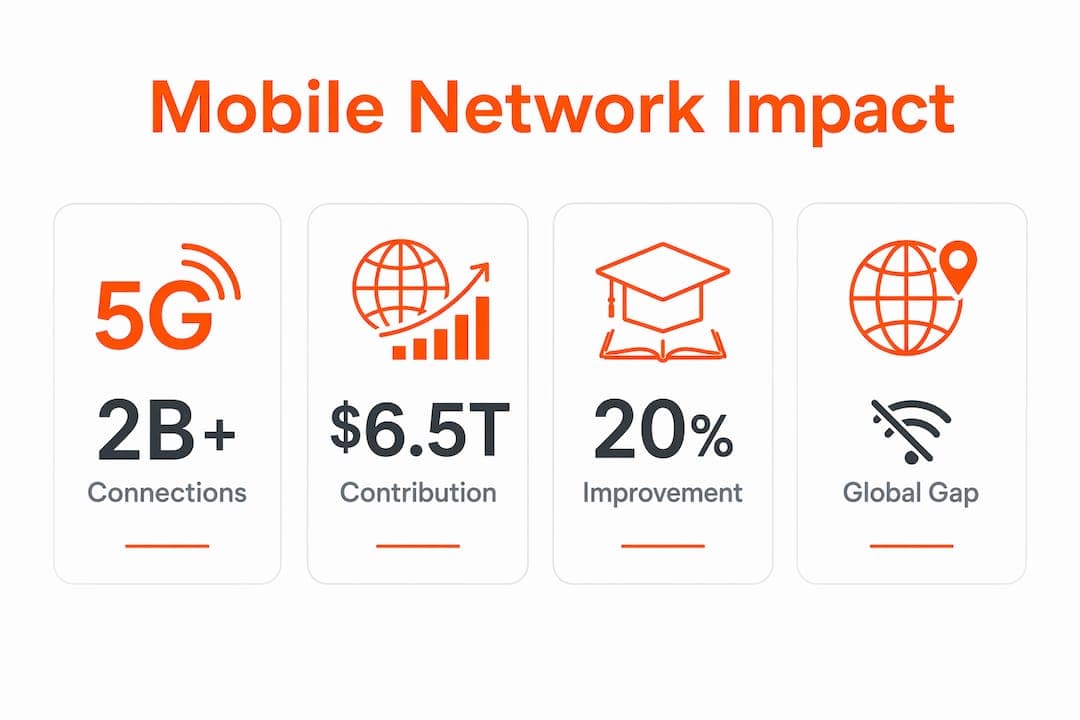
The shift from 4G to 5G is not simply a speed upgrade. Global 5G connections surpassed 2 billion by the end of 2024, and 5G is projected to become the dominant mobile technology by 2028. The real distinction is 5G Standalone architecture, which enables ultra-reliable low-latency communications, network slicing for enterprise use cases, and the kind of AI integration that 4G cannot support at scale.
| Network generation | Key feature | Primary impact |
|---|---|---|
| 3G | Basic mobile data | Email, basic browsing |
| 4G LTE | High-speed broadband | Video streaming, app economy |
| 5G Sub-6 GHz | Low latency, high capacity | AI tools, remote work, IoT |
| 5G mmWave | Ultra-high speed, short range | Dense urban, stadiums, venues |
| Fixed Wireless Access (FWA) | 5G home broadband | Rural broadband alternative |
One underappreciated risk in this transition is the network sunset problem. As carriers decommission 2G and 3G networks, legacy IoT devices built on older protocols face operational failure. Businesses running smart meters, fleet trackers, or industrial sensors on older networks need migration plans now, not after the shutdown notices arrive.
Pro Tip: Strong indoor mobile connectivity is often the missing piece for AI-driven workplace tools. WiFi alone frequently fails to meet performance needs for real-time AI applications, creating hidden productivity bottlenecks that most IT teams attribute to software rather than network infrastructure.
How mobile connectivity drives productivity and business performance
The impact of mobile networks on business productivity is direct and measurable. Mobile connectivity enables AI-driven tools that require low latency and consistent throughput. When networks are weak or congested, those tools stall, and the productivity gains that AI promises evaporate. For companies running real-time analytics, video conferencing, or cloud-based collaboration platforms, network quality is not a background condition. It is a business input.
For digital nomads and remote workers, the role of eSIM in digital nomadism has redefined what uninterrupted connectivity looks like. Instead of hunting for local SIM cards at airports or paying steep roaming fees, professionals can switch carriers digitally before boarding a flight. This is mobile connectivity and business intersecting at the most practical level.
The benefits of mobile networks for productivity include:
- Real-time cloud access: Tools like Google Workspace, Microsoft 365, and Salesforce require consistent uptime to function at full capacity.
- Video collaboration: Platforms like Zoom and Microsoft Teams degrade sharply below 10 Mbps, making network quality a direct meeting quality issue.
- AI assistant performance: Applications built on models like GPT-4 or Gemini require low-latency connections for responsive, real-time output.
- File transfer and backup: Remote workers handling large media or data files depend on upload speeds that only 4G and 5G networks reliably provide.
- Location-independent access: eSIM-enabled devices let professionals maintain their primary business number and data plan across 160-plus countries without reconfiguration.
How mobile connectivity transforms travel experiences
Travel is where the impact of mobile networks becomes most personal. A traveler landing in Tokyo, Lagos, or São Paulo without a working data connection faces a cascade of friction: no navigation, no translation, no hotel confirmation, no ride-hailing. The types of global connectivity available in 2026 have largely solved this problem for travelers who plan ahead.

5G connectivity reshapes the travel experience beyond speed. Fast, reliable connections enable real-time translation apps, AR-based navigation overlays, and instant access to local services that make unfamiliar cities navigable within minutes of arrival. These are not luxury features. For business travelers managing client calls across time zones, they are operational requirements.
Mobile connectivity also serves a safety function that most travelers overlook until they need it. Japan’s mobile operators coordinate to deliver cell broadcast emergency alerts across all networks simultaneously, reaching every device in an affected area regardless of network congestion or user registration. This model demonstrates that mobile connectivity advantages extend well beyond convenience into life-safety infrastructure.
Pro Tip: When choosing a mobile connectivity plan for travel, prioritize coverage breadth over raw speed. A plan with reliable 4G across 150 countries outperforms a 5G-only plan that drops to no signal in secondary cities.
Key takeaways
Mobile connectivity is the foundational infrastructure for economic growth, business productivity, and safe, efficient travel in 2026, and the gap between connected and unconnected populations carries measurable costs for every economy.
| Point | Details |
|---|---|
| Economic scale | Mobile networks contribute $6.5 trillion to global GDP, representing 5% of world economic output. |
| Spectrum drives rural access | Adding low-band spectrum increases rural 5G coverage by 11 points and boosts download speeds by up to 8%. |
| 5G enables AI productivity | 5G Standalone architecture is the network foundation required for real-time AI tools and enterprise applications. |
| Travel connectivity is safety-critical | Cell broadcast technology delivers emergency alerts to all devices simultaneously, regardless of network load. |
| eSIM removes friction | Digital SIM switching lets travelers and remote workers maintain connectivity across 160-plus countries without physical SIM changes. |
The connectivity gap is the real story nobody is telling
Most coverage of mobile connectivity focuses on 5G speeds and enterprise AI. That framing misses the more consequential story. The usage gap, where people have coverage but cannot afford or do not know how to use data services, is larger than the coverage gap in most developing regions. Closing that gap matters more for global economic output than upgrading urban networks from 4G to 5G.
From a professional standpoint, I have watched organizations invest heavily in AI tools and then wonder why adoption is low. The answer is almost always network quality, specifically indoor connectivity that WiFi cannot reliably provide. The AI productivity argument only holds when the network underneath it is solid.
For travelers, the shift to eSIM technology is the most underrated change in mobile connectivity in the past decade. The ability to activate a local data plan before landing, without visiting a carrier store or carrying multiple physical SIMs, removes the single biggest friction point in international travel. Solutions like Lumo have built their entire model around this insight, and the demand confirms it was the right call.
The next frontier is not faster speeds in cities that already have excellent coverage. It is affordable, reliable connectivity in the places where it can generate the highest return: rural communities, low-income urban areas, and the roughly 2.6 billion people who remain offline entirely.
— Bogdan
Stay connected anywhere with Lumo eSIM
Reliable mobile connectivity should not depend on where you land or which carrier happens to cover your destination. Lumo provides instant global data plans covering over 160 countries, with activation via QR code before you even board your flight. There are no roaming fees, no physical SIM swaps, and no gaps in coverage when you cross a border. Whether you are a remote professional running client calls from three continents or a traveler who needs navigation and translation to work the moment you arrive, Lumo’s flexible 4G and 5G plans are built for exactly that use case. Explore Lumo’s plans and activate your eSIM in minutes.
FAQ
Why does mobile connectivity matter for business?
Mobile connectivity gives businesses access to cloud tools, AI applications, and real-time collaboration platforms from any location. Weak or inconsistent networks directly reduce the performance of tools like Microsoft 365, Salesforce, and AI assistants, translating into measurable productivity losses.
What is the economic impact of mobile networks?
The mobile industry contributes approximately $6.5 trillion to global GDP, representing about 5% of world economic output in 2024. A 10% increase in mobile broadband penetration correlates with a 1.5 to 2.5% GDP per capita increase in developing nations.
How does 5G differ from 4G for travelers and professionals?
5G offers lower latency and higher capacity than 4G, enabling real-time AI tools, high-quality video calls, and faster file transfers. For travelers, 5G also supports advanced applications like AR navigation and instant translation that 4G networks cannot run reliably.
What is an eSIM and why does it matter for global travel?
An eSIM is a digital SIM card embedded in your device that allows you to switch mobile carriers without a physical SIM swap. For international travelers, this means activating a local data plan before landing and avoiding roaming charges across 160-plus countries.
How does mobile connectivity support emergency communication?
Cell broadcast technology sends emergency alerts to all mobile devices in a geographic area simultaneously, bypassing network congestion and user registration requirements. Japan’s coordinated multi-network alert system demonstrates how mobile infrastructure functions as life-safety infrastructure during disasters.
Recommended
- Business travel tech essentials for global connectivity | Lumo eSIM Store
- Multi-device connectivity explained: seamless data for travelers | Lumo eSIM Store
- Your Global Connectivity Checklist for International Travel | Lumo eSIM Store
- Enterprise mobile data explained: global connectivity for travelers | Lumo eSIM Store
Related Topics
Stay Connected Anywhere
Prepaid eSIM data plans for 180+ countries and territories. No physical SIM required.