How 5G reshapes and elevates your travel experience

TL;DR:
- 5G transforms travel through ultra-low latency, high bandwidth, and massive device connectivity.
- Private 5G networks improve airport, hotel, and tourist site experiences with reliable, secure, high-speed connections.
- Travelers must verify device compatibility, roaming agreements, and local coverage to maximize 5G benefits worldwide.
Most travelers assume 5G is simply a faster way to stream videos or load maps on the road. That assumption misses the bigger picture entirely. The fifth generation of mobile connectivity is quietly rewriting what’s possible at every step of a trip, from how airports manage crowds to how a hotel room recognizes your preferences before you arrive. This article breaks down the real changes 5G is bringing to travel, the hurdles still slowing it down, and the practical moves you can make to stay connected and get the most out of every journey.
Table of Contents
- How 5G connectivity is reshaping the travel landscape
- 5G at airports, hotels, and beyond: Real-world scenarios
- Seamless roaming and operator collaboration: Making global 5G a reality
- Challenges and what savvy travelers need to know
- Beyond the hype: What actually matters for travelers embracing 5G
- Enhance your travel with seamless 5G connectivity
- Frequently asked questions
Key Takeaways
| Point | Details |
|---|---|
| 5G is more than speed | It enables real-time experiences and automation in travel, from AR tours to smart airports. |
| Private networks offer reliability | Resorts and airports use private 5G for secure, stable connections that outperform Wi-Fi. |
| Seamless travel requires operator collaboration | Consistent 5G access depends on carrier agreements and local deployment, especially abroad. |
| Beware uneven global 5G rollout | Coverage and network quality vary, so savvy travelers must check specifics before each trip. |
| Mix your connectivity strategies | Combining eSIM, local networks, and Wi-Fi ensures the best travel connectivity in 2026. |
How 5G connectivity is reshaping the travel landscape
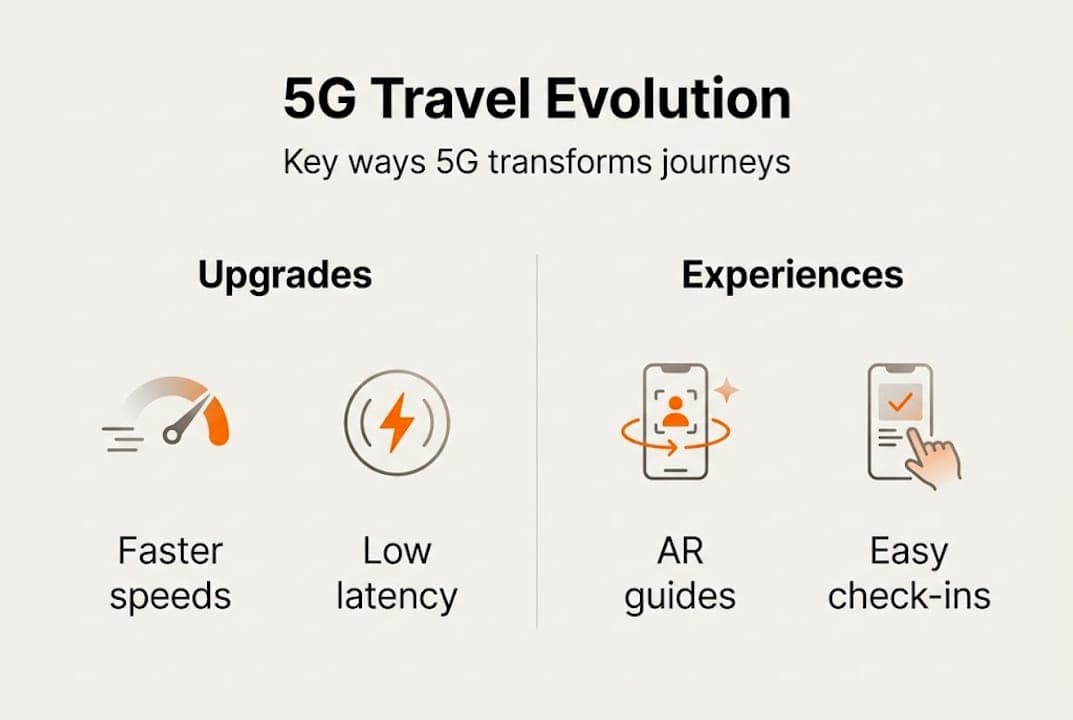
Let’s address the most common misread: 5G is not just a speed upgrade. It is an architectural shift in how devices communicate with networks. Where 4G focused on giving individual users faster downloads, 5G is built around three pillars that matter deeply for travel: ultra-low latency (response delays as short as 1 millisecond), massive bandwidth, and the ability to connect thousands of devices simultaneously in a small area.
For travelers, this means much more than quick Instagram uploads. Understanding what is 5G connectivity reveals why its impact goes well beyond raw speed. 5G transforms travel by enabling entirely new categories of experience that simply weren’t viable on older networks.
Consider these real applications already emerging at travel destinations:
- Augmented reality (AR) city guides that overlay historical facts onto real-world views through your smartphone, with zero lag
- Automated hotel check-ins powered by IoT sensors that recognize your device and prepare your room before you walk through the door
- Crowd management systems at airports and tourist sites using live sensor data to redirect foot traffic in real time
- Instant translation earbuds that require near-zero latency to keep pace with live conversation
5G enables ultra-low latency, high bandwidth, and massive device connectivity, supporting real-time applications like AR/VR tours, automated check-ins, and IoT for crowd management in tourism. That’s a meaningful shift, not a marketing slogan.
| Feature | 4G LTE | 5G (Standalone) |
|---|---|---|
| Typical latency | 30 to 50 ms | 1 to 10 ms |
| Peak download speed | 100 Mbps | Up to 10 Gbps |
| Connected devices per km² | ~100,000 | Up to 1 million |
| AR/VR performance | Limited | Fully supported |
| IoT scalability | Moderate | High |
Pro Tip: When researching a destination or transit hub, look specifically for “5G SA” or “5G Standalone” labeling. Many places advertise 5G but run a non-standalone (NSA) version that relies on a 4G core, limiting the latency gains that make AR and automation actually work well.
5G at airports, hotels, and beyond: Real-world scenarios
Now let’s see how these capabilities play out in real travel environments. The gap between theory and lived experience is where many travelers get caught off guard, so it helps to walk through a 5G-powered trip from start to finish.
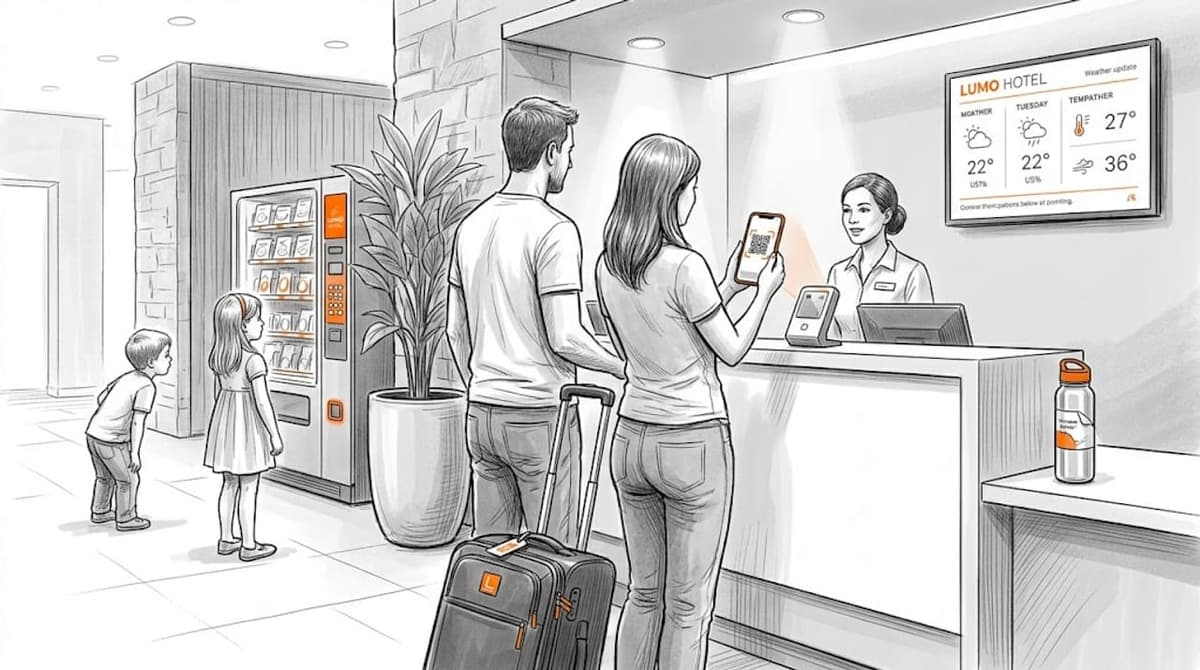
Private 5G networks provide stable coverage for complex environments like resorts and airports, performing far better than Wi-Fi for operations that can’t afford interruptions. Traditional public Wi-Fi at airports is shared, congested, and often insecure. Private 5G changes that equation entirely.
Here’s what a real 5G-enhanced journey can look like:
- At the departure airport: Your airline app uses 5G-connected kiosks to process biometric boarding without a physical pass. Digital signage updates in real time based on passenger flow data.
- During the flight hunt: Connected lounges stream VR content to guests, and staff use IoT tablets on 5G to manage inventory and service requests simultaneously.
- On arrival: Smart baggage systems track your luggage from plane to carousel with live updates pushed directly to your phone, no app refresh needed.
- At the hotel: Your device is recognized on the property’s private 5G in tourism network the moment you arrive. Your room settings, preferred temperature, and TV preferences load automatically through IoT integrations.
- Exploring the city: AR walking tours give you context-rich overlays at landmarks. Real-time transit apps tell you the exact next bus, its live location, and how crowded the next stop is.
“5G private networks allow resorts and airports to deliver consistent, secure, high-bandwidth connectivity that public infrastructure simply cannot match for guest-facing or operational applications.” — Industry connectivity analysis on smart tourism deployment
| Factor | Private 5G | Public Wi-Fi |
|---|---|---|
| Security | Network-level encryption | Shared, often unencrypted |
| Reliability | Dedicated bandwidth | Varies by congestion |
| Latency | 1 to 10 ms | 20 to 100+ ms |
| Device capacity | Thousands simultaneously | Limited per router |
| Ideal use case | Airports, resorts, stadiums | Casual browsing |
Understanding seamless mobile data across different environments is key to setting the right expectations before you travel.
Seamless roaming and operator collaboration: Making global 5G a reality
Global 5G isn’t automatic everywhere. What’s needed for it to work smoothly worldwide comes down to one word: agreements. Mobile network operators must establish roaming arrangements with each other across borders, and those agreements need to specifically cover 5G protocols, not just fall back to 4G when you land abroad.
5G transforms travel from connectivity enabler to immersive platform, but realization depends on overcoming deployment hurdles and operator collaborations for seamless global roaming. Put simply, the technology can exist in a country without being accessible to your device the moment you land.
Understanding global network access helps travelers avoid the frustration of expecting 5G and getting throttled 4G. Before any international trip, check these factors:
- Device band compatibility: 5G uses different frequency bands in different regions. A phone bought in North America may not support millimeter-wave (mmWave) or sub-6GHz bands used in Asia or Europe.
- Carrier roaming agreements: Call your carrier or check their website to confirm 5G roaming is supported in your destination country, not just 4G fallback.
- Local operator coverage maps: The country you visit may have 5G only in major urban centers, not rural or coastal areas popular with tourists.
- Network type: Confirm whether local operators use NSA or SA 5G, since that determines whether low-latency features actually work.
- Data plan limits: Some roaming plans throttle you to lower speeds after a data threshold, even if 5G is technically available.
Knowing the main types of travel connectivity before you leave helps you build a smart strategy. Understanding data roaming and how charges accumulate abroad is equally important for avoiding bill shock.
Pro Tip: eSIM solutions give you the flexibility to switch between local network operators without swapping physical SIM cards. If your primary carrier doesn’t have 5G roaming in a destination, you can activate a local data plan digitally and connect to a network that does, all from your existing device.
Challenges and what savvy travelers need to know
With the promise of global connectivity in mind, it’s also critical to address what can go wrong and how to stay ahead.
The 5G rollout worldwide is deeply uneven. Major cities in South Korea, Japan, the UAE, and parts of Western Europe have mature 5G infrastructure. But vast stretches of Southeast Asia, Africa, and Latin America are still building out 4G coverage, let alone 5G. Travelers heading off the beaten path need to plan for this reality.
Deployment challenges for 5G in travel and tourism include high infrastructure costs, spectrum licensing complexity, uneven global rollout, data privacy concerns, and integration with legacy systems. These aren’t short-term problems. They’ll shape traveler experiences for the next several years.
Here are the most common mistakes travelers make when it comes to 5G on the road:
- Assuming all 5G is equal: A 5G signal icon on your phone does not guarantee true 5G performance. NSA networks reuse 4G cores and offer limited latency improvement.
- Ignoring device band support: A flagship phone released in one region may physically lack the hardware to connect to 5G bands used in another region.
- Overlooking privacy settings: Connecting to unknown private 5G networks without checking security settings exposes your device to potential data interception.
- Not verifying roaming specifics: Roaming agreements for 5G are separate from 4G agreements. Your carrier may roam on 4G only in certain destinations.
On the technical side, latency improvements lag behind throughput gains in mobile benchmarks, which is critical for AR/VR performance in travel applications. Travelers wanting the full immersive experience should prioritize 5G SA coverage specifically. Speed alone won’t cut it.
Protecting your data on the road matters just as much as staying connected. Smart data security travel tips help you avoid the risks that come with connecting to unfamiliar networks.
Beyond the hype: What actually matters for travelers embracing 5G
Here’s a truth the marketing rarely mentions: most 5G coverage maps are optimistic. Bars on a map don’t guarantee consistent performance at street level, inside buildings, or in dense tourist areas where hundreds of devices compete for the same spectrum. Real travelers, not press releases, are the most reliable source for ground-truth 5G performance at a destination.
Our view is that the smartest approach isn’t chasing 5G for its own sake. It’s building a layered connectivity strategy. Use 5G where it’s genuinely strong. Supplement with eSIM local plans where your home carrier falls short. Treat international travel tech tips as an evolving skill set, not a one-time setup. The travelers who get the most from 5G are the ones who understand what they’re actually connecting to.
Enhance your travel with seamless 5G connectivity
Knowing the technology is one thing. Having the right connectivity tools with you is another.

Lumo makes it simple to pair your 5G-capable device with instant, flexible eSIM data plans across more than 160 countries. No physical SIM swaps, no surprise roaming fees, and no waiting for a local store when you land. Activate in minutes via QR code, switch networks as your route changes, and stay connected on 5G or 4G wherever coverage allows. If you’re serious about getting the most from your next trip, Lumo is built specifically for travelers like you.
Frequently asked questions
Will my phone automatically connect to 5G networks abroad?
Not always. Your ability to roam on 5G depends on your carrier’s agreements with local operators, and many carriers still default to 4G roaming agreements in destinations where 5G roaming hasn’t been formally established.
Are all 5G networks the same for travel experiences?
No. Performance varies significantly based on local rollout maturity and the type of 5G deployed. Latency improvements lag throughput in many non-standalone 5G deployments, meaning AR and real-time features may underperform even when a 5G signal is present.
How does 5G improve airport or hotel experiences for travelers?
5G supports fast, stable, high-capacity connections that enable real-time navigation, automated check-ins, and AR/VR guides. Ultra-low latency and massive device connectivity make crowd management, smart room controls, and live baggage tracking viable at scale.
What should travelers verify to make the most of 5G connectivity on a trip?
Check your device’s band compatibility, confirm 5G roaming coverage with your carrier, and research local operator deployment levels. Deployment challenges including uneven rollout and regulatory complexity mean coverage varies widely, so verifying ahead of time saves real frustration on the road.
Recommended
Related Topics
Stay Connected Anywhere
Prepaid eSIM data plans for 180+ countries and territories. No physical SIM required.