Your ultimate travel connectivity guide: stay connected globally

TL;DR:
- eSIMs are ideal for short to medium trips due to instant activation and flexibility.
- Local physical SIMs are more cost-effective for long-term stays exceeding a month.
- Combining eSIM plans with local SIMs or portable Wi-Fi optimizes connectivity, security, and savings.
Picture this: you’re in a café in Bangkok, your remote standup starts in three minutes, and your phone shows no signal. Or you’re navigating a rental car through rural Portugal and your map just froze. Poor connectivity abroad isn’t a minor inconvenience anymore. It costs you work, money, and sometimes your safety. This guide cuts through the noise and gives you a clear, practical playbook for staying connected no matter where 2026 takes you, whether you’re a weekend city-hopper, a slow traveler, or a full-time digital nomad.
Table of Contents
- Assessing your travel connectivity needs
- Comparing global SIM, eSIM, and roaming options
- Setting up your travel connectivity: Step-by-step
- Maximizing performance, security, and savings abroad
- A realistic perspective: What most guides don’t tell you about travel data in 2026
- Go further: Seamless travel connectivity with Lumo eSIM
- Frequently asked questions
Key Takeaways
| Point | Details |
|---|---|
| Tailor your solution | Assess your travel habits and destinations to choose the most effective connectivity method. |
| eSIMs offer flexibility | Instant activation and global coverage make eSIMs ideal for modern travelers on short to medium trips. |
| Device compatibility is essential | Verify your device supports eSIM or intended SIM types before leaving home. |
| Plan for security and savings | Use trusted networks, manage data usage, and switch plans to control costs and protect your information. |
| Backup options | Always have a secondary connectivity method such as a physical SIM or offline maps for emergencies. |
Assessing your travel connectivity needs
Before you buy any plan or pop in any card, you need to honestly answer a few questions. How many devices do you travel with? Are you hopping between three countries in ten days, or staying in one place for three months? Do you stream video, or just need maps and messaging? Your answers will shape everything.
Here are the key factors to work through before choosing your setup:
- Trip length: Short trips favor convenience; long stays reward local pricing
- Destination count: Multi-country itineraries need flexible, borderless plans
- Data volume: Light users (maps, email) need 2 to 5 GB; heavy users (video calls, streaming) may need 20 GB or more
- Device type: Smartphones, tablets, and laptops all have different SIM and eSIM compatibility requirements
- Local regulations: Some countries restrict certain SIM or eSIM activations for foreign nationals
As a general rule, eSIMs excel for short-medium trips, while local physical SIMs tend to be cheaper for stays beyond a month. Knowing your profile early saves you from expensive last-minute decisions at the airport.
Pro Tip: Map out every country you plan to visit before purchasing any plan. Many providers offer regional bundles that cover multiple countries at a flat rate, which can cut your data costs significantly.
| Traveler type | Best connectivity approach | Why it works |
|---|---|---|
| Tourist (1 to 14 days) | eSIM with regional plan | Instant setup, no SIM swap needed |
| Digital nomad (1 to 6 months) | Local SIM + eSIM backup | Cost-effective locally, flexible globally |
| Business traveler | eSIM with 5G global plan | Reliable, premium speed, multi-device |
| Budget backpacker | Local SIM at each destination | Lowest cost, best local rates |
Explore smart connectivity options to match these profiles with real-world plan types available this year.
Comparing global SIM, eSIM, and roaming options
Now that you know what you need, let’s look at what the market actually offers. In 2026, three main options dominate: eSIMs, physical SIMs, and carrier roaming plans. Each has a clear sweet spot.
| Feature | eSIM | Physical SIM | Carrier roaming |
|---|---|---|---|
| Setup speed | Instant via QR code | Minutes to hours | Automatic |
| Cost | Low to mid-range | Low (local) | High |
| Flexibility | Switch plans remotely | Swap cards manually | Carrier-controlled |
| Device support | Most modern phones | Universal | Universal |
| Coverage | 160+ countries | Local only | Varies by carrier |
Here’s a quick breakdown of which option wins in each scenario:
- Multi-country trip (under 30 days): eSIM wins. No card swapping, instant regional activation.
- Single-country stay (over 30 days): Local physical SIM wins on price.
- Emergency or backup coverage: Carrier roaming works, but read the fine print. Roaming is only cost-effective if your carrier plan already includes international usage, like T-Mobile in the EU.
- Business travel with multiple devices: eSIM with a multi-device plan wins on simplicity.
One thing most travelers overlook: roaming charges can stack silently. A single day of unmonitored roaming in Southeast Asia can exceed the cost of a full-month local eSIM plan. Check out this eSIM vs SIM comparison to run the real numbers before you commit.
For a broader look at how to access data across regions, the guide on getting global mobile internet covers carrier partnerships, data speeds, and what 5G coverage actually looks like on the ground.
Setting up your travel connectivity: Step-by-step
Knowing which option fits you is only half the battle. Getting it running smoothly before you board is where most travelers drop the ball.

Check that your device supports eSIM or international SIM use well before your departure date. Don’t leave this for the night before. Some devices are carrier-locked and will not accept foreign SIMs without an unlock code that can take days to process.
Here’s the full setup process:
- Confirm device compatibility: Go to Settings > Mobile/Cellular and look for an ‘Add eSIM’ or ‘Add Mobile Plan’ option. If it’s not there, check your manufacturer’s support page.
- Unlock your phone: Contact your carrier at least a week before travel if your phone is locked to a single network.
- Research your destination’s plan options: Compare regional eSIM plans and local SIM providers. Read the fine print on data caps and throttling speeds.
- Purchase and download your eSIM: Most providers send a QR code via email. Scan it under Settings to install instantly.
- Test before you fly: Make a call and load a map while still on home soil. Fix issues now, not at the gate.
- Set data roaming rules: Turn off automatic roaming on your secondary profile to avoid accidental charges.
Traveler’s note: Even if you go all-in on eSIM, always keep a physical SIM slot free. In countries with limited eSIM support, a locally purchased SIM card can be a genuine lifesaver.
Pro Tip: Bookmark a glossary of essential eSIM terms before you set up. Terms like ICCID, EID, and IMSI trip up first-time eSIM users and can cause unnecessary confusion during activation.
For a curated list of the most reliable providers this year, see the roundup of best travel eSIMs tested across real-world international conditions.
Maximizing performance, security, and savings abroad
Having a plan activated is not the same as having a plan that works well. Here’s how to actually get the most out of your setup.
For speed and performance:
- Prioritize 5G or 4G LTE plans in major cities; expect 3G in rural areas
- Disable automatic app updates and cloud backups while on mobile data
- Use data compression in your browser settings to reduce consumption
- Check 5G connectivity abroad for real coverage maps before assuming your destination is 5G-ready
For security:
- Always use a reputable VPN on public or hotel Wi-Fi
- Avoid logging into banking apps on shared networks
- Data management and trusted providers are your first line of defense against data interception abroad
For savings:
- Set hard data limits in your phone settings to cut off usage at a threshold
- Use local Wi-Fi for large downloads and save mobile data for navigation and communication
- Buy data top-ups in advance rather than paying overage rates
Pro Tip: Combine a lean eSIM plan for mobile use with a portable Wi-Fi device (pocket router) in accommodations for heavy work sessions. This split approach lowers your monthly data costs without sacrificing productivity. Explore eSIM travel benefits to see how this stacks up against other strategies.
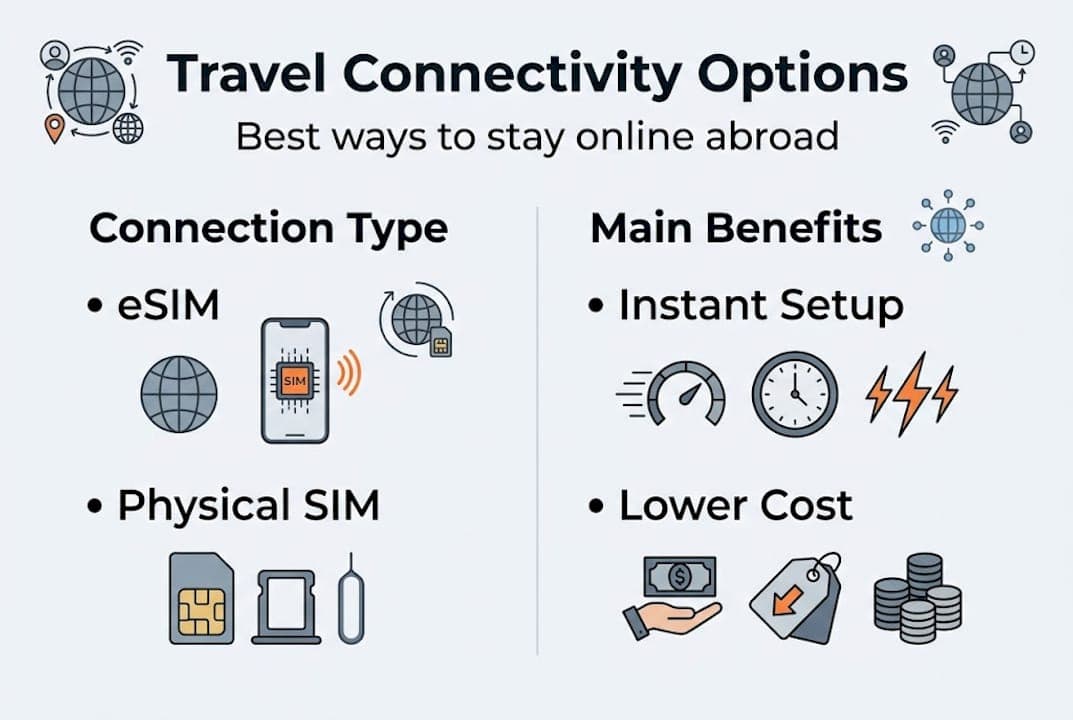
A realistic perspective: What most guides don’t tell you about travel data in 2026
Here’s the uncomfortable truth: no connectivity solution is universally perfect. Most articles rank eSIMs as the clear winner, but that framing erases a lot of real-world nuance.
If you’re a rising eSIM adoption skeptic, here’s what actually matters on the ground. eSIMs are genuinely excellent for planners doing short to medium trips. But long-term nomads often find that local SIMs stay cheaper once you’re settled, and that roaming can be fine if your home carrier already covers the region.
The travelers who struggle most are those who commit to one solution and refuse to adapt. Connectivity is a local problem. What works in Tokyo may fail in rural Colombia. Build in redundancy, ask locals which network actually works in their area, and never assume your premium global plan covers you in the way the marketing suggests. Sometimes paying a little more for a faster, more stable local connection is simply the right call.
Go further: Seamless travel connectivity with Lumo eSIM
Ready to take these tips off the page and into your next trip? Lumo makes it simple to find, compare, and activate the right data plan for where you’re headed.
With coverage across 160+ countries, instant QR code activation, and plans built for every traveler type, Lumo eSIM global plans remove the guesswork from staying connected. Whether you need a weekend plan for a city break or a flexible monthly option for extended travel, Lumo has you covered. Browse the latest recommendations in our guide to top travel eSIMs and find your fit before your next departure.
Frequently asked questions
What is the difference between eSIM and physical SIM for travel in 2026?
eSIMs let you activate data plans instantly without swapping cards, while physical SIMs may offer better value in some regions or for long-term stays beyond a month.
How do I know if my phone supports eSIM while traveling?
Check your device settings for an ‘Add eSIM’ or ‘Mobile Plans’ option, or visit your manufacturer’s official support page for a confirmed compatibility list.
Is using mobile data abroad safe in 2026?
Yes, provided you use a VPN on public networks, choose trusted data providers, and avoid accessing sensitive accounts on shared or unsecured connections.
Which is better: buying a plan in advance or at your destination?
Buying before you travel guarantees coverage from the moment you land, but local SIMs may offer better per-GB pricing for stays longer than a few weeks.
Can I switch between eSIM plans and local SIMs?
Most modern smartphones support dual SIM functionality, letting you run an eSIM and a physical SIM side by side and switch between them as needed.
Recommended
- The ultimate international travel tech checklist for 2026 | Lumo eSIM Store
- Secure mobile data guide: Stay connected globally, risk-free | Lumo eSIM Store
- International travel tech tips for seamless connectivity | Lumo eSIM Store
- 6 main types of travel connectivity for seamless trips | Lumo eSIM Store
Related Topics
Stay Connected Anywhere
Prepaid eSIM data plans for 180+ countries and territories. No physical SIM required.