Role of eSIM in IoT – Unlocking Seamless Global Connectivity

Traveling from American tech hubs to European innovation centers brings new opportunities but also challenges in keeping devices connected. For frequent business travelers, avoiding costly roaming fees and finding reliable global data access is essential to stay productive. The article explains how the embedded SIM (eSIM) technology simplifies global connectivity, offering business professionals smarter ways to manage multiple devices with secure remote provisioning and flexible network access.
Table of Contents
- eSIM Technology And IoT Connectivity Basics
- Types Of eSIM And IoT Device Integration
- Remote Provisioning And SGP.32 Standards Explained
- Key Benefits For Enterprise IoT Deployments
- Security, Compliance, And Lifecycle Management Issues
- Challenges, Costs, And Common Deployment Pitfalls
Key Takeaways
| Point | Details |
|---|---|
| eSIM Advantages | eSIM technology simplifies device connectivity by enabling remote profile management and global authentication, reducing hardware complexity and operational overhead. |
| Architecture Types | Three primary eSIM architectures (M2M, Consumer, IoT Specialized) cater to distinct connectivity needs, enhancing integration and flexibility for various IoT applications. |
| Security Enhancements | The SGP.32 standard establishes robust security protocols for remote SIM provisioning, ensuring secure profile management and protecting against unauthorized access. |
| Deployment Challenges | Successful eSIM implementation requires navigating technical integration hurdles and financial considerations, necessitating thorough pre-deployment assessments to mitigate risks. |
eSIM Technology and IoT Connectivity Basics
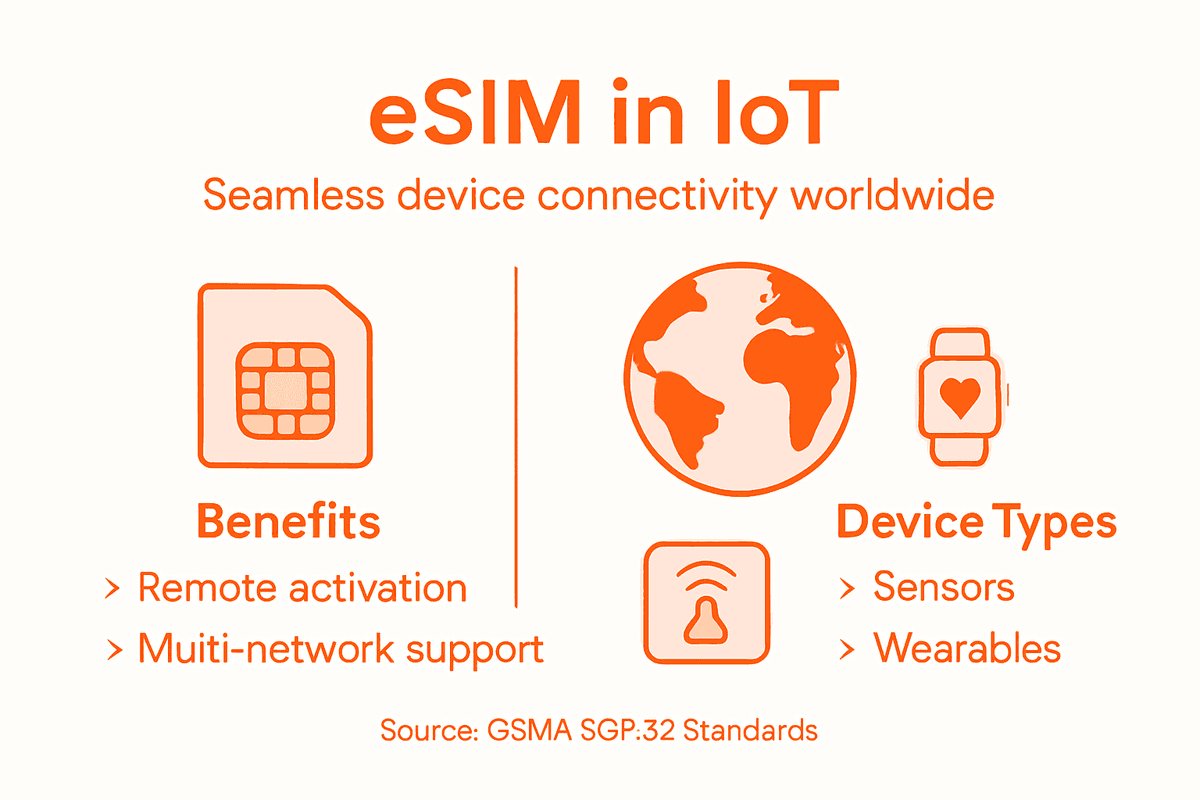
The emerging landscape of Internet of Things (IoT) connectivity is being dramatically transformed by embedded SIM (eSIM) technology. Unlike traditional physical SIM cards, eSIMs provide a revolutionary approach to managing device connectivity across global networks. Cellular IoT connections are rapidly expanding, driven by increasing demands for reliable and scalable network solutions.
eSIM technology offers several critical advantages for IoT deployment:
- Remote profile provisioning and management
- Multiple carrier profile storage capability
- Elimination of physical SIM card constraints
- Simplified global device authentication
- Reduced hardware complexity
At its core, eSIM enables remote SIM provisioning through digital profiles that can be downloaded and authenticated without physical intervention. This capability is particularly powerful for managing large device networks across diverse geographic regions. Industries like smart cities, logistics, and industrial monitoring can now deploy complex IoT infrastructures with unprecedented ease.
The technical architecture of eSIM supports seamless switching between cellular networks, providing IoT devices with enhanced flexibility and reliability. Manufacturers can now design products with built-in global connectivity, reducing complexity and enabling more sophisticated embedded communication strategies.
Pro tip: When designing IoT solutions, prioritize devices with native eSIM capabilities to maximize future-proofing and global deployment potential.
Types of eSIM and IoT Device Integration
The landscape of embedded SIM (eSIM) technology encompasses diverse architectures designed to meet the complex connectivity needs of Internet of Things (IoT) devices. Three primary eSIM architectures have emerged to address different technological requirements: Machine-to-Machine (M2M), Consumer, and specialized IoT architectures.
These eSIM architectures offer unique capabilities for device integration:
- M2M Architecture
- Automated profile management
- No user interaction required
- Ideal for industrial sensors and remote monitoring
- Consumer Architecture
- User-controlled profile selection
- Manual network switching
- Designed for smartphones and personal devices
- IoT Architecture
- Supports devices with limited interfaces
- Optimized for low-power networks
- Enables global connectivity for diverse device types
Remote SIM provisioning capabilities enable sophisticated IoT device integration across multiple industries. This technology supports multiple authentication mechanisms, allowing devices with constrained connectivity to maintain seamless global network access. The flexibility of eSIM architectures means manufacturers can design products with embedded connectivity tailored to specific operational requirements.

The technical implications are profound. IoT devices can now be deployed with built-in, adaptable connectivity solutions that transcend traditional hardware limitations. From smart city infrastructure to agricultural monitoring systems, eSIM technology provides a universal framework for global device communication.
Here’s a comparison of the main eSIM architectures and their best-fit use cases:
| eSIM Architecture | Ideal Device Types | User Involvement | Network Adaptability |
|---|---|---|---|
| M2M | Industrial sensors, meters | None (fully remote) | Excellent for global fleets |
| Consumer | Smartphones, wearables | Manual profile choice | Good for travel flexibility |
| IoT Specialized | Trackers, low-power units | Automated management | Optimized for limited access |
Pro tip: When selecting IoT devices, prioritize those with native eSIM capabilities to ensure maximum network flexibility and future-proof connectivity.
Remote Provisioning and SGP.32 Standards Explained
The Remote SIM Provisioning (RSP) framework represents a critical technological advancement in eSIM connectivity, enabling sophisticated profile management without physical hardware interventions. GSMA’s SGP.32 standard establishes comprehensive security protocols that define how eSIM profiles are securely downloaded, authenticated, and managed across global networks.
Key characteristics of the SGP.32 standard include:
- Secure authentication mechanisms
- Over-the-air profile management
- Mutual authentication protocols
- Dynamic profile lifecycle management
- Standardized security frameworks
IoT device connectivity management has been dramatically simplified through these standardized processes. The specification enables devices to dynamically switch between cellular networks, download new profiles, and maintain robust security without requiring physical SIM card replacements. This approach eliminates traditional connectivity barriers, particularly for large-scale IoT deployments spanning multiple geographic regions.
The technical architecture of SGP.32 supports complex authentication workflows that protect against unauthorized profile downloads and network access. By establishing a universal framework for secure, remote profile management, the standard ensures that IoT devices can maintain consistent, reliable connectivity across diverse technological ecosystems.
Pro tip: When evaluating IoT connectivity solutions, verify SGP.32 compliance to guarantee robust, secure remote provisioning capabilities.
Key Benefits for Enterprise IoT Deployments
The embedded SIM (eSIM) technology has revolutionized enterprise connectivity by offering unprecedented flexibility and efficiency in managing complex Internet of Things (IoT) networks. Enterprise IoT deployments can now leverage advanced connectivity solutions that dramatically reduce operational complexities and enhance global scalability.
Key strategic advantages for enterprises include:
- Simplified Global Connectivity
- Seamless network switching
- Reduced roaming complexities
- Multi-region device management
- Enhanced Security
- Hardware-based credential protection
- Remote authentication protocols
- Reduced vulnerability to unauthorized access
- Cost Optimization
- Elimination of physical SIM replacement
- Dynamic subscription management
- Reduced operational overhead
Remote connectivity management capabilities enable enterprises to transform their IoT infrastructure. By supporting dynamic profile management, organizations can instantly reconfigure device networks, switch cellular operators, and maintain consistent connectivity across diverse technological ecosystems. This approach is particularly powerful for industries requiring rapid, adaptive network responses.
The transformative potential of eSIM extends beyond traditional connectivity constraints. Enterprises can now design more resilient, flexible IoT architectures that adapt seamlessly to changing operational requirements, geographic challenges, and technological innovations.
This table summarizes key differences between traditional SIM and eSIM for enterprise IoT deployments:
| Feature | Traditional SIM | eSIM Technology |
|---|---|---|
| Physical Card Needed | Yes | No |
| Remote Provisioning | Not supported | Fully supported |
| Profile Switching | Manual SIM swap | Over-the-air update |
| Security Model | Fixed, less flexible | Dynamic and adaptive |
| Roaming Complexity | High | Lower, seamless switching |
Pro tip: Conduct a comprehensive audit of your current IoT infrastructure to identify specific connectivity pain points where eSIM technology can deliver immediate operational improvements.
Security, Compliance, and Lifecycle Management Issues
The eSIM technology introduces sophisticated security frameworks that fundamentally transform device authentication and management in Internet of Things (IoT) ecosystems. Mutual authentication procedures establish critical trust mechanisms between devices and network operators, preventing unauthorized access and ensuring robust protection across complex connectivity environments.
Key security and compliance dimensions include:
- Authentication Protocols
- Hardware-based credential verification
- Secure zero-touch provisioning
- Dynamic profile validation
- Lifecycle Management
- Remote profile activation
- Automatic profile suspension
- Secure profile deletion mechanisms
- Compliance Standards
- GSMA regulatory alignment
- Global security framework adherence
- Consistent operational protocols
Advanced security integration approaches now combine eSIM technologies with emerging frameworks like blockchain and software-defined networking. These integrated strategies address critical vulnerabilities in IoT device onboarding, creating autonomous systems with enhanced security postures that can dynamically respond to potential threats.
The comprehensive security model enables organizations to implement granular control mechanisms that protect device identities, manage connectivity risks, and maintain regulatory compliance across diverse technological landscapes. By leveraging these advanced authentication and lifecycle management capabilities, enterprises can significantly reduce potential attack surfaces and improve overall network resilience.
Pro tip: Implement multi-layered authentication protocols and conduct periodic security audits to ensure your eSIM-enabled IoT infrastructure maintains optimal protection against evolving cybersecurity threats.
Challenges, Costs, and Common Deployment Pitfalls
Deploying eSIM technologies for Internet of Things (IoT) ecosystems presents a complex landscape of technical and strategic challenges that organizations must carefully navigate. Deployment complexities extend beyond simple technological implementation, requiring comprehensive planning and strategic foresight.
Key deployment challenges include:
- Technical Integration Hurdles
- Interoperability between network operators
- Varying regional regulatory requirements
- Complex remote provisioning infrastructures
- Financial Considerations
- Initial hardware compatibility investments
- Software infrastructure modification costs
- Personnel training expenses
- Operational Risks
- Potential profile activation delays
- Security vulnerability management
- Scalability limitations
Multi-operator profile management strategies represent a critical aspect of successful eSIM deployment. Organizations must develop robust frameworks that can dynamically manage connectivity across diverse network environments, accounting for regional variations in technological standards and regulatory landscapes.
Successful eSIM implementation demands a holistic approach that balances technological capabilities with strategic organizational objectives. Enterprises must invest in comprehensive assessment processes, understanding their specific connectivity requirements, and developing adaptive deployment strategies that can evolve with emerging technological standards.
Pro tip: Conduct a thorough pre-deployment assessment that maps your specific IoT ecosystem requirements against potential eSIM implementation challenges to minimize unexpected complications.
Unlock Seamless Global Connectivity with Lumo eSIM Solutions
The article highlights the growing challenges of managing IoT device connectivity across diverse global networks using traditional SIM cards and complex provisioning. With concepts like remote SIM provisioning, multi-carrier profile management, and security protocols becoming essential, enterprises and individuals face connectivity pain points such as costly roaming fees, difficult network switching, and limited device flexibility. Lumo addresses these challenges head-on by offering a streamlined eSIM platform designed for instant activation and effortless global coverage in over 160 countries. Its support for multiple eSIM profiles and rapid QR code activation perfectly aligns with the need for flexibility and security emphasized in eSIM architectures and the SGP.32 standards.
Experience a new era of connectivity that matches the cutting-edge technology described in the article. Whether you are managing complex IoT deployments or seeking reliable mobile data for your digital lifestyle, Lumo empowers you to switch networks instantly without worrying about roaming fees or hardware limitations. Act now to simplify your global connectivity and future-proof your devices by visiting Lumo’s official site. Discover how our innovative eSIM platform delivers affordable, secure, and easy-to-use solutions built for travelers and enterprises alike. Start your journey toward seamless connectivity today at https://lumo.to and explore how eSIM technology can transform your world.
Frequently Asked Questions
What is eSIM technology and how does it differ from traditional SIM cards?
Embedded SIM (eSIM) technology is a digital SIM that enables remote management of device connectivity without the need for a physical SIM card. Unlike traditional SIM cards, eSIMs allow for seamless switching between carriers and simplified global device authentication.
How does eSIM improve IoT device deployment?
eSIM improves IoT device deployment by allowing remote profile management, reducing hardware complexity, and enabling multiple carrier profiles. This makes it easier to manage large networks of devices across various geographical regions.
What are the security benefits of using eSIM in IoT applications?
Using eSIM in IoT applications enhances security through hardware-based credential protection, secure authentication mechanisms, and mutual authentication protocols. It also facilitates over-the-air profile management, reducing vulnerabilities related to unauthorized access.
What should enterprises consider when implementing eSIM technology for IoT?
Enterprises should consider technical integration challenges, compliance with regional regulations, and initial financial investments. It’s also important to develop robust multi-operator profile management strategies to ensure seamless connectivity across different network environments.
Recommended
- Role of eSIM in Telecommunication – Transforming Global Connectivity | Lumo eSIM Store
- Role of eSIM in Connectivity – Why It Matters Now | Lumo eSIM Store
- Remote Work and eSIM: Unlocking True Global Flexibility | Lumo eSIM Store
- 7 Smart Examples of eSIM Devices for Travelers | Lumo eSIM Store
- IoT in Energy Grid Monitoring | Singleclic
Related Topics
Stay Connected Anywhere
Prepaid eSIM data plans for 180+ countries and territories. No physical SIM required.