What Is Roaming and Why It Impacts Travelers

Booking a flight to Spain or a work stint in Singapore should not mean battling patchy mobile service or dreading surprise fees on your next bill. For many frequent travelers and remote workers, the urgency of staying connected across borders makes choosing the right roaming option a key concern. Understanding the basics of mobile phone roaming empowers you to sidestep excessive charges and ensures you enjoy reliable internet access no matter where your journey takes you.
Table of Contents
- Roaming Basics: Definition And Key Concepts
- Types Of Roaming And How They Differ
- How Roaming Works Behind The Scenes
- Real-World Roaming Scenarios For Travelers
- Costs And Common Pitfalls Of Roaming
- Alternatives To Roaming For Global Connectivity
Key Takeaways
| Point | Details |
|---|---|
| Understanding Roaming | Roaming enables mobile users to stay connected while traveling by accessing services through foreign networks. It involves complex agreements between carriers to ensure seamless service continuity. |
| Types of Roaming | Roaming includes national, international, and specialized types, each with unique characteristics and pricing structures. Travelers should understand these differences to choose the best option for their needs. |
| Cost Awareness | Unchecked data usage during roaming can lead to unexpected charges. Travelers should consult their carrier’s policies and manage settings to prevent financial surprises. |
| Connectivity Alternatives | Exploring alternatives such as local SIM cards, portable WiFi, and eSIM technology can reduce costs and provide flexibility in mobile connectivity while abroad. |
Roaming Basics: Definition and Key Concepts
Roaming is a critical mobile telecommunications service that enables travelers to stay connected while moving across different geographic regions. At its core, roaming allows mobile phone users to access telephony, SMS, and data services through third-party networks outside their home carrier’s coverage area. Mobile phone roaming involves complex technical processes that ensure seamless connectivity across diverse wireless technologies and network infrastructures.
The fundamental mechanism of roaming relies on sophisticated agreements between mobile network operators. When you travel internationally, your mobile device automatically connects to a foreign network partner of your home carrier, enabling continuous communication without manual intervention. These inter-carrier agreements determine critical aspects like wholesale rates, authentication protocols, and billing mechanisms. The European Union’s regulatory framework has been particularly instrumental in standardizing roaming practices, introducing consumer-friendly policies like the ‘roam like at home’ principle that significantly reduces international communication costs.
Technically, roaming encompasses several intricate steps: mobility management, network authentication, authorization, and billing procedures. Your smartphone negotiates connection permissions with foreign networks, verifies your home carrier’s credentials, and establishes a temporary connection that allows you to make calls, send messages, and access mobile data. This process happens instantaneously and transparently, creating a seamless experience for travelers who expect uninterrupted connectivity across different countries and cellular networks.
Pro tip: Always check your mobile carrier’s specific roaming policies and international data packages before traveling to avoid unexpected charges and ensure smooth connectivity.
Types of Roaming and How They Differ
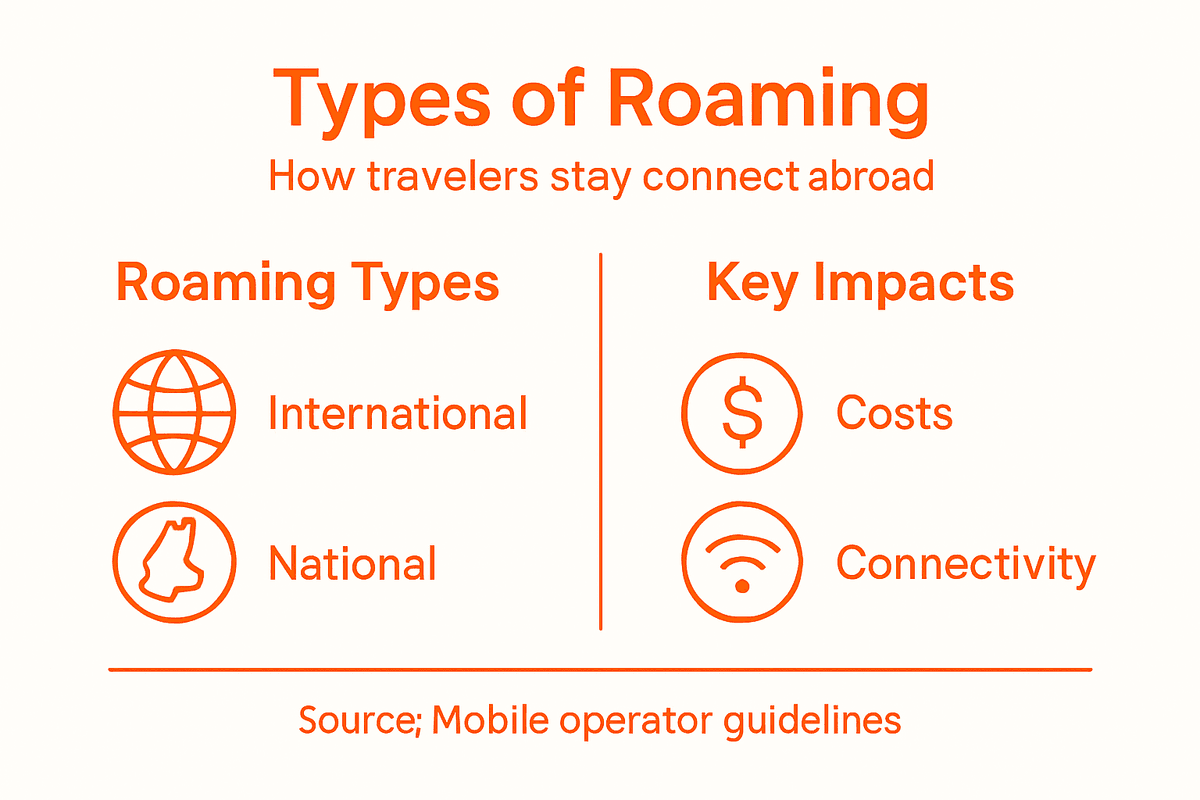
Mobile roaming is not a one-size-fits-all service but encompasses several distinct types tailored to different communication needs and geographic contexts. GSM roaming categories primarily include national roaming, international roaming, and voice/data roaming, each with unique characteristics and operational mechanisms. National roaming occurs when a mobile device connects to another operator’s network within the same country, typically in areas where the primary carrier lacks coverage.
International roaming represents the most common type for travelers, enabling mobile service continuity across different countries. This type of roaming allows users to make calls, send messages, and access mobile data while abroad, facilitated by complex inter-carrier agreements. Unlike national roaming, international roaming involves more intricate authentication and billing processes, often resulting in higher per-minute or per-megabyte charges. Some specialized roaming services like academic network roaming demonstrate unique applications beyond traditional mobile communications, providing secure network access for research and educational institutions worldwide.
The primary differentiators between roaming types include geographic scope, service specifics, and underlying technical infrastructure. Voice roaming enables telephony services across networks, while data roaming focuses on internet connectivity. Some advanced roaming solutions now offer seamless switching between cellular, WiFi, and local networks, providing travelers with more flexible and cost-effective communication options. These nuanced roaming approaches reflect the evolving complexity of global telecommunications and the increasing demand for continuous, reliable connectivity.
Here’s a comparison of major roaming types and their main characteristics:
| Roaming Type | Geographic Scope | Services Supported | Typical Costs |
|---|---|---|---|
| National Roaming | Within home country only | Voice, SMS, some data | Usually lower, regulated |
| International Roaming | Across multiple countries | Voice, SMS, full data | Higher, varies by region |
| Specialized Roaming | Academic/global networks | Secure WiFi, data access | Often free or low-cost |
Pro tip: Before traveling, verify your specific roaming type and potential additional costs by contacting your mobile carrier and exploring alternative connectivity solutions like local SIM cards or eSIM technologies.
How Roaming Works Behind the Scenes
Roaming operates through a complex network of telecommunications agreements and technical infrastructure that enables seamless mobile connectivity across different carriers and countries. International roaming agreements form the foundational framework that allows mobile devices to connect to foreign networks, creating a sophisticated global communication ecosystem. When a traveler turns on their smartphone in another country, multiple behind-the-scenes processes are instantly triggered to authenticate and enable service.

The technical architecture of roaming involves intricate interactions between home and visited networks, with several key components working simultaneously. LTE roaming architecture demonstrates this complexity through its multiple network elements, including Public Land Mobile Networks (PLMN), home network authentication servers, and international gateways. These systems coordinate to verify subscriber credentials, route communication signals, and manage billing processes within milliseconds of a connection attempt. The visited network first checks the user’s home network for authorization, ensuring that only valid subscribers can access services.
Billing and authentication represent the most critical backend processes in roaming technology. Different charging mechanisms exist for prepaid and postpaid accounts, with each requiring unique session management protocols. Mobile operators negotiate wholesale rates that determine the cost of services when a user connects to a foreign network. These intricate agreements include detailed specifications about call duration, data usage, and interconnection charges, creating a complex economic ecosystem that enables global mobile communication.
Pro tip: Before international travel, contact your mobile carrier to understand specific roaming protocols and potential additional charges to avoid unexpected billing surprises.
Real-World Roaming Scenarios for Travelers
Travelers encounter diverse roaming scenarios that demonstrate the critical importance of understanding mobile connectivity options while abroad. European roaming regulations have transformed how international travelers manage mobile services, particularly within the European Economic Area. For instance, a business professional attending a conference in Paris can now use their existing mobile plan without worrying about exorbitant additional charges, thanks to ‘roam like at home’ policies that ensure continuity of service.
Different travel contexts present unique roaming challenges and solutions. A digital nomad working from multiple countries might require seamless data connectivity across diverse networks, while a vacationer might need intermittent access for navigation and communication. International mobile connectivity enables travelers to maintain communication regardless of their location, with mobile operators facilitating connections through complex international agreements. These scenarios range from short-term tourist trips to extended work assignments, each demanding flexible and reliable mobile services.
Understanding the practical implications of roaming is crucial for modern travelers. Different countries have varying roaming policies, with some offering more favorable terms than others. Prepaid travelers might face different connection protocols compared to postpaid subscribers, and data usage limits can significantly impact communication strategies. Factors like network compatibility, fair usage policies, and potential additional charges create a complex landscape that requires careful navigation and proactive planning.
Pro tip: Research your destination’s specific roaming policies and consider purchasing local SIM cards or eSIM solutions for more predictable and cost-effective mobile connectivity.
Costs and Common Pitfalls of Roaming
Roaming can quickly transform from a convenient communication solution into a financial nightmare for unprepared travelers. Wireless roaming regulations mandate fair pricing, but consumers still face significant risks of unexpected charges. Mobile users often discover shocking bills after returning from international trips, with data consumption being the primary culprit for astronomical roaming expenses.
The complexity of international mobile pricing creates multiple potential pitfalls for travelers. Wholesale charges between operators, varying network agreements, and inconsistent regulatory frameworks contribute to an unpredictable cost landscape. Some carriers impose steep per-minute call rates, while others charge exorbitant data rates that can accumulate rapidly. Global roaming pricing challenges demonstrate how dramatically prices can fluctuate across different countries, making it crucial for travelers to understand the specific terms of their mobile plans before departing.
Unexpected roaming costs often stem from several common scenarios: background data usage, automatic app updates, navigation services, and streaming content. Smartphones continuously sync and update information, consuming data without users’ active awareness. Messaging applications, cloud storage services, and email synchronization can generate significant charges when left unchecked. Many travelers inadvertently rack up expenses by not adjusting their device settings or understanding their carrier’s specific international policies.
Pro tip: Enable airplane mode and use WiFi networks whenever possible, and download offline maps and content before traveling to minimize unexpected roaming charges.
Alternatives to Roaming for Global Connectivity
Travelers seeking cost-effective and flexible communication solutions have multiple alternatives to traditional mobile roaming. Specialized network alternatives provide innovative ways to stay connected without incurring excessive roaming charges. These options range from local SIM cards and international data packages to WiFi-based communication strategies that can significantly reduce connectivity expenses for global travelers.
One compelling alternative is the use of international WiFi networks, which offer secure and often free connectivity in numerous locations. Global academic WiFi networks demonstrate how institution-based authentication can provide seamless internet access across different countries. For travelers, this translates into strategies like purchasing local SIM cards, utilizing portable WiFi devices, or leveraging comprehensive international data plans that offer more predictable and affordable connectivity compared to traditional roaming services.
Each alternative connectivity solution comes with unique advantages and potential limitations. Local SIM cards provide immediate, low-cost access in specific countries but require device unlocking and manual configuration. Portable WiFi devices offer flexibility but might have limited battery life and coverage. International eSIM technologies are emerging as a sophisticated solution, allowing travelers to switch between multiple network providers without physically changing SIM cards, providing unprecedented convenience and cost management for global communication needs.
Below is a summary of common alternatives to traditional roaming for travelers:
| Connectivity Option | Key Benefits | Limitations | Best Use Case |
|---|---|---|---|
| Local SIM Card | Low cost, local rates | Needs unlocked device | Extended stays in one country |
| Portable WiFi Device | Shareable, fixed rates | Limited battery life | Group travel, multiple devices |
| International eSIM | Flexible of providers | Not supported on all phones | Multi-country trips |
| Public WiFi Network | Free or cheap, available spots | Security risks, unstable | Occasional connectivity |
Pro tip: Research and compare multiple connectivity options before traveling, and consider purchasing a local SIM or international data plan that matches your specific communication requirements and destination.
Stay Connected Effortlessly Wherever You Go
Traveling internationally can overwhelm you with confusing roaming charges and unreliable connections. The article highlights how roaming involves complex agreements, unexpected costs, and frustrating network compatibility issues that can ruin your journey. You deserve a seamless mobile experience without worrying about shocking bills from background data use or limited coverage.
Discover how Lumo’s all-in-one eSIM solution simplifies global connectivity by letting you switch instantly between over 160 local carriers. Say goodbye to expensive roaming fees and complicated setups. With fast 5G/4G access on multiple devices and flexible data plans, you stay connected on your terms. Take control of your travel communications now by exploring how Lumo can eliminate roaming headaches and empower your digital lifestyle at https://lumo.to. Start your hassle-free international journey today.
Frequently Asked Questions
What is mobile roaming and how does it work?
Mobile roaming allows users to access telephony, SMS, and data services through foreign networks when traveling outside their home carrier’s coverage area. It involves agreements between mobile network operators to ensure seamless connectivity without manual intervention.
What are the different types of roaming?
The main types of roaming include national roaming, which occurs within a home country using another operator’s network, international roaming, which enables services across multiple countries, and specialized roaming for unique applications such as academic networks that provide secure access for institutions.
How can I avoid unexpected charges while roaming?
To avoid unexpected charges, check your mobile carrier’s specific roaming policies before traveling, enable airplane mode when not using data, and utilize WiFi whenever available. You can also consider purchasing local SIM cards or international data packages as cost-effective options.
What are some alternatives to traditional mobile roaming?
Alternatives to traditional mobile roaming include using local SIM cards, portable WiFi devices, and international eSIMs, which provide flexible data access without incurring high roaming costs. Public WiFi networks are also available as a free or low-cost option, though they may come with security risks.
Recommended
Related Topics
Stay Connected Anywhere
Prepaid eSIM data plans for 180+ countries and territories. No physical SIM required.