What Is Seamless Connectivity for Travelers in 2026

TL;DR:
- Seamless connectivity enables devices to stay online without manual switching when moving between networks. It relies on standards like GSMA SGP.32 and eUICC hardware to allow automatic profile switching over the air. Using a managed eSIM plan improves global access, reduces disruptions, and reduces travel-related stress.
Seamless connectivity is defined as the ability of devices and networks to maintain uninterrupted digital access as users move between Wi-Fi, cellular, and satellite networks without manual switching or signal loss. For travelers and remote workers, this is not a luxury. Over 54% of travelers name slow or unreliable internet as their top travel frustration, which means a dropped connection is not just annoying. It costs time, money, and peace of mind. Understanding how this technology works, and how to use it, is the first step toward fixing it.
What is seamless connectivity and why does it matter?
Seamless connectivity means your device stays online automatically as you move from one network to another. You walk out of an airport lounge, your phone drops off the Wi-Fi, and your cellular data picks up without you touching a setting. That handoff, when done correctly, is invisible.

The industry term for the underlying technology is access-agnostic networking. Experts at CableLabs define true seamlessness as treating connectivity as a unified fabric, not a set of fragmented options. That framing matters because most people still think of Wi-Fi and mobile data as two separate things they switch between manually.
For remote workers and frequent travelers, the stakes are real. Mobile connectivity is now the top priority for 9 out of 10 travelers in 2026. That figure reflects a fundamental shift: connectivity has become as critical as a flight being on time.
What are the key benefits for travelers and remote workers?
The most direct benefit is productivity. Corporate eSIM users report an 81.3% positive impact on productivity, compared to 52.4% for travelers who arrange their own connectivity. That gap is significant. It shows that the method of connectivity, not just the presence of it, determines how well you work on the road.
Beyond productivity, uninterrupted access supports several critical functions:
- Communication: Video calls, messaging apps, and email stay live across network transitions.
- Navigation: Real-time maps and traffic updates require a stable data connection, especially in unfamiliar cities.
- Cloud access: Files, documents, and collaboration tools like Google Workspace stay synced without manual reconnection.
- Mobile payments: Contactless payments and banking apps depend on a live data signal.
- Safety: Emergency services, location sharing, and travel alerts all require active connectivity.
86.5% of business travelers report stress from connectivity issues, and 79% rank reliable internet alongside safety and punctuality. That data point reframes the conversation. Connectivity is not a technical feature. It is emotional infrastructure.
How does seamless connectivity technically work?
True network continuity depends on three layers working together: hardware, software, and standards. No single layer can deliver it alone.
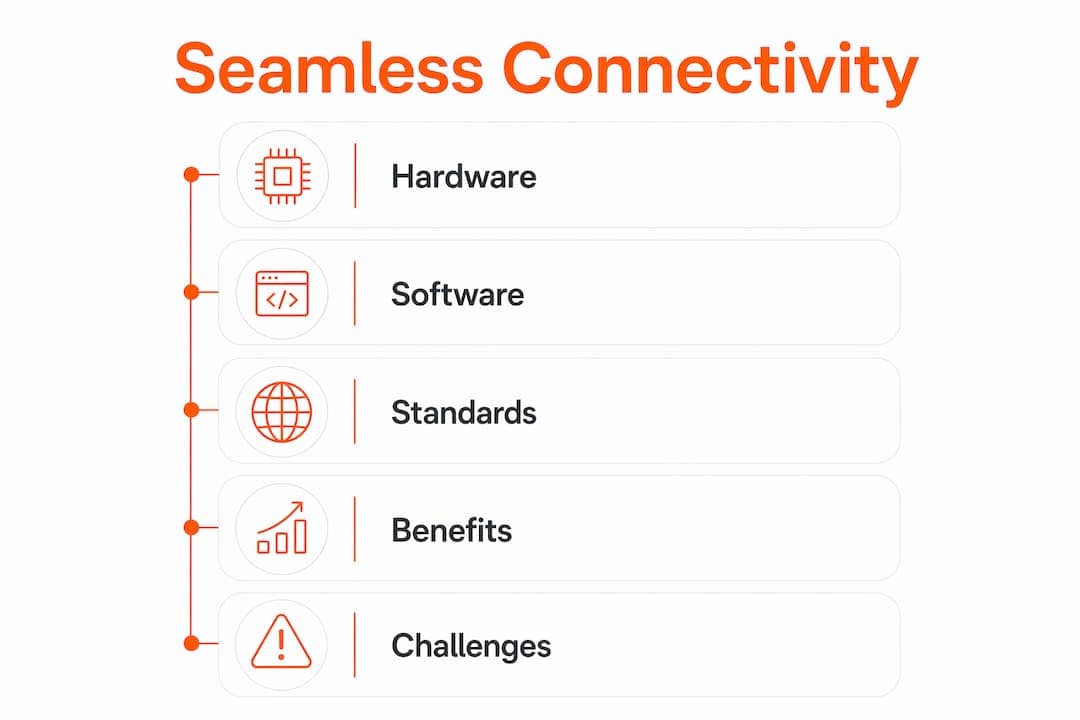
At the hardware level, eUICC-enabled devices carry an embedded SIM chip that stores multiple network profiles. The GSMA SGP.32 standard enables remote SIM profile management without any user action. This is called zero-touch provisioning, and it means your device can download and activate a new carrier profile over the air while you are mid-flight.
At the software level, backend orchestrators monitor signal quality across available networks and trigger automatic switching when thresholds drop. This is what prevents the half-second freeze you notice when a video call degrades before cutting out entirely.
| Standard or technology | Function |
|---|---|
| GSMA SGP.32 | Remote SIM profile download and switching |
| eUICC | Hardware chip enabling multiple SIM profiles |
| IEEE 802.21 | Media Independent Handover between network types |
| Backend orchestrator | Monitors signal and triggers network switching |
| Zero-touch provisioning | Activates carrier profiles without user input |
Pro Tip: When buying a phone for international travel, confirm it supports eUICC and is carrier-unlocked. A locked device cannot switch profiles, which defeats the purpose of eSIM technology entirely.
What challenges exist in achieving true seamless connectivity?
The biggest obstacle is not technology. It is coordination. Dozens of network operators, device manufacturers, and software platforms must agree on shared standards, and they rarely do.
Captive portals are a common example. You connect to airport Wi-Fi, but your device cannot authenticate automatically because the portal requires a browser login. That manual step breaks the handoff. IEEE 802.21 offers a Media Independent Handover standard to solve this, but commercial adoption remains limited.
Security adds another layer of complexity. Security has overtaken speed as the top priority for international mobile connectivity among business travelers. Public Wi-Fi networks are the leading source of both connection instability and data risk. Relying on them without a secure alternative exposes both your data and your workflow.
Common barriers travelers face include:
- Captive portals that block automatic authentication
- Inconsistent quality-of-service standards between Wi-Fi and cellular networks
- Device lock-in that prevents profile switching
- Lack of universal roaming agreements between regional carriers
Emerging solutions include 6G architecture, which is being designed with native multi-network support from the ground up. Organizations like CableLabs are also pushing for enterprise IT integration that treats connectivity as a managed service rather than a user responsibility.
Pro Tip: Avoid relying on hotel or airport Wi-Fi for sensitive work. Use a dedicated eSIM data plan with a reputable provider to maintain both speed and security. Check out eSIM security best practices before your next trip.
What are practical examples of seamless connectivity for digital nomads?
Picture a consultant flying from New York to Tokyo. She lands, turns off airplane mode, and her phone connects to a local Japanese carrier automatically through a pre-loaded eSIM profile. No SIM swap. No roaming charge. Her Slack messages load, her calendar syncs, and she joins a video call from the taxi. That is what working connectivity looks like in practice.
For digital nomads who move between countries monthly, the same principle applies at a larger scale. Business travelers who use eSIM solutions for international work report fewer disruptions and faster onboarding in each new location.
Smart connectivity habits for frequent travelers:
- Activate your eSIM before departure. Download the carrier profile while still on your home network.
- Disable automatic Wi-Fi connections in airports and hotels to avoid captive portal interruptions.
- Use a VPN on any public network you cannot avoid.
- Check coverage maps for your destination before choosing a data plan.
- Keep a backup eSIM profile for a secondary carrier in case your primary network has gaps.
The shift from physical SIM cards to eSIM technology is the single most practical step a traveler can take toward consistent global access. It removes the hardware dependency and puts network switching under software control.
Key Takeaways
Uninterrupted global connectivity requires hardware support (eUICC), open standards (GSMA SGP.32), and a managed eSIM solution to eliminate manual switching and roaming disruptions.
| Point | Details |
|---|---|
| Connectivity is emotional infrastructure | 86.5% of business travelers report stress from connectivity issues, affecting decisions and output. |
| eSIM users outperform traditional roamers | Corporate eSIM users report 81.3% productivity gains versus 52.4% for self-arranged solutions. |
| Standards make or break the handoff | GSMA SGP.32 and eUICC hardware enable automatic profile switching without user input. |
| Security now outranks speed | Business travelers prioritize secure connections over fast ones when traveling internationally. |
| Preparation prevents disruption | Activating eSIM profiles before departure eliminates the most common connectivity failure point. |
Why connectivity failures hit harder than we admit
The technical explanation for seamless connectivity is straightforward. The human cost of getting it wrong is less discussed.
I have watched colleagues lose client deals because a video call dropped at the wrong moment. I have seen remote workers burn two hours in a foreign city trying to find a stable connection for a deadline. These are not edge cases. They are the norm for anyone who travels without a deliberate connectivity plan.
What strikes me most about the 2026 research is the emotional dimension. Connectivity is now infrastructure in the same category as shelter and transport. When it fails, it does not just slow you down. It creates anxiety, erodes trust with clients, and forces bad decisions under pressure.
The shift toward intelligent, adaptive networks is real, and 6G will accelerate it. But the gap between where standards are heading and where most travelers are today is wide. The practical answer right now is a managed eSIM solution that removes the manual work entirely. How eSIM transforms international travel is not a future story. It is available today for anyone willing to set it up before they board.
— Bogdan
How Lumo keeps you connected across 160+ countries
Reliable global access does not require technical expertise. Lumo provides instant digital SIM plans that activate via QR code, covering over 160 countries with 4G and 5G networks. There are no physical SIM swaps, no roaming fees, and no manual network hunting when you land.
Lumo is built for travelers and remote workers who need their connection to work the moment they arrive. Plans are flexible, activation takes minutes, and 24/7 support is available if anything goes wrong. For anyone serious about staying productive across borders, explore Lumo’s global eSIM plans and activate before your next departure.
FAQ
What is seamless connectivity in simple terms?
Seamless connectivity is when your device automatically stays online as it switches between Wi-Fi, cellular, and other networks without any action from you.
How does eSIM enable seamless connectivity?
eSIM technology uses the GSMA SGP.32 standard to download and switch carrier profiles over the air, removing the need for physical SIM swaps when crossing networks or borders.
Why do travelers struggle with connectivity abroad?
Over 54% of travelers cite slow or unreliable internet as their top frustration, caused by captive portals, incompatible SIM cards, and inconsistent roaming agreements between carriers.
Is seamless connectivity secure?
Security depends on the network you use. Dedicated eSIM data plans are significantly safer than public Wi-Fi, which remains the leading cause of data risk for international travelers.
What is the difference between network connectivity and seamless connectivity?
Network connectivity means your device has access to a network. Seamless connectivity means that access continues automatically and without interruption as you move between different networks or locations.
Recommended
Related Topics
Stay Connected Anywhere
Prepaid eSIM data plans for 180+ countries and territories. No physical SIM required.