eSIM Across Borders: 4 Checks Before You Fly

Yes, an eSIM can keep you connected across multiple countries, provided you check three things first: your device is carrier-unlocked, the plan you choose actually covers every country on your route, and your phone supports the local network bands. Most travel eSIMs handle data only, so voice calls and texts or a local phone number often need a separate setup step.
TL;DR:
- Global plans can exclude countries or switch to slower roaming partners, so verify every stop and match the data allowance to daily use.
- For frequent border crossings, a regional shared data bucket avoids repeated purchases; long overland routes may cost less with stacked country plans.
- Keep your home SIM active for calls and texts while the travel eSIM handles data, and install and test the profile on your home network.
- At each border, toggle airplane mode and manually select a network if needed; keep your IMEI, plan ID, and coverage screenshots ready for support.
Table of Contents
- How global, regional, and single-country eSIM plans actually behave at borders
- Pre-trip checklist: unlocking, device compatibility, and dual-SIM setup
- How to pick the best plan for a route: global, regional, or stacked passes
- Step-by-step: buy, activate, test, and switch eSIM profiles while crossing borders
- Evidence and expert guidance behind the device-compatibility rules
- Matching your eSIM strategy to your travel style
- Where to check coverage and buy your cross-border eSIM
- FAQ
- Sources
How global, regional, and single-country eSIM plans actually behave at borders
A global plan bundles data across dozens of countries under one profile, a regional plan covers a continent or cluster like Europe or Southeast Asia, and a single-country plan is built for one destination only. The label matters less than the fine print: some “global” plans quietly exclude a handful of countries or hand you off to a roaming partner with slower speeds once you cross into them.
Before buying, confirm whether the plan is data-only. Most are, which means you will rely on apps like WhatsApp or iMessage for calls and texts instead of a traditional phone number.
- Global plans suit travelers hitting many countries in one trip and skipping constant repurchases.
- Regional plans fit itineraries confined to one continent or tight cluster of neighboring countries.
- Single-country plans work best for longer stays in one place where per-country data allowances matter more than breadth.
Plan duration should match your itinerary, not just your total trip length. A 30-day global plan with a shared data bucket can run out fast if you spend two weeks in a high-usage country and leave little allowance for the rest.
Pre-trip checklist: unlocking, device compatibility, and dual-SIM setup
A few checks before departure prevent most connectivity failures once you land.
- Confirm your device is carrier-unlocked. The FCC recommends contacting your home provider to verify unlock status and international roaming compatibility before you travel.
- Check your phone’s supported LTE and 5G bands on the manufacturer’s page and compare them against the networks used at your destination. Unlocking alone does not guarantee service if your hardware does not support the local bands.
- Decide whether to run dual-SIM. Keeping your home SIM active for calls and texts while installing a travel eSIM for data is the setup Apple documents for iPhone travelers, and it lets you receive messages on your usual number without roaming charges on data.
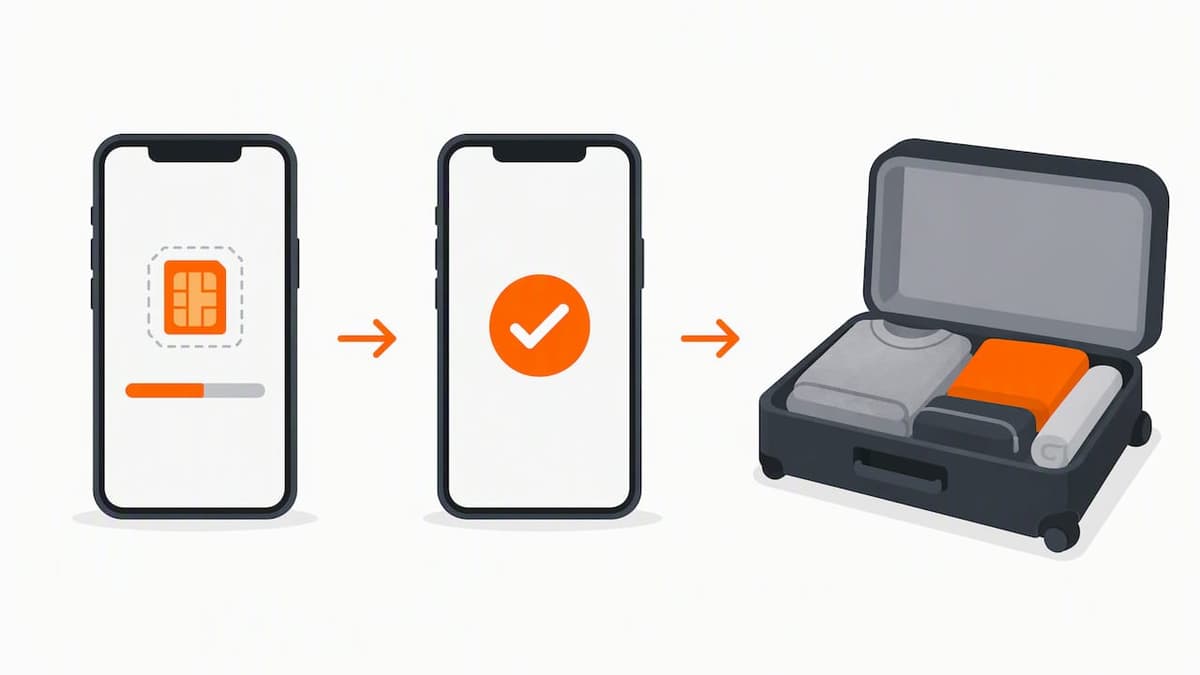
- Install and activate the eSIM before you leave, while still on home Wi-Fi, so any activation issues surface while you still have normal connectivity to troubleshoot.
If your device is still locked, a guide to locked-phone eSIM use walks through what to check and how to request an unlock from your carrier.
Pro Tip: Install your eSIM at home and confirm it shows as active in Settings before you pack your bags, not after you land.
How to pick the best plan for a route: global, regional, or stacked passes
The right purchasing strategy depends on how many countries you are visiting, how long you stay in each, and how much data you actually use. A trip through three countries in ten days with light data needs behaves differently than a six-month overland route with dozens of border crossings.
- Pay-per-day or short fixed-data plans suit quick trips through one or two countries where total usage is predictable.
- A single bucket of data shared across a whole region works well when you move frequently and do not want to repurchase at each border.
- Stacking individual country plans back to back often costs less and avoids coverage gaps on long, multi-stop overland routes.
Before buying anything, check the coverage-by-country page for your exact route and confirm band compatibility for each stop. Some countries also require ID or local registration to activate a number, a detail worth checking ahead of time rather than at a border crossing.
Step-by-step: buy, activate, test, and switch eSIM profiles while crossing borders
A short, repeatable sequence keeps you connected whether you cross one border or ten.
- Before departure: confirm your device is unlocked, buy the plan or plans for your route, install via QR code or app, and check that the profile appears in your device Settings.
- Run a quick test on home Wi-Fi to confirm the plan activates and shows a data connection.
- At each new country: toggle airplane mode off and on, and if the network does not connect automatically, manually select an available operator in your network settings.
- If a connection drops: try the airplane mode toggle first, then reselect the operator, then reinstall the profile if neither works.
- Carry your device’s IMEI number, your plan ID, and screenshots of your coverage confirmation and activation instructions in case you need support.
Roaming itself depends on more than an active plan. The CTIA explains that roaming requires compatible network technologies and frequency bands, meaning an unlocked phone with the wrong antenna hardware still will not connect reliably, even with a valid eSIM installed. A detailed walkthrough of switching networks abroad covers this troubleshooting sequence in more depth for travelers crossing several borders in one trip.
Evidence and expert guidance behind the device-compatibility rules
Official guidance backs up nearly every check in this article. The FCC’s international roaming guide notes that eSIM and physical SIM behavior varies by device and carrier, so manufacturer instructions matter as much as carrier settings.
- Apple’s support documentation walks through buying a travel eSIM and roaming with your existing carrier side by side.
- Samsung’s dual-SIM guidance covers installing dual SIMs and notes that available options vary by carrier and region.
- Checking your phone’s 5G band support before buying a plan avoids a common and preventable connectivity failure.
Pro Tip: Screenshot your coverage confirmation and band compatibility check before you fly. It saves time if you need support once you land.
Matching your eSIM strategy to your travel style
Short trips with a few stops call for one regional or global plan and nothing more complicated. Overland routes with many border crossings often do better with stacked single-country plans plus a physical SIM backup for any destination that requires local registration. Travelers settling in one place for months are usually better served by a long-duration local plan, renewed as needed, than by a short-term global bucket.
— Theo Wheeler
Where to check coverage and buy your cross-border eSIM
Once you know your route, checking coverage and buying takes a few minutes. Coverage extends to many countries with instant QR code activation and no contracts or registration required, offering plans suitable for multi-country trips like those discussed here. Support is available to assist if you encounter difficulties during your trip, especially given how often carrier-level identity checks now come into play around SIM activation and account security.
- Check your eSIM coverage by country before buying to confirm your full route is included.
- Browse Global eSIM Plans for trips spanning several continents.
- Browse Europe eSIM Plans for itineraries confined to Europe.
Verify your route, pick the plan that matches it, and install before you leave home.
FAQ
Can I get an eSIM for two countries?
Yes, a regional or global eSIM plan can cover two or more countries under one data allowance, as long as both destinations appear on that plan’s coverage list. Check the coverage page for your specific countries before buying, since some plans carve out exceptions even within a listed region.
Which eSIM is best for traveling around Europe?
A regional Europe eSIM plan is usually the most efficient choice for multi-country European trips, since it covers the continent under one profile instead of requiring a new plan at each border. Confirm your phone supports the LTE and 5G bands used in each country you plan to visit before you travel.
What is the best eSIM for travel overseas?
The best option depends on your route: a global plan suits trips across several continents, a regional plan suits travel within one area, and a single-country plan suits an extended stay in one place. In every case, confirm your device is unlocked and that the plan’s coverage list matches your itinerary.
Can I use an eSIM while traveling internationally?
Yes, as long as your device is unlocked and supports eSIM technology, you can install a travel eSIM for data while abroad. Many travelers run it alongside their home SIM in dual-SIM mode, keeping their usual number active for calls and texts while the eSIM handles data.
Sources
- Cell Phone Unlocking | Federal Communications Commission
- International roaming: mobile phone use abroad | Federal Communications Commission
- How roaming works | CTIA
- Use eSIM while traveling internationally with your iPhone | Apple Support
Recommended
- eSIM security best practices: Protect your data globally
- 5 Preflight Checks to Verify eSIM Coverage Maps
- 7 Must-Have Items on Your eSIM Travel Essentials List
- Travelers: Verify eSIM Coverage in 160+ Countries Before You Fly
Related Topics
Stay Connected Anywhere
Prepaid eSIM data plans for 180+ countries and territories. No physical SIM required.