Travelers: Verify eSIM Coverage in 160+ Countries Before You Fly

eSIM technology is supported in a large majority of countries and territories worldwide, but “works” doesn’t mean “identical everywhere.” Coverage, speed, and included services (data, voice, texting) shift by destination and by the specific plan you buy. Before purchasing, pull up the provider’s country page or interactive coverage map and confirm your exact destination shows active local network partners, not just a “coming soon” flag.
TL;DR:
- Confirm that the destination country shows active local network partners on the provider’s coverage map, not just “coming soon” status, to avoid being stranded without signal.
- Choose a single-country eSIM plan if staying mainly in one place to get better speeds and pricing, or opt for regional or global plans only if multiple countries are involved and convenience outweighs cost.
- Verify that your device supports eSIM, is unlocked, and has the latest OS version, especially for dual-SIM support, before installing the profile on Wi-Fi at least a day prior to departure.
- Be aware that most travel eSIMs are data-only, so avoid reliance on SMS for verification or calls, and verify whether the plan includes voice and SMS services explicitly.
- Recheck coverage, network support, and updates in the destination country page within a week of travel to account for possible changes in networks, roaming agreements, or regulations.
Table of Contents
- How to Read eSIM Coverage Maps and Country Lists
- How to Confirm eSIM Support for a Specific Country
- Device Compatibility and Activation Requirements
- What Coverage Pages Don’t Tell You
- How Coverage Looks in Popular Travel Destinations
- How Lumo Solves Country-Level Coverage Gaps
- How Local Regulations Shape eSIM Availability
- Differences Between Major Carriers’ eSIM Support
- How Roaming Agreements Affect eSIM Costs and Function
- How to Verify Coverage Changes Before You Travel
- A Traveler’s Quick Checklist Before Buying Any eSIM
- Get Your Country or Global eSIM Set Up Before You Fly
- Sources
- FAQ
How to Read eSIM Coverage Maps and Country Lists
A coverage map is only useful if you know what its colors and labels actually mean. Most providers, Lumo included, use three basic states: active service with named local partners; “coming soon,” for markets still being onboarded; and no service at all. Buying a plan for a “coming soon” country is the single fastest way to end up stranded with no signal.
Plan scope matters just as much as the map color. A single-country plan locks you to one destination’s network, which usually gives you the best local speeds and pricing. A regional plan (say, all of Europe) covers multiple borders under one profile, useful for a multi-stop trip. A global plan trades some per-gigabyte value for the convenience of not switching profiles at all, according to Wise’s breakdown of eSIM plan types.
When you’re scanning a country page, look for:
- Named local network partners rather than a vague “local coverage” claim
- A 5G or 4G/LTE flag next to the country, since older 3G-only listings signal a weaker connection
- Multiple partner networks listed for one country, which usually means better fallback if one network has an outage
How to Confirm eSIM Support for a Specific Country
Skipping the verification step is how travelers end up buying a plan that never activates. Run through this sequence before you check out:
- Search the destination on the provider’s coverage map or country list and confirm it shows active status, not “coming soon.”
- Check the plan type. A country-specific plan, a regional bundle, and a global plan often have different pricing and different included services, so confirm whether you need voice and SMS or data alone.
- Verify your device model supports eSIM and that it’s carrier-unlocked. A locked phone is one of the most common, and most preventable, causes of failed activation abroad.
- Install the eSIM profile before you fly. Initial setup typically requires a Wi-Fi or existing data connection, and Apple’s own support guidance confirms carrier and regional rules can affect how that activation goes.
Pro Tip: Install and activate on your home Wi-Fi at least a day before departure. If activation fails once you land, you may have no Wi-Fi and no local shop to walk into for help. Lumo’s guide on eSIM activation timing walks through exactly when to trigger that install.
Device Compatibility and Activation Requirements
Coverage on the map means nothing if your phone can’t run the eSIM. Newer iPhones and Pixel devices support eSIM broadly, and some recent models are now sold as eSIM-only in certain markets, a shift Wikipedia’s eSIM overview traces back to Apple and Google’s rollout starting in 2017.
A few details decide whether activation succeeds:
- Carrier lock status. A device still locked to a home carrier frequently blocks eSIM installation entirely, even where local coverage is strong.
- OS version and dual-SIM capability. Older software versions or single-SIM hardware limit how many profiles you can run.
- Wi-Fi at setup. No internet connection at the moment of installation means no activation, which is why doing this before you leave home matters.
- Profile limits. eSIM profiles are bound to the device that installed them, so losing your phone means contacting your provider to reissue the profile, a process that can take hours depending on identity verification. Lumo’s step-by-step setup guide covers the exact install flow, and its compatible phones checklist is worth checking before you buy anything.
What Coverage Pages Don’t Tell You
A green checkmark on a coverage map hides a lot of fine print. Most travel eSIMs are data-only, meaning no local phone number for calls or texts, which becomes a real problem the moment a bank sends a one-time SMS code for two-factor authentication.
Independent testing of travel eSIM providers has repeatedly flagged this as the most common surprise travelers hit, according to Nomad Desk’s reporting on eSIM catches. A few other gaps worth knowing about:
- No physical storefront exists for most eSIM brands, so an activation failure on arrival often means a support ticket, not a walk-in fix.
- “Unlimited” data plans frequently throttle speeds after a set threshold; the cap is usually buried in the plan’s terms, not the headline.
- Some countries impose ID or residency requirements on local carrier eSIMs specifically, separate from the travel eSIMs sold by third-party providers.
If you need SMS for banking, keeping your home SIM active in a secondary slot or using an authentication app instead of text codes solves the gap without paying for a full local number.
How Coverage Looks in Popular Travel Destinations
Coverage entries aren’t uniform, and comparing a few common destinations shows why:
- Europe: Individual country plans are common and usually list several named local partners; regional Europe-wide plans add convenience but often cost more per gigabyte than a single-country option.
- Japan: Listings tend to name specific carrier-grade partners with clear per-gigabyte pricing, reflecting Japan’s dense, well-documented mobile infrastructure.
- United States: Widely listed across nearly every provider, but most travel plans are data-only, so anyone needing a US number for calls or SMS verification should check that explicitly.
- Mexico and similar markets: Watch for plans riding a smaller regional partner network, and confirm whether SMS is excluded before you assume it’s included.
How Lumo Solves Country-Level Coverage Gaps
Lumo’s coverage spans more than 160 countries, with instant QR code activation designed to remove the guesswork from the checks above. Instead of hunting through vague coverage claims, you get a country-by-country listing built for exactly this kind of pre-trip verification.
Multi-profile support means you can hold separate eSIMs for different trips or devices without juggling physical cards, and if an activation issue does come up, Customer support can fill the gap left by not having a local shop to visit. That combination directly targets the two failure points that trip up most travelers: buying a plan for the wrong country, and getting stuck with no help after landing. For a fuller rundown of what this setup solves day to day, Lumo’s breakdown of eSIM benefits for travelers covers the rest.
How Local Regulations Shape eSIM Availability
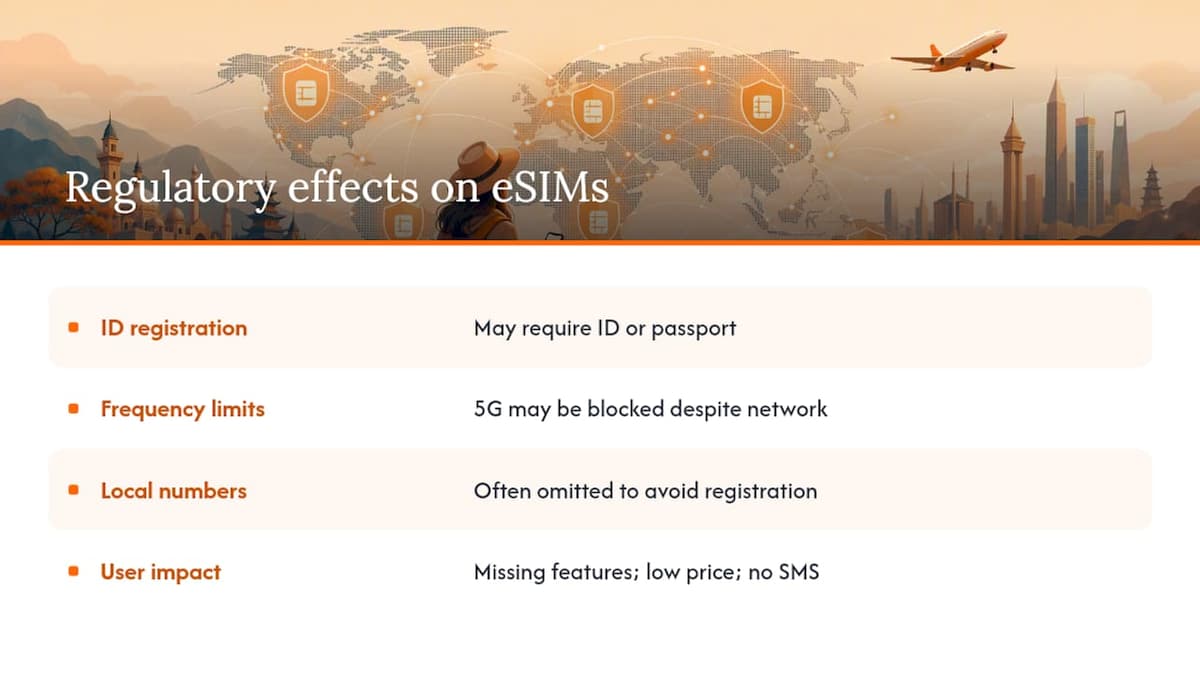
Coverage maps show where a network exists, not where local law lets a traveler use it freely. Some governments require SIM registration tied to a national ID or passport for any mobile service, local or foreign, which can affect how travel eSIMs are packaged and sold in that market. Other countries restrict which frequencies carriers can use for data services, which shapes whether 5G shows up on a coverage page even when the underlying network exists.
Regulatory friction is also why so many travel eSIMs skip local phone numbers entirely. Assigning a real phone number (an MSISDN) usually pulls a provider into the same registration and compliance requirements as a domestic carrier. Staying data-only lets providers sidestep that process, which is part of why “no local number” is the default rather than the exception across most travel eSIM products.
None of this shows up as a warning label on a coverage map. It shows up as a missing feature, an unusually low price for what looks like full service, or a plan that simply excludes SMS with no explanation. When a country’s listing looks thinner than a neighboring country’s, on services rather than raw availability, local regulation is often the quiet reason. Always cross-check a specific country’s page for stated exclusions before assuming a listing that shows “active” means every service works exactly the way it does at home.
Differences Between Major Carriers’ eSIM Support
Even within one country, not every carrier partner offers the same eSIM experience. Some networks provide full eSIM provisioning, including voice and SMS, while others license out data-only capacity to travel eSIM brands without extending their full service stack. That gap explains why two providers listing the “same” country can deliver noticeably different results.
Network grade matters too. A provider might list three partner carriers in one country, but only one of them carries 5G in major cities, while the other two top out at 4G outside urban centers. Coverage maps that specify the connection type per partner, rather than a blanket “4G/5G available” tag, give you a far more honest picture.
Carrier support for eSIM profile switching also varies. Some networks allow multiple profile downloads and easy switching between them, useful if you’re combining a home eSIM with a travel one. Others cap the number of active or stored profiles, which becomes a real constraint if you travel frequently and rotate through several country plans over a year. None of this is usually visible until you dig past the initial “supported” checkmark, so checking a provider’s specific network partner list per country, not just the country name, is worth the extra thirty seconds.
How Roaming Agreements Affect eSIM Costs and Function
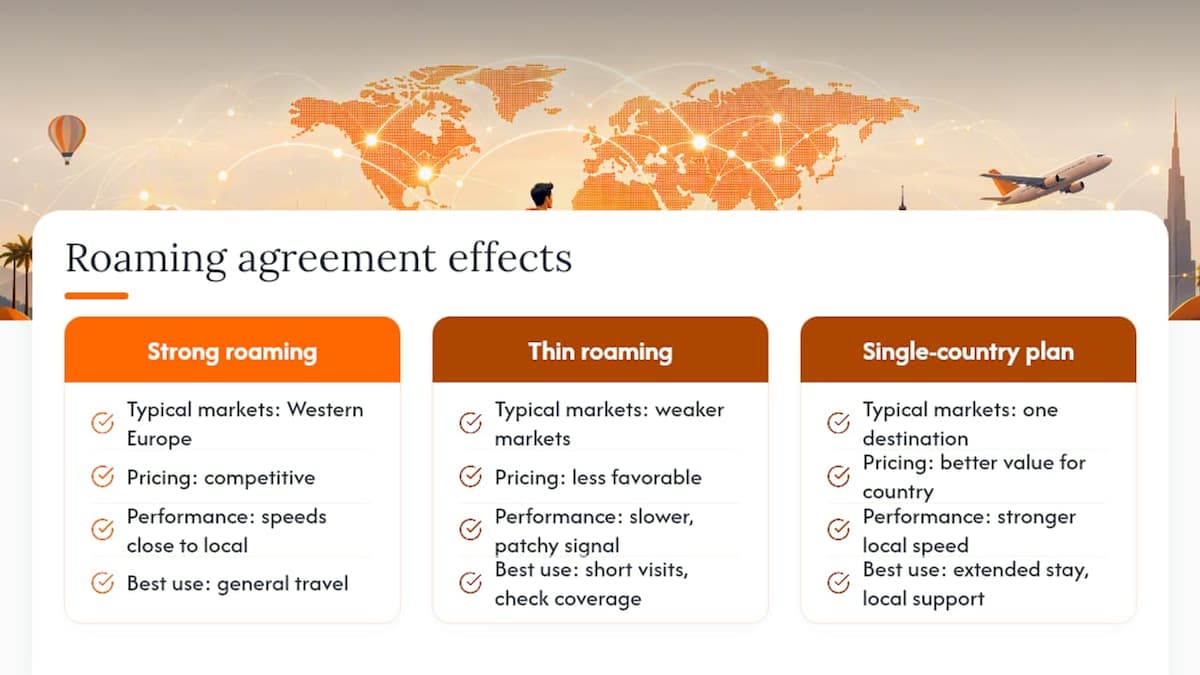
Roaming agreements are the commercial contracts between carriers that let a traveler’s device connect to a foreign network. A travel eSIM works because the provider has already negotiated bulk data access with local carriers in each country, then repackages it as a prepaid plan. Where those agreements are strong and well established, like across much of Western Europe, pricing tends to be competitive and speeds close to what a local resident gets.
Where roaming agreements are thinner, coverage can technically exist but perform worse. A provider might have access to only one smaller regional carrier in a given country instead of the dominant national network, which shows up as slower speeds or patchier signal outside major cities, even though the map marks the country as covered.
This is also where regional and global plans lose some ground to single-country plans. A global plan has to maintain roaming agreements across dozens of markets simultaneously, and not every one of those agreements is equally favorable. A dedicated single-country eSIM, built around one strong local partnership, often delivers better speed and value for that specific destination, an idea backed by Wise’s point that country-specific plans tend to offer better local support than broader bundles. If you’re headed to one place for an extended stay, that trade-off usually favors the narrower plan.
How to Verify Coverage Changes Before You Travel
Coverage maps aren’t static documents. Carriers add 5G to new regions, roaming agreements get renegotiated, and providers periodically drop or add partner networks in a given country. Checking a map once, months before a trip, and assuming it still applies at departure is a common and avoidable mistake.
The most reliable check is re-visiting the specific country page within a week of travel rather than trusting an old bookmark or a saved screenshot. Look specifically for a “last updated” date if the provider lists one, and re-confirm the network partner names haven’t changed since you last checked.
It also helps to cross-reference against your device manufacturer’s own compatibility list. Apple and Google periodically update which carriers support eSIM per country, separate from what any single travel eSIM provider controls, so a mismatch between the two sources is worth investigating before you buy. If a coverage page lists a country as active but doesn’t name a single network partner, treat that as a signal to dig deeper rather than a green light.
A Traveler’s Quick Checklist Before Buying Any eSIM
Run this in order, every time: confirm your device is unlocked, pull up the destination’s country page, decide whether you actually need voice and SMS or just data, then install the profile on Wi-Fi before you leave. Reach for a single-country plan when you’re staying in one place for most of the trip; switch to regional or global only when you’re crossing several borders in one journey. If a country page shows no named network partner or buries connection speed in fine print, that’s your signal to look elsewhere.
— Theo Wheeler
Get Your Country or Global eSIM Set Up Before You Fly
The checklist above can lead to a purchase of various eSIM plans, which include single-country, regional, or global options activated via QR code, with support available if activation issues arise. If local calls or SMS verification matter for your trip, a tool like Lara’s phone call translation options can fill the gap a data-only plan leaves behind. Before you book flights, check your destination’s country page on Lumo, confirm the plan type that matches your needs, and install the profile on home Wi-Fi so it’s ready the moment you land.
Sources
- ESIM - Wikipedia
- Use eSIM while traveling internationally with your iPhone - Apple Support (HK)
- How does an eSIM Work? Beginner’s Guide for Travellers - Wise
- eSIM for Travel: How It Works, and the Catches Nobody Mentions (2026) | Nomad Desk
FAQ
In which countries does eSIM work?
eSIM technology is supported in the majority of countries worldwide, but actual service depends on whether a provider has active local network partners in that specific destination. Always check the provider’s own country page rather than assuming general eSIM support means your provider covers that market.
What are the downsides of using an eSIM?
Most travel eSIMs are data-only, so they don’t include a local phone number for calls or SMS-based verification, and eSIM profiles are bound to a single device, which complicates recovery if your phone is lost or damaged. There’s also no physical retail location to visit if activation fails.
Do eSIMs work in every country?
No. Coverage has expanded to more than 160 countries and territories, but some markets are still listed as “coming soon,” and local regulations occasionally restrict which services (like local phone numbers) a foreign eSIM provider can offer.
Which is the best eSIM to use internationally?
The right choice depends on your itinerary: a single-country plan usually delivers the best local speed and pricing for one destination, while a global plan like Lumo’s covers dozens of countries under one profile for travelers hitting multiple borders on one trip.
Recommended
Related Topics
Stay Connected Anywhere
Prepaid eSIM data plans for 180+ countries and territories. No physical SIM required.