Role of eSIM in Remote Work Connectivity

Every tech startup team member knows the frustration of arriving in a new country only to face sky-high roaming fees or scramble for a local SIM card. For European remote workers, maintaining secure, flexible connectivity is vital to business productivity, yet traditional SIM solutions often fail when crossing borders. This article reveals how eSIM technology transforms global data access, letting you switch carriers instantly and manage multiple profiles for seamless, cost-effective mobile connectivity.
Table of Contents
- Defining Esim Technology And Its Fundamentals
- How Esim Powers Seamless Remote Work
- Key Features For Tech Startups Abroad
- Cost Savings Versus Traditional Sim Solutions
- Common Mistakes And Security Considerations
Key Takeaways
| Point | Details |
|---|---|
| eSIM Enhances Flexibility | eSIM technology allows remote workers to switch between carriers instantly, eliminating the need for physical SIM cards. |
| Cost Savings on Connectivity | By activating local profiles, users can save 60-80% on data costs compared to traditional roaming charges. |
| Simplified Device Management | eSIM enables multi-profile management, allowing users to handle multiple carriers on one device, streamlining logistics for businesses. |
| Increased Security | eSIM’s secure architecture includes encrypted transmissions and remote authentication, enhancing data protection for remote work. |
Defining eSIM Technology and Its Fundamentals
eSIM stands for embedded SIM, a digital alternative to the physical plastic cards you’ve carried in your phone for decades. Unlike traditional SIM cards, an eSIM is built directly into your device’s hardware, eliminating the need for physical swapping when you change carriers or travel internationally.
Think of it this way: instead of sliding a tiny card into a slot, you’re downloading a digital profile onto your phone over the internet. This shift from physical to digital fundamentally changes how remote workers manage global connectivity.
How eSIM Architecture Works
At its core, eSIM technology uses an embedded Universal Integrated Circuit Card (eUICC)—essentially a secure computer chip built into your device. This chip stores and manages multiple operator profiles, allowing you to switch between carriers without touching anything physical.
The magic happens through remote SIM provisioning (RSP), which lets you download and activate new carrier profiles directly from your phone. You scan a QR code, tap a few buttons, and you’re connected to a new network within minutes.
Key technical components include:
- Secure mutual authentication: Your device and the carrier verify each other’s identity before any data transfers
- Encrypted transmission: All profile downloads happen through encrypted channels, protecting your data from interception
- Multi-profile management: Your device can store multiple carrier profiles and switch between them seamlessly
- Over-the-air updates: Profiles can be updated remotely according to GSMA standards without visiting a store
These technical standards for eSIM provisioning ensure consistent, secure global connectivity across different devices and carriers.
Why This Matters for Remote Workers
Imagine you’re based in Berlin but traveling to Madrid for a client meeting. With a traditional SIM, you’d either use expensive roaming charges or hunt for a local carrier and physically swap cards. With eSIM, you activate a Spanish carrier profile mid-flight and land with local data rates already active.
For tech startup teams scattered across Europe, eSIM eliminates the logistical nightmare of managing separate physical SIM cards. One device. Multiple carrier profiles. Instant switching.
Remote SIM provisioning architecture also enables better device management, particularly when you’re using tablets, laptops, or smartwatches alongside your primary phone. Each device can maintain separate profiles independently, yet you control everything from your main device.
The Fundamental Shift
eSIM represents a move from carrier lock-in to carrier flexibility. You’re no longer tied to long-term contracts or stuck with whoever owns the local infrastructure.
eSIM removes the friction of physical SIM swapping and enables seamless, remote carrier switching without visiting a store or waiting for postal delivery.
This flexibility is especially valuable during extended international travel or when working across multiple countries simultaneously.
Pro tip: When setting up eSIM for the first time, ensure your device supports multi-profile management and verify that your primary carrier offers eSIM activation before traveling—this prevents connectivity gaps during your transition.
How eSIM Powers Seamless Remote Work
Remote work thrives on one thing: reliable connectivity. eSIM removes the barriers that traditionally kept remote workers tethered to expensive roaming plans or tied to a single carrier’s infrastructure.
When you’re building distributed teams across European tech hubs, connectivity isn’t a luxury—it’s your operational backbone. eSIM enables that backbone to work wherever your team is.
Always-On Connectivity Across Locations
Traditional SIM cards force a choice: use expensive roaming or find a local carrier and physically swap cards. Neither option scales well when you’re constantly moving between client sites, coworking spaces, or home offices across different countries.
Always-on mobile workforce connectivity eliminates this friction entirely. Your device stays connected to the best available network in any location, automatically switching between carriers without manual intervention.
For remote workers, this means:
- Zero downtime during travel: No searching for SIM vendors or waiting for mail delivery
- Automatic carrier selection: Your device chooses the strongest signal in your current location
- Instant activation: Switch carriers within minutes using QR codes, not postal services
- Multiple profiles active: Keep your primary carrier and backup options simultaneously loaded
Cost Savings and Device Management
Most European remote workers who travel regularly spend hundreds of euros annually on roaming charges. eSIM eliminates this completely by letting you activate local carrier profiles instantly.
Instead of paying your German carrier’s roaming rates in Spain, you activate a Spanish profile and pay local rates. The math is simple: you save 60-80% on data costs compared to traditional roaming.

Device management becomes dramatically simpler too. Rather than juggling multiple SIM cards for your phone, tablet, and laptop, you manage everything through one profile system. Businesses reduce logistical overhead significantly—no more tracking physical SIM inventory or waiting for carrier support.
Security and Corporate Integration
eSIM architecture includes built-in security protocols that physical SIM cards simply cannot match. Secure authentication and encrypted profile downloads protect corporate data as it travels across international networks.
Your company’s IT team gains better control over device provisioning and access management. Remote workers can’t lose SIM cards. Profiles can be remotely disabled if a device is stolen or an employee leaves.
eSIM enables businesses to deploy secure, manageable connectivity globally while remote workers maintain always-on access without roaming friction or cost.
This combination of flexibility and security is exactly what distributed tech teams need.
Pro tip: Before international travel, activate your destination carrier profile 24 hours in advance and verify it’s working on Wi-Fi—this prevents connectivity gaps during your flight and ensures seamless arrival.
Key Features for Tech Startups Abroad
When your startup operates across multiple European countries, eSIM delivers features that standard mobile plans simply cannot match. These aren’t just convenience features—they’re operational necessities for distributed teams.
Think of eSIM as infrastructure that scales with your team’s ambitions, not against them.
Instant Carrier Switching Without Contracts
Your startup needs flexibility. You don’t want carrier contracts binding you to one provider across all European markets. eSIM lets you activate different carriers in different countries without any long-term commitments.
This means your Berlin office uses one carrier, your Barcelona team uses another, and your London developers use a third—all on the same device management system. No contracts. No paperwork. No vendor lock-in.
You activate profiles through QR code scanning, which takes roughly 30 seconds. Compare that to traditional SIM card ordering, which requires weeks of planning and logistical coordination.
Multi-Profile Device Management
Your team probably carries multiple devices: smartphones, tablets, backup phones, mobile hotspots. Managing connectivity across all of them traditionally requires juggling multiple SIM cards and carriers.
eSIM changes this fundamentally. Your team members can maintain:
- Primary work profile: Your company’s preferred carrier for secure corporate connectivity
- Local profiles: Carriers in whatever country they’re currently working from
- Backup profiles: Alternative carriers for redundancy and cost optimization
- IoT connectivity: Separate profiles for laptops, tablets, or IoT devices
All profiles can be managed centrally through your company’s device management system, reducing IT overhead significantly.
Cost Control and Transparency
Startups operate on tight margins. eSIM cost savings for business travel directly impact your bottom line by eliminating roaming charges and allowing you to choose the cheapest local carrier in each market.
You gain complete visibility into data usage across your team. Rather than hidden roaming charges appearing on invoices months later, you see exactly what each team member spent in each location.
Many startups save 40-60% on mobile connectivity costs within the first three months of deploying eSIM across their teams.
5G/4G Coverage Across 160+ Countries
Your team travels to unexpected places. Client meetings in Stockholm. Tech conferences in Amsterdam. Investor pitches in Paris. eSIM connectivity works across 160+ countries with high-speed 5G and 4G options available in most markets.
You’re not limited to roaming on your home carrier’s agreements. You activate local carriers that offer the fastest speeds and best coverage in each specific location.
eSIM enables startup teams to maintain always-on, high-speed connectivity globally while controlling costs and eliminating roaming friction.
This flexibility is competitive advantage for distributed startups.
Rapid Onboarding for New Team Members
When you hire someone in Paris or Prague, you don’t need to ship them a SIM card or navigate carrier enrollment. They activate an eSIM profile on their device immediately and get connected to local networks within minutes.
This matters for startup velocity. You onboard faster. You reduce logistics overhead. You get teams productive immediately.
Pro tip: Set up eSIM profiles for all team members before they travel, not after they arrive—this prevents the common mistake of arriving in a new country without connectivity and burning through expensive roaming data while setting up local service.
Cost Savings Versus Traditional SIM Solutions
The financial gap between eSIM and traditional SIM cards widens every month you’re traveling internationally. What seems like a small daily charge in roaming fees compounds into a significant expense that directly impacts your startup’s bottom line.
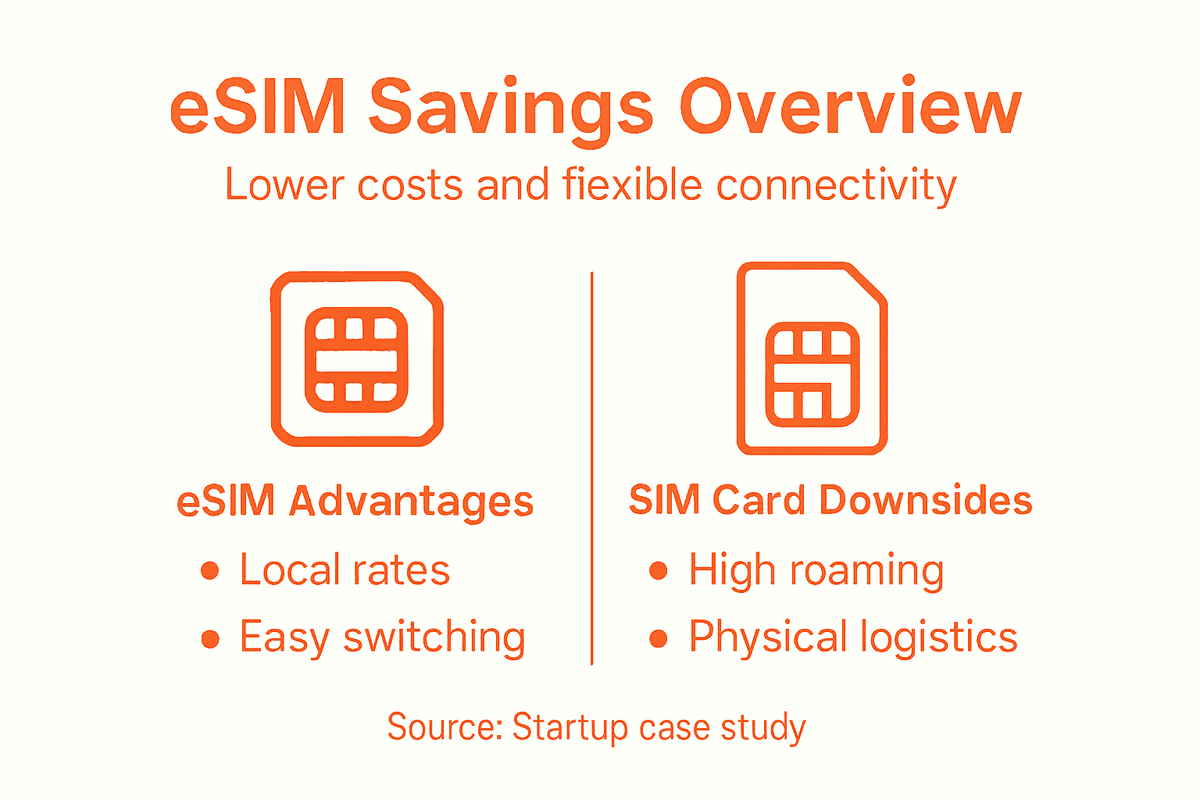
Let’s break down where your money actually goes.
The Hidden Costs of Traditional SIM Cards
Traditional SIM cards carry costs that aren’t immediately visible. You’re paying for the physical card manufacturing, shipping, handling, and carrier enrollment overhead. But those upfront costs pale compared to ongoing expenses.
When you roam internationally on your home carrier’s network, you’re not paying local rates. You’re paying a markup—sometimes 5-10 times higher than what a local customer pays for identical service. A gigabyte of data that costs €2 locally might cost €15 on your German carrier’s roaming plan.
Many remote workers in Europe don’t realize they’re accumulating €200-400 monthly in roaming charges during business travel.
Why eSIM Costs Less Over Time
eSIM lifetime costs are significantly lower than traditional removable SIM cards, primarily because you eliminate roaming fees and choose local carriers at local prices. There’s no shipping. No physical card manufacturing. No carrier enrollment delays.
Instead of paying roaming premiums, you activate a local Spanish carrier in Barcelona and pay what Spanish customers pay—roughly 80% less than roaming rates.
Consider the math: A remote worker traveling 6 months yearly saves approximately €1,800-2,400 annually by switching from roaming to local eSIM plans.
Direct Cost Comparison
Here’s what the numbers actually look like:
- Traditional roaming: €15-20 per gigabyte internationally
- eSIM local plans: €2-5 per gigabyte in most European markets
- Setup fees (traditional SIM): €15-25 per card
- Setup fees (eSIM): €0 (instant digital activation)
- Shipping costs: €5-15 per SIM versus instant eSIM delivery
For startups deploying eSIM across 10 team members, the savings multiply quickly.
Here’s a quick comparison of eSIM versus traditional SIM cards for international remote workers:
| Factor | eSIM Solution | Traditional SIM Card |
|---|---|---|
| Activation Process | Instant digital download | Physical card purchase |
| Switching Carriers | Remote QR code scanning | Manual card swap |
| International Usage | Local rates, auto switching | Costly roaming, manual setup |
| Device Management | Centralized, multi-profile | One card per device |
| Security Protocols | Encrypted provisioning | Limited authentication |
| Onboarding Speed | Minutes, no shipping | Days, logistics involved |
| Cost Over Time | 40-60% savings | High recurring fees |
Flexible Pay-as-You-Go Plans
eSIM flexibility eliminates expensive fixed plans by allowing you to activate only the data you need, when you need it. You’re not locked into 24-month contracts with unused capacity.
Your Berlin developer works locally on a monthly plan. That same person travels to a conference in Vienna for three days—they activate a pay-as-you-go Austrian profile with only 2 gigabytes instead of paying for a full month of service they won’t use.
eSIM reduces total lifetime connectivity costs by 40-60% compared to traditional SIM solutions through eliminated roaming, flexible pricing, and simplified logistics.
This matters especially for startups managing tight operational budgets.
Real-World Savings for Your Team
Your 8-person tech startup based in Berlin with regular travel across Europe could save €3,200-4,800 annually by switching from roaming to eSIM. That’s equivalent to hiring an additional contractor or investing in critical development tools.
These aren’t theoretical savings. They’re operational reality that directly impacts profitability.
Pro tip: Track your team’s roaming charges for three months before implementing eSIM, then measure the actual savings post-deployment—this data helps justify the investment to leadership and shows which team members generate the highest travel costs.
Common Mistakes and Security Considerations
eSIM adoption brings connectivity advantages, but it also introduces security risks that remote workers and startup teams often overlook. Understanding these risks prevents costly mistakes and protects your company’s sensitive data.
This isn’t about fear. It’s about informed decision-making.
The Profile Provisioning Risk
When you activate an eSIM profile, you’re downloading credentials onto your device through remote provisioning channels. This process depends on third-party networks handling your authentication data.
eSIM provisioning security risks include data routing through opaque third-party networks, exposure to foreign jurisdictions, and limited transparency about who accesses your profiles. Resellers can view user profile information without clear consent frameworks, and deleting profiles doesn’t always guarantee complete removal from carrier systems.
For a distributed startup handling proprietary code or client data, this matters significantly.
eSIM Swapping and Account Takeover
Traditional SIM swapping attacks require stealing your physical card. eSIM swapping is different—an attacker only needs your account credentials to transfer your profiles to their device.
If someone gains access to your corporate account, they can provision your eSIM profile remotely and intercept your communications. This is particularly dangerous for team members managing critical infrastructure or client accounts.
Protection requires:
- Strong unique passwords: Never reuse credentials across carriers and eSIM platforms
- Two-factor authentication: Enable it everywhere, even if inconvenient
- Biometric locks: Use fingerprint or face recognition on your device
- Profile PIN protection: Set carrier PINs that prevent unauthorized profile changes
- Regular carrier account audits: Check for unauthorized profile additions quarterly
Incomplete Profile Deletion and Lock-in
You deactivate an eSIM profile, but it may remain in carrier databases longer than you expect. Old profiles sometimes reactivate unexpectedly, creating security gaps.
Worse, some carriers implement practices that lock you into their ecosystem after activation. You can’t freely switch profiles or port numbers without friction.
eSIM ecosystem security challenges include memory exhaustion attacks where malicious profiles consume device storage, memory authentication weaknesses, and firmware integrity risks. ENISA recommends robust authentication protocols, encryption standards, and continuous security assessments to mitigate these threats.
Common Operational Mistakes
Beyond security risks, teams commonly make mistakes that compromise connectivity and data:
- Not backing up profile QR codes: If you lose your device, you can’t recover profiles without the original QR code
- Sharing profiles across team members: Each person needs their own profile for audit trails and security
- Ignoring carrier notifications: Profile expiration notices get deleted, causing unexpected disconnections
- Traveling without backup profiles: No redundancy means a single carrier outage disconnects your entire team
- Using personal devices for corporate work: Blurred personal-professional boundaries create compliance headaches
Implement carrier-specific PINs, enable two-factor authentication on all carrier accounts, and maintain backup profiles across different carriers to mitigate eSIM security risks.
These measures prevent most attack vectors.
To help teams avoid common mistakes, here’s a summary of recommended eSIM security strategies:
| Security Strategy | Why It Matters | Implementation Tip |
|---|---|---|
| Unique Strong Passwords | Prevents unauthorized access | Use dedicated password manager |
| Two-Factor Authentication | Stops account takeover attacks | Require 2FA for all profiles |
| Profile PIN Protection | Blocks rogue profile changes | Set strong carrier-specific PINs |
| Regular Account Audits | Detects hidden risks early | Schedule quarterly reviews |
| Backup Profile Management | Ensures connectivity during outages | Store backup QR codes securely |
Security Best Practices for Teams
Your startup’s IT team should establish clear eSIM policies before deployment across the team. Document which profiles are corporate-controlled versus personal, require profile change approvals, and implement regular security audits.
Consider using mobile device management (MDM) software to enforce consistent security policies across all eSIM-enabled devices. This gives IT visibility into profile changes and helps prevent unauthorized access.
Pro tip: Before deploying eSIM across your startup, test the profile deletion process with a non-critical device to verify that profiles fully remove from carrier databases and don’t reactivate unexpectedly—this prevents security surprises during actual team rollout.
Unlock Seamless Remote Work Connectivity with Lumo’s eSIM Solution
The article highlights the challenges that remote workers and global teams face with traditional SIM cards such as costly roaming charges, device management complexity, and limited carrier flexibility. Key pain points include the need for instant activation, multiple carrier profiles on one device, and reliable global coverage without interruptions. Concepts like remote SIM provisioning, multi-profile management, and cost savings from local rate data plans resonate deeply with professionals who demand always-on connectivity while traveling or working internationally.
Lumo offers a powerful answer to these challenges with an all-in-one digital eSIM platform designed precisely for remote workers and modern travelers. Enjoy instant 5G/4G activation across 160+ countries with multiple local carriers ready to switch with just a QR code scan. Say goodbye to manual SIM swaps and expensive roaming fees while staying secure with encrypted profile provisioning. Whether on smartphones, tablets, or laptops, managing connectivity is simplified and cost-effective.
Take control of your remote work connectivity today with Lumo and experience digital freedom like never before. Ready to reduce your mobile costs by up to 60 percent and activate carrier profiles instantly? Visit Lumo’s main page now to get started. Effortless global data connectivity is just a click away for your team and your travels.
Frequently Asked Questions
What is eSIM technology and how does it differ from traditional SIM cards?
eSIM, or embedded SIM, is a digital alternative to physical SIM cards, embedded directly into a device’s hardware. Unlike traditional SIM cards, which require physical swapping when changing carriers, eSIM allows users to download and manage multiple carrier profiles digitally over the internet.
How does eSIM improve connectivity for remote workers?
eSIM simplifies the process of switching carriers while traveling, allowing remote workers to activate local carrier profiles without physical card changes. This eliminates expensive roaming fees and ensures seamless, reliable connectivity across different networks and locations.
What are the security benefits of using eSIM over traditional SIM cards?
eSIM technology includes secure mutual authentication, encrypted profile downloads, and better control over device provisioning. This reduces security risks associated with lost or stolen physical SIM cards and enhances data protection during international travel.
How can eSIM help businesses save on mobile connectivity costs?
Businesses can save 40-60% on mobile connectivity costs by eliminating roaming charges and activating local carrier profiles as needed. This flexibility allows startups to control expenses while providing reliable connectivity for their remote teams.
Recommended
- Remote Work and eSIM: Unlocking True Global Flexibility | Lumo eSIM Store
- Role of eSIM in Future Connectivity Explained | Lumo eSIM Store
- Role of eSIM in IoT – Unlocking Seamless Global Connectivity | Lumo eSIM Store
- Role of eSIM in Telecommunication – Transforming Global Connectivity | Lumo eSIM Store
- Mobeus Airstore
Related Topics
Stay Connected Anywhere
Prepaid eSIM data plans for 180+ countries and territories. No physical SIM required.