USA eSIM Coverage: What Your Plan Really Covers
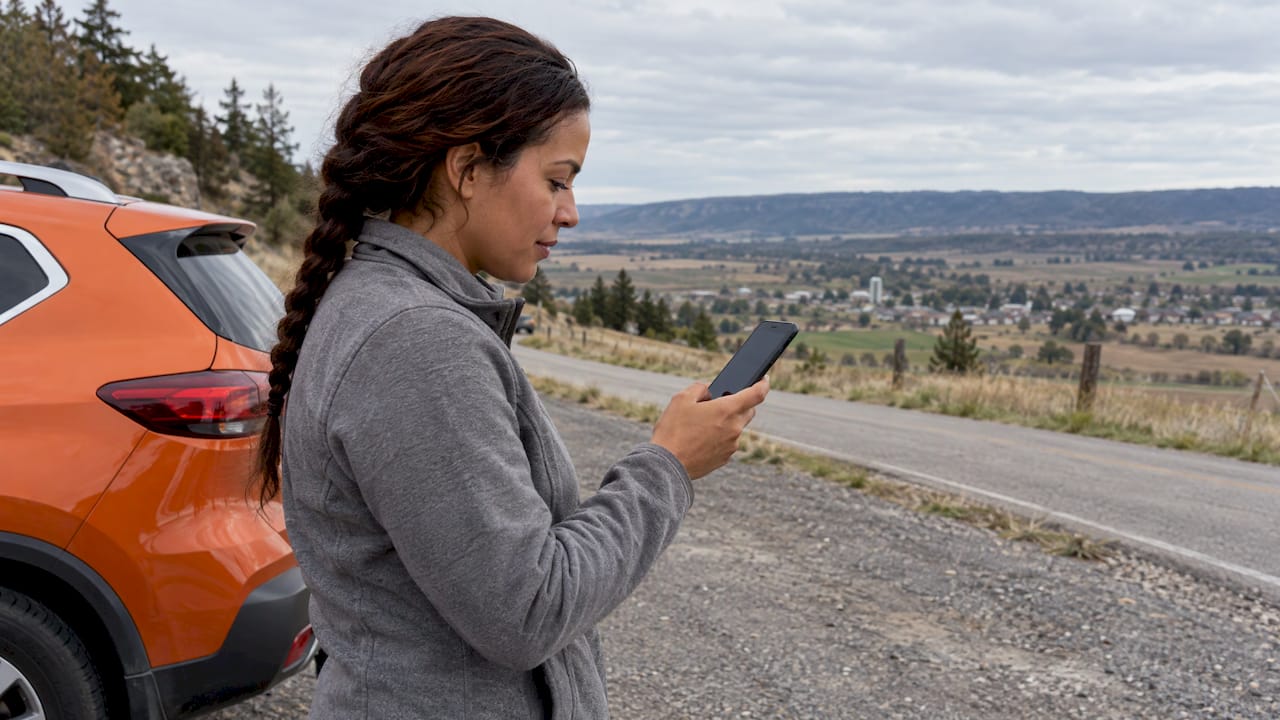
USA eSIM coverage is the coverage of the mobile network your eSIM connects to, not the eSIM itself. In cities and along major highways, a U.S. travel eSIM on a premium carrier network will give you 4G or 5G data almost everywhere you go. Outside them, coverage depends on the carrier, the terrain and your device. Check your route against the maps before you fly. Our United States eSIM plans start from $2 and activate by QR code, so you can set one up before you land.
TL;DR
- An eSIM has no towers of its own. Your coverage is the footprint of the carrier network behind the plan.
- Urban America is covered almost completely. Rural America is where the gaps are, especially in the West.
- Official coverage maps are carrier-submitted models, so treat them as a best case and check the stretches of your route that matter.
- Your phone must support eSIM and the 5G bands you want, and be network-unlocked, or you will not get the speed the plan promises.
- Install the eSIM before departure, and download offline maps for remote legs.
Table of Contents
- What “coverage” means for a U.S. eSIM
- How the U.S. networks compare
- 5G and 4G LTE: what the FCC data shows
- Does a USA eSIM cover all 50 states?
- Why maps overstate what you will get
- What else affects your signal
- How to check coverage for your trip
- Install early, test on arrival
- Which plan fits which trip
- Our view
- Get a U.S. eSIM before you fly
- FAQ
- Sources
What “coverage” means for a U.S. eSIM
A travel eSIM is a digital SIM profile. You scan a QR code, the profile installs, and your phone connects to a mobile network that has an agreement with the plan provider. The eSIM decides which network you can use. The network decides where you have signal.
That is why two plans for the same country can behave differently in the same place. The U.S. has three national networks: T-Mobile, AT&T and Verizon. Each has its own towers, spectrum and strengths. Our plans run on premium carrier networks, and the practical question for your trip is how well those networks cover the places you will actually be.
Coverage also has several layers:
- Population coverage: the share of people who live where a network reaches. This is the big number in advertisements.
- Geographic coverage: the share of land area with service. This is much lower, and it matters if you plan to drive.
- Technology: 5G, 4G LTE or older. A place can have signal but no 5G.
- Experience: the speed and reliability you actually get, which depends on crowds, buildings and your device.
How the U.S. networks compare
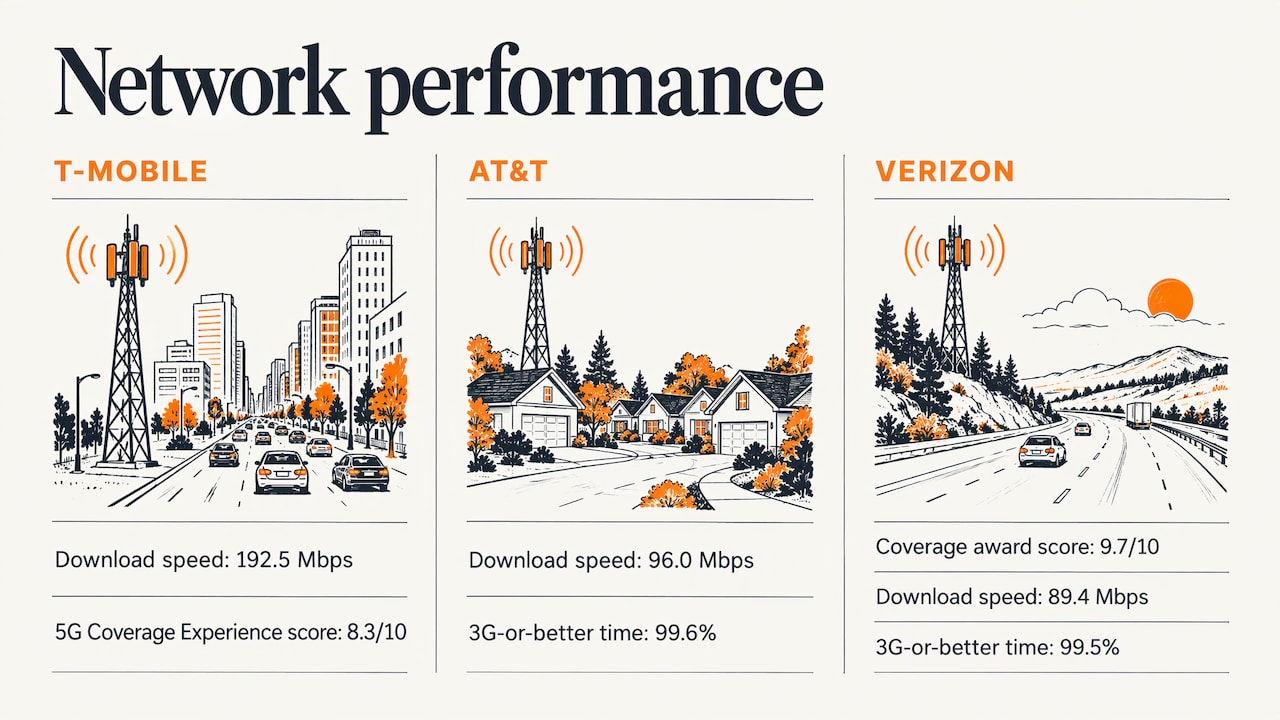
Independent measurement gives a useful picture of how the three networks differ. In its July 2026 U.S. report, covering April 1 to June 29, 2026, Opensignal gave Verizon the Coverage award with a score of 9.7 out of 10. Average download speeds in the same report were 192.5 Mbps on T-Mobile, 96.0 Mbps on AT&T and 89.4 Mbps on Verizon.
The pattern was similar earlier in the year. Opensignal’s January 2026 report (data from September to November 2025) found AT&T users had a 3G-or-better connection 99.6% of the time, against 99.5% for Verizon. It also found T-Mobile led on 5G availability, with a 5G Coverage Experience score of 8.3 out of 10.
These figures move with each report, which Opensignal publishes periodically, so read them as a snapshot. The lasting takeaway is the shape: T-Mobile is strongest on speed and 5G, Verizon on reach, and AT&T close to both on basic connectivity.
Opensignal’s analysis also says T-Mobile’s lower Coverage Experience score reflects an urban-first strategy. It adds that after the June 2026 FCC mid-band spectrum re-auction, T-Mobile added the most licenses with a rural focus, while Verizon bought denser urban licenses. Rural 5G is therefore likely to keep changing.
5G and 4G LTE: what the FCC data shows
The Federal Communications Commission (FCC) collects coverage filings from every carrier. The Uptime Report analyzes the December 2025 filing in its 5G coverage map by state and carrier. Three findings matter for a traveler.
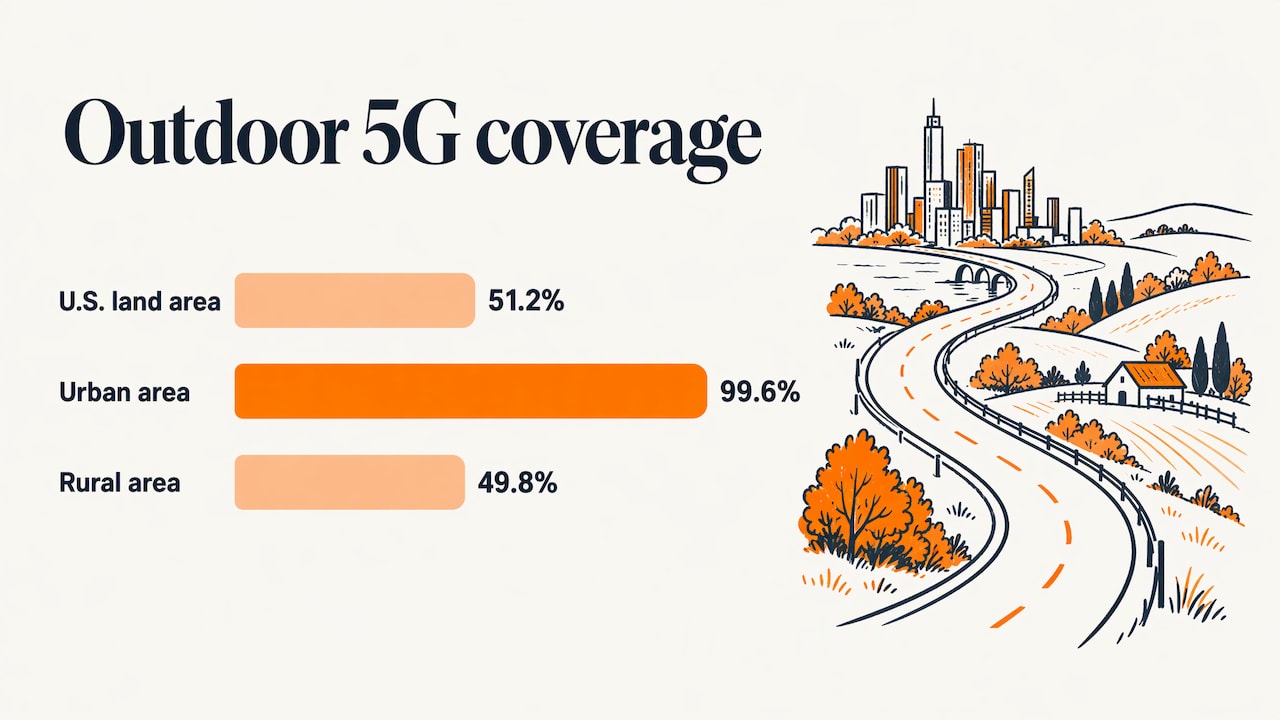
5G is nearly universal in cities and half-present in the countryside. At least one carrier reports 5G at 7/1 Mbps outdoors across 51.2% of U.S. land area. That is 99.6% of urban area but only 49.8% of rural area.
State totals hide a lot. The lowest 5G area shares are Alaska (1.8%), Maine (32.6%), Oregon (34.6%), Wyoming (37.9%) and Nevada (39.4%). DC (99.6%), Rhode Island (94.8%) and New Jersey (92.5%) lead. T-Mobile has the largest 5G footprint in 38 of 51 jurisdictions, AT&T in 9 and Verizon in 4.
4G LTE is the real safety net. On LTE, Verizon reports the largest footprint at 60.9% of U.S. area, against 57.4% for AT&T and 47.3% for T-Mobile. All carriers combined cover 69.8% of U.S. area outdoors. When 5G drops away on a back road, LTE is usually what keeps your maps and messages working.
| Measure (FCC data, Dec 2025 filing) | T-Mobile | AT&T | Verizon |
|---|---|---|---|
| 5G share of U.S. area | 40.7% | 34.2% | 24.5% |
| 4G LTE share of U.S. area | 47.3% | 57.4% | 60.9% |
Read the table as a trade-off. T-Mobile leads on 5G area and Verizon on LTE area, so “best coverage” depends on whether you want speed in populated places or reach on long drives.
Does a USA eSIM cover all 50 states?
In practice, you can use a U.S. eSIM in all 50 states, but “covered” does not mean “covered everywhere in the state”. Every state has towns and highways with service. What varies is how much of the empty land between them has any signal.
An analysis of FCC filings as of June 30, 2026 by BestNeighborhood.org puts numbers on this. 96.2% of residents live where all three national carriers file service. But 28.7% of U.S. land has no service from any of the three, including 49% of land in the West against 4% in the Midwest. About 900,000 people live where no carrier files service at all.
So plan around geography:
- Dense and reliable: the Northeast corridor, major metro areas, Florida, the Texas triangle, most of California’s coast and the Midwest.
- Patchy: the Mountain West, the Pacific Northwest interior, northern Maine, Alaska and desert stretches in Nevada and Utah.
- Often no signal at all: deep canyons, backcountry trails and many national park interiors, whichever network you use.
No eSIM fixes a place where no carrier has built a tower. The best you can do is pick a network with the right footprint and prepare for the gaps.
Why maps overstate what you will get
Coverage maps are the obvious place to check, but they are optimistic. The Uptime Report explains that FCC maps are carrier-submitted propagation models, not measurements. Under 47 CFR 1.7004, carriers must model 5G at 7/1 and 35/3 Mbps with 90% cell-edge probability at 50% network loading. A model describes what should happen under ideal assumptions.
Real-world testing shows the difference. BestNeighborhood.org notes that in the FCC’s 2018 to 2019 drive tests, staff found no 4G LTE signal at all on 16% to 38% of tests in areas carriers had reported as covered. A 2022 study of rural and tribal New Mexico found FCC carrier data showed up to 15% more coverage than crowdsourced measurements.
The Uptime Report adds a counting detail. The FCC measures area in hexagons, so a carrier that covers every town but few empty miles can score lower than one that models wide coverage over farmland. For you, that means the urban/rural split matters more than any state total. It also means a plan that can use more than one network can cover more ground than any single carrier. For a general look at how designing around more than one network improves reach, see these network coverage planning principles.
What else affects your signal
The network is only half of it. Several things on your side change what you see.
Device support. Your phone must support eSIM and be unlocked from its home carrier. Check this before you buy. Our guide to verifying eSIM 5G support walks through the three quick checks. For the technical background on bands and compatibility, see mobile network compatibility explained.
Bands. U.S. carriers use specific frequency bands. A phone sold in another region may lack some of them, which can mean LTE where a local would get 5G.
Crowds and congestion. Stadiums, airports and festivals slow down every network. 5G in a crowd can be slower than LTE on a quiet street.
Buildings and vehicles. Concrete, basements, metal-roofed buildings and some rental cars cut signal. Mid-band 5G, the speed-and-reach compromise most carriers now rely on, penetrates buildings better than the fastest high-band 5G but worse than low-band LTE.
Roaming status. Travelers are usually visitors on a partner network. In very remote areas, a local subscriber may still get a signal that a visitor does not.
How to check coverage for your trip
Work through this once before you buy. It takes about ten minutes.
- List your places. Write down where you will sleep, work and drive, not just cities. Include each stretch of road longer than an hour.
- Open the carrier maps. Check the national carriers’ own maps for each place, and read the legend. “5G”, “extended 5G” and “LTE” mean different things.
- Treat the maps as a best case. Given the modeling gap above, assume indoor and fringe areas will be weaker than shown.
- Use the FCC National Broadband Map for the remote legs. It shows what each carrier reported for a given address, which is useful for a cabin or trailhead.
- Check your plan’s network. Our coverage page lists networks by country, and the guide to verifying eSIM coverage by country explains how to read it.
- Confirm your phone. eSIM-capable, unlocked, and with the bands you want.
- Prepare for gaps. Download offline maps and playlists, and save reservations as PDFs.
Install early, test on arrival
With an eSIM you can install the profile before you leave home and switch it on when you land. Our setup averages 45 seconds, and there is no registration or contract, with guest checkout at purchase. Do the install on Wi-Fi at home, because you need an internet connection to download the profile.
On arrival, turn on the eSIM line for mobile data, turn off data roaming on your home SIM to avoid foreign charges, and make sure the data roaming toggle for the eSIM is on. If you are weighing this against buying a local SIM, our comparison of eSIM versus a local SIM for U.S. trips covers the practical differences for short stays.
Which plan fits which trip
Coverage needs differ by traveler type.
- City break (New York, Chicago, San Francisco, Miami): strong 5G on every network. A smaller data allowance often covers it, since hotels and cafes have Wi-Fi.
- Business trip across several cities: prioritize a plan that works well in airports and downtowns and carries enough data for tethering your laptop.
- Road trip or national parks: coverage is the whole question. Check each leg, pick generous data, and carry offline maps.
- Digital nomad on a long stay: you need steady data for weeks or months. Look at long-validity plans and test your base location’s speed in the first days.
- Multi-country trip: if the U.S. is one stop among several, a regional or global plan saves you swapping profiles. We cover this in the global coverage guide.
Our view
Coverage is the one thing an eSIM cannot promise on its own, because no provider builds the towers. What a good provider can do is connect you to premium carrier networks, keep activation instant, and make switching easy if your plans change.
That is how we built Lumo. Travelers should not have to queue at an airport kiosk, show ID or sign up for anything to get online. You buy a plan as a guest, scan a QR code, and connect. Our plans cover 160+ destinations, so the same habit works whether your next stop is Chicago or Chiang Mai.
Our advice for the U.S. is simple. Look at the places you will really be, give the remote ones extra preparation, and install before you fly. Do that, and the eSIM becomes the least interesting part of your trip, which is exactly what it should be.
Theo Wheeler
Get a U.S. eSIM before you fly
Our United States eSIM plans are prepaid, one-off purchases from $2, with 4G/5G data, no contract and no registration. You get the QR code instantly, and our support team is available 24/7 by human and AI chat if you need help with setup. If your trip continues beyond the U.S., see the Global eSIM plans, from $7.
FAQ
Does a USA eSIM work in every state?
Yes, you can use it in all 50 states, but signal varies by location. Cities and major highways are well covered, while parts of the Mountain West, Alaska and national parks have gaps for every network. Check your specific route on the carrier and FCC maps.
Will my eSIM get 5G in the U.S.?
In most cities, yes, provided your phone supports the U.S. 5G bands and the plan includes 5G. In rural areas, expect 4G LTE. FCC data shows 5G reaches 99.6% of urban area but 49.8% of rural area.
Can I use my U.S. eSIM for a hotspot?
It depends on the plan, so check the plan details on the product page before you buy. If tethering is included, you can share data with a laptop or tablet. This matters most for business travelers working on the road.
Should I install the eSIM before I leave home?
Yes. Install the profile on Wi-Fi before departure, then switch it on when you land. That way you have data from the moment you leave the plane, and any setup question is solved at home.
What happens if I have no signal on a road trip?
No eSIM can create a signal where no carrier has a tower. Download offline maps for remote legs, tell someone your route, and keep emergency calling in mind: your phone can generally attempt an emergency call on any available network.
Sources
- 5G Coverage Map 2026: Every State and Carrier, FCC Data (The Uptime Report)
- United States, July 2026, Mobile Network Experience Report (Opensignal)
- USA January 2026, Mobile Network Experience Report (Opensignal)
- Mobile Providers in Your Area (BestNeighborhood.org)
- WiFi Coverage: Why It’s Essential For Unifi Networks
Recommended
- United States eSIM Plans from $2
- Trips Under a Few Weeks: eSIM vs Local SIM for U.S. Travelers
- 5 Preflight Checks to Verify eSIM Coverage Maps
- Travelers: Verify eSIM Coverage in 160+ Countries Before You Fly
Related Topics
Stay Connected Anywhere
Prepaid eSIM data plans for 180+ countries and territories. No physical SIM required.