Cut International eSIM Costs: $1.12 Median per 1GB (2026)
The cheapest eSIM plans with at least 1GB now carry a global median price of $1.12, though what you actually pay depends heavily on the region and bundle size you pick. The single best move for most trips is to buy a right-sized regional or country eSIM from a provider like Lumo before you fly, rather than grabbing a small top-up plan at the airport or defaulting to your carrier’s day-pass roaming.
TL;DR:
- Regional eSIM prices vary widely, with Europe averaging about $0.62 per 1GB and remote island nations reaching significantly higher costs.
- Comparing plans by calculating price per gigabyte provides the clearest value, especially since unlimited plans are still rare and often expensive.
- Choosing a plan that matches your trip duration and the number of countries you visit prevents overpaying and expiry issues, with regional plans offering a good middle ground.
- Buying your eSIM 24 to 48 hours before departure allows time for troubleshooting activation without risking unused paid time.
- An eSIM typically costs less than roaming day passes and can be more convenient than local SIMs for trips lasting a few days to weeks, provided your device supports it.
Table of Contents
- How Much Does an eSIM Cost Internationally Right Now?
- How Do You Calculate the Real Cost Per Gigabyte?
- Which eSIM Plan Type Fits Your Trip?
- Is an eSIM Cheaper Than Roaming or a Local SIM?
- How Do You Compare Offers Before You Buy?
- How Do You Activate an eSIM Without Getting Hit by Roaming Charges?
- What Actually Saves You Money on eSIM Costs?
- An Editor’s Take on eSIM Pricing
- Find the Right Lumo Plan for Your Route
- Sources
- FAQ
How Much Does an eSIM Cost Internationally Right Now?
That $1.12 median figure isn’t a flat rate. It is the median price of the cheapest plan offering 1GB or more, tracked across a global sample of live eSIM offers by eSIM Advice. Regional numbers swing hard around that midpoint, and the swing tells you almost everything about how to shop.
Europe sits at the cheap end of the spectrum, with a regional median around $0.62 per 1GB, the effect of dense carrier competition and a continent full of budget mobile networks fighting for the same tourist traffic. Oceania sits at the other extreme, and it isn’t close. Remote island nations and small territories often have one or two network operators total, no competitive pressure, and thin infrastructure to spread costs across. That combination pushes prices well above the global median in that region.
A few patterns show up consistently once you start comparing plans side by side:
- Dense, competitive markets are cheap. Countries with several carriers fighting for eSIM resale deals, think most of Western and Eastern Europe, tend to post the lowest per-GB prices.
- Isolated markets are expensive. Small island nations and countries with a single dominant carrier have little reason to discount.
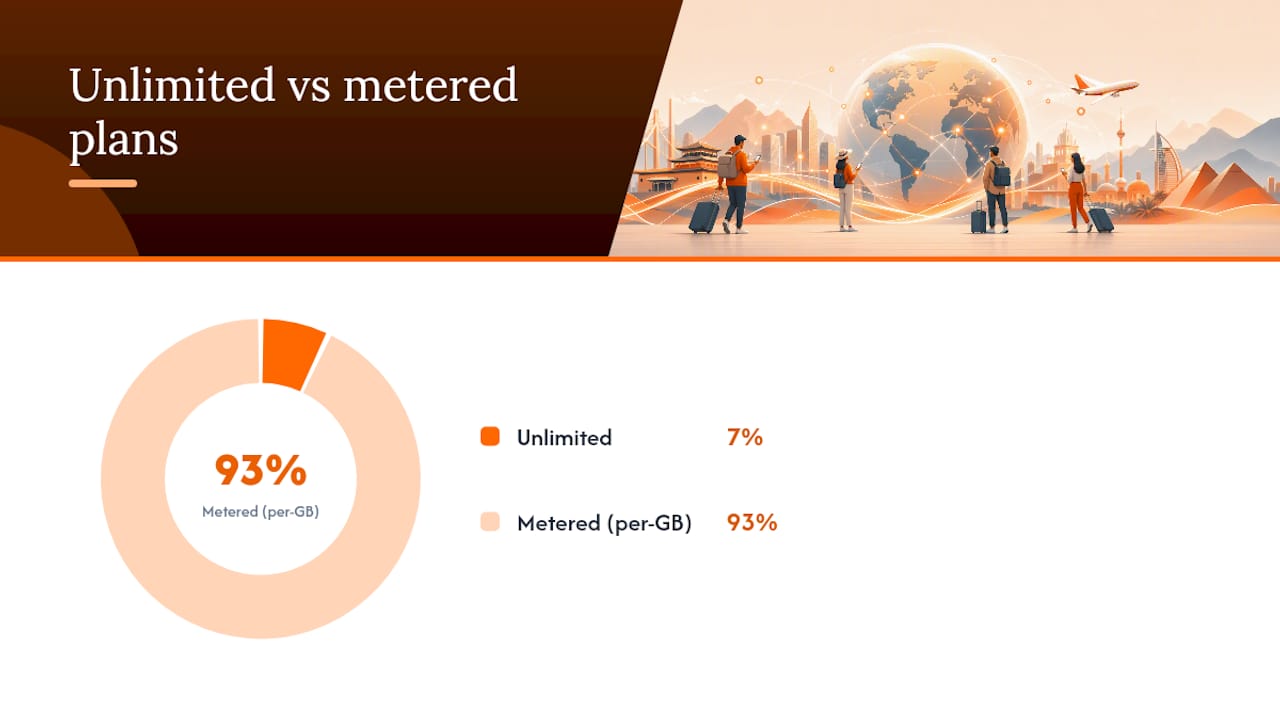
- Unlimited plans are still rare. Only about 7% of live plans tracked by eSIM Advice offer unlimited data, so most price comparisons are still a straight $/GB exercise, not a flat monthly fee comparison.
- Popular tourist corridors often undercut the regional median. Heavy traveler demand in places like Southeast Asia has pulled prices down as providers compete for volume.
Quick fact: the gap between the cheapest and priciest markets tracked by eSIM Advice is wide enough that the same 5GB allowance can cost multiple times more in a remote Pacific territory than in a major European country, driven mostly by how many carriers actually compete for that traffic, according to eSIM Advice’s pricing research.
Because unlimited plans remain the exception rather than the rule, your real comparison tool almost never changes: price divided by gigabytes. That math is simple, but it’s where most travelers get tripped up, and it’s worth walking through before you buy anything.
How Do You Calculate the Real Cost Per Gigabyte?
Divide the plan’s total price by its data allowance, and you get the number that actually matters: cost per GB. A $15 plan with 5GB works out to $3 per GB. A $25 plan with 20GB works out to $1.25 per GB. Same provider, same destination, wildly different value, and the sticker price alone tells you nothing about which is the better deal.
Bundle size drives this more than almost any other factor. Smaller plans, the 1GB or 2GB options aimed at light users or short weekend trips, routinely carry a much higher per-GB rate than 10GB or 20GB bundles from the same provider. Buying twice the data for less than twice the price is common enough that it should be your default assumption when comparing tiers, not a pleasant surprise.
Duration matters just as much as data volume, and it’s easy to overlook. A 7-day plan and a 30-day plan might list similar prices, but if your trip only runs five days, the 30-day plan’s unused window is money left on the table, while a 7-day plan that expires two days before you fly home leaves you scrambling for a top-up at the worst possible moment. Match validity windows to your actual itinerary length, not to whichever plan happens to show up first in search results.
A handful of checkout-page traps also inflate the real cost beyond the number you first see:
- Listed price versus checkout price. Some providers show a base rate, then add local taxes or processing fees at the final screen.
- Auto-renewal defaults. A handful of plans quietly renew at full price once your validity window ends, unless you cancel first.
- Coupon restrictions. Discount codes often apply only to first-time buyers or specific bundle sizes, not the plan you actually want.
- Currency conversion markups. Paying in a currency other than the one listed can add a few percentage points through your card issuer.
Pro Tip: Screenshot the checkout price, not just the plan’s advertised price, before you buy. If a provider changes the total between the landing page and the final screen, that gap is your early warning sign for auto-renewal terms or hidden fees buried in the fine print.
Which eSIM Plan Type Fits Your Trip?
Not every plan type serves every itinerary. Picking the wrong category is the single most common reason travelers overpay, and the fix usually comes down to matching plan structure to how your trip is actually shaped.
- Single-country plans work best for short trips confined to one price-competitive market. If you’re spending five days in Portugal and nowhere else, a single-country plan from a cheap-data market beats a broader regional bundle almost every time, since you’re not paying a premium for coverage you won’t use.
- Regional plans make sense for multi-country trips clustered in one area, a two-week loop through Italy, France, and Spain, for example. You’ll usually pay a modest premium over the cheapest single-country rate in exchange for not juggling three separate eSIMs and three separate activation windows.
- Global plans earn their keep on itineraries that include a remote or expensive market. If your route runs through Western Europe and then a Pacific island with thin carrier competition, a global plan smooths out that one expensive leg instead of forcing you to buy an overpriced local bundle just for a few days.
- Unlimited plans pay off for heavy data users and long stays, streamers, remote workers on video calls, or anyone spending a month or more in one place. Since unlimited offerings remain uncommon industry-wide, expect to pay more upfront, but the per-day cost can beat repeatedly buying and re-upping capped bundles.
The fastest way to sort these is a simple gut check: count your countries, estimate your daily GB, then match that shape to the category above before you start comparing individual providers.
Is an eSIM Cheaper Than Roaming or a Local SIM?
Run the numbers on a typical week abroad and the gap between options becomes obvious fast. A carrier roaming day-pass priced around $10 a day turns a seven-day trip into roughly $70 in connectivity costs. A 7-day eSIM bundle covering the same destination frequently lands well under that total, even at the higher end of regional pricing, because you’re paying for a data allowance instead of a flat daily access fee.
Physical local SIMs flip the equation for a different kind of trip. For stays running 60 to 90 days or longer in low-cost domestic markets, a local SIM purchased in-country can beat even a well-priced eSIM on raw cost. The catch is the time and paperwork: finding a shop, showing ID, sometimes registering with a local carrier, none of which makes sense for a five-day visit but starts to pay for itself over months.
| Factor | eSIM | Carrier roaming | Physical local SIM |
|---|---|---|---|
| Typical cost for a 1-week trip | Often under $20 for moderate data use | Around $70 at a $10/day pass rate | Low, but requires in-person purchase |
| Setup effort | QR code scan before or during travel | Automatic, already on your phone | Requires a store visit and ID |
| Keeps your home number active | Yes, alongside the travel eSIM | Yes | Only if you keep a second device slot free |
| Best fit | Trips of days to a few weeks | Emergency backup or very short stays | Extended stays of two months or more |
Beyond price, the tradeoffs are worth weighing on their own terms. An eSIM bought and activated before you leave means you land already connected, no kiosk line, no language barrier at a phone shop counter. Roaming passes and platforms like switching carriers abroad through your existing SIM slot require zero setup but usually cost more per gigabyte than a pre-purchased plan. Local SIMs win on raw long-stay economics but cost you time, sometimes a passport photocopy, and occasionally a second physical slot your phone may not have.
How Do You Compare Offers Before You Buy?
Run through a short checklist before adding anything to your cart. The strongest offers hold up on all of these; the weak ones usually fail on at least two.
- Price per GB, calculated yourself, not just the sticker price.
- Validity window, matched to your actual travel dates, not rounded up “just in case.”
- Fair-use limits on plans marketed as unlimited, since most cap high-speed data before throttling kicks in.
- Hotspot or tethering permission, which some cheaper plans restrict or block outright.
- Coverage list, confirmed for every country on your route, not just the region name.
- Refund policy, in case your device fails to activate or your trip changes.
- Device compatibility, verified before you pay, not after.
Once you’ve screened an offer against that list, the buying process itself takes about five minutes:
- Estimate your daily data use. Maps and messaging apps run light, around 100 to 200MB a day. Video calls and streaming can burn 1GB or more per hour.
- Choose your plan type using the single-country, regional, global, or unlimited logic covered above.
- Confirm coverage for every stop on your itinerary, including layovers longer than a few hours.
- Buy and test activation while you still have Wi-Fi access, ideally a day or two before departure.
- Carry a backup option, whether that’s a second eSIM profile or your home carrier’s roaming as a fallback.
Pro Tip: Buy your eSIM 24 to 48 hours before departure rather than the morning of your flight. Most plans don’t start their validity clock until first use, so early purchase costs you nothing, and it gives you a buffer to troubleshoot activation while you still have reliable home Wi-Fi.
How Do You Activate an eSIM Without Getting Hit by Roaming Charges?
Before you buy anything, confirm three things about your device: that it actually supports eSIM (most phones from the last several years do, but check the model), that it’s carrier-unlocked, and that your chosen plan’s coverage list actually includes every country on your route.
Activation itself is straightforward once you’re past that check. You install the eSIM through a QR code scan, set it as your primary data line in your phone’s cellular settings, and then, critically, disable data roaming on your home SIM. Apple’s own support documentation flags this last step specifically: your home line can still rack up roaming charges in the background even while your travel eSIM is active, if you don’t turn off its data roaming manually.
This one setting is the most common activation mistake travelers make, and it’s an easy one to miss because your phone doesn’t always flag it clearly. Leaving the home SIM’s roaming switched on means two data connections are technically live at once, and carriers don’t split the bill evenly between them.
If activation fails or data won’t connect once you land, have a few things ready before you contact support: a screenshot of your cellular settings screen, the exact error message if one appeared, your device model, and confirmation of whether you’re connected to Wi-Fi (some activation steps require it). Support teams move faster when you hand them specifics instead of “it’s not working.”
What Actually Saves You Money on eSIM Costs?
The single biggest lever is bundle size. Since smaller plans routinely carry a steeper per-GB rate than larger ones from the same provider, sizing up even one tier, from 3GB to 5GB, for example, often costs less per gigabyte even though the sticker price is higher. If you know you’ll stream video or make video calls, buy bigger from the start rather than topping up twice.
For multi-country trips, regional plans usually beat buying separate single-country eSIMs for each stop, both on convenience and on total spend. You avoid the small-plan penalty on each leg and skip the friction of reactivating a new profile every time you cross a border.
A few habits stretch whatever data you do buy considerably further:
- Download offline maps before you leave Wi-Fi, so navigation doesn’t eat your cellular allowance.
- Pre-load content, podcasts, shows, playlists, on your last home Wi-Fi connection.
- Limit background app refresh for apps you don’t need live updates from while traveling.
- Save heavy streaming for Wi-Fi, at your hotel or a café, rather than your mobile data.
- Check your data management settings a day into your trip to catch any app quietly burning through your allowance.
Pro Tip: Turn on your phone’s built-in data usage tracker on day one of your trip. Checking it after 24 hours tells you exactly how fast you’re burning through your allowance, giving you time to switch to a bigger bundle before you run dry mid-trip instead of after.
An Editor’s Take on eSIM Pricing
Most advice on eSIM shopping treats price comparison like picking a flight: find the lowest number and book it. That’s backwards. The lowest sticker price is usually attached to the smallest bundle, which carries the worst per-GB rate on the whole menu. Real savings come from sizing the plan to the trip, not chasing the cheapest listed number.
The other blind spot is duration mismatch. Travelers obsess over data caps and ignore validity windows, then get stuck paying for a top-up on day six of a seven-day trip because their plan quietly expired. Coverage that fits your actual dates, and a provider like Lumo built around fast, no-registration activation, matters more than shaving a dollar off the sticker price.
— Theo Wheeler
Find the Right Lumo Plan for Your Route
Lumo sells exactly the plan categories this guide walks through: global eSIM plans for routes that cross a remote or pricier market, Europe eSIM plans for multi-country loops across the continent, and single-country and regional options across Asia, Africa, the Caribbean, and beyond. Every plan activates through a QR code in about 45 seconds on average, with no contract, no registration, and no waiting to find out if it worked.
Before you fly, pull up the destination page for your route and check the listed coverage against your actual itinerary; a two-minute look now saves you a scramble at the airport later. If your trip spans several countries in one region, the Europe eSIM plans page shows current pricing by bundle size so you can match data allowance to trip length before you buy. Customer support for activation may be available after purchase, varying by provider.
Sources
FAQ
Is an eSIM Worth It for International Travel?
Yes, for most trips of a few days to a few weeks. eSIMs typically cost less than carrier roaming day passes and avoid the setup hassle of a physical local SIM, as you can activate before you board your flight.
Which eSIM Is Best for International Travel?
It depends on your route: single-country plans suit one-destination trips in cheap markets, regional plans suit multi-country loops, and global plans cover itineraries with a remote or expensive stop. Lumo offers all three plan types across many destinations, so you can match the plan to your specific itinerary.
What Is the Downside of eSIM?
The main drawbacks are device compatibility (not every phone supports eSIM) and fair-use data caps on plans marketed as unlimited. Coverage gaps in very remote areas can also mean weaker signal than a local carrier’s own physical SIM would provide.
Is an eSIM Cheaper Than Roaming?
Usually, yes. A $10-a-day roaming pass adds up to roughly $70 over a week, while a comparable 7-day eSIM bundle typically costs less for the same or greater data allowance, especially in regions with a low median per-GB price.
Recommended
Related Topics
Stay Connected Anywhere
Get instant eSIM data plans for 160+ countries. No physical SIM required.