The Role of Telecom in Globalization: 2026 Guide

TL;DR:
- Telecommunications infrastructure underpins globalization by enabling real-time data exchange and international trade. Nations investing in fiber, mobile networks, and satellites gain competitive advantages, while digital divides and data colonialism pose significant challenges. Effective governance and equitable investment are crucial to ensure inclusive global connectivity and cultural exchange.
Telecommunications is defined as the foundational infrastructure that makes globalization possible. Without fiber optic networks, mobile broadband, and satellite systems, the real-time exchange of goods, services, ideas, and capital across borders would stop. The role of telecom in globalization extends far beyond phone calls. It underpins the digital economy, shapes how multinational firms organize work, and determines which nations participate fully in global trade. Fiber optic networks directly correlate with higher national GDP growth and reduced international trade costs. Understanding that connection is the starting point for anyone serious about global business or international affairs.
How does the role of telecom in globalization work?
Telecom infrastructure is the physical and digital backbone that connects economies. Fiber optic cables carry the vast majority of international data traffic, enabling high-speed transmission of financial transactions, business communications, and consumer content. Studies confirm that fiber infrastructure supports the scaling of 5G, AI, and cloud services essential for global economic integration. That means a factory in Vietnam, a bank in Frankfurt, and a startup in Lagos all depend on the same underlying cable topology to function in the global economy.
Broadband penetration is one of the clearest predictors of economic growth at the national level. Countries that invest in fiber and mobile networks reduce transaction costs for businesses operating across borders. The topology of subsea cable networks functions as a non-physical trade barrier or facilitator, directly influencing trade flows and economic outcomes. Nations positioned at the center of these networks gain measurable trade advantages over those on the periphery.
Satellite networks add a critical layer of resilience. Low-earth orbit satellite integration bridges connectivity gaps in developing regions, enabling e-commerce and payment settlements where physical infrastructure is unreliable. This matters because it means globalization is no longer exclusively a game for nations with dense fiber grids.

| Infrastructure type | Primary function | Global trade impact |
|---|---|---|
| Fiber optic cables | High-speed data transmission | Reduces distance elasticity in trade |
| Mobile broadband (4G/5G) | Wireless connectivity | Enables mobile commerce and remote work |
| Subsea cable networks | Intercontinental data routing | Shapes trade corridor efficiency |
| Low-earth orbit satellites | Rural and remote coverage | Extends digital trade to underserved markets |
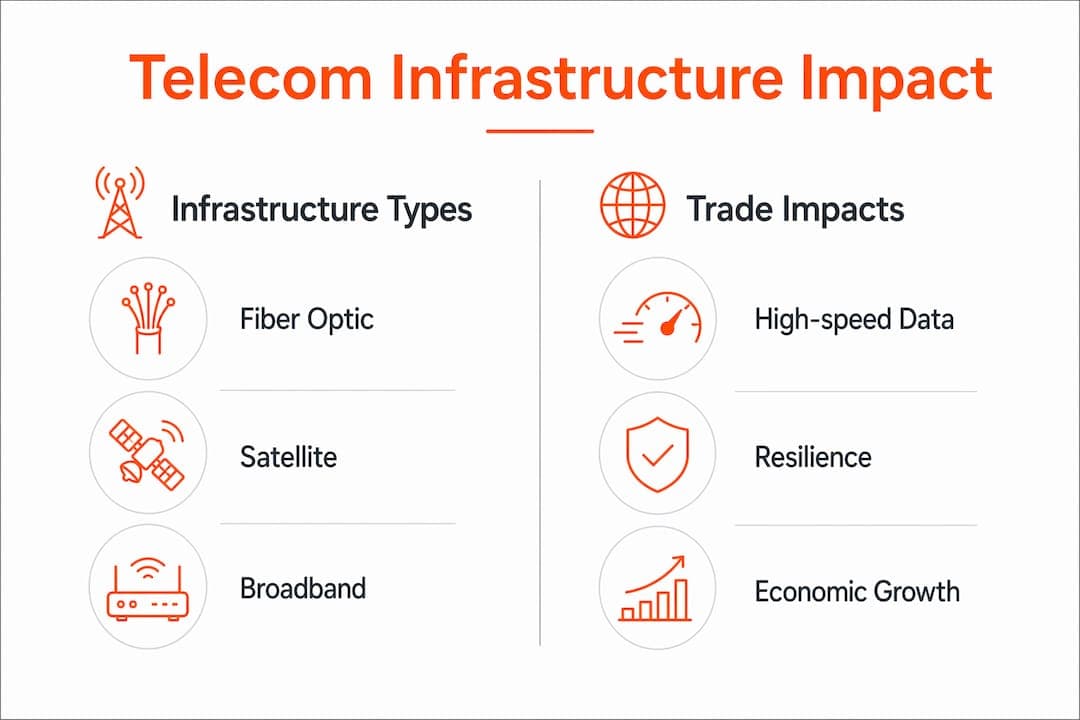
Pro Tip: If you work in international business, check your country’s subsea cable centrality score. Nations with more cable landing stations consistently show lower cross-border transaction costs and faster settlement times.
How does telecom reshape global business and trade flows?
The organization of global business changed fundamentally when telecom costs fell far enough to make real-time coordination across continents practical. Since 2006, service globalization shifted toward within-firm reorganization using Global Capability Centers, or GCCs, enabled by telecom networks. Large multinationals no longer simply outsource tasks to third parties. They build offshore knowledge centers that function as integrated parts of the parent company, coordinating in real time via telecom infrastructure.
This shift has concrete consequences for trade flows and labor markets:
- Knowledge-intensive remote work at scale is now standard for firms in finance, software, legal services, and consulting. Telecom efficiency makes this possible without sacrificing coordination quality.
- Global supply chains depend on real-time data exchange. A delay in communication between a manufacturer in Shenzhen and a logistics hub in Rotterdam can cascade into missed delivery windows and financial penalties.
- Offshore labor demand influences wages. The expansion of GCCs creates a self-limiting dynamic: as offshore labor demand rises, wages in those markets increase, which eventually raises the productivity threshold firms need to justify further offshoring.
- Transaction cost reduction is measurable. Lower communication costs directly increase the range of firms that can participate in global markets, including small and medium enterprises that previously lacked the resources to coordinate internationally.
For professionals working across borders, understanding this dynamic explains why business travel tech essentials and reliable connectivity are not optional. They are the operational foundation of modern global work.
How does telecom drive cultural globalization?
Telecom does not just move money and data. It moves culture. Two-way communication technologies allow individuals to be both creators and consumers of global content, reshaping culture beyond the limits of any single nation-state. This is a structural shift, not a trend. When a protest movement in one country can organize via social media and inspire parallel movements on three other continents within 48 hours, the political geography of influence has changed permanently.
The cultural effects of telecom-led globalization are not uniform:
- Diaspora communities maintain cultural identity across geographic distance through video calls, streaming media, and social platforms. A Nigerian family in Houston can participate in a Lagos wedding in real time.
- NGOs and civil society groups use telecom networks to coordinate advocacy, fundraising, and pressure campaigns that cross national borders without requiring physical presence.
- Cultural hybridity accelerates. Digital communication intensifies both cultural diversity and homogenization simultaneously. Local music scenes gain global audiences while also absorbing global influences.
- Dominant platforms shape what culture looks like globally. The algorithms of a small number of large platforms determine which content spreads and which does not, concentrating cultural influence in ways that predate the internet.
Telecommunications empower individuals and NGOs to influence global discourse, creating transnational culture that bypasses nation-state limits. Two-way communication technologies allow users to be both creators and consumers, reshaping culture beyond borders.
Cultural transformations under digital globalization confirm that telecom advances cultural hybridity while also risking the erosion of cultural uniqueness by promoting dominant global patterns. The tension between those two forces defines much of the current debate about what globalization actually means for local communities.
What are the emerging challenges in telecom-led globalization?
5G, AI, and cloud services are accelerating the pace of global integration. They also introduce new risks that did not exist a decade ago. The same infrastructure that enables a small business in Nairobi to sell to customers in Berlin also creates exposure to cybersecurity threats, data extraction, and regulatory fragmentation.
Key challenges shaping the next phase of telecom-driven globalization:
- Digital divides remain wide. Access to high-speed internet is still unevenly distributed across income levels and geographies. Nations without fiber or reliable mobile coverage are structurally excluded from the most productive forms of global trade.
- Data colonialism is a real economic risk. Platforms operating on extractive profit models capture value from users in developing markets while concentrating revenue and data in a small number of wealthy-country headquarters.
- Cybersecurity threats scale with connectivity. Every new device or network node added to the global system is a potential attack surface.
- Misinformation spreads at the speed of fiber. The same infrastructure that enables global commerce also accelerates the spread of false information across borders.
Pro Tip: When evaluating a country’s readiness for digital trade, look at its regulatory framework for data sovereignty alongside its raw broadband penetration numbers. Infrastructure without governance creates vulnerability, not opportunity.
Flexible regulatory policies that support fiber optic infrastructure investment while protecting data rights are the most effective path toward equitable global digital integration.
Key Takeaways
Telecom infrastructure is the non-negotiable foundation of globalization, and nations that invest in fiber, mobile broadband, and satellite networks gain measurable advantages in trade, productivity, and cultural influence.
| Point | Details |
|---|---|
| Fiber drives GDP growth | Fiber optic networks directly correlate with higher national GDP and lower cross-border trade costs. |
| GCCs reshape global work | Telecom enables within-firm remote coordination at scale, transforming how multinationals organize globally. |
| Culture crosses borders via telecom | Two-way digital communication creates transnational culture and empowers non-state actors globally. |
| Digital divides limit equity | Uneven infrastructure access structurally excludes lower-income nations from the most productive global trade. |
| Data colonialism is a real risk | Extractive platform models concentrate value in wealthy markets while drawing data from developing regions. |
Telecom’s invisible power: a perspective worth stating plainly
The most striking thing about telecom’s role in globalization is how invisible it becomes once it works. Nobody thinks about the subsea cable when they close a cross-border deal on a video call. Nobody considers the fiber splice point when they stream a film produced on another continent. That invisibility is a sign of success, but it is also a trap.
I have watched organizations treat connectivity as a commodity until the moment it fails. A dropped connection during a contract negotiation, a payment gateway that times out in a market with poor backhaul, a remote team that cannot coordinate because latency makes video calls unusable. These are not abstract infrastructure problems. They are business failures with real financial consequences.
The deeper issue is that globalization cannot be understood without acknowledging the centrality of telecommunications. Policymakers who treat telecom investment as a line item rather than a strategic priority are making a category error. The same applies to professionals who assume connectivity will simply be there wherever they go.
The balance between global integration and cultural uniqueness is genuinely difficult. Telecom accelerates both forces at once. The answer is not to slow the infrastructure. The answer is to invest in it equitably and govern it thoughtfully, so that the benefits of global connectivity do not accrue only to those who were already connected.
— Bogdan
Stay connected wherever globalization takes you
Global connectivity is not just an infrastructure question for nations and corporations. It is a daily practical challenge for travelers, remote workers, and professionals operating across borders.

Lumo provides instant global data plans through eSIM technology, covering over 160 countries with 5G and 4G connectivity. Activation takes minutes via QR code, with no physical SIM required and no roaming fees. Whether you are coordinating with a Global Capability Center in Bangalore or attending a conference in São Paulo, Lumo’s global data plans keep you connected on the same networks that power international commerce. For professionals who need reliable connectivity as a baseline, not a luxury, Lumo delivers mobile connectivity for work and travel without the complexity of traditional carrier arrangements.
FAQ
What is the role of telecom in globalization?
Telecommunications provides the infrastructure that enables real-time global communication, cross-border trade, and cultural exchange. Without fiber optic networks, mobile broadband, and satellite systems, modern globalization as we know it could not function.
How does fiber optic infrastructure affect global trade?
Countries well-integrated into global fiber optic networks experience lower distance elasticities in trade, meaning geography matters less as a barrier. Subsea cable topology directly shapes which nations benefit most from global commerce.
What are Global Capability Centers and why do they matter?
Global Capability Centers are offshore knowledge hubs that multinationals build to perform complex, knowledge-intensive work remotely. Their growth since 2006 reflects how telecom efficiency transformed service globalization from simple outsourcing into integrated global operations.
How does telecom affect cultural globalization?
Telecom enables two-way cultural exchange at global scale, allowing diaspora communities, NGOs, and individuals to participate in global discourse. It also accelerates cultural homogenization by concentrating influence in a small number of dominant digital platforms.
What is data colonialism in the context of telecom?
Data colonialism describes how large digital platforms extract economic value and behavioral data from users in developing markets while concentrating revenue in wealthy-country headquarters. It is one of the central equity challenges in telecom-driven globalization.
Recommended
Related Topics
Stay Connected Anywhere
Prepaid eSIM data plans for 180+ countries and territories. No physical SIM required.