Business Travel Connectivity Checklist for Professionals

TL;DR:
- A business travel connectivity checklist ensures secure and reliable internet during international trips by covering device preparation, data plan choices, VPN setup, and offline readiness. Proper planning and testing before departure prevent common issues like unsupported devices, connectivity failures, and security breaches. Adhering to corporate policies and conducting pre-trip checks improve travel security and minimize disruptions.
A business travel connectivity checklist is a structured set of steps designed to guarantee stable, secure internet access and effective communication during international trips. Without one, professionals risk dropped calls during client meetings, data breaches on public Wi-Fi, and unexpected roaming bills that derail expense reports. This guide covers every item you need, from pre-trip device hardening to corporate policy alignment, so you arrive at your destination ready to work.

1. Your business travel connectivity checklist starts with device prep
Device preparation is the single most important step before any international trip. A misconfigured device can expose sensitive data before you even board the plane.
- Confirm your phone supports eSIM and the 5G bands used at your destination
- Install all pending software and app updates before departure
- Set data usage warnings at 80–90% of your cap to avoid throttling mid-trip
- Enable multi-factor authentication (MFA) on all business accounts. MFA blocks unauthorized access even when credentials are intercepted on unsecured networks
- Disable network sharing, Bluetooth discovery, and AirDrop
Pro Tip: Charge all devices to 100% and carry a portable power bank rated at least 20,000 mAh. Dead devices cannot connect to anything.
2. Choose the right connectivity option for your trip
Not every connectivity solution fits every trip. The right choice depends on your destination, trip length, and data needs.
eSIM regional bundles work best for short trips across multiple countries. Local eSIM plans deliver better value for longer stays in a single country. Traditional international roaming plans from your home carrier are the most expensive option and offer the least flexibility.
| Option | Best for | Key limitation |
|---|---|---|
| eSIM regional bundle | Multi-country short trips | Data caps vary by region |
| Local eSIM plan | Single-country long stays | Requires advance research |
| Company mobile hotspot | Team travel, shared data | Device dependency |
| International roaming | Last-minute trips | High cost per MB |
A company-issued mobile hotspot gives your whole team a shared, controlled connection. Tethering from your phone works as a backup but drains battery fast. Always test your connection after eSIM activation by toggling airplane mode and running a speed test before you leave home.
3. Lock down your VPN before you fly
A VPN is not optional for business travel. Encrypted VPN tunnels are mandatory on any public network, including airport lounges, hotel lobbies, and conference centers.
Install and test your VPN at home, not at the gate. Confirm it connects automatically when you join any new network. Choose a VPN that supports split tunneling so you can route business traffic securely while keeping local apps on the open connection. Your IT team should whitelist the VPN app before you depart so corporate firewalls do not block it abroad.
4. How to use public Wi-Fi safely during business trips
Public Wi-Fi is the biggest security risk on any corporate travel connectivity checklist. Auto-connect devices can silently join rogue hotspots that impersonate legitimate hotel or airport networks. This attack, called an evil twin, lets criminals intercept every packet you send.
- Turn off auto-connect to known networks on every device
- Select networks manually and confirm the exact name with hotel or venue staff
- Disable file sharing and Bluetooth before connecting
- Never access banking portals, HR systems, or client data on public Wi-Fi without an active VPN
Treat every international trip as a temporary deployment. Layered security, including VPN, hardened devices, and strict authentication, is the professional standard, not a precaution.
Pro Tip: Schedule sensitive work like contract reviews or financial reporting for times when you have a confirmed secure connection, not during airport layovers.
5. Offline preparation and backup communication
Connectivity gaps happen. The professionals who handle them best prepare offline access before they leave.
- Download all key work files, presentations, and contracts to local device storage
- Save offline maps for every city on your itinerary using Google Maps or Apple Maps
- Store emergency contacts, your company’s IT helpdesk number, and your carrier’s support line in your phone’s contacts, not just in an app
- Install messaging apps that work over Wi-Fi, such as WhatsApp or Signal, to maintain communication without cellular data
- Configure your device to alert you when you hit data thresholds so you can switch to Wi-Fi before you run out
Offline preparation also means knowing your troubleshooting steps. Restart your device, toggle airplane mode, and re-select your network manually before calling support. Most connectivity issues resolve in under two minutes with these steps.
6. Align your checklist with corporate travel policy
A solid travel connectivity guide for professionals does not end with personal device setup. Corporate policy governs which tools you can use and how you bill for them.
- Use your corporate email address for all eSIM and data plan registrations so invoices route correctly
- Check your company’s preferred provider list before purchasing any data plan
- Save all receipts and invoices digitally on the day of purchase for expense reporting
- Ask your IT department whether Mobile Device Management (MDM) is active on your device. MDM can remotely provision eSIM profiles and enforce security policies without your manual input
- Confirm whether your company uses pooled data plans or split billing before you add a local plan
Planning your ground transportation and meeting routes in advance also supports connectivity readiness. Knowing which venues have reliable Wi-Fi lets you schedule calls and file transfers at the right locations.
7. Build your pre-trip connectivity test routine
Testing before departure catches problems that would otherwise surface at the worst possible moment. Run this routine 24 hours before your flight.
Activate your eSIM at home and confirm data is flowing. Open your VPN and verify it connects without errors. Send a test message on WhatsApp and Signal. Check that your data usage alerts are active by temporarily lowering the threshold, triggering the alert, then resetting it. Confirm your offline files are accessible in airplane mode. This full test takes about 15 minutes and eliminates the most common trip disruptions.
For a complete international travel tech checklist, Lumo’s resource library covers device compatibility, eSIM activation steps, and security configurations in one place.
Key takeaways
A complete business travel connectivity checklist covers device security, connectivity options, VPN use, offline preparation, and corporate policy alignment before every international trip.
| Point | Details |
|---|---|
| Device prep comes first | Update software, set data alerts at 80–90%, and enable MFA before departure. |
| eSIM beats roaming | Regional eSIM bundles cost less and offer more flexibility than carrier roaming plans. |
| VPN is non-negotiable | Activate and test your VPN at home so it connects automatically on every public network. |
| Offline access prevents disruption | Download files, maps, and install Wi-Fi messaging apps before you fly. |
| Corporate policy governs tools | Register plans with your corporate email and confirm MDM settings with IT before travel. |
What I’ve learned from years of watching connectivity failures derail business trips
Most connectivity failures I see are not technical. They are planning failures. The professional who lands in Frankfurt and discovers their phone does not support the local 5G band did not have a device problem. They had a checklist problem.
The pitfall I see most often is skipping the pre-trip test. Travelers assume that because their eSIM activated, everything works. It does not always. Hotspot functions sometimes require a separate toggle. VPN apps sometimes conflict with carrier settings. You find this out at home in two minutes or at the airport gate in twenty, with a client waiting on a call.
Security discipline is the other gap. Disabling auto-connect feels like a small inconvenience. Joining an evil twin hotspot in a business lounge and having credentials intercepted is not small. The threat is real and the fix is free.
The technology is getting better. eSIM provisioning is faster, 5G coverage is wider, and smart business travel data management tools are more accessible than ever. But the checklist discipline has to come from you. No app replaces the habit of preparing before you leave.
— Bogdan
Lumo eSIM: global data plans built for business travelers
Business travelers need data that activates instantly, covers more than one country, and does not require a trip to a carrier store.
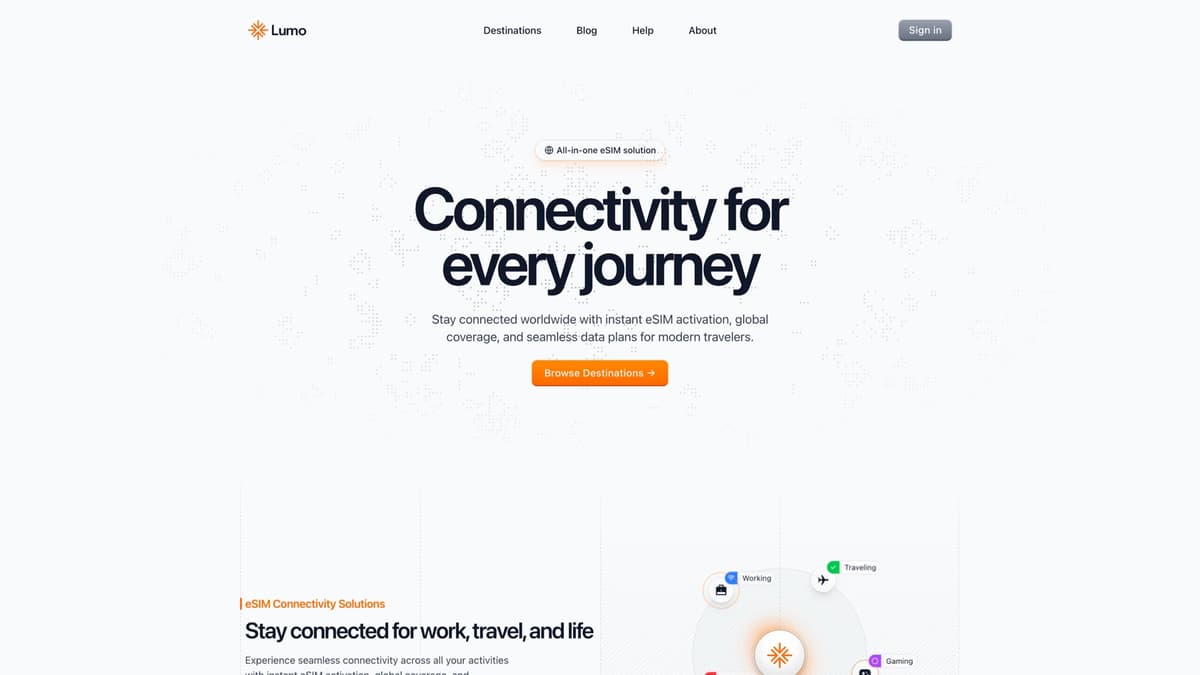
Lumo provides instant global eSIM plans across more than 160 countries, activated via QR code in minutes. Plans are built for the way business travelers actually move: flexible data options, 5G/4G speeds, and 24/7 support when something goes wrong at 2 a.m. in a different time zone. Lumo works alongside your VPN and MDM setup, so your corporate security stack stays intact. For a full breakdown of what to pack digitally before your next trip, the business travel tech essentials guide covers every tool worth considering.
FAQ
What is a business travel connectivity checklist?
A business travel connectivity checklist is a structured list of steps covering device setup, data plan selection, VPN configuration, and offline preparation to maintain secure internet access during international trips.
How do I stay connected while traveling internationally without roaming fees?
Use an eSIM regional bundle or local eSIM plan instead of your home carrier’s roaming service. Activate it before departure and test data and hotspot functions at home.
Is public Wi-Fi safe for business use?
Public Wi-Fi is not safe without an active VPN. Rogue hotspots can intercept your data, so always connect through an encrypted VPN tunnel and disable auto-connect on your device.
What is the best way to manage data usage abroad?
Set data usage alerts at 80–90% of your plan’s cap directly on your device. This gives you time to switch to Wi-Fi or purchase additional data before you hit your limit.
Do I need MDM if I already use a VPN?
Yes. Mobile Device Management enforces security policies, provisions eSIM profiles remotely, and restricts unauthorized tethering. VPN protects your traffic. MDM protects the device itself.
Recommended
Related Topics
Stay Connected Anywhere
Prepaid eSIM data plans for 180+ countries and territories. No physical SIM required.