Mobile Telecommunications Glossary: Key Terms Explained

TL;DR:
- A mobile telecommunications glossary defines essential technical terms, standards, and identifiers that enable global network connectivity. Understanding concepts like MNOs, MVNOs, eSIM codes, and messaging protocols helps travelers and professionals make informed decisions and troubleshoot effectively. Clear terminology prevents misunderstandings, ensuring reliable service and efficient international communication.
A mobile telecommunications glossary is a structured reference tool that defines the technical terms, standards, and codes governing how mobile networks operate and connect people worldwide. Whether you are a frequent traveler managing eSIM profiles across multiple countries, a remote worker troubleshooting connectivity, or a telecom professional navigating network specifications, understanding mobile telecom terms is not optional. It is the difference between choosing the right data plan and paying for one that does not work where you need it. This glossary covers the core vocabulary: from GSM and 5G standards to eSIM identifiers, MVNOs, and A2P messaging.
What is a mobile telecommunications glossary?
A mobile telecommunications glossary organizes the technical vocabulary of cellular networks into clear, usable definitions. The telecom industry spans infrastructure, software, regulation, and services, and telecommunications services are classified by both transmission medium and service type. That distinction matters because a term like “network service” means something different to a regulator than it does to a traveler buying a prepaid eSIM. Knowing the difference helps you ask better questions and make smarter decisions about connectivity.
Core mobile network standards: GSM to 6G
Mobile network generations define the speed, capacity, and capability of wireless connections. Each generation introduced new standards that shaped how devices communicate.

GSM (2G) is the Global System for Mobile Communications. GSM supports over 90% of global mobile handsets as of January 2026, making it the most widely deployed cellular standard in history. Even as newer generations dominate data traffic, GSM remains the fallback for voice and SMS in areas where 4G and 5G coverage is thin.
3G and WCDMA brought mobile data into practical use. WCDMA delivers up to 2 Mbps for voice, video, and data transmission. That was transformative in the early 2000s, though it now represents the minimum viable standard for most users.
4G/LTE shifted mobile connectivity from a phone feature to a productivity tool. LTE (Long-Term Evolution) introduced packet-switched architecture that treats all traffic, including voice, as data. For travelers, 4G/LTE is the baseline expectation for reliable video calls and cloud access. You can explore 4G and 5G coverage specifics to understand regional availability before you travel.
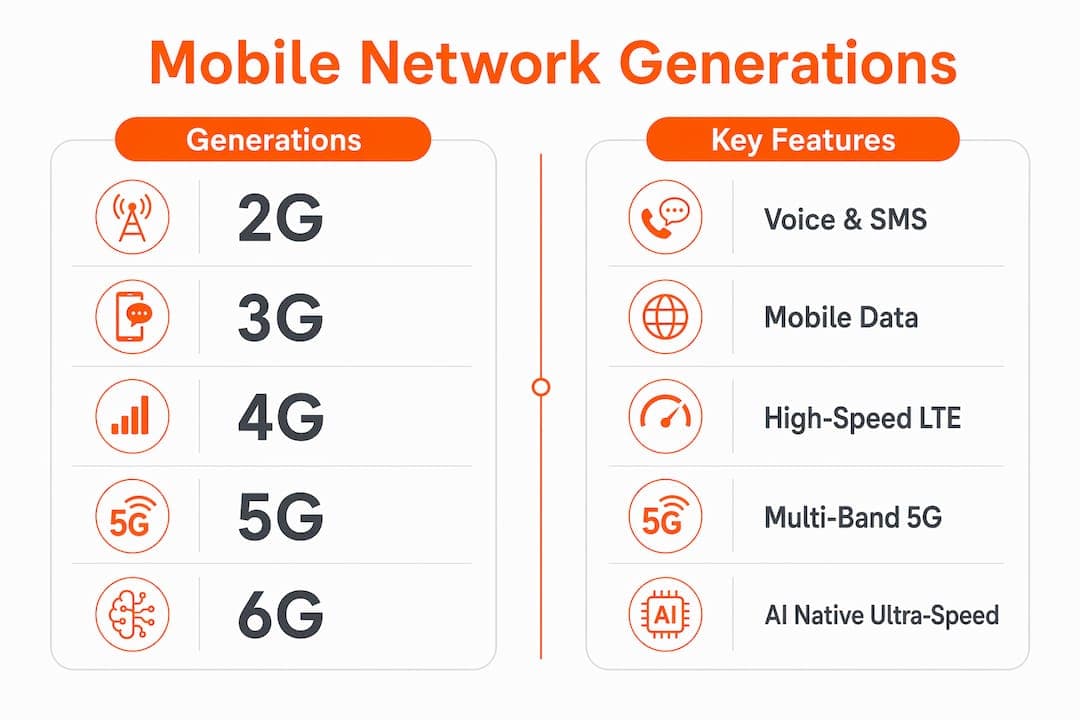
5G operates across three spectrum bands: low-band for coverage, mid-band for balanced speed and reach, and high-band (mmWave) for ultra-fast speeds in dense urban areas. The practical impact for remote workers is lower latency and higher throughput on compatible devices.
6G is defined by the European Commission as an AI-native network integrating ultra-high-speed communication and sensing capabilities. Commercial 6G deployment is expected in the early 2030s. For now, understanding 5G architecture is the relevant priority.
| Generation | Standard | Peak Speed | Key Feature |
|---|---|---|---|
| 2G | GSM/GPRS | 114 Kbps | Voice and SMS |
| 3G | WCDMA/HSPA | 2–14 Mbps | Mobile data |
| 4G | LTE/LTE-A | 100–1000 Mbps | Packet-switched all-IP |
| 5G | NR (New Radio) | 1–10 Gbps | Low latency, massive IoT |
| 6G | AI-native (emerging) | 1 Tbps (projected) | Sensing and AI integration |
Pro Tip: When buying an eSIM for travel, confirm whether your destination’s primary coverage is 4G LTE or 5G. A plan advertised as “5G capable” is only useful if your device and the local towers both support the same 5G band.
What is the difference between MNOs and MVNOs?
MNOs own physical infrastructure while MVNOs lease network capacity to deliver flexible mobile services. This distinction directly affects your options as a traveler or remote worker.
A Mobile Network Operator (MNO) builds and maintains the towers, spectrum licenses, and core network equipment. Examples include AT&T, Deutsche Telekom, and NTT Docomo. MNOs set the baseline quality of service in any given country.
A Mobile Virtual Network Operator (MVNO) has no towers of its own. It buys wholesale access from one or more MNOs and resells it under its own brand, often with more flexible pricing or specialized plans. Many eSIM providers operate as MVNOs or aggregators, partnering with multiple MNOs to deliver global connectivity without roaming charges. This is exactly the model that makes services like Lumo possible across 160+ countries.
Here is how MNOs and MVNOs compare for travelers and remote workers:
- MNOs: Strongest network quality and priority access, but expensive roaming rates and rigid contract structures
- MVNOs: Lower costs and flexible plans, but may receive deprioritized bandwidth during peak congestion
- eSIM aggregators: Switch between multiple MNO networks automatically, giving you the best available signal without manual SIM swaps
- Coverage depth: MNOs cover rural and remote areas more reliably; MVNOs depend entirely on their MNO partners’ footprint
Pro Tip: Before purchasing a travel data plan, check whether the provider is an MVNO tied to a single MNO or an aggregator with multi-network access. Multi-network access matters most in countries with uneven coverage.
Messaging and communication terms you need to know
Telecom jargon creates real barriers for non-specialists, and messaging terminology is where that confusion hits hardest. These are the terms that govern how texts, alerts, and authentication codes reach your phone.
A2P messaging (Application-to-Person) is the delivery of automated messages from software applications to individual users. A2P automates messages for OTPs, appointment reminders, and fraud alerts. When your bank sends a login code, that is A2P. P2P messaging (Person-to-Person) is standard SMS between individuals.
The numbered flow below shows how a typical A2P message reaches you:
- Application layer: A business platform (bank, airline, or app) triggers a message
- API integration: The platform connects to a messaging provider via an API (Application Programming Interface)
- Routing: The message travels through an aggregator to the destination carrier
- Delivery report: The carrier confirms receipt and returns a status code to the sender
- OTP delivery: The message arrives on your device, often within seconds
Grey routes are unofficial message pathways that bypass standard carrier agreements. Grey routes reduce cost but introduce unreliable delivery and compliance risk. For critical OTP messages, grey routes are unsuitable because a failed authentication code can lock a user out of an account entirely.
Pro Tip: If you are not receiving OTP codes while traveling internationally, the issue is often grey route filtering by the local carrier. Switching to a local eSIM profile resolves this in most cases because the message routes through a domestic carrier path.
Key identifiers and codes: SIM, eSIM, MCC, MNC, and IMSI
Every mobile device and network connection relies on a set of codes that identify who you are and which network you belong to. These identifiers are the backbone of roaming, authentication, and eSIM profile management.
A SIM (Subscriber Identity Module) is a physical chip that stores your subscriber credentials. An eSIM (Embedded SIM) performs the same function digitally, allowing you to download and switch carrier profiles without a physical card. For a deeper look at eSIM terminology for travelers, the concepts below provide the foundation.
MCC and MNC codes are embedded in every eSIM profile and are critical for correct network selection and roaming. The Mobile Country Code (MCC) is a three-digit number identifying a country. The Mobile Network Code (MNC) identifies the specific operator within that country. Together, they form the PLMN (Public Land Mobile Network) identifier.
The IMSI (International Mobile Subscriber Identity) is a unique 15-digit number stored on your SIM or eSIM that identifies your subscription globally. When your device connects to a foreign network, the IMSI is what the visited network uses to verify your roaming agreement with your home carrier.
| Code | Full Name | Purpose |
|---|---|---|
| MCC | Mobile Country Code | Identifies the country of the network |
| MNC | Mobile Network Code | Identifies the specific operator |
| PLMN | Public Land Mobile Network | Combined MCC+MNC for network ID |
| IMSI | International Mobile Subscriber Identity | Unique subscriber identifier |
| ICCID | Integrated Circuit Card Identifier | Unique SIM/eSIM card number |
Pro Tip: If your eSIM fails to connect after arriving in a new country, check that the PLMN codes in your profile match the available networks. Most eSIM apps display this in the profile settings.
Key takeaways
Understanding mobile telecom terminology is the foundation for making informed decisions about connectivity, whether you are managing eSIM profiles, choosing between MNO and MVNO plans, or troubleshooting roaming failures.
| Point | Details |
|---|---|
| Network generations matter | GSM through 5G each define speed and capability; confirm which generation your destination supports. |
| MNO vs. MVNO distinction | MVNOs offer flexible pricing but depend on MNO infrastructure; multi-network eSIM aggregators offer the best travel coverage. |
| A2P messaging and OTPs | Grey routes risk OTP delivery failures; a local eSIM profile routes messages through domestic carrier paths. |
| PLMN codes drive roaming | MCC and MNC codes embedded in eSIM profiles determine which network your device selects abroad. |
| Telecom regulation is broad | Telecom rules cover everything from voice subscriptions to broadband, so terminology applies across all service types. |
Why terminology clarity is the real connectivity problem
Most connectivity failures I have seen are not technical. They are definitional. A traveler buys a plan advertised as “global coverage” without realizing the provider is an MVNO tied to a single MNO with no presence in their destination country. A remote worker cannot receive OTP codes because their messaging provider routes through grey routes that the local carrier blocks. These are not edge cases. They happen constantly, and they happen because reliable messaging requires interoperability and unified terminology among all stakeholders in the chain.
The telecom industry has a habit of using the same word to mean different things depending on context. “Roaming” means one thing to a carrier and something else to a user. “Coverage” can mean the presence of a tower or the ability to make a call. When you understand the precise definitions, you stop trusting marketing language and start asking the right questions before you buy. That shift alone saves money and prevents frustration. For anyone working or traveling across borders, I recommend reading about why mobile connectivity matters before committing to any plan.
— Bogdan
Stay connected anywhere with Lumo eSIM
Knowing the terminology is step one. Putting it to work is step two.
Lumo provides instant global data plans for travelers and remote workers across 160+ countries, with eSIM profiles that activate via QR code in minutes. Lumo operates as a multi-network aggregator, meaning your device selects the strongest available MNO signal in each country automatically. No physical SIM swaps, no roaming fees, and no grey route OTP failures. Plans are flexible, coverage includes 5G where available, and support is available around the clock. If you want to apply what you have learned about 5G connectivity to a real purchase decision, Lumo is built for exactly that.
FAQ
What does a mobile telecommunications glossary include?
A mobile telecommunications glossary defines technical terms covering network standards (GSM, LTE, 5G), operator types (MNO, MVNO), subscriber identifiers (IMSI, PLMN), and messaging protocols (A2P, OTP). It serves as a reference for users, professionals, and travelers navigating mobile connectivity decisions.
What is the difference between an MNO and an MVNO?
An MNO owns physical network infrastructure, while an MVNO leases capacity from MNOs to offer mobile services. MVNOs typically offer lower prices and flexible plans, and many eSIM providers operate as MVNOs or multi-network aggregators.
Why do eSIM profiles use MCC and MNC codes?
MCC and MNC codes identify the country and operator of a network. eSIM profiles embed these codes to determine which network a device connects to when roaming, making accurate PLMN data critical for reliable international connectivity.
What is A2P messaging and why does it matter for travelers?
A2P (Application-to-Person) messaging delivers automated messages like OTPs and alerts from apps to users. Travelers using foreign SIMs may miss these messages if the carrier filters grey route traffic, which a local eSIM profile typically resolves.
What is the difference between a SIM and an eSIM?
A SIM is a physical chip storing subscriber credentials, while an eSIM is a digital equivalent embedded in the device. eSIMs allow remote profile downloads and carrier switching without a physical card swap, making them ideal for international travel.
Recommended
- Enterprise mobile data explained: global connectivity for travelers | Lumo eSIM Store
- eSIM Terminology: Essential Concepts for Global Travelers | Lumo eSIM Store
- Mobile Data Roaming: Costs, Risks, and Smarter Choices | Lumo eSIM Store
- Global mobile network access explained: roam without worry | Lumo eSIM Store
Related Topics
Stay Connected Anywhere
Prepaid eSIM data plans for 180+ countries and territories. No physical SIM required.