Regional eSIM Guide: How to Pick, Install and Use One

A regional eSIM is a prepaid data plan that works across a group of neighboring countries, such as Europe or Asia, on one digital SIM profile. You buy it once, install it by QR code, and your phone connects to local partner networks as you cross borders. It is usually the simplest choice when your trip touches three or more countries in the same part of the world. This guide explains how the coverage works, when a regional plan beats the alternatives, how to check your phone, and how to install it without stress.
TL;DR
- A regional eSIM covers a defined group of countries on one plan, so you skip buying and installing a new profile at every border.
- Choose regional for multi-country trips in one area, a single-country plan for one destination, and a global plan when your route spans continents.
- Before buying, confirm your phone supports eSIM and is carrier-unlocked, then check the plan’s country list against your itinerary.
- Install the eSIM on Wi-Fi before you fly, but switch it on only when you land, so the validity clock starts at the right time.
- Keep your home SIM as a second line for calls and verification texts, and turn off data roaming on it.
Table of Contents
- What a regional eSIM actually is
- Regional, country or global: which one fits your trip
- What Lumo’s regional options look like
- How to check that a regional plan covers your itinerary
- Is your phone ready? Eligibility checks
- Installing and activating your regional eSIM
- Using your phone abroad with a regional eSIM
- Choosing allowance and duration without overpaying
- Our perspective
- Ready to pick a plan?
- FAQ
- Sources
What a regional eSIM actually is
An eSIM is a SIM built into your device. According to the GSMA’s guide to eSIM architectures, it relies on remote SIM provisioning in an embedded chip, and its main job is to authenticate your device to a network so you can make calls, send messages and use data. The same document explains that profiles can be downloaded, then enabled or disabled remotely. That is why you can get a travel plan from a QR code without visiting a shop or swapping a plastic card.
A regional plan is simply one such profile whose coverage is defined by geography rather than by a single country. Instead of one network in one place, the profile is set up to work with partner networks in each country on the list. The reason that works is roaming. The GSMA describes international roaming as made possible by wholesale agreements between a customer’s home operator and the network being visited. A travel eSIM provider holds those arrangements for you, so you pay a flat prepaid price instead of per-megabyte roaming charges from your home carrier.
In practice that means three things for you:
- One profile, many countries. The plan lists the countries it covers. Cross a border inside that list and your phone picks up a local partner network.
- One data allowance. Your gigabytes are shared across all the covered countries. Spend them in Spain or Poland, it comes out of the same pot.
- One validity period. The plan runs for a set number of days, such as 7, 15 or 30, counted from activation or first connection.
If you want the bigger picture on avoiding roaming bills, our guide to avoiding roaming fees with eSIM covers the basics.
Regional, country or global: which one fits your trip
The right plan depends on your route, not on which one looks cheapest per gigabyte. Use this comparison as a starting point.
| Trip type | Best fit | Why |
|---|---|---|
| One country, any length | Single-country plan | Tightest coverage, often the lowest price for that destination |
| Two or three neighboring countries | Regional plan, or one country plan if you spend nearly all your time in one | One install, no switching at the border |
| A rail or road trip through many countries in one area | Regional plan | Coverage follows you without new purchases |
| Several continents in one trip | Global plan | A single profile covers places no regional plan reaches together |
| Long stay in one place with short side trips | Country plan plus a regional top-up, or a regional plan if the side trips are frequent | Depends on how much data you use at home base |
When regional wins
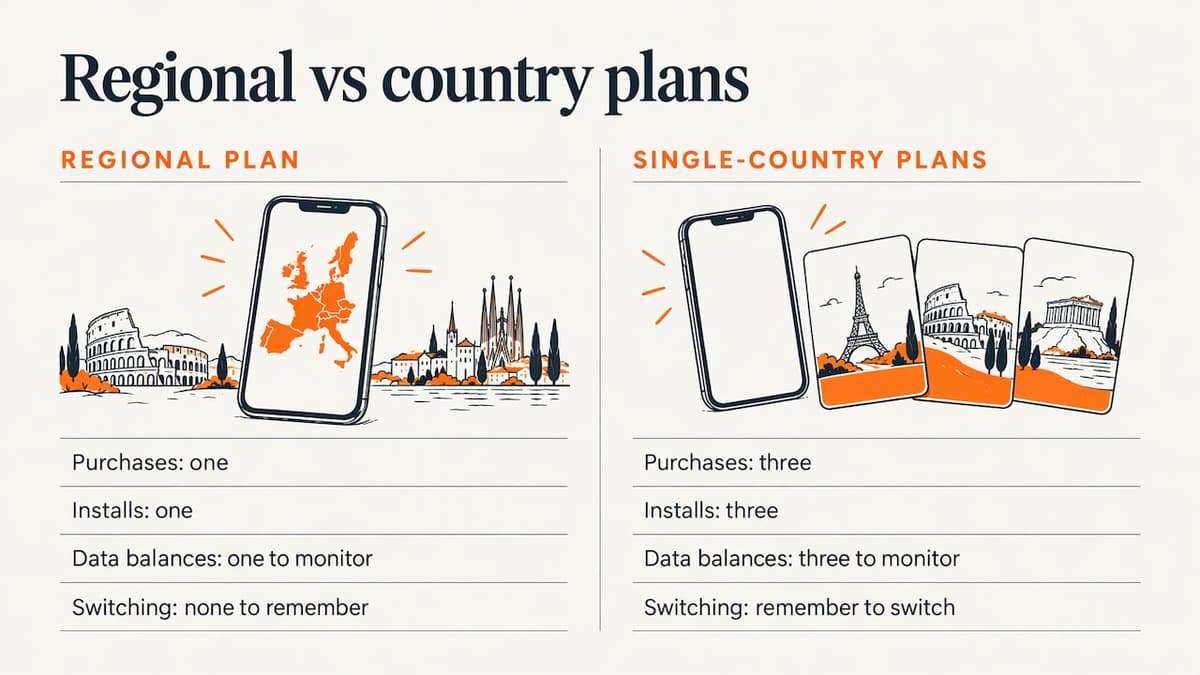
Regional is the sweet spot when you are crossing borders often. Picture ten days through Italy, Austria and Germany, or two weeks hopping between Thailand, Vietnam and Singapore. Three single-country plans would mean three purchases, three installs and three data balances to watch. One regional plan replaces all of that. Your phone keeps working on a train that crosses a border at night, and you do not have to remember to switch anything.
When a country plan is better
If 90 percent of your trip is in one country, a country-specific plan is the cleaner pick. It is built around that destination, and you are not paying for coverage you will not use. Our Italy plans, Ireland plans and Singapore plans are examples of this approach, each starting from $1.
When to go global
A global plan makes sense when your itinerary spans regions, for example a stopover in Asia on the way to Europe, or business travel that changes every few weeks. You trade some price efficiency for the freedom of not planning coverage at all. Our Global eSIM plans start from $7.
A simple decision test
Write down every country you will touch, including layovers where you might use data. Then ask three questions:
- Are all of them in one region on the plan’s country list? If yes, regional.
- Is one country where you will spend most of your time? If yes, consider a country plan for it.
- Does your route cross continents? If yes, global.
What Lumo’s regional options look like
We sell prepaid eSIM plans with no contract and no registration, activated by QR code, and our range includes regional and multi-country choices. The starting prices below are the lowest published for each product line, as one-off payments. The price you pay depends on the data amount and number of days you choose.
| Plan | Starting price | Best for |
|---|---|---|
| Europe eSIM plans | from $1 | Multi-country trips across Europe |
| Asia eSIM plans | from $2 | Backpacking or business loops in Asia |
| Southeast Asia eSIM plans | from $2 | Island and city hopping in the region |
| Central Asia eSIM plans | from $2 | Silk Road style routes |
| Africa eSIM plans | from $8 | Safaris and multi-country travel |
| Caribbean eSIM plans | from $8 | Island hopping and cruise stops |
| North America eSIM plans | from $3 | Trips across the US and neighboring countries |
| Australia, United Kingdom & United States plans | see the page | English-speaking multi-country itineraries |
To see which carriers sit behind each country, use our coverage page, which lists networks by country.
How to check that a regional plan covers your itinerary
Coverage claims are only useful if you verify them against your own route. Do this before you pay.
- Read the country list, not the plan name. “Europe” can mean different things from one plan to another. Some include the UK, Switzerland or Turkey, some do not. Look for every country you will enter, including short transit stops.
- Check the networks. The country list tells you where the plan works; the network list tells you how well. Look at which carriers the plan uses in each place you will spend real time.
- Look for 4G or 5G support in your destinations if you stream, navigate or work on video calls.
- Read the fine print on the data allowance. Some plans reduce speed after a fair-use threshold. Check whether the allowance is shared across all countries or split.
- Confirm the validity rule. Find out whether the clock starts when you install, when you first connect, or on a date you pick.
Our article on mobile network compatibility for travelers goes deeper on why a network that works in one country may behave differently in the next.
Is your phone ready? Eligibility checks
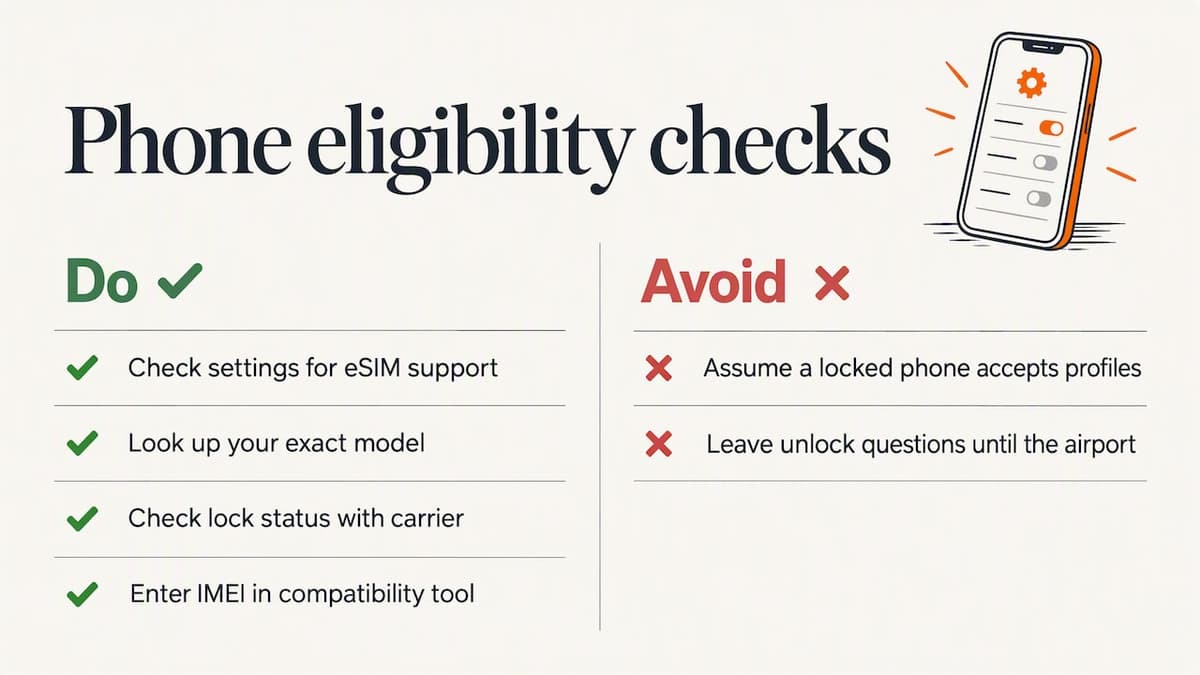
Two things decide whether a regional eSIM will work on your phone: eSIM support and carrier lock.
eSIM support. A phone needs to support eSIM to use a digital plan at all. Most recent flagship phones do, but many budget models and older devices do not. Check your settings for an option to add an eSIM or a mobile plan, or look up your exact model on the manufacturer’s site.
Carrier lock. A phone that is locked to its original carrier will not accept a new network’s profile. Consumer Reports notes that to switch to another compatible network, a phone may need to be unlocked, and that it needs to support eSIM to use a digital eSIM. Their guidance for US shoppers is to check the lock status in your settings or with your carrier, and to enter your IMEI in the new network’s compatibility tool. You can find your IMEI by dialing *#06# or in the About section of your settings.
If your phone is still tied to a payment plan, your carrier may have conditions before it will release the lock. The question of when a carrier must unlock your phone is worth sorting out weeks before departure, not at the airport.
For a fuller pre-flight list, see our four checks before you fly.
Installing and activating your regional eSIM
Installation takes a few minutes. Our setup is designed to be quick, averaging about 45 seconds by our own measure, but give yourself some calm time rather than doing it in a boarding queue.
Before you leave
- Buy the plan and keep the QR code email handy. Guest checkout means you do not need an account.
- Connect to reliable Wi-Fi. The profile has to be downloaded.
- Open your phone’s settings, choose the option to add an eSIM or mobile plan, and scan the QR code.
- Label the new line something recognizable, like “Travel data”.
- Leave the eSIM turned off, or keep data roaming off for it, until you arrive. This protects your validity period.
When you land
- Turn the eSIM line on and set it as your mobile data line.
- Turn on data roaming for the eSIM line only. This is normal for travel eSIMs, because they connect through partner networks.
- Wait a minute or two for the network to register. If nothing appears, restart the phone.
Installing early or on arrival?
Installing at home is almost always better. You have stable Wi-Fi, you can fix problems with support, and you arrive with a working connection for maps and rides. The only case for waiting is a phone that will not hold two profiles well, or a plan whose validity starts at installation instead of first connection. Check the plan details if you are unsure.
If you want to move between networks once you are abroad, our step-by-step guide to switching mobile networks walks through it, including common mistakes to avoid.
Using your phone abroad with a regional eSIM
Data
Your eSIM line carries your data. Set it as the default for mobile data and turn off data roaming on your home line, so a background app never uses your home plan at roaming rates. Download offline maps for areas with patchy signal.
Calls and texts
Most travel eSIMs are data plans. That is fine for most travelers, because messaging and calling apps work over data. Your home number stays on your physical or primary SIM, so you can still receive texts, including bank codes. Check with your home carrier first about any fees for receiving calls or texts abroad, and consider switching to Wi-Fi calling.
Two lines at once
Dual-SIM use is the main advantage of an eSIM. Keep your home line active for calls and verification messages, and the travel eSIM for data. Name them clearly and set the default line for data so you never guess which one is spending.
Tracking your balance
Check your remaining data and days regularly, especially on long trips or when you are using maps and video. If you run low, top up or buy a second plan before you cross a border, not after you lose signal.
Choosing allowance and duration without overpaying
Plans differ mainly in data amount and days. A few rules of thumb help you avoid both running out and overbuying.
- Light use (maps, messaging, email): a small allowance is typically enough for a short trip.
- Moderate use (social media, some video, ride apps): size up, and check usage in your phone settings during a normal week at home to get a baseline.
- Heavy use (video calls, remote work, streaming): pick a larger allowance or longer plan, and use hotel Wi-Fi for big downloads.
- Duration: match days to your trip length plus a buffer day or two. Many plans offer 7, 15 or 30 days.
Because our plans are prepaid and one-off, you know the cost before you go. Our guide to choosing a travel SIM has more on matching plans to how you use your phone.
Our perspective
We built Lumo for people who cross borders often and do not want to think about connectivity. In our experience, the biggest mistake travelers make is not choosing the wrong provider, it is choosing the wrong shape of plan for their route. A traveler who buys three separate country plans for a rail trip ends up juggling three installs and three balances, while one regional plan does the job quietly in the background.
That is why we offer regional and global options next to single-country plans, with no contract, no registration and guest checkout. You pick the data and days you need, scan a QR code, and go. Our aim is to design every step to be fast, and our support team, both human and AI, is available around the clock if something does not connect.
Our advice: list your countries, check the plan’s coverage against them, confirm your phone is unlocked and eSIM-ready, and install before you fly. Do those four things and a regional eSIM becomes the least interesting part of your trip, which is exactly how it should be.
Theo Wheeler
Ready to pick a plan?
If your route is mostly in one area, start with our Europe eSIM plans or Asia eSIM plans, both starting at low one-off prices with instant QR code delivery. If your trip crosses continents, our Global eSIM plans start from $7. You can browse every option on our destinations page.
FAQ
Is a regional eSIM cheaper than buying a plan for each country?
Often, when you cross several borders in one area, because you buy once and share one data allowance. If you spend nearly all your time in one country, a single-country plan can cost less. Compare the total for your actual route rather than the price per gigabyte alone.
Do I need to unlock my phone for a regional eSIM?
Yes, if your phone is locked to a carrier it may not accept a profile from another network. Consumer Reports advises checking lock status in your settings or with your carrier. Do this before you buy, since unlocking can take time.
Can I keep my regular number while using a regional eSIM?
Yes, on a dual-SIM capable phone. Keep your home SIM active for calls and texts, and set the travel eSIM as your mobile data line. Turn off data roaming on the home line to avoid unexpected charges.
When should I install my regional eSIM?
Install it at home on Wi-Fi before you leave, so you can fix any problems with support. Then switch the eSIM line on when you land. Check your plan’s validity rules to see whether the days count from installation or first connection.
What happens if I visit a country that is not on my plan’s list?
Your eSIM will not connect there, so you would need another plan for that country or a global plan. Check the country list against your full itinerary, including layovers, before you buy.
Sources
- GSMA, A guide to eSIM architectures (2024)
- GSMA, Overview of International Mobile Roaming
- Consumer Reports, How to unlock your phone from any major carrier
Recommended
Related Topics
Stay Connected Anywhere
Prepaid eSIM data plans for 180+ countries and territories. No physical SIM required.