Why Avoid Traditional SIM Cards: A 2026 Travel Guide

TL;DR:
- Traditional SIM cards pose security risks from physical theft and are costly compared to eSIMs.
- Switching to eSIMs can save travelers up to 90% on roaming fees and offers faster activation.
Traditional SIM cards are removable physical chips that create real security risks, limit your connectivity options, and cost significantly more than modern alternatives. The reasons to avoid traditional SIM cards are well documented: physical theft enables immediate misuse, roaming fees drain travel budgets, and the plastic waste adds up across millions of cards annually. The GSMA and major telecom standards bodies now actively promote eSIM technology as the successor to physical SIM provisioning. For travelers and globally mobile individuals, understanding these disadvantages of physical SIM cards is the first step toward smarter connectivity.
Why avoid traditional SIM cards for security?
Physical SIM cards carry a security flaw that most travelers overlook. Anyone who removes your SIM can insert it into another phone and immediately access your number, your calls, and your two-factor authentication codes. SIM swap fraud losses reached $17.4 million as reported by the FBI in 2025. That figure represents real financial damage to real people, not a theoretical risk.
eSIM technology addresses this directly. An eSIM is soldered into the device and protected by cryptographic authentication, meaning physical theft alone cannot enable misuse. A thief who steals your phone still needs your carrier credentials and account access to exploit an eSIM profile. That extra barrier stops most opportunistic attacks cold.
That said, eSIMs are not immune to every threat. Digital SIM-swap attacks, where a bad actor convinces a carrier to reassign your number, remain a concern depending on how strong a carrier’s identity verification is. The risk shifts from physical to digital, which changes the attack surface but does not eliminate it entirely.
Key security vulnerabilities of physical SIM cards include:
- Physical removal: Anyone with access to your phone can pop out the SIM tray in seconds.
- Burner phone insertion: A stolen SIM works immediately in any compatible unlocked device.
- 2FA interception: SMS-based authentication codes go to whoever holds the SIM, not the account owner.
- No remote lock: Carriers can deactivate a lost SIM, but the window between theft and deactivation creates real exposure.
Pro Tip: Keep your physical SIM active for banking and 2FA apps, and use an eSIM for daily data and travel. This hybrid setup limits your exposure on both fronts.
How much do travelers save by switching to eSIM?

The cost difference between eSIM and traditional roaming is the most immediate reason travelers make the switch. Travel eSIM plans cost 70–90% less than traditional carrier roaming fees. For a two-week trip to Europe, that gap can mean the difference between a $5 data plan and a $60 roaming charge.
Speed of activation matters just as much as price. An eSIM activates in as little as 60 seconds, while a physical SIM requires 5–30 minutes, often including a store visit in a foreign country. Landing in Tokyo at midnight and needing data immediately is a situation where that gap is not a minor inconvenience. It is the difference between having a map and not having one.
The environmental case is also real. The GSMA highlights that eSIM’s zero physical footprint reduces CO2 emissions from manufacturing and transport. Billions of plastic SIM cards have been produced globally, each requiring packaging, shipping, and eventual disposal. Eliminating that supply chain is a measurable environmental gain.
| Feature | eSIM | Physical SIM |
|---|---|---|
| Activation time | Under 60 seconds | 5–30 minutes |
| Travel data cost | 70–90% lower than roaming | Standard roaming rates apply |
| Risk of loss or damage | None | Card can be lost, bent, or damaged |
| Environmental impact | No plastic waste | Plastic card, packaging, logistics |
| Dual-profile support | Yes, home and travel simultaneously | Requires physical swap |
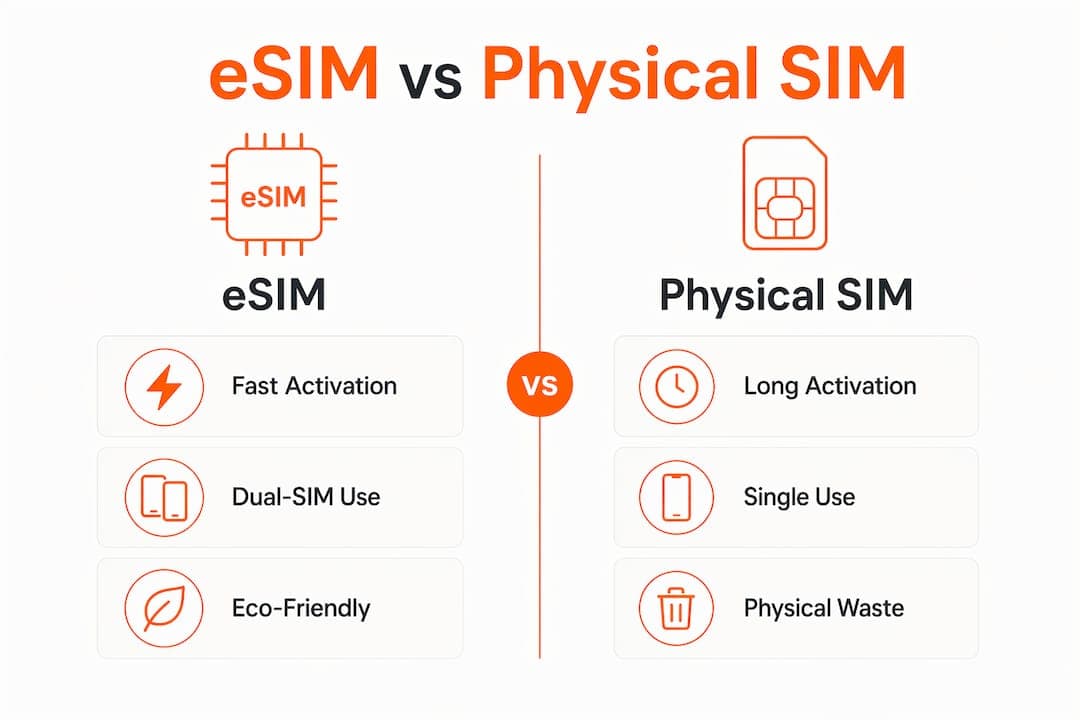
Dual-SIM capability is another practical win. With an eSIM, you can run your home number and a local travel profile at the same time. You stay reachable on your regular number while paying local data rates abroad. Physical SIM users have to choose one or the other, or carry two phones.
When does a physical SIM card still make sense?
Physical SIM cards remain the right choice in specific situations, and ignoring that reality leads to poor decisions. Not all carriers or regions fully support eSIM provisioning in 2026. Budget carriers and some regional networks still require in-store physical SIM activation, particularly across parts of Southeast Asia, Africa, and Latin America.
Device compatibility is the other limiting factor. Older smartphones, many budget Android models, and some feature phones do not support eSIM at all. Travelers who frequently lend devices or swap phones between family members also find physical SIM swaps faster and simpler than transferring eSIM profiles, which depend on carrier and platform support.
Situations where keeping a physical SIM makes practical sense:
- Older or budget devices that lack eSIM hardware support.
- Regions with limited eSIM coverage, where local carriers only provision physical cards.
- Frequent device swapping, such as sharing a phone with a family member or colleague.
- Backup connectivity, where a physical SIM from a local carrier provides a fallback if the eSIM provider has an outage.
The recommended best practice from connectivity experts is a hybrid model: keep your physical home SIM for your primary number and banking apps, and layer a travel eSIM on top for data when you cross a border. Check out the eSIM compatibility guide from Lumo for a detailed breakdown of which devices and regions support eSIM provisioning today.
What privacy risks come with eSIM technology?
Switching to eSIM shifts your trust from a physical carrier relationship to a digital provider’s infrastructure. That shift has real privacy implications that travelers rarely consider before buying a plan. Regional eSIM providers often lack transparency on how they handle IMSI data, how long they retain connection logs, and whether they share data with third parties.
Your IMSI, the International Mobile Subscriber Identity, is a unique identifier tied to your eSIM profile. Providers who log this data can build a detailed picture of your location and usage patterns. Physical SIMs carry the same identifier, but the difference is that eSIM data flows entirely through a provider’s digital infrastructure, making the provider’s privacy policy the single most important document you should read before activating a plan.
The broader context of IoT and mobile integration makes this even more relevant. As eSIM expands into tablets, laptops, and wearables, the volume of data flowing through a single provider grows. Choosing a provider with clear, auditable privacy practices is not optional for privacy-conscious travelers.
Pro Tip: Before activating any eSIM plan, read the provider’s privacy policy specifically for terms on data logging, IMSI handling, and third-party data sharing. If those terms are vague or absent, choose a different provider.
Lumo’s approach to mobile data security covers exactly what travelers should look for in a trustworthy eSIM provider, including what questions to ask before you buy.
Key Takeaways
Avoiding traditional SIM cards comes down to four concrete factors: security exposure from physical theft, high roaming costs, limited flexibility for global travelers, and the privacy responsibility that comes with choosing any digital provider.
| Point | Details |
|---|---|
| Physical SIM security risk | Stolen SIMs enable immediate misuse; eSIMs require carrier credentials to exploit. |
| Travel cost savings | eSIM travel plans cost 70–90% less than standard carrier roaming fees. |
| Hybrid model is best practice | Keep a physical SIM for banking and 2FA; use eSIM for travel data. |
| eSIM gaps still exist | Some regions and budget carriers do not yet support full eSIM provisioning. |
| Privacy requires due diligence | Review any eSIM provider’s data logging and IMSI handling policy before activating. |
The hybrid approach is the honest answer
I have used both physical SIMs and eSIMs extensively across more than 30 countries, and the all-or-nothing framing that dominates most coverage gets it wrong. Telling travelers to ditch physical SIMs entirely ignores real gaps in eSIM infrastructure. Telling them to stick with physical SIMs ignores a cost and security gap that is genuinely significant.
The hybrid model is not a compromise. It is the most rational setup available right now. I keep my home carrier’s physical SIM active for my bank’s SMS authentication and my primary number. Every time I cross a border, I activate a travel eSIM for data. The two systems complement each other rather than compete.
What I would caution against is choosing an eSIM provider based on price alone without reading the privacy policy. I have seen providers with no clear statement on log retention or data sharing. That is a red flag regardless of how cheap the plan is. The eSIM security best practices guide from Lumo is the most practical resource I have found for travelers who want to make this evaluation quickly and confidently.
Gradual adoption works better than a hard switch. Start with a travel eSIM on your next trip. See how the activation process feels, evaluate the coverage, and read the provider’s privacy terms. Then decide how much further you want to go.
— Bogdan
Lumo eSIM: global data without the physical SIM hassle
Travelers who want reliable data across more than 160 countries without hunting for a SIM card kiosk at the airport have a straightforward option. Lumo offers instant global eSIM plans that activate via QR code in under a minute, with 5G and 4G coverage and 24/7 customer support.
Lumo’s plans are built for the hybrid model described above. You keep your home SIM for calls and banking, and activate a Lumo eSIM for data the moment you land. No store visits, no roaming surprises, and no plastic card to lose at the bottom of your bag. The eSIM vs physical SIM guide on Lumo’s site walks through exactly how to set this up for your specific device and destination.
FAQ
Why are traditional SIM cards considered a security risk?
Physical SIM cards can be removed from a device and inserted into another phone, enabling immediate misuse. SIM swap fraud caused $17.4 million in losses reported by the FBI in 2025.
How does eSIM activation compare to getting a physical SIM?
An eSIM activates in as little as 60 seconds via QR code, while a physical SIM typically takes 5–30 minutes and often requires a store visit.
Do all phones support eSIM technology?
No. Older smartphones and many budget Android devices lack eSIM hardware. Check your device specifications or the Lumo compatibility guide before purchasing an eSIM plan.
Is eSIM better for privacy than a physical SIM?
Not automatically. eSIM data flows through the provider’s digital infrastructure, so the provider’s privacy policy and data logging practices determine your actual privacy level.
What is the best approach for frequent international travelers?
The recommended setup is a hybrid model: retain a physical SIM for your home number and banking apps, and activate a travel eSIM for data when crossing borders.
Recommended
Related Topics
Stay Connected Anywhere
Prepaid eSIM data plans for 180+ countries and territories. No physical SIM required.