eSIM vs. Carrier Day Pass: Which Costs Less Abroad?

For most trips longer than a few days, a travel eSIM costs less than a carrier day pass, because a day pass bills you for every day you use data while an eSIM is a one-time purchase for a fixed amount of data. A day pass wins on one thing: you keep your own number and plan with no setup. A prepaid eSIM from Lumo gives you local-network data in your destination, installed by QR code before you leave, and it can run next to your home line so your number stays reachable.
Below is the full comparison: what each option is, what each costs on a real trip, what each includes, and how to avoid the roaming charge that catches people who use both.
TL;DR
- A carrier day pass charges a flat daily fee, typically $12 a day on the biggest U.S. carriers, for each day you use data abroad. Costs grow with every day.
- A travel eSIM is prepaid: you buy a set amount of data for a set number of days, with no daily meter and no bill after the trip.
- A day pass keeps your talk and text on your regular plan. An eSIM is data-focused, so you keep your home number active on the second line and use messaging apps or Wi-Fi calling for the rest.
- For a weekend, a day pass can be fine. From about a week up, or for a family, the eSIM math usually favors the eSIM.
- Before choosing an eSIM, check that your phone supports eSIM and is unlocked, then switch your home line’s data roaming off.
Table of Contents
- What a carrier day pass and a travel eSIM actually are
- What each costs on a real trip
- What you get with each: data, calls, texts, hotspot
- Check these before you choose
- Avoiding the double charge
- When each option fits a trip
- Promo: eSIM plans sized to your route
- Perspective: why we build for the traveler, not the meter
- FAQ
- Sources
What a carrier day pass and a travel eSIM actually are
A carrier day pass is an add-on from your existing mobile provider. You keep using your normal plan abroad, and the carrier charges a flat fee for each 24-hour period in which you use data. As one example, AT&T’s International Day Pass lets existing customers use their plan as if they were in the U.S. for $12 a day on days they use data abroad. Other large carriers run similar programs with their own prices and rules.
A travel eSIM is a digital SIM you download to your phone, tablet or laptop. An eSIM is simply a SIM card built into the device that you set up with a QR code instead of a plastic card. A travel eSIM is a prepaid data plan for a country, a region or the world. You pay once, install it, and your phone connects to a local network at your destination.
The core difference is how you are billed. A day pass meters time: each day you use data costs the same fee whether you send one email or stream video all day. An eSIM meters data: you buy, say, 3 GB or 10 GB for 30 days, and once it is used up you stop or top up. Neither is automatically cheaper in every case, but the two structures behave very differently as a trip gets longer.
What each costs on a real trip
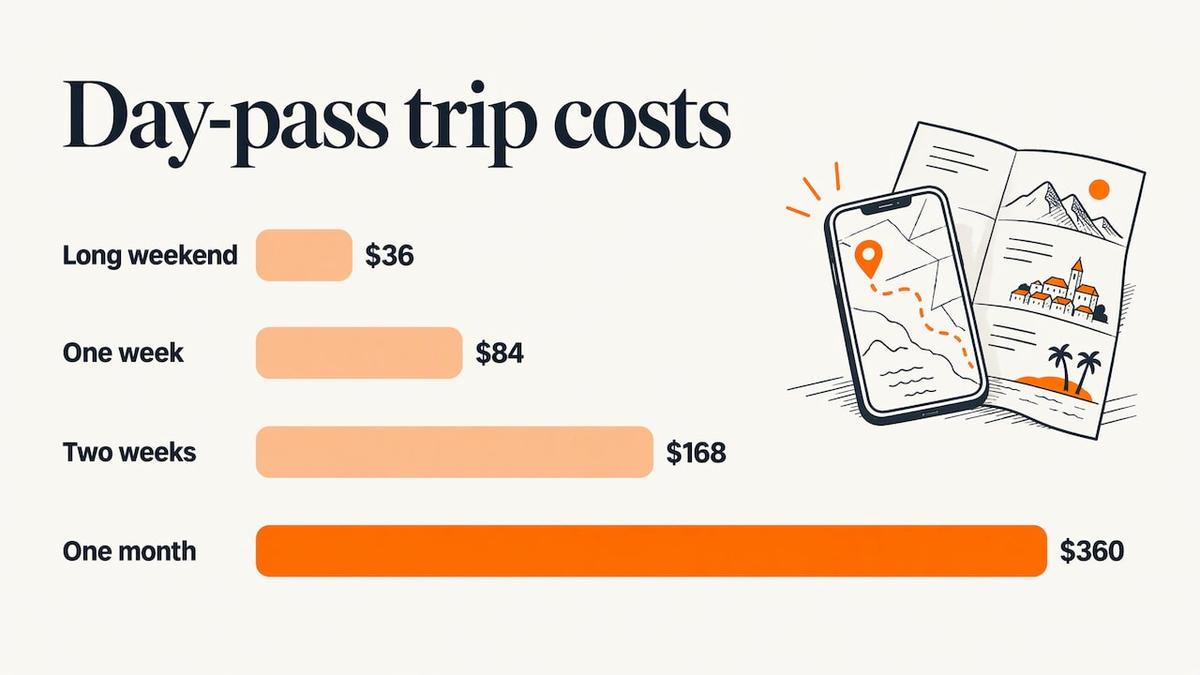
Published U.S. carrier pricing is easy to compare. Verizon’s TravelPass is $12 a day in 210 other countries and $6 a day in Canada and Mexico. AT&T’s pass is $12 a day in 210-plus countries. T-Mobile offers $5 a day, $35 for 10 days with 5 GB, or $50 for 30 days with 15 GB. Carriers change these programs, so check your provider’s current page before you travel.
Now put them next to a trip. Using the $12 daily rate, here is what the pass alone costs for one traveler:
| Trip length | Days using data | Day pass at $12/day | Travel eSIM |
|---|---|---|---|
| Long weekend | 3 | $36 | One plan, priced once |
| One week | 7 | $84 | One plan, priced once |
| Two weeks | 14 | $168 | One plan, priced once |
| One month | 30 | $360 | One plan, priced once |
Lumo’s published plans start at $1 for Europe, $1 for the United Kingdom, $2 for Asia and $2 for the United States, with Global plans from $7 and Africa and the Caribbean from $8, all one-off prices with no contract. Larger data amounts and longer validity cost more, so the final price depends on the plan you pick. The point of the table is the shape of the two curves: the day pass line climbs every day, while the eSIM is a single purchase decided at checkout.
Worked example: two weeks in Europe
Imagine you use maps, messaging, email and some video calls on a 14-day trip across three European countries. On a $12 day pass, that is 14 billable days, so $168 before any taxes or fees your carrier adds. With a regional eSIM you choose a plan sized to your use, buy it once and move across borders without a new purchase. If your trip is split between countries, a regional plan matters more, because one plan covers all of them.
Two travelers, double the cost
A day pass is billed per line. Two people on separate lines both using data pay the daily fee twice. An eSIM is bought per device, so each traveler picks the size that matches their use, and the person who only checks maps does not pay for the person who streams.
What you get with each: data, calls, texts, hotspot
This is where day passes earn their place, so it is worth being precise.
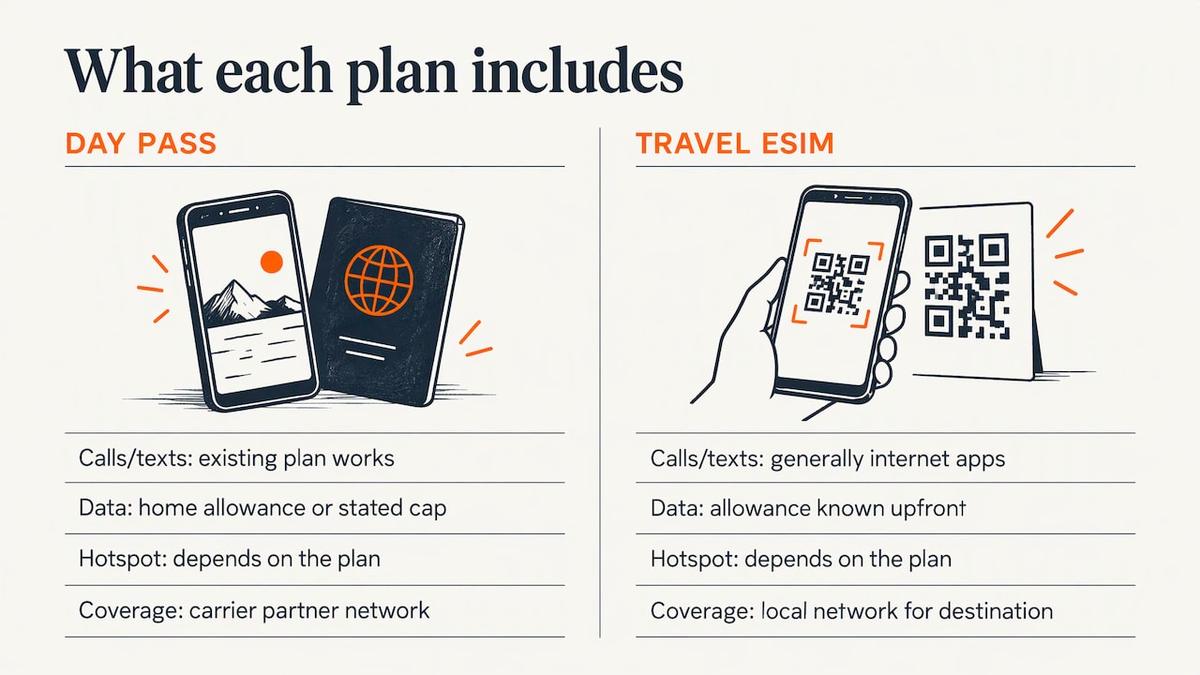
Calls and texts. A carrier pass normally keeps your existing plan working as is. Verizon’s listed TravelPass includes unlimited talk and text and 5 GB of high-speed data before speeds drop to 3G, while AT&T’s pass uses your regular plan allowance. A travel eSIM is built around data. Calls and texts generally go through internet apps, or stay on your home line, which you can keep active on the second slot of a dual-SIM phone.
Data. With an eSIM you know the allowance up front. With a pass, your data is either your home plan’s allowance or a stated cap, then slower speeds. Check which applies to you before you rely on it for navigation.
Hotspot. Whether you can share your connection depends on the specific plan, for passes and eSIMs alike. If you work from a laptop on the road, confirm hotspot support on the plan page before you buy.
Coverage. Both depend on the destination and the network. A pass uses whichever partner network your carrier has an agreement with. A travel eSIM connects to a local network chosen for that country, and Lumo lists the networks it uses on its coverage page.
A practical way to put it: if the question is “will people reach my phone number?”, a day pass answers it by default. If the question is “will my data work cheaply in every country on my route?”, the eSIM answers it better.
Check these before you choose
Both options have requirements that are easy to verify in five minutes at home.
- Phone supports eSIM. On iPhone, eSIM and Dual SIM are supported from the iPhone XS, XS Max and XR onward. Many recent Android phones also support eSIM. Look for the feature in your phone’s SIM or network settings, or in the device guide.
- Phone is carrier-unlocked. A phone locked to your carrier may refuse a SIM or eSIM from another provider. Your carrier can tell you the lock status, and it is worth settling before you leave, not at the airport.
- You have a dual-SIM setup in mind. Your iPhone can use one cellular data network at a time, but both numbers can make and receive calls and messages. In practice: your home line stays on for calls and texts, and the travel eSIM carries the data.
- You know your pass rules. If you use a day pass instead, find out whether it is automatic, how the 24-hour period is counted, and which destinations are included.
- Your trip route is covered. Match the plan to your countries. Single-country, regional and global plans exist for different routes.
Lumo’s device compatibility guides list supported phones, tablets and laptops, so you can check a specific model before checkout.
Avoiding the double charge
The expensive mistake is not choosing one option over the other. It is installing a travel eSIM and leaving your home line free to roam. A day pass can be triggered by data use on your home line, so even if your eSIM carries your browsing, a background app that uses the home line can trigger a daily fee.
The fix takes a minute and is the same on every phone:
- Set the travel eSIM as your cellular data line.
- Turn data roaming off on your home line. AT&T advises controlling the line’s data-roaming setting and using airplane mode with Wi-Fi and Wi-Fi calling off when you are not using the phone.
- Keep the home line on for calls and texts only if you want to be reachable, and know how your carrier bills those abroad.
- Review the exact toggles in our guide to roaming settings with eSIM.
If you will lean on hotel or airport Wi-Fi in place of cellular, read up on using public Wi-Fi safely as well. A mobile data plan removes most of the need to log in to open networks.
For a longer checklist, see our 7-step checklist for avoiding roaming charges.
When each option fits a trip
A day pass fits when
- The trip is two or three days and you want zero setup.
- You need your full plan for calls and texts on your usual number, without apps.
- Your phone is locked to your carrier and cannot take another provider’s eSIM.
A travel eSIM fits when
- The trip is a week or more, so the daily meter would add up.
- You cross several countries and want one plan across the route.
- You travel with a tablet or laptop that needs its own data.
- You work remotely and need predictable data for video calls.
- You travel as a couple or group and do not want to pay a daily fee per line.
Cruises and other unusual routes
Ships use maritime networks that follow different pricing than land networks, and standard passes and plans may not cover them. AT&T, for example, charges $20 per 24 hours at sea for each line on days the phone is used. If you cruise, read the terms of whatever plan you carry before you board and keep your phone in airplane mode when you do not need it.
Promo: eSIM plans sized to your route
Lumo sells prepaid eSIM data plans for smartphones, tablets and laptops in 160+ countries, with no contract and no registration required. You can check out as a guest, get your QR code, and install it; our average setup time is 45 seconds. Pick the plan that matches where you are going: Europe plans from $1, United States plans from $2, Asia plans from $2, or a Global plan from $7 if your route spans regions. Support is available 24/7, with both human and AI help.
Perspective: why we build for the traveler, not the meter
We designed Lumo around a simple observation: travelers want to know their cost before they leave, not after they land. A flat daily fee is easy to understand, but it asks you to count days. A prepaid eSIM asks you to pick a plan once, and then your trip is paid for.
That is why we skip contracts and registration, and why guest checkout and QR delivery are part of the design. You buy, scan, and connect. Our plans run on premium carrier networks across 160+ destinations, in 4G and 5G where the network offers it, and a plan can be installed on a phone, tablet or laptop.
Most of our customers keep their home number on the second line and use the eSIM for data. That setup is what we recommend to frequent travelers, digital nomads and business travelers: your number stays yours, your data is local, and your bill does not move with the calendar. If you cross borders often, the same habit carries from trip to trip.
Theo Wheeler
FAQ
Is an eSIM cheaper than a carrier day pass?
On trips of more than a few days, usually yes. A day pass at $12 a day reaches $84 in a week, while a Lumo plan is a one-off purchase, with Europe plans starting at $1. Your actual saving depends on the data you choose and the length of your stay.
Can I keep my phone number if I use a travel eSIM?
Yes, on a dual-SIM phone. Your home line stays on the primary slot for calls and texts, and the travel eSIM carries data. Apple’s guidance describes using one number for your home line and another for your travel line. Read our dual SIM travel setup guide for the steps.
Can I be charged a day pass even if I bought an eSIM?
It can happen if your home line uses data abroad. Set the eSIM as your data line and turn data roaming off on your home line. For the toggles in detail, see our guide to avoiding roaming fees abroad.
Do I need an unlocked phone for an eSIM?
In general, yes: your phone needs to support eSIM and not be locked to a carrier that blocks other providers. Check both in your settings or with your carrier before you leave, and review the device compatibility guide on our site.
Does an eSIM include calls and texts?
Travel eSIMs are data plans. You can call and message through internet apps, and your home line can still receive calls and texts if you leave it on with data roaming off. For a longer comparison, read our guide on day pass vs. eSIM for travel data.
Sources
- Best international phone plans in 2026, Tom’s Guide
- Traveling to the World Cup? What you need to know about international data plans, Tom’s Guide
- Using Dual SIM with an eSIM, Apple Support
- Explore tips on using your device internationally, AT&T support
- Safe use of public Wi-Fi, Smart Management
Recommended
Related Topics
Stay Connected Anywhere
Prepaid eSIM data plans for 180+ countries and territories. No physical SIM required.