Mobile Network Access: What Travelers Need to Know

TL;DR:
- Mobile network access allows mobile devices to connect wirelessly to cellular networks for calls, texts, and internet regardless of location. Successful connection depends on both radio link and core network authentication, with signal strength alone not guaranteeing data access. Using eSIMs simplifies international roaming and improves connectivity reliability by enabling quick network profile changes without physical SIM swaps.
Mobile network access is the ability of your mobile device to connect wirelessly to a cellular network via radio signals, granting access to voice calls, text messaging, and internet services anywhere within coverage. The industry term for this capability is cellular network connectivity, and understanding how it works changes how you plan data usage abroad. Whether you carry a physical SIM or an eSIM, your device depends on base stations and radio waves to stay connected. Knowing the layers behind that connection helps you avoid bill shock, dropped sessions, and dead zones while traveling.
What is mobile network access, exactly?
Mobile network access is defined as the process by which a mobile device authenticates itself to a cellular network and receives services. The network is built around cells, geographic areas each served by a dedicated base station. Those cells form a honeycomb pattern, allowing operators to reuse radio frequencies without interference and maintain continuous coverage as you move between areas.
Your SIM or eSIM is the key that unlocks this system. It stores a unique identifier that tells the network who you are and what services you are authorized to use. Without a valid SIM or eSIM, your device can detect radio signals but cannot register on the network or access any services. Major operators like AT&T, T-Mobile, Vodafone, and Singtel each maintain their own infrastructure of macro towers and small cells to deliver this coverage.
How does mobile network access work technically?
The technical process behind mobile network connectivity involves two distinct layers: the Radio Access Network (RAN) and the core network. Each layer has a specific job, and both must function correctly for you to get usable mobile data.
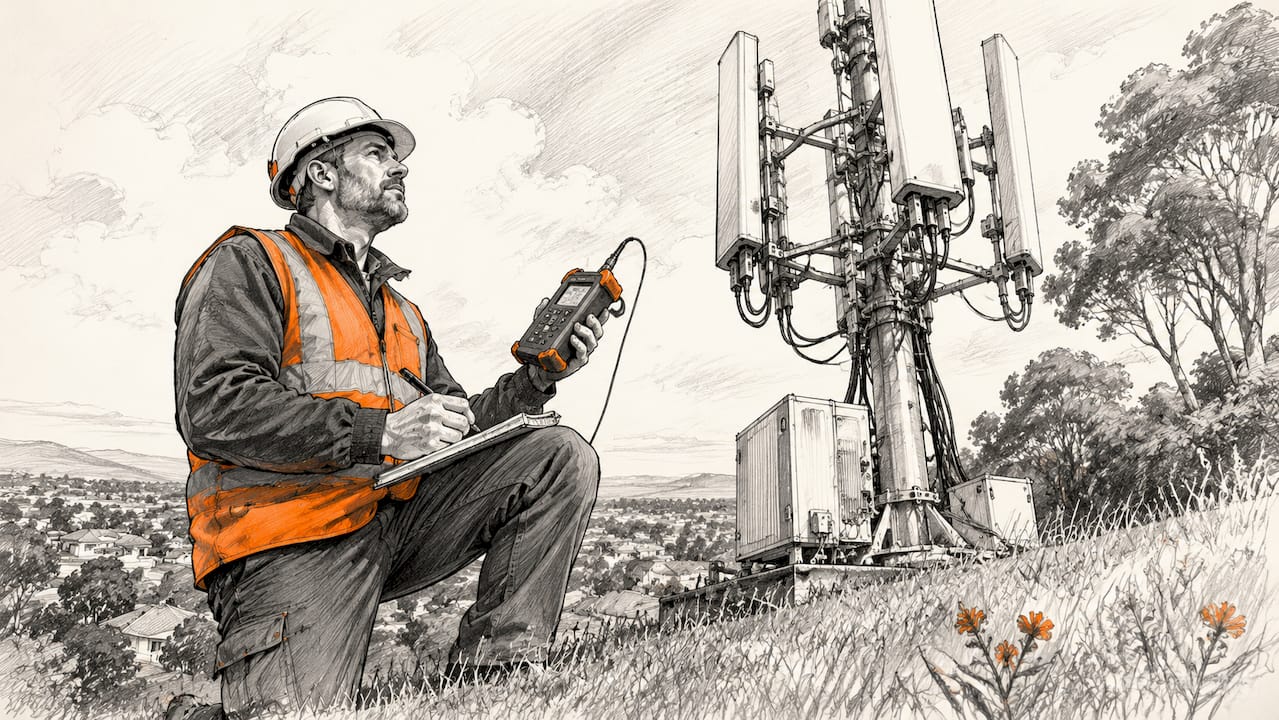
The Radio Access Network (RAN) handles everything between your phone and the nearest base station. It manages the radio link, schedules data transmissions, controls interference, and tracks your device as you move between cells. Think of the RAN as the on-ramp to the highway. It gets your data moving but does not decide where it goes.
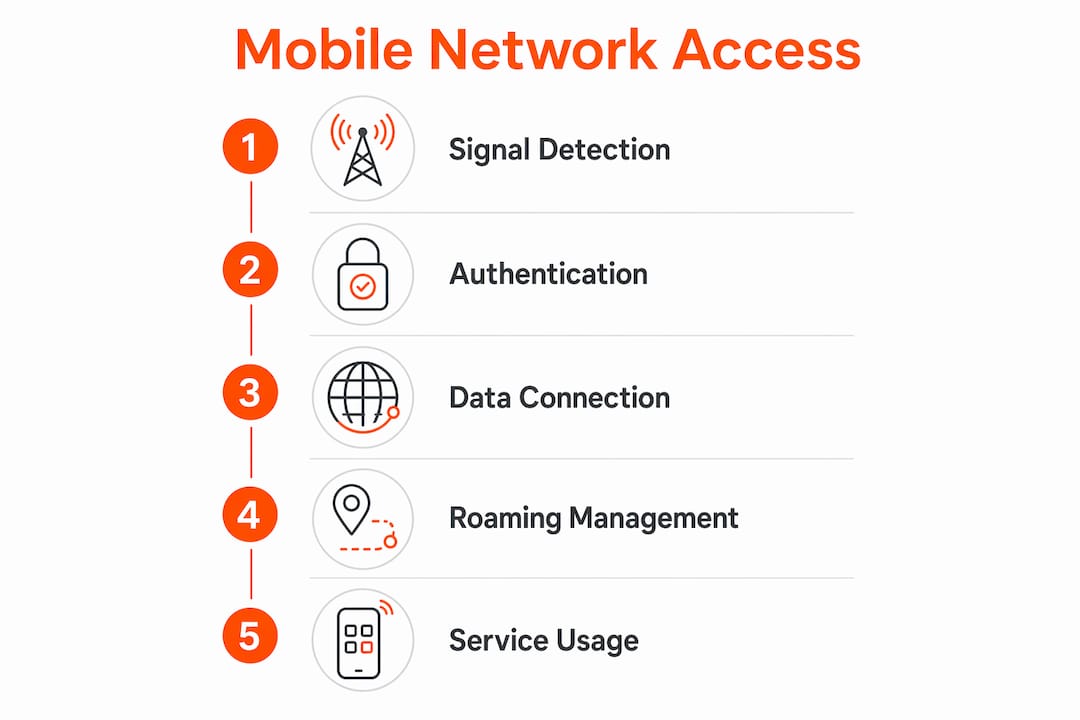
The core network takes over from there. It authenticates your device, routes traffic, manages your session, and applies data policies like speed limits or data caps. The core network is also where roaming agreements are enforced. If you are traveling abroad, the visited network’s RAN picks up your device, but your home operator’s core network still controls what you can access.
Here is a critical distinction most users miss: signal presence does not guarantee usable mobile data. You can have full bars on your screen and still fail to load a webpage if the core network session has not been established or if a policy blocks your data access. This happens frequently when roaming on a partner network that has not fully negotiated data routing with your home operator.
- Your phone connects to the nearest base station over radio frequencies.
- The RAN manages the radio link and hands your device off between cells as you move.
- The core network authenticates your SIM or eSIM and opens a data session.
- Traffic is routed through the core to the public internet or other services.
- Loss of service can stem from either a radio coverage gap or a core network authorization failure.
Pro Tip: If your phone shows signal but cannot load data, toggle airplane mode off and on. This forces your device to re-register with the core network and re-establish the data session.
How do 2g, 3g, 4g, and 5g compare?
Mobile network generations differ in speed, latency, capacity, and the types of services they support. The generation your device connects to directly determines what you can do with your mobile data.
| Network | Max Speed | Latency | Primary Use |
|---|---|---|---|
| 2G | ~0.3 Mbps | 300–1000 ms | Voice calls, SMS |
| 3G | ~7 Mbps | 100–500 ms | Basic browsing, email |
| 4G LTE | ~150 Mbps | 30–50 ms | Video streaming, VoIP |
| 5G | ~1 Gbps+ | Under 10 ms | HD video, IoT, real-time apps |
5G delivers the highest speeds and lowest latency, making it the best option for professionals who rely on video conferencing or large file transfers while traveling. However, 5G coverage remains concentrated in urban centers across most countries. In rural or remote areas, your device will fall back to 4G or even 3G, which affects both speed and the reliability of data-heavy applications.
How do coverage and roaming affect your connection?
Coverage is the foundation of mobile network access. Operators publish coverage maps showing where their networks reach, and GSMA Intelligence provides an interactive mapping service built from direct operator data. These maps are a useful starting point for trip planning, but they are not a performance guarantee.
Real-world experience varies because coverage maps reflect operator submissions, not actual user experience. Building materials, terrain, and local network congestion all reduce signal quality even inside a mapped coverage zone. A hotel room on the ground floor of a concrete building in Bangkok may show 4G on the map but deliver barely usable speeds in practice.
Roaming extends your reach by letting your device connect to a partner operator’s network when you leave your home coverage area. Your home operator has pre-negotiated agreements with foreign carriers that define what services you can access and at what cost. Without a roaming agreement in place, your device simply cannot register on that foreign network.
- Check operator coverage maps before traveling, using GSMA Intelligence or your carrier’s own tool.
- Confirm your plan includes data roaming, not just voice roaming.
- Understand that terrain and building density reduce real-world signal quality below what maps suggest.
- Consider local eSIM profiles for countries where your home operator’s roaming rates are high.
- Monitor data usage actively, since roaming data often depletes faster due to background app activity.
Pro Tip: Download offline maps via Google Maps or Maps.me before you land. If your data session fails to establish on a roaming network, offline maps keep you moving without needing a live connection.
Benefits and challenges of mobile network access for travelers
Mobile network access gives travelers and remote professionals the freedom to work, communicate, and navigate without being tied to Wi-Fi. That mobility is the core value. A consultant flying between Singapore, Dubai, and New York needs connectivity that follows them, not a list of café passwords.
The practical advantages are real, but so are the friction points. Here is what experienced travelers consistently encounter:
- Dropped data sessions on roaming networks. Core network policy mismatches between home and visited operators cause sessions to fail silently. Your phone shows signal, but nothing loads.
- Coverage gaps in transit. Trains, highways, and rural areas often fall outside macro cell coverage. Small cells and repeaters help in cities but rarely extend to countryside routes.
- Security risks on mobile data connections. Roaming traffic sometimes routes through less secure paths. Reviewing eSIM security best practices before traveling reduces exposure to interception and data leakage.
- Unexpected data costs. Roaming data charges from traditional carriers can reach $10–$20 per gigabyte in some regions. Local eSIM profiles eliminate this entirely.
- SIM swap friction. Physical SIM cards require finding a local store, navigating a foreign language, and risking your primary number. eSIM profiles solve this by switching networks digitally, without touching hardware.
For professionals managing mobile data security across multiple countries, eSIM flexibility is not a convenience feature. It is a practical necessity.
Key takeaways
Mobile network access requires both successful radio connection to a base station and core network authentication. Signal alone is not enough for usable data.
| Point | Details |
|---|---|
| Two layers required | Both the RAN and core network must succeed for full mobile data access. |
| Signal does not equal data | Core network session and policy enforcement determine actual internet access. |
| Generation matters | 5G delivers the best speeds, but 4G remains the reliable standard for most travel destinations. |
| Coverage maps are estimates | Real performance varies with terrain, building density, and local congestion. |
| eSIM reduces roaming friction | Switching to a local eSIM profile cuts costs and avoids physical SIM swaps abroad. |
Why coverage claims deserve more skepticism
I have spent years traveling across Southeast Asia, Europe, and parts of Africa with a mix of physical SIMs and eSIM profiles. The single most consistent lesson: operator coverage claims are optimistic. I have stood in the center of a city marked as full 5G coverage on three different carrier maps and watched my phone cycle between 4G and no service for twenty minutes.
The gap between coverage maps and lived experience is not a minor rounding error. It reflects the difference between a signal that reaches your device and a signal strong enough to sustain a data session. Concrete, elevation, and sheer network congestion during peak hours all chip away at what the map promises.
What actually works is layering your options. I keep a primary eSIM for my home network, a regional eSIM for the area I am visiting, and a backup data plan ready to activate. The role of eSIM in future connectivity is precisely this: removing the hardware barrier so switching networks takes seconds, not a trip to a carrier store. As 5G infrastructure expands beyond urban cores, that flexibility will matter even more.
— Bogdan
Stay connected anywhere with Lumo
Reliable mobile network connectivity should not require a spreadsheet of roaming fees and carrier agreements.
Lumo offers instant global data plans across more than 160 countries, activated via eSIM in minutes. No physical SIM required. No surprise roaming charges. You scan a QR code, select your plan, and your device connects to a reputable local operator automatically. Lumo supports 5G and 4G networks, making it a practical choice for travelers and professionals who need consistent, fast connectivity without the overhead of traditional carrier roaming. Plans are flexible, coverage is broad, and switching between profiles takes seconds.
FAQ
What is mobile network access in simple terms?
Mobile network access is your device’s ability to connect to a cellular network via radio signals and use services like calls, texts, and mobile data. It requires both a valid SIM or eSIM and a functioning connection to a base station.
Why does my phone show signal but no data?
Signal indicates radio connectivity to a base station, but usable data also requires the core network to authenticate your device and open a data session. If either step fails, you will see bars but no internet access.
What is the difference between 4g and 5g for travelers?
4G LTE delivers speeds up to 150 Mbps with latency around 30–50 ms, which handles most travel needs. 5G offers speeds exceeding 1 Gbps and latency under 10 ms, but coverage is still concentrated in major cities globally.
How does roaming work on a mobile network?
Roaming lets your device connect to a partner operator’s network when you travel outside your home coverage area. Your home operator’s core network still controls authentication and data policies, which is why roaming data sometimes fails even when local signal is strong.
Is an eSIM better than a physical SIM for international travel?
An eSIM lets you switch between carrier profiles digitally, without swapping hardware. For international travel, this means activating a local data plan the moment you land, avoiding roaming fees and the hassle of finding a local SIM card store.
Recommended
Related Topics
Stay Connected Anywhere
Get instant eSIM data plans for 160+ countries. No physical SIM required.