Digital Nomad Connectivity: Your 2026 Complete Guide

TL;DR:
- Digital nomads rely on layered systems of eSIMs, VPNs, and travel routers for reliable worldwide internet. Combining these tools ensures consistent, secure, and cost-effective connectivity across borders and varying infrastructure. Proper management of multiple profiles and backup options helps avoid costly connection failures in critical moments.
Digital nomad connectivity is defined as the integrated system of mobile internet tools, data plans, and security practices that allow location-independent professionals to access fast, reliable internet across multiple countries without physical SIM card swaps. Understanding what is digital nomad connectivity means recognizing that it goes far beyond finding a coffee shop with Wi-Fi. The modern approach combines eSIM technology, travel routers, and VPNs into a layered system that keeps remote workers productive regardless of where they land. Getting this system right separates professionals who thrive on the road from those who lose billable hours to dead connections.
What is digital nomad connectivity, and why does it matter?
Digital nomad connectivity is the technical and logistical framework that keeps location-independent workers online across borders. The UN Statistics Division defines digital nomads as individuals who travel across borders on a semi-permanent basis, typically staying in single locations for at least four weeks. That mobility pattern demands internet access that is consistent, affordable, and fast enough to support video calls, file transfers, and cloud-based work tools simultaneously.
The core of this framework is eSIM technology. An eSIM is a digital SIM card embedded directly in your device. It lets you activate local data plans instantly in over 195 countries without visiting a carrier store or swapping a physical card. That single capability eliminates the most common connectivity bottleneck remote workers face when crossing borders.
Complementary tools fill the gaps eSIM alone cannot cover. Travel routers amplify weak hotel Wi-Fi signals and run VPN protection at the network level. VPNs encrypt your traffic on public networks and bypass geo-restrictions on work tools. Together, these technologies form a connectivity stack that is resilient enough for professional use anywhere in the world.
What technologies enable digital nomad connectivity?
Four core technologies power reliable remote work connectivity for nomads:
- eSIM. A digital SIM embedded in your device that activates regional data plans instantly. 1GB plans cost around $4.50, making eSIM far cheaper than traditional roaming for most destinations.
- Local physical SIM cards. Still useful for getting a local phone number, which many services require for SMS verification. Carry one as a backup for number-dependent tasks.
- Travel routers. A travel router bridges weak Wi-Fi signals from hotels or coworking spaces, shares a single connection across all your devices, and runs a VPN at the network level so every device is protected automatically.
- VPNs. A trusted VPN encrypts your data on public networks and unlocks geo-restricted work platforms. Evaluating options through a resource like verified VPN rankings helps you choose a provider with a proven no-logs policy.
Pro Tip: Set your VPN to connect automatically on every new network. Manual activation is the step most travelers skip, and that one lapse on a hotel network is enough to expose sensitive client data.
Modern devices can store 10–20 eSIM profiles simultaneously. That means you can keep dormant plans for countries you visit regularly and reactivate them instantly without purchasing a new plan each trip. This profile management feature alone makes eSIM the most practical primary connectivity tool for high-frequency travelers.
How do digital nomads choose and manage their internet options?
Choosing between roaming, eSIM, and local SIM cards comes down to three factors: cost, coverage, and convenience. Each option has a clear use case, and the best nomads combine all three rather than relying on one.

Traditional roaming is the most expensive option. Carriers charge premium rates per megabyte, and many plans exclude entire regions. The cost compounds fast on a month-long trip. Roaming works best as a fallback for voice calls and SMS verification, not as a primary data source.
eSIM wins on cost and convenience for data. Plans are purchased online, activated by scanning a QR code, and live on your device within minutes. The price difference versus roaming is significant: a 20GB eSIM plan costs around $66, while equivalent roaming data can cost multiples of that depending on your carrier and destination.
Local physical SIMs offer the cheapest per-gigabyte rates in many countries, but they require visiting a carrier store, presenting identification, and sometimes navigating a foreign-language interface. They also give you a local number, which is valuable for services that block international numbers during SMS verification.
| Option | Cost | Ease of setup | Best use case |
|---|---|---|---|
| Roaming | High | Instant (existing plan) | Voice calls, SMS verification |
| eSIM | Low to moderate | Fast (QR code activation) | Primary data in 195+ countries |
| Local SIM | Lowest per GB | Moderate (in-store purchase) | Long stays, local number needs |
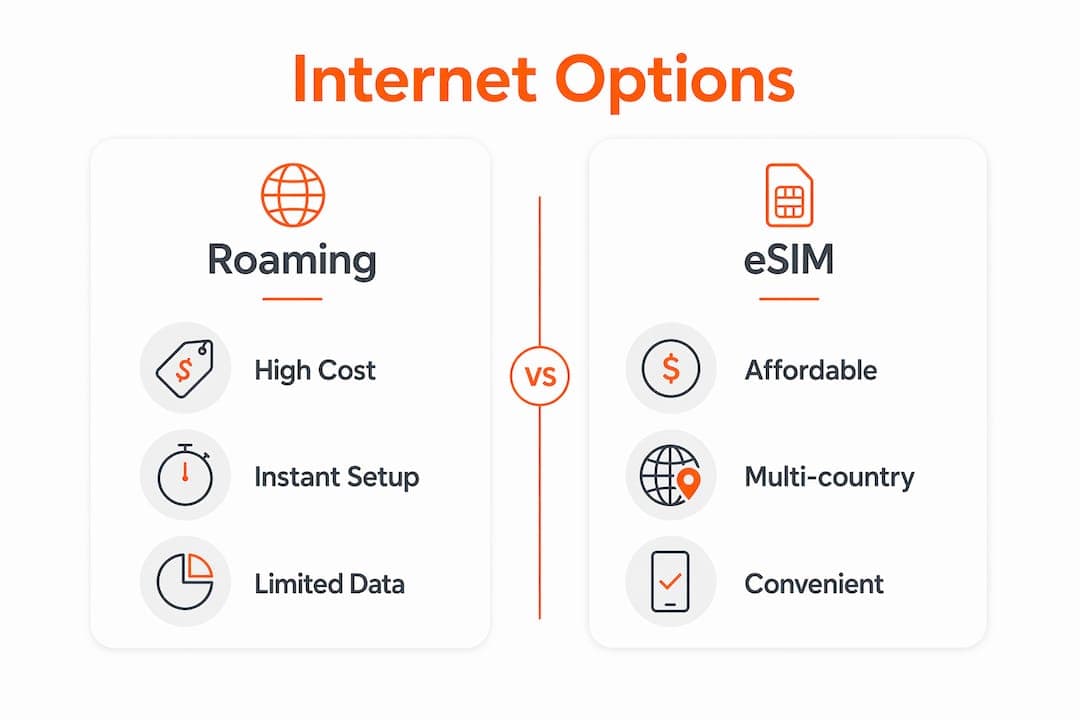
The hybrid approach that works best in practice: keep your home number active on a minimal roaming plan for verification and voice, and run all data through an eSIM. This combination covers every scenario without overpaying for either.
What challenges affect internet connectivity for digital nomads?
Infrastructure inconsistency is the biggest practical obstacle to reliable remote work connectivity. Even modern cities can have buildings with poor signal penetration or ISPs that throttle speeds during peak hours. Infrastructure quality varies dramatically between neighborhoods in the same city, not just between countries.
The single most effective mitigation strategy is simple: always request a recent speed test screenshot from your accommodation before booking. A listing that advertises “high-speed Wi-Fi” means nothing without a verified download speed. Aim for at least 25 Mbps download for comfortable video conferencing, and 50 Mbps or higher if you transfer large files regularly.
Security risks compound the infrastructure problem. Public Wi-Fi in airports, cafes, and hotels is a common attack vector. The risks include:
- Man-in-the-middle attacks on unencrypted networks that intercept login credentials.
- SIM swapping, where attackers convince a carrier to transfer your number to a new SIM, bypassing SMS-based two-factor authentication.
- Rogue hotspots that mimic legitimate network names to capture your traffic.
SMS-based 2FA is vulnerable when traveling because SIM swapping is easier to execute in regions with less strict carrier verification. Switch to an authenticator app like Google Authenticator or a hardware security key for any account that holds financial or client data.
Pro Tip: Enable remote wipe on every device before you leave home. If a laptop or phone is stolen in a country where you have no local support, remote wipe is the only way to protect client data without physical access to the device.
How can digital nomads optimize their connectivity setup?
A resilient connectivity setup follows a layered structure. Each layer covers the failure points of the one below it.
- Activate a primary eSIM plan before you land. Choose a regional plan that covers your destination and at least two neighboring countries. This gives you data the moment you clear customs, before you find any Wi-Fi.
- Store dormant regional eSIM profiles on your device for countries you visit more than twice a year. Reactivation takes seconds and costs nothing until you turn the plan on.
- Carry a travel router. Plug it into your accommodation’s ethernet port or connect it to hotel Wi-Fi, then run all your devices through it. The router handles VPN at the network level, so you never forget to connect manually.
- Install a trusted VPN and configure it to launch on startup. Connect before opening any browser or work application on a new network.
- Build a backup plan. Know the nearest coworking space to every accommodation you book. Keep a local SIM with a small data balance as a hotspot fallback. A layered connectivity checklist prevents a single point of failure from killing a workday.
Switching carriers abroad through eSIM is the fastest way to recover from a dead connection in an unfamiliar country. Having that option pre-configured on your device means recovery takes minutes, not hours.
Key Takeaways
Reliable digital nomad connectivity requires a layered stack of eSIM, VPN, and travel router tools, not a single solution.
| Point | Details |
|---|---|
| eSIM is the primary data tool | Activate plans in 195+ countries instantly; 1GB costs around $4.50 versus costly roaming rates. |
| Hybrid approach beats single-option | Combine home roaming for voice and SMS with eSIM data for cost-effective, full coverage. |
| Infrastructure varies widely | Always request a speed test screenshot from accommodations before booking to verify real speeds. |
| SMS 2FA is a security risk abroad | Use authenticator apps or hardware security keys to protect accounts from SIM swapping attacks. |
| Layered setup prevents failures | Primary eSIM, travel router, VPN, and a backup local SIM cover every realistic connectivity scenario. |
The connectivity mistake I see most nomads make
Most remote workers treat connectivity as a problem to solve once and forget. They buy a single eSIM plan, connect to hotel Wi-Fi, and assume that is enough. It rarely is, and the failure always comes at the worst moment.
The shift that actually changes things is treating connectivity like a professional tool, not a utility. A lawyer does not show up to court without a backup copy of every document. A nomad should not start a client call without knowing exactly what they will do if the primary connection drops in the next 60 seconds.
The eSIM and iSIM trend is accelerating fast. More devices are shipping with embedded SIMs that cannot be removed, which makes the skills of managing multiple profiles and switching plans remotely more valuable every year. Nomads who learn this now will spend far less time troubleshooting and far more time working.
Security is the area I see most people underinvest in. A travel router with a VPN running at the network level costs less than a single lost client engagement. The math is obvious once you frame it that way.
— Bogdan
How Lumo eSIM fits into your connectivity stack
Remote workers who want instant global data without the complexity of physical SIM logistics have a direct solution in Lumo.
Lumo offers instant eSIM activation across 195+ countries with 5G/4G coverage, flexible data plans, and 24/7 support. Plans activate via QR code in minutes, and you can manage multiple regional profiles from a single account. Whether you need a short-term plan for a two-week sprint in Southeast Asia or a long-term regional plan for a European base, Lumo’s data options fit the hybrid connectivity approach that professional nomads rely on. For travelers who want to avoid roaming charges without sacrificing coverage or speed, Lumo is built specifically for that use case.
FAQ
What is digital nomad connectivity in simple terms?
Digital nomad connectivity is the system of internet tools, including eSIMs, VPNs, and travel routers, that lets remote workers access reliable internet in any country. It replaces traditional roaming with faster, cheaper, and more flexible alternatives.
What internet speed do remote workers need abroad?
A minimum of 25 Mbps download supports stable video conferencing. Workers who transfer large files or use cloud-based design tools benefit from 50 Mbps or higher.
Is eSIM better than a local SIM for digital nomads?
eSIM wins on convenience and speed of activation, especially for short stays across multiple countries. Local SIMs offer lower per-gigabyte costs for long stays in a single country and provide a local phone number for SMS verification.
How do digital nomads protect their accounts while traveling?
Replace SMS-based two-factor authentication with an authenticator app or hardware security key. Enable remote wipe on all devices and use a VPN on every network, including hotel and coworking space connections.
Can one eSIM cover multiple countries?
Yes. Regional eSIM plans cover multiple countries under a single data allowance. Devices also store 10–20 profiles, so nomads can keep country-specific plans dormant and activate them instantly when needed.
Recommended
Related Topics
Stay Connected Anywhere
Prepaid eSIM data plans for 180+ countries and territories. No physical SIM required.